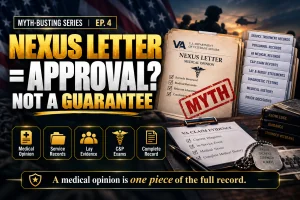


Medical evidence can play an important role in a VA disability claim, but having an extensive file does not always make the relevant information easy to locate or understand. The challenge is not always a lack of evidence. Sometimes relevant details may be buried in hundreds of pages, missing, recorded inconsistently, or not clearly connected to the condition being evaluated.
A private VA medical record review brings the available records together to clarify the veteran’s medical history. Depending on the case, it may help determine whether they provide a sufficient basis for further medical analysis or an independent medical opinion.
This blog explains what a VA medical record review includes, what it may uncover, when it may be appropriate, and what veterans should understand before submitting their records.
Table of Contents
What Is a VA Medical Record Review?
A VA medical record review is a private evaluation of medical and claim-related documents performed by a qualified healthcare professional to address a specific condition or medical question. Instead of relying on one appointment, test result, or treatment note, the reviewer considers a veteran’s full medical history to understand how the relevant evidence fits together.
The purpose is generally to determine what the available records document and whether they contain enough medically relevant information for further analysis. Depending on the circumstances, the private reviewer may evaluate whether the medical question can be addressed through a reasoned, independent medical opinion.
A medical record review is not the same as:
- A Nexus Letter or Independent Medical Opinion
- A Disability Benefits Questionnaire
- A VA Compensation and Pension examination
- A new medical diagnosis
- Medical treatment
- An official VA decision
The reviewer may identify relevant diagnoses, symptoms, treatment history, military events, inconsistencies, and possible evidence gaps related to a particular condition.
A private medical record review does not replace a VA examination when one is required. Also, the reviewing provider does not decide whether VA will determine service connection or assign a particular disability rating.
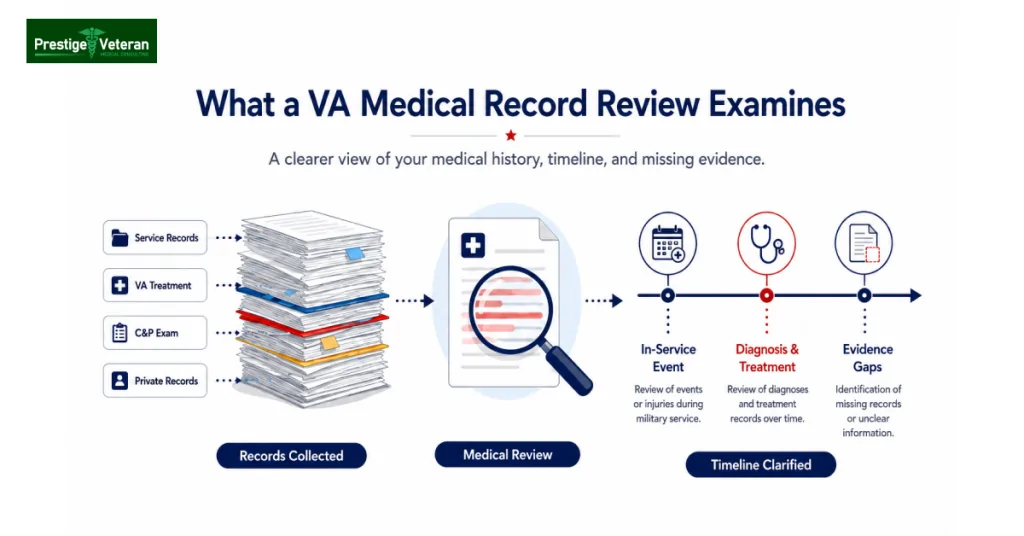
What Records May Be Examined?
The records included in a VA medical record review depend on the condition being evaluated, the medical question involved, and the complexity of the veteran’s history. A reviewer may need documents from military service, post-service healthcare, and earlier stages of the VA claim process to understand the full medical timeline.
Service And Military Records
Relevant military documentation may include:
- Service treatment records
- Entrance and separation examinations
- In-service diagnoses, injuries, complaints, or hospitalizations
- Sick-call and emergency treatment notes
- Deployment records when medically relevant
- Military occupational records (such as duties involving heavy lifting, aircraft noise, or repetitive physical strain)
- Line-of-duty determinations
- Incident or accident reports
- Physical profiles or duty restrictions
These documents may help show when symptoms were first reported, whether an injury or illness was documented during service, and whether the veteran’s physical or mental health changed between entry and separation. Service records may also provide context about the veteran’s duties and the circumstances surrounding a reported medical event.
Post-Service Medical Records
A reviewer may examine post-service records from both VA and non-VA healthcare providers, including:
- VA treatment records
- Private physician and hospital records
- Urgent care and emergency room records
- Imaging reports, such as X-rays, MRIs, or CT scans
- Laboratory and diagnostic test results
- Specialist evaluations
- Surgical and rehabilitation records
- Physical or occupational therapy notes
- Medication histories
- Mental health treatment notes
Post-service medical records may show when a current condition was diagnosed, how it has been treated, and whether symptoms continued or changed after military service. They may also document responses to treatment, medication side effects, recurring symptoms, and limitations affecting work or daily activities.
Claim-Related Documents
A medical record review for a VA disability claim may also include:
- Previous VA rating decisions
- Compensation and Pension (C&P) exam reports
- Completed DBQs
- Prior Nexus Letters or other medical opinions
- Lay and buddy statements
- Relevant portions of the VA claims file
- Medical studies or literature cited in an earlier opinion
Claim-related documents help the reviewer understand which medical issues VA previously considered and what evidence informed earlier examinations or opinions. For example, a rating decision may identify a missing element, while a C&P report may show which records the examiner reviewed and how the medical history was interpreted.
What Can a Medical Record Review Find?
A private medical record review does more than confirm whether a particular diagnosis appears somewhere in the file. It examines how the evidence fits together and whether the medical history provides a clear, consistent, and clinically supportable account of the condition.
Evidence Of An In-Service Event, Injury, Or Illness
The reviewer may look for documentation of an event, illness, exposure, or injury during military service. Relevant evidence may include sick-call visits, emergency treatment, repeated complaints, exposure-related records, physical restrictions, hospital records, or changes recorded between entrance and separation examinations.
For example, a veteran seeking an opinion related to a chronic knee condition may have a service treatment note documenting knee pain after a training injury. The reviewer may also find a temporary physical profile, follow-up visits, prescribed medication, or reports of continued symptoms at separation.
The presence of one service record does not establish that a current condition is related to military service. The reviewer must consider the nature of the original event, the current diagnosis, the medical timeline, and other possible causes.
A Current Diagnosis And Treatment History
A review may identify whether the claimed condition has been formally diagnosed and when that diagnosis first appeared in the records.
The private reviewer may look into relevant examination findings and diagnostic test results. They may also consider how the condition has been managed over time, including medication changes, therapy, surgical procedures, referrals to specialists, and the veteran’s response to treatment. Records may further identify functional limitations, such as difficulty walking, lifting, sleeping, concentrating, working, or completing daily activities.
This broader history helps distinguish reported symptoms from a confirmed medical condition. For example, a veteran may have reported recurring back pain for several years before an MRI later showed degenerative changes or a specialist identified a specific lumbar disorder. The earlier reports are not themselves a diagnosis, but they may provide relevant context about when the symptoms began and how they progressed.
Continuity Or Progression Of Symptoms
Records may reveal a timeline showing whether symptoms continued, returned periodically, or became more severe after service. This chronology may be spread across military assessments, primary care notes, specialist evaluations, and private treatment records.
Consider a veteran who reported headaches during deployment, mentioned recurring headaches during a post-deployment assessment, and later received migraine treatment from a private neurologist. An independent medical record review may organize these separate entries into a medical chronology that is difficult to recognize when each record is viewed in isolation.
A gap in documented treatment does not necessarily mean that symptoms were absent or that a medical relationship cannot exist. Veterans may delay treatment for many reasons, including limited access to care, self-management, work responsibilities, or not recognizing that symptoms required medical attention. However, the medical significance of a treatment gap depends on the condition and the veteran’s individual circumstances.
Possible Medical Relationships Between Conditions
When more than one diagnosed condition is involved, the reviewer may examine whether the records document a medically relevant interaction between them.
The veteran’s file may contain information about:
- Side effects associated with prescribed medication
- Altered movement or body mechanics
- Sleep disruption
- Reduced physical activity
- Changes in weight or conditioning
- Compensatory movement
- Aggravation of another diagnosed condition
For example, a veteran receiving long-term medication for a diagnosed mental health condition may later report persistent daytime fatigue, weight changes, or disturbed sleep. The reviewer may examine when the medication was prescribed, when the additional symptoms began, whether dosage changes affected those symptoms, and whether treating providers identified other possible explanations.
The records must support the specific medical relationship being considered. One diagnosis does not, by itself, establish that it caused or aggravated the other.
Inconsistencies And Missing Evidence
A private records review may also identify information that is unclear, conflicting, or absent. Potential issues include:
- Conflicting dates for the onset of symptoms
- Different or changing diagnoses across separate records
- Missing imaging, laboratory, or diagnostic test reports
- Gaps in the documented treatment and symptom timeline
- Missing service, VA, or private treatment records
- A prior medical opinion that did not address important evidence
- Findings that suggest another possible cause of the condition
For instance, a C&P examination report may state that symptoms began several years after service, while an earlier treatment note documents similar complaints much sooner. That discrepancy does not invalidate the examination, but it may require careful medical clarification to determine whether the records describe the same symptoms and condition.
A reviewer may also determine that the records do not contain enough information to answer the medical question responsibly. Identifying missing information or limitations in the record is an important part of a credible review.
When May You Need a VA Medical Record Review?
A review may be useful whenever the medical history is difficult to interpret or a provider needs to determine whether the available evidence supports further medical analysis.
It is true that every veteran’s records are different, but several situations may call for a closer review of the medical evidence.
Before Requesting A Nexus Letter
A preliminary review may help determine whether the documentation contains enough relevant evidence for a healthcare professional to offer an informed and medically supportable opinion.
This can prevent a nexus letter provider from preparing an opinion based on an incomplete history. It may also identify records that should be obtained before the medical question is evaluated.
After Receiving An Unfavorable C&P Opinion
A review may identify important records that were not discussed, inaccuracies in the reported history, conflicting findings, or medical questions that require further explanation.
For example, an examination may report that there was no documented in-service complaint, while the service treatment records contain several related visits under a different medical terminology. A private reviewer can compare those entries and assess whether they are medically relevant to the current condition.
Note that disagreement with a C&P examiner does not, by itself, establish that the exam was medically incorrect or inadequate.
When A Secondary Medical Relationship Is Being Evaluated
A reviewer may examine whether the file documents both diagnosed conditions, when each condition developed, how each was treated, and whether the records describe a clinically plausible interaction.
This may require reviewing medication histories, specialist notes, changes in mobility, sleep records, imaging, and other medical evidence rather than relying only on the names of the diagnoses.
For example, a veteran with service-connected PTSD may later be diagnosed with obstructive sleep apnea. The reviewer may compare sleep studies, PTSD treatment records, medication history, weight changes, and other risk factors to assess whether they provide a basis for further medical analysis of causation or aggravation.
When Current Severity Needs To Be Documented
When a veteran reports that a service-connected condition has worsened, current medical records may help document changes in its severity.
A medical record review may identify recent documentation of worsening symptoms, treatment changes, flare-ups, hospitalizations, functional limitations, or changes in the veteran’s ability to work and perform daily activities.
The review does not assign or recommend an increased VA disability rating. It organizes and evaluates medical documentation that may be relevant to the condition’s current presentation.
When The Medical File Is Lengthy Or Complicated
An independent medical record review may be particularly useful when a veteran has:
- Received treatment from several providers
- Been diagnosed with multiple conditions
- Accumulated decades of medical records
- Received conflicting medical findings
- Experienced several injuries affecting the same body area
- More than one possible cause of a condition
- Separate VA, military, and private medical files
A reviewer can place the records chronologically and separate medically relevant evidence from unrelated history.
During A Claim Or Decision Review Process
A medical record review may help clarify what the existing evidence documents and whether earlier examinations or medical opinions considered the veteran’s complete medical history.
It may also identify missing records, unresolved inconsistencies, or additional medical evidence related to an issue discussed in a previous VA decision. For a Supplemental Claim, any additional evidence must meet VA’s requirement that it be new and relevant.
However, a medical evaluation of the records does not determine which VA review option veterans should choose. You may ask questions about the decision review process to a VA-accredited attorney, claims agent, or representative.
What A Medical Record Review Cannot Do
A VA medical record review can clarify what the available documentation shows, but it cannot replace other medical, administrative, or legal processes. A review cannot:
- Determine a VA claim outcome: The reviewer cannot help determine service connection, a disability rating, or any other VA benefits decision.
- Create or alter medical evidence: A private reviewer cannot change the original treatment record or supply documentation that was never created.
- Establish medical causation: The presence of an in-service event and a current diagnosis does not by itself prove a medical relationship. Any conclusion must be supported by the individual records and a reasoned medical explanation.
- Guarantee a supportive Nexus Letter: A record review does not ensure that a provider can issue an opinion supporting the proposed medical relationship. The reviewer may find that important evidence is missing or that the available records do not support a medically reasoned opinion.
- Replace diagnosis, testing, or treatment: A records-only service cannot diagnose a new condition when no clinical evaluation is provided. It does not replace examinations, imaging, laboratory testing, or ongoing medical care.
- Replace an official VA examination: VA may still require a C&P examination or medical opinion when it needs additional information to evaluate the claimed condition.
- Replace accredited guidance: A medical reviewer does not replace legal guidance from a VA-accredited representative on forms, deadlines, decision-review options, or legal strategy.
The reviewer may ultimately conclude that the available evidence is incomplete or does not support a medically defensible opinion. That conclusion may be disappointing, but it is more responsible than producing an opinion that cannot be supported by the documented history and accepted medical reasoning.
How To Prepare Your Records For Review
Organized and complete records can help the private reviewer follow the medical history more accurately.
Before submitting documents for a VA medical record review:
- Clearly identify the condition being reviewed.
- Gather relevant service, VA, and private treatment records.
- Obtain relevant imaging, laboratory, and diagnostic reports.
- Include C&P reports, DBQs, rating decisions, and prior medical opinions.
- Arrange the records chronologically when possible.
- Note important treatment facilities and approximate dates.
- Include records discussing other possible causes.
- Do not remove documents simply because they appear unfavorable.
- Use secure methods when transmitting protected health information.
Veterans can review, print, and download available VA medical records through the My HealtheVet experience on VA.gov. When required, request a complete copy from your VA facility’s Release of Information office online, by mail, fax, or in person, including through VA Form 10-5345a.
For non-VA medical records, veterans may request copies directly from their private healthcare providers. VA Forms 21-4142 and 21-4142a authorize VA to request records from private doctors, hospitals, and other non-VA sources.
What Happens After The Review?
After examining the file, several outcomes are possible. The reviewer may determine that the available records provide a sufficient medical basis to address the question in an Independent Medical Opinion. When key information is missing, the veteran may be asked to obtain missing treatment notes, diagnostic reports, service records, or other relevant documents.
In some cases, the reviewer may conclude that no supportable medical opinion can be provided from the available evidence. This does not change the existing record or determine the VA claim outcome. But it means the documentation does not currently permit the reviewer to reach a responsible medical conclusion.
If the provider completes a medical report, the veteran may submit it to VA through the applicable claim or decision-review process. Evidence requirements depend on the type and stage of the VA matter.
Conclusion
A VA medical record review can help turn a scattered or complex file into a more understandable medical history. Before requesting one, veterans should provide complete, relevant records and clearly identify the condition or medical question under review. Including both supporting and conflicting information gives the reviewer a more accurate picture of the case.
A records review may clarify whether further medical evaluation is appropriate, but it cannot replace clinical care or determine how VA will decide the claim. Even so, a well-prepared review can give veterans and healthcare professionals a clearer foundation for understanding the medical evidence. For questions about the claim process or review options, consult a VA-accredited representative.
Frequently Asked Questions (FAQs)
Is A Medical Record Review The Same As A Nexus Letter?
No. A record review evaluates the available documentation. A Nexus Letter is a written medical opinion addressing whether a relationship exists between a diagnosed condition and military service or another service-connected condition.
What Does VA Consider Medical Evidence?
According to the Department of Veterans Affairs, it may consider service treatment records, doctors’ reports, imaging, medical test results, treatment records, and other evidence related to the claimed condition.
Does A Medical Record Review Guarantee A Favorable Opinion?
No. A qualified healthcare provider must be able to support the conclusion using the medical records, clinical knowledge, and a reasoned medical explanation.
Can Private Medical Records Support A VA Disability Claim?
Yes. VA encourages veterans to submit relevant records from private healthcare providers for consideration. Private physicians may have valuable knowledge of a veteran’s diagnosis, treatment history, symptoms, and response to care.
The relevance and weight of a particular record depend on its content and the medical issue being considered.
Can VA Obtain Private Treatment Records For Me?
VA’s duty to assist generally includes making reasonable efforts to obtain relevant non-federal records that a veteran identifies and authorizes VA to request.
Do I Need Every Page Of My Medical History?
The medical records reviewer should receive all records relevant to the condition and claim theory. In some cases, broader records may also be necessary when they document alternative causes, related conditions, medication use, or the complete medical timeline.
How Long Does A Medical Record Review Take?
The timeline depends on the number of pages, the complexity of the conditions, the completeness of the file, and the provider’s process.
Also Read: How to Understand VA Medical Records Structure
At Prestige Veteran Medical Consulting, a veteran-owned company, we specialize in Independent Medical Opinions (IMOs) known as Nexus letters.
Our purpose is to empower YOU, the veteran, to take charge of your medical evidence and provide you with valuable educational tools and research to guide you on your journey.
Understanding the unique challenges veterans face, our commitment lies in delivering exceptional service and support.
Leveraging an extensive network of licensed independent medical professionals, all well-versed in the medical professional aspects of the VA claims process, we review the necessary medical evidence to incorporate in our reports related to your VA Disability Claim.
Prestige Veteran Medical Consulting is not a law firm, accredited claims agent, or affiliated with the Veterans Administration or Veterans Services Organizations. However, we are happy to discuss your case with your accredited VA legal professional.