
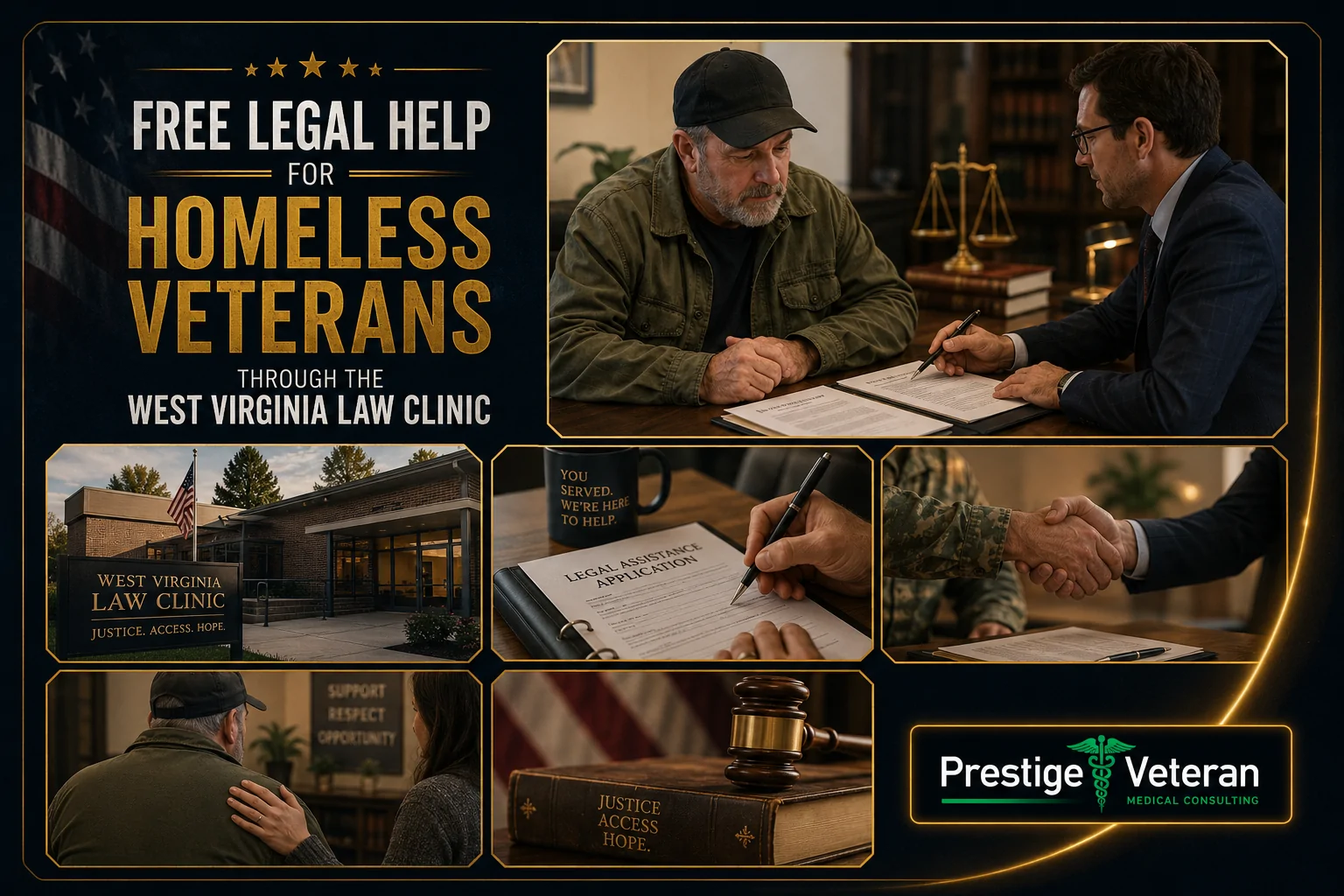
Housing instability can affect veterans in many different ways. For some, the issue may involve an eviction notice, income disruption, family law concern, or difficulty accessing benefits. For others, the concern may be more immediate, such as not having a safe or stable place to stay.
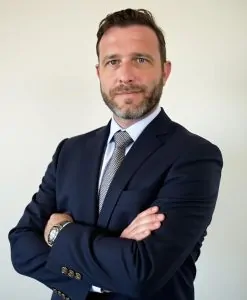
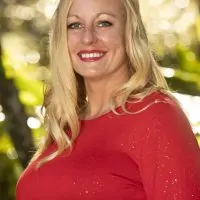
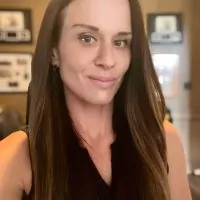
In this conversation, Leah Bucholz, CEO and founder of Prestige Veteran Medical Consulting, speaks with Ashley Talbott, Co-Director of the West Virginia University Veterans Advocacy Law Clinic, about how homeless veterans and veterans at risk of homelessness may be able to access free legal support through the clinic and related community resources.

Table of Contents
What Is the WVU Veterans Advocacy Law Clinic?
The West Virginia University Veterans Advocacy Law Clinic provides legal services to veterans through WVU’s Clinical Law Program. In this interview, Ashley Talbott explains that her work in veterans law began after law school and eventually became the central focus of her career.
She now serves as Co-Director of the WVU Veterans Advocacy Law Clinic, where law students and clinic staff work with veterans on legal issues that may affect stability, access to benefits, housing, and long-term support.
For many veterans, legal problems do not exist in isolation. A housing issue may connect to income, family law, discharge status, public benefits, prior incarceration, or other barriers. This is why clinic-based and community-based legal support can be important for veterans who are trying to regain or maintain stability.
Legal Help for Homeless Veterans and Veterans at Risk
One of the main topics discussed in the video is legal support for homeless veterans and veterans who are at risk of homelessness.
Ashley explains that the clinic’s work is supported in part through legal services funding connected to homelessness prevention. The purpose is not only to respond after a veteran has already lost housing, but also to help address legal issues that may contribute to housing instability before the situation worsens.
That distinction matters.
A veteran may not be sleeping outside or in a shelter, but may still be at risk. For example, a veteran may be facing eviction, sudden income loss, employment instability, family court issues, or other legal barriers that make stable housing more difficult.
Legal support may be able to help address some of these issues before they become an emergency.
Do Veterans Have to Already Be Homeless to Qualify?
A key point from the conversation is that veterans do not always need to already be homeless before seeking assistance.
Ashley explains that one of the strengths of this type of grant-funded legal work is that it may also support veterans who are at risk of homelessness.
This can include situations involving:
- Sudden loss of income
- Job loss or employment instability
- Eviction concerns
- Family law issues
- Health crises
- Prior incarceration or reentry challenges
- Barriers to benefits or income support
- Other circumstances that may threaten stable housing
The goal is to help veterans address legal problems early enough to reduce the risk of homelessness where possible.
What Types of Legal Issues Can Affect Housing Stability?
Housing instability is not always caused by one single issue. In many cases, several legal and practical problems overlap.
During the discussion, Ashley and Leah talk about several areas that may affect a veteran’s stability, including:
- Housing-related concerns
- Civil legal issues
- Family law matters
- Child custody or support issues
- Spousal support or modification concerns
- Income instability
- Public benefits
- Discharge-related issues
- Reentry after incarceration
- Barriers created by eviction history or other records
For example, a family law order or income-related issue may directly affect whether a veteran can maintain housing. An eviction record may create barriers to future housing. A discharge status concern may affect access to certain benefits or resources.
These issues are not always simple, and they may require legal review rather than medical review.
Why Community Partnerships Matter
Another important part of this conversation is the role of community partnerships.
Ashley explains that the clinic works with local stakeholders and housing assistance contacts to help connect veterans with appropriate support. That kind of coordination can matter because one organization may not be able to solve every problem alone.
A veteran facing housing instability may need help from multiple sources, such as:
- Legal clinics
- Legal aid organizations
- Housing assistance programs
- VA-related homeless services
- Community providers
- Benefits support programs
- Social service organizations
The clinic may help identify the legal issue, but the broader support network may help address housing, income, emergency needs, or other urgent concerns.
Support for Veterans Who Were Previously Incarcerated
Leah also asks about veterans who have been incarcerated and are transitioning back into the community.
Ashley emphasizes that veterans who were previously incarcerated should not assume they are beyond help. While there may be limits on what a legal clinic can do in criminal matters, the clinic may still be able to assist with civil legal issues or connect veterans to appropriate resources.
Reentry can involve many barriers, including housing, employment, benefits, driver’s license issues, old fines, family law concerns, or records that make it harder to move forward.
The message from the conversation is clear: prior incarceration does not mean a veteran should avoid asking for help.
First Steps for Veterans Facing Housing Instability
When Leah asks what veterans should do first if they are facing housing instability, Ashley gives a simple answer:
Ask for help.
That may sound basic, but it is often the hardest step.
Veterans may feel embarrassed, overwhelmed, frustrated, or unsure where to start. Some may not know that legal clinics, legal aid organizations, or community agencies exist. Others may wait until the situation becomes more urgent.
A practical starting point may include identifying local resources such as:
A nearby law school clinic
Legal aid organizations
Pro bono legal services
VA homeless program contacts
Community housing organizations
Veteran-focused nonprofit services
The right resource may vary by state, location, and legal issue. Some veterans may need help from more than one organization.
Eligibility and Documentation
Eligibility can depend on the program, the type of legal issue, the veteran’s circumstances, and the organization providing assistance.
In this interview, Ashley explains that the clinic may look at whether a veteran is homeless or at risk of homelessness. Examples may include sudden income loss, employment instability, eviction, health crises, discharge-related concerns, or other factors that could affect housing stability.
She also explains that documentation can help the clinic understand the veteran’s situation.
Veterans may be asked to provide documents such as:
- DD Form 214 or discharge paperwork
- Income-related documents
- Health-related documents, where relevant
- Eviction paperwork
- Court orders
- Family law documents
- Benefits-related documents
- Any paperwork connected to the legal issue
These documents help establish the starting point. Even if the paperwork is incomplete or difficult to gather, veterans should not assume that means they cannot ask for help.
Does Disability Rating or Service Connection Affect Eligibility?
Leah also asks whether a veteran’s disability rating percentage or service-connected status affects eligibility for this type of assistance.
Ashley explains that disability rating or service-connected status is not necessarily the deciding factor for this type of legal assistance. Instead, eligibility may involve a more holistic look at the veteran’s situation, including housing risk and other instability factors.
This is an important point because some veterans may assume they do not qualify for support because they already receive some form of benefit, while others may assume they cannot get help because they are not service connected.
The better approach is to ask the organization directly and let the appropriate professionals determine whether assistance is available.
Why Veterans Should Ask for Help Early
One of the strongest messages in this interview is that veterans should not wait to ask for help.
Ashley explains that one of the most common mistakes veterans make is not asking for the help they need. That may include help with eviction concerns, income support, benefits issues, family law issues, or other barriers.
Veterans may feel embarrassed to discuss legal, financial, housing, or family problems. But legal clinics and veteran-focused service providers are familiar with difficult situations. Their role is not to judge the veteran. Their role is to understand the problem and determine whether there is a way to help or connect the veteran with the right resource.
As Ashley explains, a professional cannot help with a problem they do not know about.
Final Thoughts
Veteran homelessness and housing instability are complex issues. They may involve legal concerns, income challenges, family law matters, health issues, discharge status, benefits access, reentry barriers, or a combination of several factors.
The WVU Veterans Advocacy Law Clinic is one example of how legal clinics and community-based resources can help veterans address problems that may affect housing stability.
For veterans who are homeless or at risk of homelessness, the first step is often the hardest: asking for help.
Whether the issue involves eviction, income instability, discharge paperwork, family law, reentry, or another legal barrier, veterans should not assume they have to navigate the situation alone. The right professional or organization may be able to review the situation, explain available options, or help connect the veteran with appropriate local resources.
Also Read: Nexus Letter vs. Buddy Statement: Which Evidence May Be More Relevant?
At Prestige Veteran Medical Consulting, a veteran-owned company, we specialize in Independent Medical Opinions (IMOs) known as Nexus letters.
Our purpose is to empower YOU, the veteran, to take charge of your medical evidence and provide you with valuable educational tools and research to guide you on your journey.
Understanding the unique challenges veterans face, our commitment lies in delivering exceptional service and support.
Leveraging an extensive network of licensed independent medical professionals, all well-versed in the medical professional aspects of the VA claims process, we review the necessary medical evidence to incorporate in our reports related to your VA Disability Claim.
Prestige Veteran Medical Consulting is not a law firm, accredited claims agent, or affiliated with the Veterans Administration or Veterans Services Organizations. However, we are happy to discuss your case with your accredited VA legal professional.