


40 percent service-connected means the VA has determined that your military service caused or aggravated a condition that significantly impacts your earning capacity and daily life. Whether you were just awarded the rating, are considering filing for an increase, or are a family member trying to understand available benefits, understanding what a 40% VA disability truly means is essential.
From monthly tax-free compensation to VA benefits access and potential paths to higher benefits, we explain how a 40% rating empowers you to protect the benefits you’ve earned through sacrifice.
Table of Contents
What Does a 40 Percent Service-Connected Disability Rating Mean?
The U.S. Department of Veterans Affairs evaluates disabilities using the Schedule for Rating Disabilities (VASRD), which assigns percentages from 0% to 100% based on how a service-connected condition affects your earning capacity. Generally, the higher the rating, the greater the monthly tax-free compensation and access to additional benefits.
“Service-connected” means the VA has formally recognized that an illness or injury was caused or aggravated by military service, or developed secondary to an existing service-connected condition. For example, a service-connected ankle injury that causes long-term instability and contributes to degenerative arthritis may qualify as secondary. Once a service connection is established, you become eligible for monthly disability compensation, healthcare coverage, and other federal benefits.
How the VA Defines a 40% Disability Rating
The VA considers a 40 percent disability rating as a significant level of impairment reflective of roughly a 40% reduction in average earning capacity compared to a non-disabled civilian. As a critical mid-level rating, 40% qualifies veterans for higher monthly compensation than lower ratings, expanded VA healthcare access, and increased compensation for eligible dependents (available at ratings of 30% and higher). It also serves as a potential stepping stone toward higher ratings if conditions worsen.
Importantly, a 40% rating may stem from:
- One single condition rated at 40%, OR
- Multiple combined conditions that equal 40% under VA math
While a 40% disability rating is often a critical milestone, increasing to 50% or higher can unlock expanded benefits, including Priority Group 1 healthcare and other state and federal benefits.
How the VA Determines a 40% Service Connected Rating
When pursuing a 40% VA disability rating, understanding how the decision is made can significantly strengthen your claim. The VA assigns disability percentages in 10% increments based on the severity, frequency, and duration of your service-connected condition and how it impacts your ability to work. For example, a veteran with traumatic brain injury (TBI) could qualify for a 40 percent VA TBI rating if cognitive impairment, memory loss, or judgment issues substantially interfere with daily functioning.
A 40% VA rating generally reflects a moderate-to-severe level of disability that substantially impacts work and daily functioning, but does not yet meet the threshold for higher categories like 50% or 60%.
To assign a disability rating, VA decision-makers rely on measurable, objective medical evidence rather than subjective complaints alone. For example:
1. Objective Medical Measurements
VA looks for documented medical findings that show how severely a condition affects the body. VA examiners review, for example:
- Pulmonary function testing showing reduced lung capacity
- Abnormal results on cardiac stress test results indicating decreased heart function
- Neurological testing confirming nerve damage, diminished reflexes, or sensory loss
- Imaging studies (MRI, CT scan, or X-ray) verifying structural damage such as arthritis, joint degeneration, or disc herniation
2. Range of Motion Thresholds
For musculoskeletal conditions (38 CFR § 4.71a) such as back or knee injuries, VA requires you to meet specific range-of-motion limits. For instance, a veteran with a lumbar spine condition may qualify for a 40 percent rating if forward flexion is limited to 30 degrees or less due to pain, stiffness, or functional loss. These measurements must be recorded during a Compensation & Pension (C&P) examination.
3. Lab Results
Chronic conditions like diabetes, kidney disease, or blood disorders often require laboratory confirmation. Findings such as Persistent high blood glucose readings, decreased kidney filtration rates (low eGFR), abnormal liver enzyme levels, or chronic anemia can help justify a higher evaluation.
4. Functional Impact
Beyond test results, VA assesses how the service-connected condition affects your ability to work and perform daily activities. Does chronic pain limit standing or lifting? Do migraines cause frequent work absences? Does your condition affect your work productivity? Functional loss that shows real-life impact plays a critical role in determining your disability rating.
How Much Is 40 Percent VA Disability?
A 40% VA disability rating pays a set monthly amount that increases if you have eligible dependents. Below is the current 2026 compensation chart and examples showing how your total payment is calculated.
40% VA Disability Pay Chart (2026 Rates)
Below are the 2026 monthly rates for a 40% VA disability rating based on dependent status:
| Dependent Status | Monthly Compensation (USD) |
| Veteran Alone (No Dependents) | $795.84 |
| With Spouse (No Children or Parents) | $882.84 |
| With 1 Parent (No Spouse or Children) | $865.84 |
| With 2 Parents (No Spouse or Children) | $935.84 |
| With Spouse and 1 Parent (No Children) | $952.84 |
| With Spouse and 2 Parents (No Children) | $1,022.84 |
| Veteran With 1 Child Only (No Spouse or Parents) | $853.84 |
| With Spouse and 1 Child | $947.84 |
| With 1 Child and 1 Parent (No Spouse) | $923.84 |
| With 1 Child and 2 Parents (No Spouse) | $993.84 |
| With Spouse, 1 Child, and 1 Parent | $1,017.84 |
| With Spouse, 1 Child, and 2 Parents | $1,087.84 |
Added Monthly Amounts (40% Rating – 2026)
Here are additional payments that apply to a veteran’s dependents:
| Additional Dependent | Added Amount |
| Each Additional Child Under 18 | +$43.00 |
| Each Additional Child Over 18 (In School) | +$140.00 |
| Spouse Receiving Aid & Attendance | +$81.00 |
Note: VA disability compensation is tax-free and subject to annual Cost-of-Living Adjustments (COLA). Because rates change yearly, always verify the official VA compensation tables to confirm your exact 40% VA disability payment amount.
Factors That Can Lead to Additional Monthly Compensation
1. Special Monthly Compensation (SMC)
Special Monthly Compensation (SMC) is paid in addition to regular VA disability compensation when a veteran has severe disabilities such as loss of use of a limb, blindness, or requires daily personal assistance. SMC is paid at different levels (SMC-K, SMC-L, SMC-S, SMC-R2, etc.) depending on the severity of your disabilities and the level of care or assistance you require.
For example, SMC-K (Loss of Use of a Creative Organ or Limb) pays around $139.87 per month in 2026.
If you are rated 40 percent and qualify for SMC-K:
-
- Base pay (single veteran): $795.84
- SMC-K: +$139.87
- Total: $935.71 per month
If a veteran requires help with daily activities (bathing, dressing, eating), they may qualify for higher SMC levels (such as SMC-L), which can increase monthly compensation significantly beyond the standard 40% rate.
For updated SMC payment rates and eligibility details, review the official VA Special Monthly Compensation rates on VA.gov.
2. Bilateral Factor
The bilateral factor can increase your overall disability rating if you have service-connected conditions affecting both arms, both legs, or paired skeletal muscles.
For example, if you have:
- 20% for your right knee
- 20% for your left knee
Instead of simply adding the two disability percentages together, the VA uses its combined ratings formula: the first 20% leaves you 80% efficient, and the second 20% is applied to that remaining 80% (equaling 16%), resulting in a combined value of 36%. The VA then adds 10% of 36% (3.6%), bringing the total to 39.6%, which rounds up to 40%.
This could increase you from a 30% rating to 40%, raising your monthly pay from $552.47 to $795.84 (for a single veteran).
3. Eligible Dependents
At the 40% VA disability level, you may qualify for additional monthly compensation if you have eligible dependents like a spouse, children under 18, children over 18 attending school, or dependent parents. The VA adds specific amounts to your base rate depending on your family situation.
For instance, a veteran with a 40% disability rating who has a spouse and three children under age 18 receives a base monthly payment of $947.84, covering only the spouse and one child.
The VA adds compensation for the two remaining children as follows:
- Base (spouse + 1 child): $947.84
- 2 additional children: 2 × $43 = $86
- $947.84 + $86.00 = $1,033.84 total monthly compensation
Note: VA disability compensation at the 40 percent level is paid monthly through direct deposit into your bank account. If your claim is approved after filing, you may receive retroactive back pay from your effective date. The earlier your effective date, the larger your potential lump sum.
Benefits You Receive at 40 Percent VA Disability (Beyond Monthly Pay)
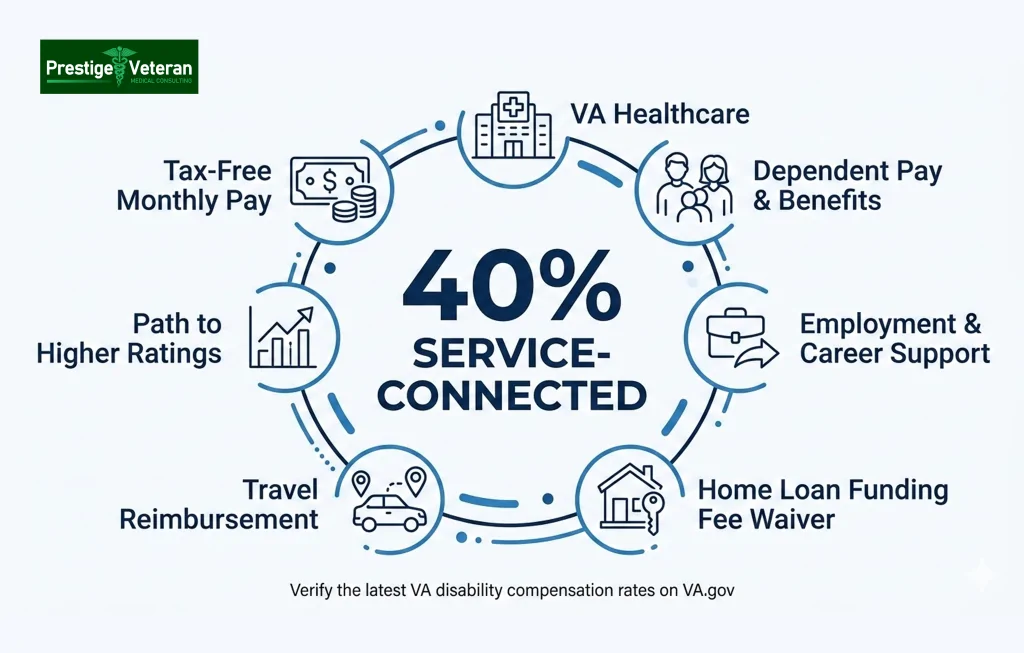
Many veterans underestimate what a 40% VA disability rating truly provides beyond the monthly tax-free compensation. While the base payment is important, the additional federal and state benefits can significantly reduce healthcare costs, improve employment opportunities, and support your family’s long-term stability.
Below is a clear breakdown of individual benefits available at this rating level.
Additional Compensation for Dependents
Veterans rated at least 30% or higher with a spouse, children, or dependent parents receive increased monthly payments. In some cases, this may include Aid and Attendance for an eligible spouse.
VA Healthcare (Priority Group 2)
Veterans at 40% rating are placed in Priority Group 2, giving access to no-cost treatment for service-connected conditions, preventive care, hospital services, mental health treatment, and specialty care.
Prescription Medication Coverage
Medications prescribed for service-connected disabilities are provided at no cost. Prescriptions for non-service-connected conditions may require small copays.
Travel Reimbursement
If your disability qualifies for a 40 percent rating, you may receive mileage or travel reimbursement for scheduled appointments at VA or VA-authorized facilities.
VA Home Loan Funding Fee Waiver
Because your rating exceeds 10%, you are exempt from the VA funding fee, potentially saving thousands when using a VA-backed mortgage.
10-Point Veterans Preference
Disabled veterans receive preference points when applying for competitive federal civil service positions.
Direct Hire Authority
Certain federal agencies can hire qualified disabled veterans without going through the full competitive hiring process.
Veteran Readiness and Employment (VR&E)
The Veteran Readiness and Employment program offers career counseling, job training, résumé assistance, apprenticeships, and education benefits for veterans whose disabilities impact employment.
Special Monthly Compensation (SMC)
Veterans or their spouses or parents may qualify for additional tax-free SMC payments if they have qualifying severe conditions, such as loss of use of a limb, loss of vision or hearing, or the need for regular aid and attendance. This benefit is paid on top of standard disability compensation.
Commissary and Exchange Privileges
With a service-connected disability rating, you can access on-base and online military commissaries, exchanges, and Morale, Welfare, and Recreation (MWR) retail facilities using a valid VA health ID card.
Burial and Plot Allowance
Eligible veterans may receive burial benefits, including national cemetery interment and potential reimbursement of funeral expenses.
Education and Training Benefits
Depending on service history, qualified veterans at 40% may use GI Bill educational benefits for degree programs, vocational training, flight school, licensing exams, and on-the-job training.
Nonprofit Scholarships for Dependents (e.g., Folds of Honor)
Families of veterans rated 40% VA disability may qualify for private nonprofit scholarships that help cover tuition and educational expenses for spouses and children.
Veterans Benefits Banking Program (VBBP)
Provides secure, low-cost direct deposit options through veteran-trusted financial institutions, ensuring safe and reliable access to your VA disability compensation payments.
Veterans Affairs Life Insurance (VALife/VGLI)
Disabled veterans may qualify for government-backed life insurance programs offering guaranteed acceptance and affordable coverage.
State-Level Benefits
Many states offer additional benefits for veterans with a 40% disability rating, including property tax reductions, discounted hunting and fishing licenses, park access, and additional veteran-specific programs.
As state benefits vary significantly, be sure to check your specific state’s veterans affairs office to ensure you’re receiving every deserved benefit.
Evidence to Submit for a 40% VA Disability Rating
To receive a 40% rating, the VA requires credible and well-documented evidence that proves both service connection and the current severity of your condition. Veterans should provide:
1. A Current, Confirmed Medical Diagnosis
To evaluate your condition, the VA requires a formal diagnosis from a licensed medical provider that clearly meets the criteria under the Schedule for Rating Disabilities.
2. Service Treatment Records (STRs)
Service treatment records help establish that your condition began during military service or resulted from a documented in-service event, injury, or illness. Line-of-duty reports, deployment records, and military medical notes can help verify your service history and support your service connection.
3. Medical Nexus Opinion
A written statement from a qualified medical provider explaining that your condition is “at least as likely as not” caused or aggravated by military service. Without this nexus opinion, the VA usually does not grant service connection, in most cases. Remember that nexus opinions can be obtained at no cost during the Compensation & Pension exam (although not always favorable). You can also obtain one from your treating doctor for little to no cost.
4. Compensation & Pension (C&P) Exam Results
The VA-ordered C&P exam is critical in determining whether your condition meets the 40 percent disability criteria. Examiners document measurable findings such as range-of-motion limitations, nerve involvement, flare-ups, instability, or functional loss. Accurate reporting of symptoms during this exam is essential.
5. Documentation of Symptom Severity
To support a 40% VA disability rating, evidence should prove significant, ongoing functional limitation and occupational impairment despite treatment.
You can provide:
- Medical records showing continued treatment
- Imaging results (MRI, X-ray)
- Specialist reports or physical therapy notes
- Prescription history
- Documented flare-ups
- Employer records showing missed work or job restrictions
6. Lay Statements Describing Functional Impact
Statements from you, family members, coworkers, or supervisors explaining how your condition limits daily activities and employment provide important context. The VA considers how your disability affects standing, walking, lifting, concentration, or maintaining substantially gainful employment.
For example, a veteran with severe degenerative disc disease who submits updated imaging, physical therapy records, and a physician’s statement explaining work limitations may meet the 40% criteria.
Many veterans choose to seek guidance from an accredited Veterans Service Organization (VSO), VA disability attorney, or other representative to help ensure their claim is properly developed and supported.
VA Disabilities Commonly Rated at 40%
The VA does not automatically assign a 40% rating simply based on a medical diagnosis, but puts weight on the severity of symptoms, their frequency, and how much they interfere with occupational and daily functioning. That means two veterans with the same diagnosis may receive different ratings depending on their level of impairment.
Below are the conditions that frequently qualify for a 40 percent VA rating.
- Back Injuries (Limited Range of Motion): A 40% rating is assigned when forward flexion of the thoracolumbar spine is limited to 30 degrees or less, or when there is favorable ankylosis of the entire thoracolumbar spine under 38 C.F.R. § 4.71a.
- Severe Sciatica: A 40 percent rating is warranted for moderately severe incomplete paralysis of the sciatic nerve under 38 C.F.R. § 4.124a, Diagnostic Code 8520.
- Diabetes Mellitus: A 40% rating is assigned when diabetes requires insulin, a restricted diet, and physician-directed regulation of activities under 38 C.F.R. § 4.119, Diagnostic Code 7913.
- Fibromyalgia: A 40 percent rating applies when symptoms are constant or nearly constant and refractory to therapy under 38 C.F.R. § 4.71a, Diagnostic Code 5025.
- Chronic Fatigue Syndrome (CFS): A 40% rating is warranted when symptoms cause incapacitation totaling four to six weeks per year or reduce daily activities to 50–75% of pre-illness levels under 38 C.F.R. § 4.88b, Diagnostic Code 6354.
- Radiculopathy (Peripheral Nerve Conditions): A 40% rating is typically assigned for moderately severe incomplete paralysis of a major nerve group under 38 C.F.R. § 4.124a. (Diagnostic Codes 8510–8730 depending on the nerve involved)
- Shoulder or Major Joint Limitation: A 40% rating is warranted when motion of the major arm is limited to 25 degrees from the side or when severe functional loss meets that level under 38 C.F.R. § 4.71a, Diagnostic Code 5201.
- Chronic Kidney Disease (Renal Dysfunction): A 40% rating is assigned for constant albuminuria with some edema, definite decrease in kidney function, or hypertension warranting at least a 40% rating under 38 C.F.R. § 4.115a, Diagnostic Code 7101.
Understanding the VA rating criteria for specific conditions can significantly improve a veteran’s ability to present strong, well-documented evidence in support of a 40 percent service-connected claim.
Can You Work at 40% VA Disability?
Yes, veterans with a 40% schedular VA disability rating can work without any income limits because VA compensation at this level is not based on employment status. Unlike TDIU, which requires an inability to maintain substantially gainful employment, a standard 40% rating generally does not restrict your ability to earn income or reduce your benefits.
How to Increase 40% to Reach 50%, 70%, or 100% VA Rating
If a service-connected 40% VA rating no longer reflects your condition, here’s how to increase it.
Filing for an Increase When Symptoms Worsen
If your service-connected condition has worsened, you can file a claim for an increased rating. The VA evaluates the frequency, severity, duration, and functional impact of symptoms. For example, a back condition previously rated at 40% may qualify for 50% or higher if it now causes nerve damage, limited range of motion, or extended incapacitating episodes.
You may consider submitting strong evidence to demonstrate increased severity, such as:
- Recent medical records
- A completed Disability Benefits Questionnaire (DBQ)
- Doctor’s statements linking symptom progression to your service-connected condition
- Employment records showing missed work or job accommodations
The more detailed your documentation, the stronger your claim may be supported, depending on the specifics.
Secondary Conditions to Raise Your Combined Rating
Many veterans qualify for higher 50%, 60%, 70%, or 80% combined ratings by filing secondary claims. Under 38 CFR § 3.310, if your primary disability causes or aggravates another condition, you may qualify for secondary service connection, increasing your overall combined rating under VA math.
Examples of common secondary service connections include:
- Back condition → Radiculopathy
- PTSD → Sleep apnea
- Diabetes → Neuropathy
For example, a veteran rated 40% for a lumbar spine condition later receives 20% ratings for radiculopathy in each leg caused by nerve compression from the spine injury. Under VA math, these ratings combine to about 62%, which rounds to a 60% combined rating, increasing monthly compensation.
A medical nexus letter from a qualified provider can strengthen a secondary claim in some cases by explaining that the secondary condition is “at least as likely as not” related to the primary service-connected disability.
Bilateral Factor to Move Beyond 40%
If you are currently rated at 40 percent, adding compensable disabilities affecting both arms, legs, or paired muscles can trigger the bilateral factor under 38 CFR § 4.26. The bilateral factor can push a 40% combined rating into the 50% range, especially when paired with secondary conditions such as radiculopathy in both legs. This strategy becomes critically important because reaching 60% or 70% from a 40% rating opens the door to TDIU eligibility.
File for TDIU Benefits if Eligible
You may qualify for a 100% rating through Total Disability based on Individual Unemployability (TDIU) governed by 38 CFR § 4.16, if your service-connected conditions prevent you from maintaining substantially gainful employment.
Under the schedular requirements of 38 CFR § 4.16(a), you must meet one of the following:
- Your combined rating reaches 70%, or
- You have one condition rated at 40% with a combined rating of 60% (commonly called the “70-40 rule”)
If you don’t meet schedular thresholds, 38 CFR § 4.16(b) allows extraschedular referral. In these cases, VA must evaluate whether your service-connected disabilities alone make you unable to secure or maintain substantially gainful employment.
Under VA regulations, TDIU pays at the 100% rate ($3,938.58 per month in 2026 for a single veteran) if service-connected conditions prevent you from maintaining substantially gainful employment.
Consideration: Appeal VA Decision If Denied
If your rating increase claim is denied, you have three main appeal lanes under the Appeals Modernization Act (AMA):
- Supplemental Claim (submit new evidence)
- Higher-Level Review (senior reviewer, no new evidence)
- Board Appeal to a Veterans Law Judge
You must file within one year of the VA decision to preserve your effective date. For official guidance on AMA appeal options, visit the Decision Review and Appeals page on VA.gov.
Every 10% increase can mean hundreds of dollars more per month and expanded benefits. If your condition worsens, review your medical evidence and take action immediately to secure the rating you deserve.
Can You Be Permanent & Total (P&T) at 40%?
Permanent and Total (P&T) status means the VA determines your service-connected disabilities are both completely disabling (100% rating) and not expected to improve. Since a 40% rating does not represent total disability, it is rarely classified as P&T and is typically subject to future reexaminations unless medical evidence shows the condition is static and unlikely to improve.
Conclusion
Reaching a 40 percent service-connected rating is an important milestone in your VA journey. While it may not be the highest rating, it officially recognizes the lasting impact of your military service. This rating provides valuable compensation and access to VA benefits, but it should also encourage you to remain proactive and seek an increase if your condition worsens over time.
If your symptoms no longer match your rating, don’t ignore it. Keep thorough medical records, attend your appointments, and consider speaking with a veterans service organization (VSO), accredited representative, or VA attorney. You earned these benefits through years of sacrifice, so make sure you’re receiving every one you deserve.
Frequently Asked Questions (FAQs)
Do I get VA dental benefits at 40 percent?
No, a 40% rating alone does not qualify you for full VA dental benefits unless you meet another eligibility category, such as a service-connected dental condition, a 100% rating (including TDIU), or participation in certain VA rehabilitation programs.
Does 40 percent qualify for CHAMPVA?
No, CHAMPVA is only available to dependents of veterans who are rated Permanent and Total (P&T), not at 40% alone.
How much is 40 percent VA disability per month?
In 2026, a single veteran with a 40% VA disability rating receives $795.84 per month, with higher amounts available for veterans with dependents.
Can I get SSDI at 40% VA disability?
Yes, you can receive Social Security Disability Insurance (SSDI) at 40% VA disability, but SSDI eligibility is based on inability to work under Social Security rules, not your VA percentage.
How do I increase from 40% to 50% VA Rating?
You can move from 40% to 50% VA rating by filing for an increased rating with medical evidence showing worsening symptoms or by adding qualifying secondary service-connected conditions.
What is the VA 70-40 rule?
The VA 70-40 rule means a veteran may qualify for TDIU if they have a combined disability rating of at least 70% with one service-connected condition rated 40% or higher and cannot maintain substantially gainful employment.
Also Read: The Complete Guide to 70% VA Disability for Veterans
At Prestige Veteran Medical Consulting, a veteran-owned company, we specialize in Independent Medical Opinions (IMOs) known as Nexus letters.
Our purpose is to empower YOU, the veteran, to take charge of your medical evidence and provide you with valuable educational tools and research to guide you on your journey.
Understanding the unique challenges veterans face, our commitment lies in delivering exceptional service and support.
Leveraging an extensive network of licensed independent medical professionals, all well-versed in the medical professional aspects of the VA claims process, we review the necessary medical evidence to incorporate in our reports related to your VA Disability Claim.
Prestige Veteran Medical Consulting is not a law firm, accredited claims agent, or affiliated with the Veterans Administration or Veterans Services Organizations. However, we are happy to discuss your case with your accredited VA legal professional.