

Receiving notice of an “ACE review,” “records review,” or “C&P examination” can leave a veteran unsure about what will happen next. These terms refer to different ways the Department of Veterans Affairs may obtain medical information while evaluating a VA disability claim.
In some cases, existing records may be sufficient. In others, VA may need a scheduled interview, physical evaluation, or updated testing. Understanding these differences can help veterans know what to expect and why documentation matters.
Table of Contents
What Is a VA ACE Exam?
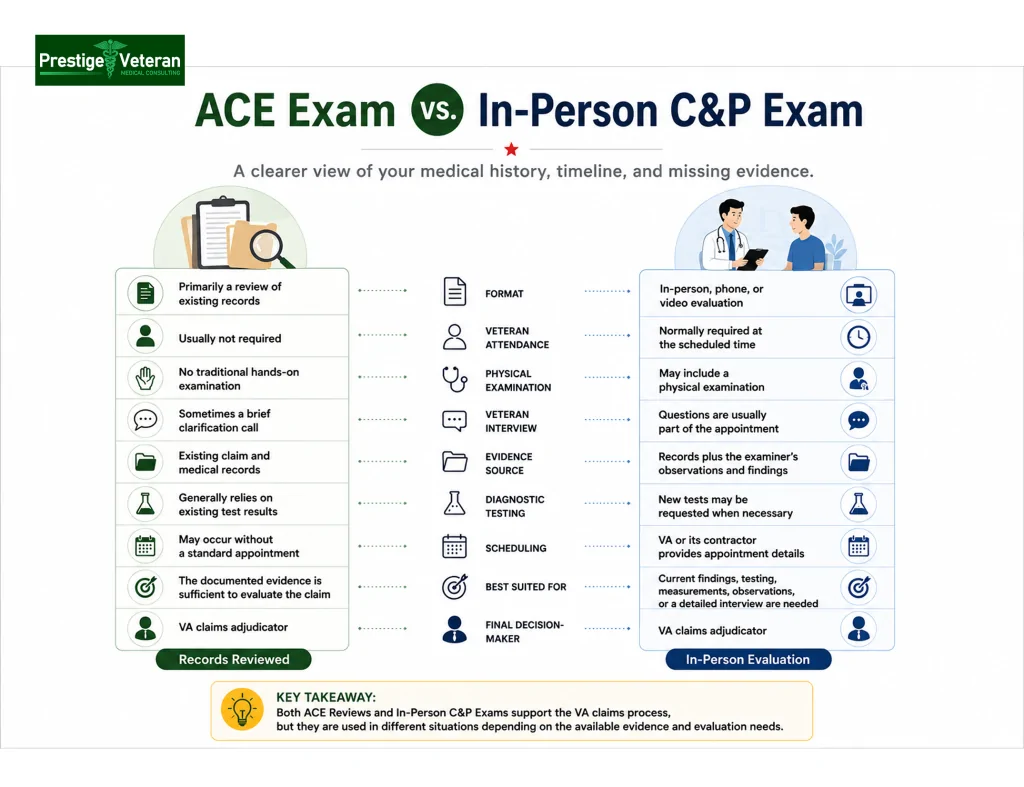
ACE stands for Acceptable Clinical Evidence. Through the ACE process, a qualified medical examiner may complete a disability evaluation or medical opinion by reviewing the evidence in a veteran’s claim file instead of conducting a standard face-to-face examination.
Veterans may hear this described as a VA records review, records-only C&P exam, or ACE exam. Regardless of the term used, the examiner primarily relies on medical and supporting evidence that is already available to VA.
Records considered during a VA ACE review may include:
- Service treatment records
- VA and private medical records
- Previous C&P examination reports
- Imaging, laboratory results, and diagnostic studies
- Specialist, hospital, or surgical reports
- Completed Disability Benefits Questionnaires
- Medical opinions, including nexus opinions
- Statements describing symptoms and functional limitations
VA may use the Acceptable Clinical Evidence process when the existing medical evidence contains enough information to address the questions involved in the claim. When additional information is needed, VA may request more evidence or arrange another type of C&P examination.
Is an ACE Review Really an “Exam”?
An ACE exam is more accurately understood as a medical records review within VA’s broader claim-examination process. The veteran usually does not attend an appointment or undergo a hands-on examination, but the examiner’s findings still become part of the evidence VA considers.
Can the ACE Examiner Call the Veteran?
Some ACE reviews are completed entirely from the written record. In other cases, an examiner or authorized VA contractor may call the veteran to clarify a limited detail.
A VA ACE phone call might involve questions about the date a symptom began, current medication use, recent treatment, or an apparent difference between two records. This type of clarification call does not necessarily convert the records-only evaluation into a traditional C&P appointment.
What Is a VA C&P Exam?
C&P stands for Compensation and Pension. A VA C&P exam is a claim examination used to gather medical information that the VA needs when evaluating a disability claim.
Depending on the issues involved, an examiner may document:
- The diagnosis or nature of a claimed condition
- Whether a condition may be related to military service
- Its current symptoms, severity, and functional limitations
- Whether a service-connected condition has worsened
- Whether one condition may be related to another condition
- Findings needed to complete the applicable DBQ
A C&P exam is not a treatment visit. The examiner generally does not prescribe medication, provide ongoing care, or make referrals for treatment. Instead, the provider reviews relevant evidence, records the findings, and sends an examination report to VA.
The examiner does not grant or deny the claim. VA adjudicators make a final decision after considering the examination report and the remaining evidence in the claim file.
In-Person C&P Exams
An in-person C&P exam allows the examiner to directly interview the veteran and perform any necessary physical assessment for the claimed condition.
The appointment may include questions about medical history, symptom onset, treatment, flare-ups, and functional impairment. Depending on the condition, the examiner may also perform range-of-motion measurements, evaluate painful movement, conduct a mental health interview, review scars, or document effects on ordinary activities.
VA may also request diagnostic testing, such as imaging, laboratory work, pulmonary function testing, hearing tests, or other diagnostic studies. The exact components depend on the disability being evaluated and the information requested by VA.
Example: A veteran claiming increased disability from a vestibular disorder may require an in-person examination when the evaluation calls for balance testing, observation of gait, or other current clinical findings that cannot be fully documented through a records-only review.
Telehealth C&P Exams
A VA telehealth C&P exam is conducted remotely, either by phone or secure video, when the condition can be appropriately evaluated without hands-on testing.
Telehealth can be appropriate when the required findings can be obtained through an interview, observation over video, and review of the medical record.
However, not every condition can be adequately assessed remotely. Conditions requiring physical measurements, direct observation, diagnostic testing, or a hands-on examination may still require an in-person C&P appointment.
Difference Between VA ACE Exam and C&P Exam
The main difference between a VA ACE exam and a C&P exam is how the examiner gathers the necessary medical evidence. The following graphic summarizes the key distinctions.
Important Considerations
Three distinctions are especially important.
First, an ACE records-only review is part of VA’s claim-examination process.
It is not a separate disability benefit, decision program, or type of claim.
Second, veterans do not normally select the examination format.
VA determines what information is needed and whether a records review, telehealth appointment, or in-person examination can provide it. A veteran may communicate accessibility concerns or request reasonable accommodations, but the required medical evaluation still depends on the circumstances of the claim.
Third, neither format predicts the final decision.
An ACE review does not mean the claim will be approved, just as an in-person examination does not mean the existing evidence is inadequate. VA considers the examiner’s report together with medical records, military records, diagnostic results, medical opinions, and relevant statements.
How VA Decides the Format of Evaluation
VA first determines whether a claim examination or medical opinion is needed. From there, the format depends on what evidence is already available and whether new clinical findings are necessary.
When VA May Use an ACE Review
An ACE review may be appropriate when available records allow an examiner to complete the required Disability Benefits Questionnaire or opinion without findings from a live appointment, such as:
- A confirmed diagnosis
- Treatment history
- Current symptoms
- Test or imaging results
- Functional limitations
- A completed DBQ or specialist report
Example: A veteran receiving treatment for prostate cancer may have a recent biopsy report, oncology records, laboratory results, and treatment notes documenting the diagnosis and current therapy. The examiner may be able to complete the review from those records, sometimes after a brief clarification call.
When VA May Schedule a C&P Exam
An in-person or telehealth C&P exam may be used when the record lacks necessary information or the evaluation requires:
- A medical interview
- Direct observation
- Physical measurements
- Diagnostic testing
- Current clinical findings
Example: A veteran reporting worsening hearing loss may have older audiology records, but VA may need a current hearing examination. The appointment can include controlled speech-discrimination testing and pure-tone audiometry to document the veteran’s present hearing levels and related functional effects.
Not every VA disability claim requires a scheduled C&P examination.
The examination format is based on the information needed to evaluate the condition.
What Happens During Each Process and How to Prepare
Preparing for and Completing an ACE Review
An ACE review may begin without the veteran receiving a traditional appointment date. VA or an authorized contractor assigns the records to a qualified examiner, who identifies and reviews the relevant evidence in the claim file.
The examiner may then complete a DBQ, prepare a medical opinion, or document findings based on the available evidence. When a limited point needs clarification, the examiner may contact the veteran before returning the completed report to VA.
Before the review, confirm that relevant private treatment records, reports, and test results have been submitted.
While an ACE review is pending, you should:
- Monitor phone calls, voicemail, email, and mail
- Keep your contact information current
- Review notices from VA and authorized examination contractors
- Verify unfamiliar callers through official contractor information
- Respond promptly to legitimate requests for clarification
A lack of a scheduled appointment does not necessarily mean nothing is happening. The examiner may be reviewing records without requiring direct participation from the veteran.
Preparing for a Scheduled C&P Exam
For a scheduled C&P exam, you will receive information about the date, time, location, phone instructions, or video connection.
Before the appointment:
- Review the examination notice
- Confirm that VA has current private medical records
- Prepare accurate notes about symptoms, treatment, flare-ups, and functional limitations
During the appointment, describe your symptoms accurately and specifically. That includes explaining how often symptoms occur, how long they last, what triggers flare-ups, and how the condition affects work and ordinary activities.
Be Specific: Saying “my back hurts” gives limited detail. A clearer explanation might describe difficulty standing for more than a certain period, interrupted sleep, problems lifting household items, or the need to take breaks during routine tasks.
Reviewing the applicable public DBQ can help you understand the subjects the examiner may cover, but your responses should remain honest to your actual experience. Avoid minimizing or exaggerating symptoms.
The length of a C&P exam varies. Some appointments may last about 15 minutes, while others may take more than an hour, depending on the condition and the information required.
The Role of Medical Documentation in ACE and C&P Exams
Medical documentation helps an examiner understand more than what a veteran is experiencing on the day of an evaluation. This is especially important for disabilities that fluctuate, worsen during flare-ups, or respond differently to treatment.
Records may establish when a condition was first identified, how symptoms developed, what treatment was provided, and how the condition has affected work and everyday activities over time.
The role of those records differs depending on whether VA uses an ACE review or a live C&P examination.
How Medical Documentation Supports an ACE Review
During an ACE review, documentation serves as the examiner’s primary source of clinical information. Records from different periods may help the examiner compare earlier symptoms with more recent findings, identify treatment patterns, and determine whether the evidence addresses the requested DBQ sections or medical opinion.
A consistent medical timeline can also help the examiner understand whether symptoms were isolated, recurring, or continuous.
Example: Records concerning a respiratory condition may document pulmonary function results, prescribed inhalers, exacerbations, and emergency treatment. Together, those details may give the examiner a clearer understanding of the condition than a brief note stating only that the veteran has asthma.
How Medical Documentation Supports an In-Person C&P Exam
During an in-person C&P exam, medical documentation helps place the current findings in context. Some conditions fluctuate, and the symptoms observed during the appointment may not represent their usual frequency or severity.
For example, a veteran may not experience a severe flare-up during a short back examination. Records can show episodes that occurred outside the examination room, including emergency visits, documented flare-ups, falls, periods of restricted activity, or changes in work duties. The examiner can consider that history alongside the veteran’s statements and any current observations, measurements, or test results.
Medical records do not all carry the same information. Specific, dated, and clinically supported documentation generally helps the examiner assess how a condition has progressed and affected the veteran.
Documentation Tip: VA advises veterans to submit relevant non-VA medical records before the claim examination. An examiner may review documents brought to an appointment, but cannot submit those records to the claim file on the veteran’s behalf. Consider speaking to a VA-accredited representative to identify the appropriate submission method.
What Happens If You Miss a C&P Exam or ACE Phone Call?
Missing a scheduled C&P exam may delay the claim or lead the VA to evaluate it using the evidence already on file. This can be significant when the missed examination was intended to provide necessary findings.
If you cannot attend, follow the instructions in the appointment notice and contact the VA medical center or authorized contractor promptly. If the exam was missed for a reason VA may recognize as good cause, explain the circumstances as soon as possible.
Missing an ACE clarification call is not necessarily the same as missing a scheduled C&P exam, but it may leave the examiner without information needed to complete the review. Check your voicemail and written correspondence, and return calls using verified VA or contractor contact information.
Common Misconceptions About ACE and C&P Exams
Myth: An ACE review means the claim will be approved.
Fact: An ACE review means the examiner may be able to address the requested medical questions using the evidence already available.
Myth: Receiving a C&P exam means the existing evidence is weak.
Fact: VA may simply request an exam because it needs current findings, direct observations, measurements, diagnostic testing, or clarification of information already in the record.
Myth: The medical examiner decides the claim.
Fact: The examiner prepares medical findings or an opinion, while VA adjudicators make the claim decision.
Myth: Veterans do not need to attend a C&P exam if the VA already has their medical records.
Fact: Missing a required examination may delay the claim or lead VA to evaluate it using only the existing record.
Myth: A telehealth C&P exam and an ACE review are the same process.
Fact: Telehealth usually involves a scheduled video appointment with an examiner, while an ACE review is primarily based on existing records.
Conclusion
An ACE review or C&P exam represents one stage in VA’s process for gathering medical evidence. Veterans should read examination notices carefully, keep relevant records organized, and retain copies of appointment details. Because the required evaluation depends on the medical questions involved, the format alone should not be interpreted as an indication of how VA will decide the claim.
If you have questions about an examination notice or VA claim procedure, consider speaking with a VA-accredited Veterans Service Organization, claims agent, or attorney.
Frequently Asked Questions (FAQs)
When May VA Use an ACE Exam Instead of a C&P Exam?
An ACE exam is a records-based form of C&P evaluation that may be used when the available medical evidence is sufficient for the examiner to address VA’s questions without a traditional appointment.
Does VA Always Require a C&P Exam?
No, VA may request a C&P exam or medical opinion when it needs additional information to evaluate the claim, but not every claim requires a scheduled examination.
Is the ACE Exam Difficult?
An ACE exam is not a test that a veteran passes or fails because the examiner primarily reviews the medical and supporting evidence already in the claim file.
How Can I Prepare for a VA C&P Exam for PTSD?
Prepare by carefully reviewing your appointment instructions, medical records, and symptom history beforehand. During the C&P exam, honestly describe your PTSD symptoms, their frequency and severity, and how they affect your work and relationships. Explain without minimizing or exaggerating them.
How Long Does It Take to Receive a Decision After a VA ACE Exam?
There is no fixed decision timeline after an ACE exam because processing time depends on the claim’s complexity, whether any additional evidence is needed, and the VA’s overall review process.
Is a C&P Exam a Good Thing?
A VA C&P exam is neither inherently good nor bad; it means VA has requested medical findings or clarification as part of evaluating the claim.
Can I Submit My Own DBQ?
You may ask an appropriate private health care provider to complete a Disability Benefits Questionnaire (DBQ), although VA does not generally reimburse the cost of the private evaluation.
Also Read: The Biggest Mistakes Veterans Make After a Bad C&P Exam
At Prestige Veteran Medical Consulting, a veteran-owned company, we specialize in Independent Medical Opinions (IMOs) known as Nexus letters.
Our purpose is to empower YOU, the veteran, to take charge of your medical evidence and provide you with valuable educational tools and research to guide you on your journey.
Understanding the unique challenges veterans face, our commitment lies in delivering exceptional service and support.
Leveraging an extensive network of licensed independent medical professionals, all well-versed in the medical professional aspects of the VA claims process, we review the necessary medical evidence to incorporate in our reports related to your VA Disability Claim.
Prestige Veteran Medical Consulting is not a law firm, accredited claims agent, or affiliated with the Veterans Administration or Veterans Services Organizations. However, we are happy to discuss your case with your accredited VA legal professional.