
Spend enough time in the VA disability world online, and you will start hearing the same buzzwords over and over again.
Magic wording.
VA cannot deny this.
Automatic approval.
Slam dunk.
Presumptive.
Secondary to.
DBQ.
Nexus.
Rebuttal.
Favorable findings.
Duty to assist.
Some of these terms can be important. The problem is that many of them are oversimplified, misused, or turned into clickbait in ways that confuse veterans instead of helping them.
When veterans start focusing on buzzwords instead of evidence, rationale, medical records, and individualized analysis, they may misunderstand what actually matters in a VA disability claim.
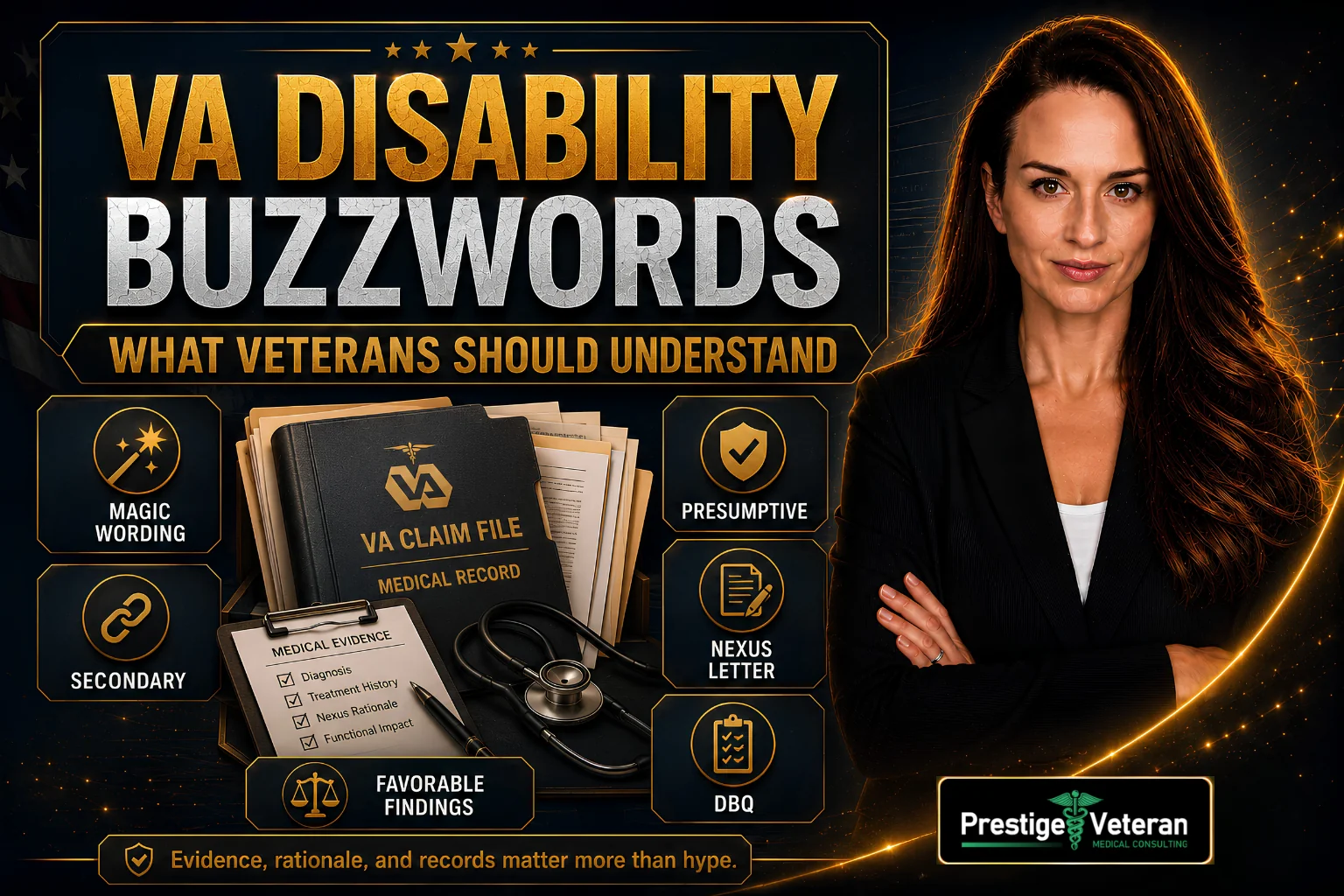
In this video, Leah Bucholz, founder and CEO of Prestige Veteran Medical Consulting, discusses some of the most overused VA disability buzzwords online and what veterans should understand about them from the medical evidence side of the process.

VA disability claims can involve medical, legal, administrative, and evidentiary issues.
That complexity creates room for confusion.
Online, some terms get repeated so often that they begin to sound like shortcuts. Veterans may hear that a certain phrase, form, or document can guarantee an outcome. They may hear that VA “has to” accept something. They may be told that a claim is a “slam dunk” because one buzzword applies.
But disability claims are usually more fact-specific than that.
From the medical evidence side, the important questions often include:
- Is there a current diagnosis?
- What does the medical timeline show?
- Are symptoms documented consistently?
- Does the medical evidence support causation or aggravation?
- Are alternative risk factors addressed?
- Does the rationale explain the relationship clearly?
- Does the opinion apply the evidence to the veteran’s individual history?
Buzzwords may describe parts of the process, but they do not replace the process.
Table of Contents
“Magic Wording” Does Not Replace Medical Rationale
One of the biggest buzzwords veterans hear online is “magic wording.”
Many veterans become convinced that there is a secret phrase that automatically makes a claim stronger or guarantees approval.
Phrases such as:
- At least as likely as not
- More likely than not
- But for causation
- Aggravated beyond natural progression
can be important in medical and legal contexts. But wording alone does not make a medical opinion persuasive.
The rationale matters.
A medical opinion should explain the reasoning behind the conclusion. It should address the veteran’s records, medical history, timeline, risk factors, and relevant medical principles.
A phrase like “at least as likely as not” may matter, but it is not enough by itself.
A strong medical opinion should answer questions such as:
- Can the provider explain the connection?
- Do the records support the timeline?
- Were alternative risk factors discussed?
- Does the reasoning make medical sense?
- Is the conclusion based on the veteran’s individual history?
The strength of an opinion is not only in the words used. It is in the reasoning that supports those words.
Presumptive Does Not Always Mean Automatic Approval
Another commonly misunderstood term is “presumptive.”
Some veterans hear “presumptive condition” and assume that means automatic approval.
That is not always how it works.
Presumptive service connection can be important, but veterans may still need evidence related to the claim. Depending on the situation, that may include a current diagnosis, qualifying service or exposure criteria, medical documentation, evidence of severity, or clarification of chronic residuals.
Presumptive does not necessarily mean no evidence is required.
This is where veterans should be careful about online advice that makes the process sound automatic. A presumptive framework may help address one part of the claim, but the overall evidence still matters.
Secondary Conditions Still Require Medical Support
“Secondary condition” is another phrase that gets used constantly online.
It is also one of the most misunderstood.
Some veterans hear claims such as:
“You can secondary anything to anything.”
That is not how credible medical analysis works.
A secondary relationship still requires a medically supportable rationale. The important question is whether the medical evidence supports a causal or aggravating relationship between the service-connected condition and the claimed secondary condition.
Sometimes the evidence supports direct causation.
Sometimes the better medical question is aggravation.
Sometimes the records do not support the proposed relationship at all.
For example, simply having two diagnoses at the same time does not automatically establish a secondary relationship. The medical analysis needs to look at the veteran’s individual history, the timeline, the mechanism, risk factors, treatment records, and whether the proposed connection makes medical sense.
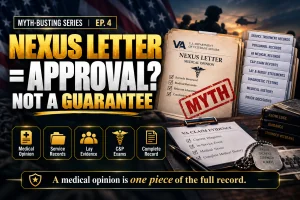
A Nexus Letter Is Not a Magic Document
A Nexus letter is another term that can become overhyped online.
A Nexus letter is not a magic document.
It is not automatically persuasive simply because it exists. It is a medical opinion addressing causation or aggravation.
Some claims may need one. Others may not.
Some claims may already have adequate evidence in the record. Others may fail for reasons that are not solved by simply adding a Nexus letter.
For example, a claim may have issues involving diagnosis, inconsistent timelines, lack of chronicity, competing risk factors, incomplete records, or legal questions that fall outside the medical provider’s role.
A Nexus letter should address a specific evidentiary gap.
It should not exist just for the sake of existing.
A strong Nexus letter should be specific, evidence-based, and medically reasoned. It should explain why the provider reached the conclusion and how the veteran’s medical history supports that conclusion.
Why “Rebuttal Opinion” Can Be Misunderstood
The term “rebuttal opinion” is often used online in a combative way.
That can create problems.
When there is negative medical evidence, there may be situations where a medical professional can provide an opinion addressing technical medical issues. For example, a provider may identify whether a prior examiner overlooked documented evidence, used incomplete rationale, failed to address aggravation, relied on inaccurate facts, or failed to discuss relevant medical principles.
But that is different from writing an emotional attack against a VA examiner.
A strong medical opinion should focus on the medical deficiencies, not personal criticism.
For example, a useful medical analysis may address whether:
Relevant records were overlooked
The rationale was incomplete
The examiner failed to address aggravation
The factual history was inaccurate
Important medical literature or principles were not considered
The conclusion did not match the documented evidence
That is very different from simply saying the examiner was wrong or unfair.
The goal should be objective medical analysis, not emotional argument.
Favorable Findings Do Not Always Mean the Claim Is Complete
“Favorable findings” is another phrase veterans may see in VA decisions.
Favorable findings can matter, especially from a legal and adjudicative standpoint. But they do not always mean the claim is automatically approved or complete.
A favorable finding may acknowledge one part of the claim. But other elements may still need to be addressed.
For example, there may still be questions involving nexus, severity, chronicity, aggravation, effective date, rating percentage, or other evidence.
Because favorable findings involve legal and adjudicative interpretation, veterans should discuss them with accredited professionals when needed.
From the medical side, the key point is that one favorable finding does not necessarily answer every medical or evidentiary question.
“VA Has to Accept This” Is Not How Evidence Review Works
Another phrase that gets repeated online is:
“VA has to accept this.”
Veterans may hear that VA has to accept a private specialist’s opinion, a DBQ, a Nexus letter, or a particular medical document.
That is not generally how evidence evaluation works.
A private medical opinion can be highly persuasive. A DBQ can be useful. A specialist’s opinion can matter.
But evidence still gets evaluated for credibility, consistency, factual basis, and probative value.
That means the reasoning behind the evidence matters.
A private medical opinion is usually stronger when it clearly explains the veteran’s diagnosis, symptoms, records, timeline, causation or aggravation theory, functional impact, and medical rationale.
The source of the evidence may matter, but the quality of the reasoning matters too.
No Ethical Professional Should Guarantee an Outcome
Some online content suggests that certain claims are guaranteed, automatic, or a “slam dunk.”
That should be a red flag.
No ethical medical provider or legal professional should guarantee the outcome of a disability claim.
Claims are fact-specific, evidence-specific, and often medically complex. Medicine is rarely completely black and white. Two veterans may have the same diagnosis but very different medical histories, timelines, risk factors, and evidence.
That is why credible professionals should avoid making guarantees.
A more appropriate approach is to evaluate what the evidence supports, what the evidence does not support, and what questions still need to be answered.
A Denial Is Not Always the End of the Road
Another word veterans hear often is “denied.”
A denial can feel discouraging, but it does not always mean the case is hopeless.
Sometimes a claim is denied because evidence was incomplete. Sometimes the rationale was weak. Sometimes records were inconsistent. Sometimes the issue was procedural. Sometimes the claim needed additional development. Sometimes there were legal or evidentiary issues that needed to be addressed by an accredited representative.
A denial is not always the end of the road.
However, understanding why a claim was denied is important.
From a medical evidence standpoint, a denial may raise questions such as:
- Was there a current diagnosis?
- Was the medical rationale adequate?
- Did the evidence address causation?
- Did the evidence address aggravation?
- Were relevant records missing?
- Was the timeline unclear?
- Were alternative risk factors ignored?
Veterans should consider reviewing denials with an accredited attorney, accredited claims agent, or Veterans Service Organization representative when claim-specific guidance is needed.
What Veterans Should Focus on Instead
Instead of chasing buzzwords, veterans may be better served by focusing on the actual evidence and medical questions in their specific case.
Strong claims are often built on:
- Credible medical evidence
- Consistent records
- Clear timelines
- Organized documentation
- Objective medical rationale
- Diagnosis clarity
- Symptom history
- Functional impact
- Appropriate legal guidance when needed
Not hype.
Not magic phrases.
Not shortcuts.
Not social media promises.
The medical evidence should be connected to the veteran’s actual history. The reasoning should explain why the conclusion makes sense. The analysis should be individualized, not copied from a generic template.
Final Thoughts
VA disability buzzwords are not always meaningless. Some of these terms can be important.
But when they are oversimplified or turned into clickbait, they can lead veterans in the wrong direction.
- Magic wording does not replace rationale.
- Presumptive does not always mean automatic approval.
- A Nexus letter is not a magic document.
- A rebuttal opinion should not be an emotional attack.
- Favorable findings may not answer every question.
- A denial is not always the end of the road.
At the end of the day, veterans should focus less on buzzwords and more on understanding the medical and evidentiary issues in their individual case.
Strong claims usually depend on credible evidence, clear reasoning, organized records, and appropriate professional guidance when needed.
Also Read: Did Secondary VA Claims Get Harder?
At Prestige Veteran Medical Consulting, a veteran-owned company, we specialize in Independent Medical Opinions (IMOs) known as Nexus letters.
Our purpose is to empower YOU, the veteran, to take charge of your medical evidence and provide you with valuable educational tools and research to guide you on your journey.
Understanding the unique challenges veterans face, our commitment lies in delivering exceptional service and support.
Leveraging an extensive network of licensed independent medical professionals, all well-versed in the medical professional aspects of the VA claims process, we review the necessary medical evidence to incorporate in our reports related to your VA Disability Claim.
Prestige Veteran Medical Consulting is not a law firm, accredited claims agent, or affiliated with the Veterans Administration or Veterans Services Organizations. However, we are happy to discuss your case with your accredited VA legal professional.