

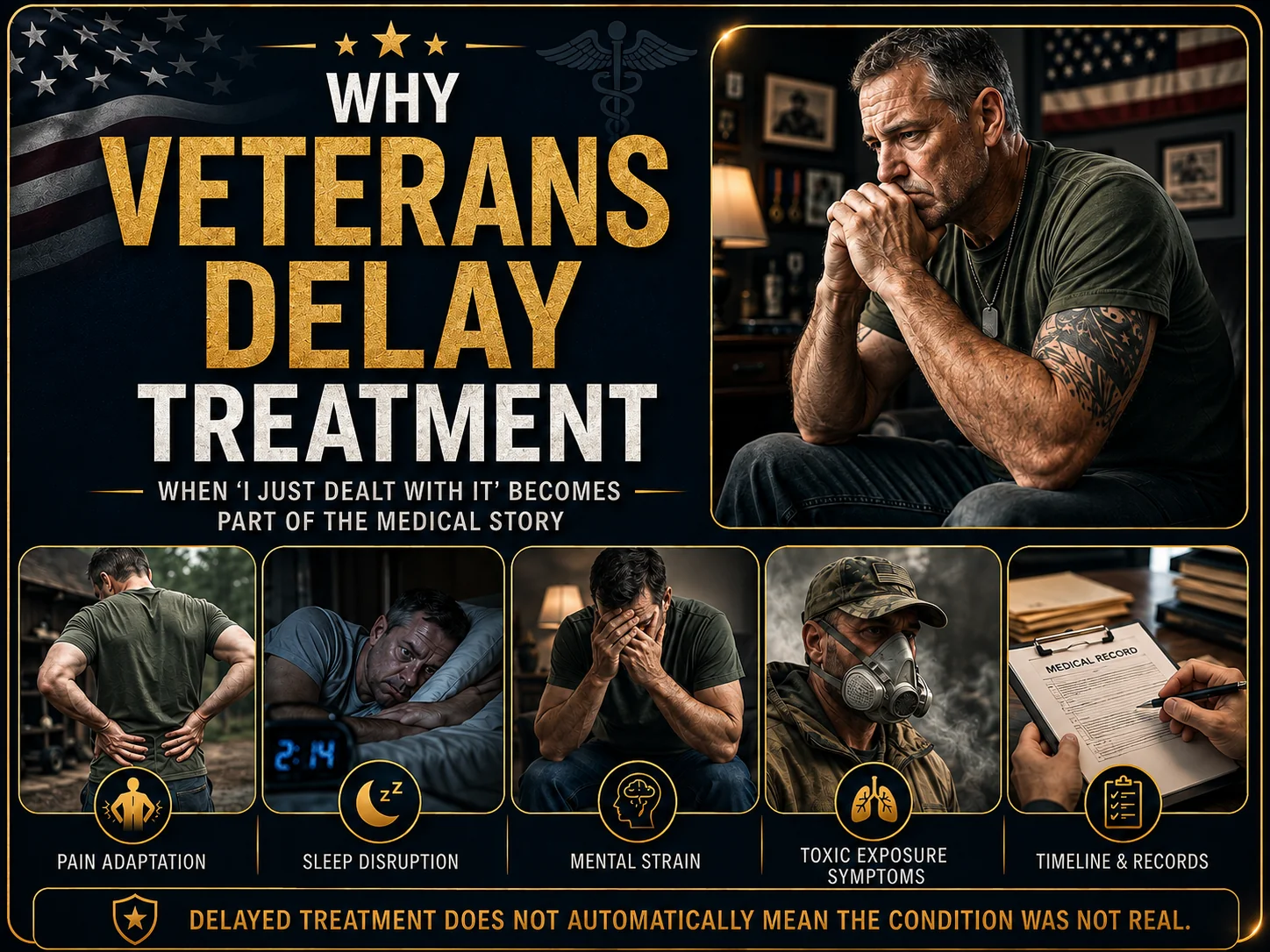
One of the most common things veterans say when discussing old injuries, symptoms, or medical concerns is:
“I just dealt with it.”
That mindset is incredibly common in military culture.
Many service members are trained to push through pain, minimize symptoms, avoid complaining, keep performing, and continue the mission regardless of what is happening physically, mentally, or operationally.
For many veterans, that mentality helped them survive military culture, deployments, leadership pressure, operational tempo, and mission demands.
But years later, that same mindset can create problems medically, emotionally, and sometimes within the VA disability claims process.
In this video, Leah Bucholz, founder and CEO of Prestige Veteran Medical Consulting, discusses why veterans delay treatment, what happens when symptoms are ignored for years, how chronic conditions may evolve over time, and why delayed treatment does not automatically mean a condition was not real.

Table of Contents
Why “I Just Dealt With It” Is Common in Veterans
A lot of people outside the military do not fully understand how normalized suffering can become in military environments.
In many military settings, service members may learn to think:
- It is not bad enough.
- Everyone hurts.
- I do not want to look weak.
- I do not want to get pulled from deployment.
- I do not want to go off jump status.
- I do not want this to affect my career.
- I do not want leadership treating me differently.
- I can tough this out.
That mindset can continue long after service ends.
This may be especially common in combat units, special operations communities, aviation, infantry, law-enforcement-style military occupations, and high operational tempo units where performance expectations are extremely high.
Over time, symptoms may become normalized. Veterans may adapt to dysfunction and stop recognizing what healthy even feels like.
How Military Culture Can Normalize Symptoms
Military culture often rewards endurance.
Service members may be praised for pushing through injuries, avoiding sick call, staying mission capable, and continuing to perform despite symptoms.
In the short term, that mindset may help someone complete the mission.
In the long term, it can come with a cost.
Veterans may go years without documenting symptoms because they were used to minimizing what they felt. They may not see certain symptoms as worth mentioning until those symptoms begin affecting work, sleep, relationships, mobility, or daily function.
That is one reason medical context matters when reviewing a veteran’s history.
Adaptation Can Hide Chronic Conditions
Adaptation can hide the true severity and progression of chronic conditions for years.
For example, a veteran may say:
“My knees did not really bother me that much when I got out.”
But after a closer discussion, the medical history may show that the veteran stopped running years ago, avoids stairs, shifts weight while standing, wakes up stiff, uses braces occasionally, or has changed activities around pain.
That is adaptation.
The veteran may not have described the condition as severe at first because they had already built their life around the limitation.
The same concept can apply to mental health.
A veteran may not initially recognize hypervigilance, irritability, emotional numbness, social withdrawal, insomnia, panic symptoms, or chronic anxiety as symptoms that require treatment.
Those symptoms may simply become their “normal” until relationships suffer, employment becomes difficult, sleep deteriorates, physical health worsens, or the veteran reaches a breaking point years later.
Delayed Diagnosis Does Not Automatically Mean a Condition Was Not Real
A delayed diagnosis does not automatically mean that the condition did not exist earlier.
This is important.
One concern veterans often have is:
“If I did not seek treatment right away, VA will assume it is not connected.”
Contemporaneous medical documentation can be helpful. Records created close in time to the symptoms can support the medical picture.
But medicine is rarely that simple.
Many chronic conditions develop gradually. Some conditions worsen progressively. Some symptoms fluctuate. Some veterans self-manage for years before finally seeking help.
To be clear, delayed treatment does not automatically mean a condition is service-related.
But delayed treatment by itself also does not automatically invalidate a veteran’s history.
The medical analysis still needs to look at the full picture.
Why Context, Timeline, and Consistency Matter
When reviewing a veteran’s medical history, context matters.
Important questions may include:
- What was the veteran’s military occupation?
- What exposures or physical demands were present?
- When did symptoms begin?
- How did symptoms progress over time?
- Were symptoms consistent with the veteran’s service history?
- Did the veteran modify activity around symptoms?
- Were there periods of self-management?
- Did the condition gradually worsen?
- Are there lay statements, treatment records, or other evidence supporting the timeline?
The timeline matters.
The consistency matters.
The occupational exposures matter.
The symptom patterns matter.
A strong medical analysis should consider more than the date of the first formal diagnosis.
How Untreated Conditions Can Lead to Secondary Problems
Another issue that may be overlooked is how untreated physical conditions can eventually contribute to secondary problems.
For example, a veteran may ignore chronic back pain for years.
Because of pain, activity decreases. Weight may increase. Sleep may worsen. Mood may worsen. Mobility may decline.
Over time, other issues may enter the picture, such as depression, anxiety, sleep apnea, hypertension, chronic fatigue, or worsening orthopedic strain.
The body is interconnected.
Untreated conditions rarely stay neatly isolated forever.
That does not mean every later condition is automatically related. But it does mean that the sequence of symptoms and functional changes may be medically important.
Delayed Symptoms and Toxic Exposure Cases
Delayed progression can also matter in toxic exposure cases.
Some veterans were exposed to burn pits, particulate matter, fuels, solvents, smoke, airborne hazards, environmental contaminants, or a combination of exposures.
They may not immediately recognize that later symptoms could potentially be related.
Some veterans normalize chronic coughing. Others normalize sinus problems, headaches, breathing issues, or inflammatory symptoms.
Years later, chronic respiratory conditions or other medical issues may become more obvious.
Delayed progression does not automatically prove a relationship, but it also does not automatically make the condition unrelated.
The medical analysis may need to consider exposure history, chronology, risk factors, symptom evolution, and supporting evidence.
Why Timelines Help Tell the Medical Story
Experienced legal professionals, Veterans Service Officers, and medical professionals who work in the veteran disability space often spend time developing timelines.
That is because strong evidence often tells a coherent medical story.
Not a perfect story.
Not a flawless story.
But a medically and factually consistent one.
A timeline may help show when symptoms began, how they progressed, when the veteran adapted around them, when function changed, and when treatment finally started.
Sometimes the question is not only:
“When was the condition diagnosed?”
Sometimes the better medical question is:
“What does the full history show before the diagnosis appeared?”
Seeking Treatment Is Not Weakness
Veterans also need to hear this clearly:
Seeking treatment is not weakness.
That may sound simple, but it matters.
Military culture can reward endurance over early intervention. Many service members learn to push through injuries, avoid medical visits, and keep performing because that is what the environment expects.
But the long-term cost can be serious.
Symptoms that are ignored for years may become more complicated. Physical symptoms can affect mental health. Mental health symptoms can affect sleep, relationships, work, and physical health. Conditions can become harder to untangle over time.
Getting care earlier can help medically and administratively.
It can create documentation, support treatment, and help veterans better understand what is happening.
Why Veterans May Notice Symptoms After Service
Some veterans do not fully notice their symptoms until after leaving the military.
During service, there may be structure, purpose, mission focus, and constant movement.
After separation, some veterans finally slow down enough to notice symptoms they ignored for years.
The body may catch up.
The mind may catch up too.
There may also be fear involved: fear of bad news, fear of appearing vulnerable, fear of career consequences, fear of stigma, fear of mental health treatment, fear of medications, or fear of becoming known as the person always going to medical.
Those fears are real, and they can influence treatment behavior in military environments.
Early Documentation Helps, But Delayed Treatment Is Not the End of the Story
Early documentation and treatment can absolutely help.
It is generally better to address symptoms earlier when possible.
But if a veteran delayed treatment for years, that alone does not mean their experiences were invalid. It does not automatically mean their symptoms were not real. It does not automatically mean their conditions cannot be analyzed in a legitimate medical way.
The key question is whether the overall evidence supports the relationship being considered.
That requires context, chronology, and individualized medical analysis.
Final Thoughts
Many veterans spent years surviving instead of seeking treatment.
That reality is deeply embedded in military culture, and understanding why veterans delay treatment is important when evaluating medical histories, chronic conditions, toxic exposures, mental health symptoms, and long-term functional decline.
Many veterans did not ignore symptoms because they did not care.
They ignored symptoms because pushing through became part of survival.
But eventually, the body can keep the score. The longer conditions go untreated, the more complicated the downstream effects may become.
That is why medical evidence, chronology, and individualized analysis remain so important in veteran disability medicine.
Also Read: VA Compensation for Sleep Apnea Secondary to Anxiety and Depression
At Prestige Veteran Medical Consulting, a veteran-owned company, we specialize in Independent Medical Opinions (IMOs) known as Nexus letters.
Our purpose is to empower YOU, the veteran, to take charge of your medical evidence and provide you with valuable educational tools and research to guide you on your journey.
Understanding the unique challenges veterans face, our commitment lies in delivering exceptional service and support.
Leveraging an extensive network of licensed independent medical professionals, all well-versed in the medical professional aspects of the VA claims process, we review the necessary medical evidence to incorporate in our reports related to your VA Disability Claim.
Prestige Veteran Medical Consulting is not a law firm, accredited claims agent, or affiliated with the Veterans Administration or Veterans Services Organizations. However, we are happy to discuss your case with your accredited VA legal professional.