
One bad Compensation and Pension (C&P) examination can leave a veteran believing their VA disability claim is over.
Maybe the examination felt rushed. Maybe the examiner seemed dismissive, did not discuss important records, or appeared to misunderstand the condition being evaluated.
But an unpleasant examination experience and an inadequate medical opinion are not necessarily the same thing.
And an unfavorable C&P opinion does not automatically determine the final outcome of a VA disability claim.
In this conversation, Leah Bucholz, founder and CEO of Prestige Veteran Medical Consulting and a former C&P examiner, is joined by Rebecca Deming, a VA-accredited attorney with ProVet Legal, to discuss what can make a C&P examination inadequate, how conflicting medical opinions are evaluated, and why the questions asked during the examination process matter.
Together, they explore the difference between medical evidence and legal decision-making, why some medical opinions lack sufficient reasoning, and what veterans should understand after a concerning C&P exam.

Table of Contents
What Actually Makes a C&P Exam Inadequate?
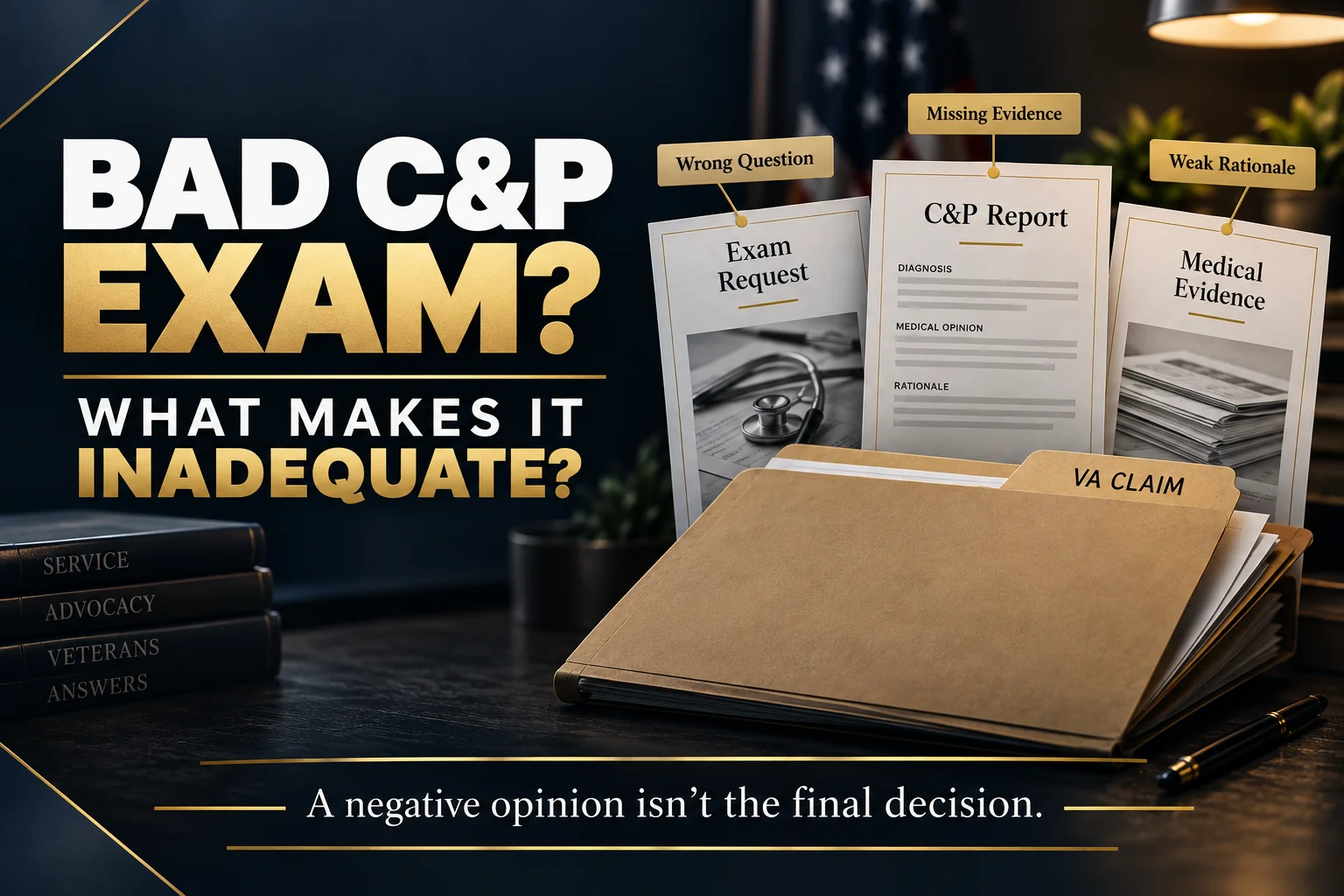
A negative medical opinion is not automatically an inadequate opinion.
An examiner may review the relevant evidence, apply appropriate medical reasoning, and reach an unfavorable conclusion that is medically supportable.
The more important question is whether the opinion adequately addresses the medical issue and explains how the evidence supports its conclusion.
Rebecca identifies two major areas of concern in the interview: the examiner’s competence to address the medical question and the adequacy of the medical rationale.
Examiner competency
A medical examiner must have appropriate qualifications to provide the opinion being requested.
However, Rebecca emphasizes that competency standards are broader than many veterans assume. An examiner practicing in a different medical specialty is not necessarily unqualified to address every condition outside that specialty.
The relevant issue is whether the examiner is competent to address the particular medical question, given their qualifications and the applicable requirements.
Medical rationale
The second concern is whether the opinion provides sufficient reasoning.
An examiner might conclude that a condition is unrelated to military service. But a conclusion alone does not explain how the examiner evaluated the relevant medical history, diagnostic findings, risk factors, or alternative explanations.
Under 38 CFR § 4.2, an examination report that lacks the detail necessary for evaluation may need to be returned as inadequate.
Whether a specific report meets the applicable legal standard requires review of the record and relevant law.
Why the Question VA Asks Can Change the Medical Analysis
One of the most important insights from this interview is that a problem may begin before the C&P examiner writes an opinion.
Rebecca explains that VA sometimes requests an examination using a question that does not fully address the theory of service connection being considered.
For example, consider a hypothetical veteran with a service-connected knee condition and a later diagnosis of obstructive sleep apnea.
The relevant medical question might involve several steps: whether the knee condition affected physical activity, whether that change contributed to weight gain, and whether the resulting history is medically relevant to sleep apnea.
But suppose the examiner is asked only:
“Did the knee condition directly cause sleep apnea?”
An examiner might answer that the knee joint and respiratory system are unrelated.
That response may address the narrow direct-causation question while leaving the proposed intermediate relationship unexplored.
The existence of such a relationship cannot be presumed. It requires a case-specific medical analysis, and the legal significance of an intermediate step must be assessed under the applicable requirements.
The broader lesson is that an opinion can answer the question presented without necessarily addressing every medically relevant question raised by the record.
This is why Rebecca emphasizes the importance of examining both the question asked and the reasoning provided.
A Medical Opinion Needs More Than a Conclusion
A persuasive medical opinion should explain how the provider reached the conclusion.
For example, an opinion stating:
“The veteran’s condition is less likely than not related to service.”
provides a conclusion, but it does not necessarily explain the reasoning.
A more complete medical analysis may discuss:
The condition being evaluated and the relevant diagnosis
Service history and reported symptoms
Medical records and diagnostic findings
Timing and progression of the condition
Relevant medical literature
Alternative causes or risk factors
Medical reasoning supporting the conclusion
Rebecca specifically notes that saying the entire claims file was reviewed does not, by itself, explain which facts informed the medical conclusion.
Similarly, an examiner’s suggestion that another cause is more likely should be supported by a meaningful explanation of that alternative.
The goal is not to produce the longest possible medical report.
A well-supported opinion explains why the medical evidence supports its conclusion.
Missing Service Treatment Records Are Not the Whole Story
Another concern discussed in the interview involves medical opinions that rely heavily on the absence of documented treatment during military service.
An examiner may note that the veteran’s service treatment records contain no documented complaint or diagnosis involving the condition under review.
That absence may be medically relevant.
But it does not automatically establish that no symptoms, injury, exposure, or medically significant event occurred during service.
Rebecca emphasizes that the broader record may contain important information, including personal statements, post-service treatment records, symptom history, and other relevant evidence.
A medical analysis should consider what those materials show and whether they support or contradict the proposed relationship.
This does not mean a veteran’s account must automatically establish a diagnosis or complex medical cause. Nor does it mean that every later-diagnosed condition is related to service.
It means that the absence of one particular type of documentation should be understood within the complete evidentiary record.
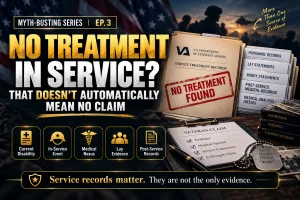
Related reading: VA Claim Myth: No Treatment in Service Means No Claim?
Can a Negative C&P Exam Still Lead to a Favorable VA Decision?
Yes, a negative C&P opinion does not automatically determine the final decision.
However, this should not be interpreted as a prediction that VA will grant the claim.
Rebecca explains that an unfavorable examination may be followed by an unfavorable rating decision. She also describes situations in which additional clarification, a different examination, or other medical evidence may become relevant.
A C&P examiner provides medical findings and opinions.
The examiner does not make the final legal determination of entitlement to VA disability benefits.
VA adjudicators evaluate the evidence and issue the claim decision.
That distinction matters because the examiner’s conclusion is not necessarily the only medical evidence available.
The record may also contain private medical opinions, diagnostic results, treatment history, lay statements, and additional evidence relevant to the claimed condition.
Whether those materials support service connection depends on the individual claim and the applicable requirements.
C&P Exam vs. Private Medical Opinion: Which Carries More Weight?
A recurring question is whether a VA C&P medical opinion automatically carries more weight than a private medical opinion.
Rebecca explains that the answer is not simply determined by where the clinician works.
A private medical opinion and a VA examination may reach different conclusions after evaluating the same medical condition.
The disagreement itself does not establish that either opinion is inadequate.
Instead, the underlying medical analysis becomes important.
Relevant considerations may include whether the provider was qualified to address the issue, whether the factual history was accurate, which medical records were considered, and whether the reasoning adequately addressed competing explanations.
A private opinion that carefully evaluates the history and provides a detailed clinical explanation may be persuasive.
A C&P examination with equally sound medical reasoning may also be persuasive.
Neither the word “private” nor the label “C&P” substitutes for the quality of the medical analysis.
Likewise, a report should not be considered stronger simply because it contains more pages.
Why an Exam That Felt Bad May Still Produce a Favorable Opinion
An important distinction in the interview is the difference between a veteran’s experience during the examination and the contents of the examiner’s final report.
Rebecca describes situations where veterans left an appointment convinced the examination had gone poorly, only to later discover that the examiner provided a favorable medical opinion.
She also describes the opposite situation: an examiner may sound supportive during the appointment but ultimately submit an unfavorable written opinion.
This is why the interaction alone does not reliably establish what the examiner concluded.
An examiner’s tone, bedside manner, or apparent agreement is not necessarily the same as the medical opinion submitted to VA.
That does not make a veteran’s experience unimportant.
It simply means the actual written report is necessary to understand the examiner’s findings and reasoning.
How Can Veterans Get a Copy of Their C&P Exam Report?
Rebecca explains that veterans often do not have immediate access to their completed C&P examination reports.
This can make it difficult to know whether an examiner overlooked evidence, misunderstood a history, or wrote an unfavorable opinion.
VA provides a process for requesting claim examination records.
According to VA’s published guidance, veterans can request the final exam report using a Freedom of Information Act or Privacy Act Request, VA Form 20-10206.
VA also explains that the report is not provided directly by the examiner at the appointment.
The request process and timing may vary. An accredited representative who is authorized to access the relevant claim records may also be able to help a veteran understand what information is available.
Official resource: VA Claim Exam Information
Access to the report matters because a concern about what happened during an examination is not necessarily the same as a documented deficiency in the medical opinion.
What Should Be Documented After a Concerning C&P Exam?
Rebecca discusses the value of making a contemporaneous record of what happened during an examination.
That means recording the experience while the details are still fresh.
For example, a veteran may want to accurately record:
- The date and location of the examination
- Important questions asked by the examiner
- Symptoms and history discussed during the appointment
- Whether a relevant test or measurement was performed
- Any information the veteran believes was misunderstood or omitted
- Specific incidents that caused concern
The purpose is to preserve an accurate description of the experience.
It is not to predict the examiner’s written conclusion or manufacture evidence that a report is inadequate.
Rebecca also discourages arguing with the examiner during the appointment to obtain a preferred opinion.
A disagreement about the adequacy of a medical report is different from a confrontation during the examination itself.
If a veteran works with an accredited representative, sharing an accurate account may help that representative understand the concern.
What if the Examination Involved Serious Misconduct?
The interview distinguishes between an examination that felt disappointing and an experience involving serious inappropriate conduct.
Rebecca discusses situations involving harassment, inappropriate touching, or conduct that may have harmed the veteran.
Those concerns should not be reduced to an ordinary disagreement over medical reasoning.
VA encourages veterans who had a bad examination experience to report their concerns. Its published options include contacting the examination contractor, providing written feedback for the claim file, contacting VA, or contacting a regional office.
The appropriate response depends on what happened.
A complaint about examiner conduct does not, by itself, establish the eventual legal or medical outcome of the claim.
Official resource: VA Claim Exam Guidance and Reporting Information
When Might an Independent Medical Opinion Be Relevant?
Leah and Rebecca also discuss the role of independent medical opinions, sometimes called Nexus letters.
Rebecca explains that the decision to obtain a private medical opinion may depend on the complexity of the medical question, the evidence already in the record, cost considerations, and the veteran’s circumstances.
For example, a complex secondary-condition question may require analysis of several medical factors.
A qualified professional might need to evaluate the history, diagnostic findings, relevant literature, and possible causal or aggravating relationships.
In other situations, the existing medical record may already address the relevant questions.
An additional private opinion is not automatically necessary in every case.
There is also an important distinction between obtaining an independent medical assessment and paying for a predetermined favorable conclusion.
The purpose of a credible medical opinion is to explain what the evidence medically supports—even when the conclusion is not favorable.
A private opinion cannot guarantee how VA will decide a claim.
What Happens if VA Relies on a Potentially Inadequate C&P Opinion?
Rebecca discusses several forms of VA decision review that may become relevant when a veteran disagrees with a decision.
The options she discusses include Higher-Level Review, Supplemental Claims, and Board Appeals.
These are different procedures, and the appropriate option depends on the record, the decision, applicable deadlines, and whether additional evidence is involved.
Higher-Level Review
VA describes Higher-Level Review as a process in which a higher-level reviewer considers the existing record and determines whether an error or difference of opinion affects the decision.
New evidence is generally not accepted in this review.
In certain circumstances, VA may identify a duty-to-assist error and undertake additional development.
Supplemental Claim
VA generally uses the Supplemental Claim process when a veteran has new and relevant evidence for review.
Depending on the medical issue, this might involve additional records or an independent medical opinion that addresses an unresolved question.
Submitting evidence does not guarantee that VA will change its previous decision.
Board Appeal
A Board Appeal involves review by a Veterans Law Judge.
Different Board review options have different rules concerning the submission of evidence and hearings.
Rebecca discusses how the level of review, record, and timing may influence the decision-making process.
These distinctions are legal and procedural. They are not determinations that a medical provider should make for a veteran.
Official resource: VA Decision Review Options
Veterans considering review options should consult an accredited attorney, accredited claims agent, or Veterans Service Officer who can examine the specific decision and explain the available choices.
Why the C&P Examiner Does Not Decide the Claim
Near the end of the interview, Leah and Rebecca return to a fundamental misconception.
Some veterans understandably believe the C&P examiner is the person who approves or denies their disability claim.
But the roles are different.
Medical professionals address medical questions. VA adjudicators make benefits decisions.
An examiner may describe diagnoses, symptoms, clinical findings, functional limitations, and medical causation.
An adjudicator considers the evidence under the applicable legal framework.
Leah emphasizes the importance of medical professionals staying within the scope of their expertise rather than making legal determinations.
Rebecca similarly explains that the examiner’s medical opinion is evidence to be considered—not the final adjudicative decision.
Understanding that separation helps veterans distinguish medical disagreements from legal questions about the resulting decision.
Final Takeaways
A bad C&P exam experience can be discouraging, but it should not automatically be treated as proof that a VA disability claim is over.
There are several important distinctions:
An unfavorable medical opinion is not automatically inadequate.
An examination that felt negative may not produce a negative report.
The medical question asked can be just as important as the examiner’s answer.
A medical conclusion needs sound reasoning and an accurate factual foundation.
Private medical opinions and C&P opinions must be considered within the broader evidentiary record.
A C&P examiner provides medical evidence but does not make the final benefits decision.
The purpose of understanding these distinctions is not to assume an unfavorable examination can always be overturned.
It is to understand what the examination actually addressed, what the record shows, and whether medical or legal questions remain unresolved.
As Leah and Rebecca emphasize throughout their discussion, accurate evidence, competent medical analysis, and appropriate accredited guidance are more meaningful than assumptions about how an appointment felt.
Also Read: The Biggest Mistakes Veterans Make After a Bad C&P Exam
At Prestige Veteran Medical Consulting, a veteran-owned company, we specialize in Independent Medical Opinions (IMOs) known as Nexus letters.
Our purpose is to empower YOU, the veteran, to take charge of your medical evidence and provide you with valuable educational tools and research to guide you on your journey.
Understanding the unique challenges veterans face, our commitment lies in delivering exceptional service and support.
Leveraging an extensive network of licensed independent medical professionals, all well-versed in the medical professional aspects of the VA claims process, we review the necessary medical evidence to incorporate in our reports related to your VA Disability Claim.
Prestige Veteran Medical Consulting is not a law firm, accredited claims agent, or affiliated with the Veterans Administration or Veterans Services Organizations. However, we are happy to discuss your case with your accredited VA legal professional.