
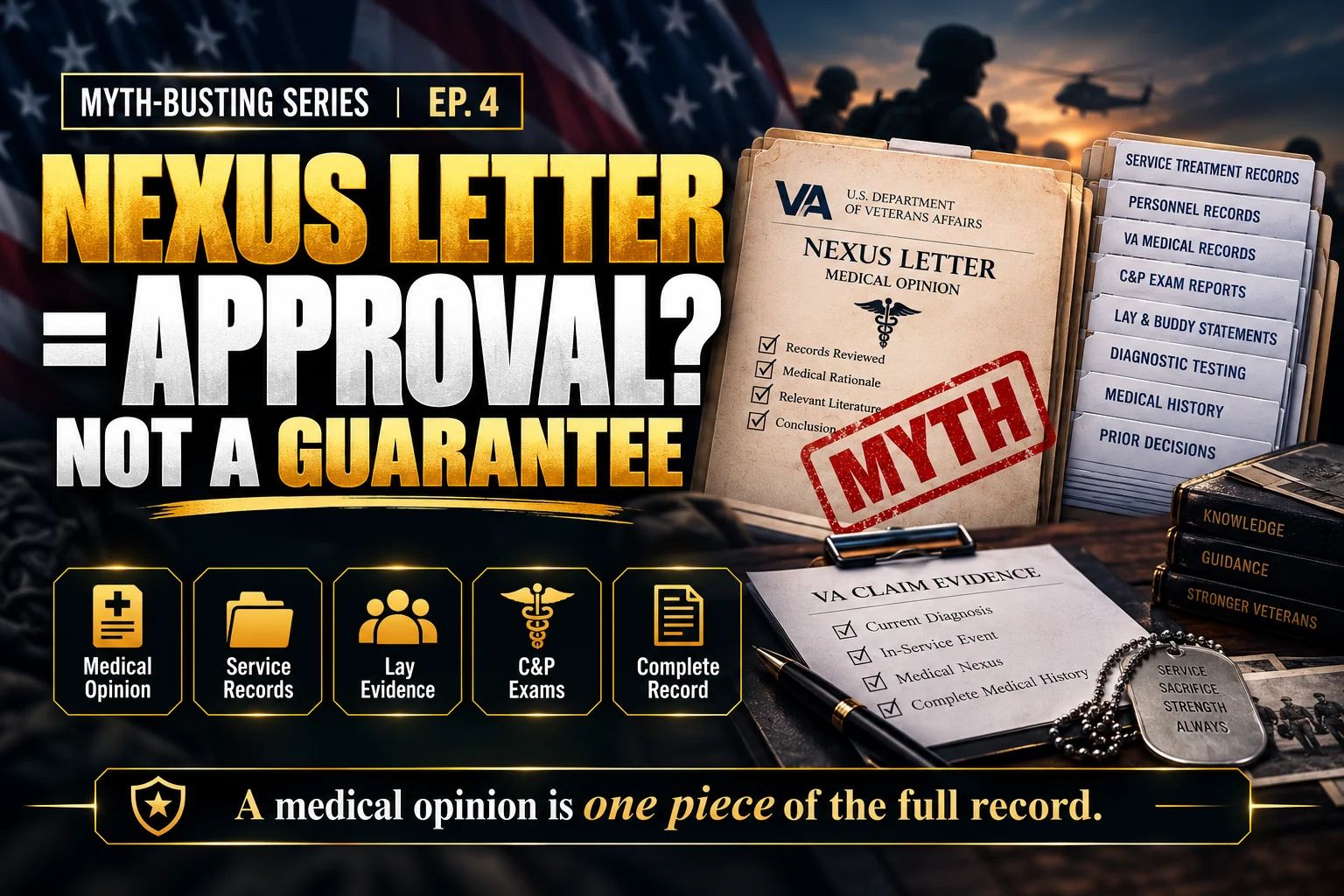
One of the most common misconceptions surrounding VA disability claims is the belief that obtaining a Nexus letter guarantees service connection.
Veterans may understandably think:
“I paid for a Nexus letter, so how could VA still deny my claim?”
Or:
“My doctor said my condition is related to service. Why wasn’t that enough?”
Those questions come up frequently because a Nexus letter is sometimes described online as though it were a golden ticket.
It is not.
In this episode of the Myth-Busting VA Claims series, Leah Bucholz, founder and CEO of Prestige Veteran Medical Consulting, explains what a Nexus letter actually is, what it is designed to do, why some medical opinions are more persuasive than others, and why even a well-supported Nexus opinion does not guarantee a particular VA decision.
A Nexus letter is medical evidence.
It can sometimes provide an important missing piece.
But it does not decide the claim.
Table of Contents
The Myth: A Nexus Letter Guarantees Approval
The myth is:
“If I get a positive Nexus letter, VA has to grant my claim.”
That is an oversimplification.
A Nexus letter can provide medical evidence addressing an important question in a disability claim, but it does not replace the rest of the record.
VA’s current public guidance says that, for a typical original disability claim related to active-duty service, the evidence generally needs to support a current disability, an in-service event, injury, or disease, and a link between the two. VA notes that medical records or medical opinions are commonly used to support that link.
A Nexus letter may address that medical link.
But the existence of the letter itself does not determine the final outcome.
What Is a Nexus Letter?
The word nexus simply means connection.
In the context of a VA disability claim, a Nexus opinion typically addresses whether there is a medically supportable relationship between two things.
That could involve a current condition and military service.
It could also involve a current condition and another condition that is already service connected.
For example, a medical professional might be asked to evaluate whether:
Military noise exposure is medically related to current hearing loss or tinnitus.
A service-connected orthopedic condition contributed to another musculoskeletal problem.
A service-connected condition caused or aggravated another medical condition.
Those are medical questions.
A qualified medical professional may review the relevant records, history, testing, risk factors, medical literature, and circumstances before offering an opinion about whether the proposed relationship is medically supportable.
That is the purpose of the Nexus opinion.
A Medical Opinion Does Not Decide the Claim
This distinction is extremely important.
Medical professionals provide medical opinions.
They do not decide entitlement to VA benefits.
As Leah explains in the video, the medical professional’s role is to address medical questions.
The provider does not determine the veteran’s disability percentage, effective date, legal entitlement, or whether VA ultimately grants the claim.
VA’s current claims-process guidance describes an evidence-review stage followed by a rating stage in which VA makes the claim decision and determines the disability rating.
Think of a medical professional as an expert witness.
An expert may explain a complicated medical issue.
But the expert does not become the person making the final decision.
The Nexus letter functions similarly.
A Nexus Letter Is One Piece of the Evidence
A medical opinion exists within a much larger evidentiary record.
Depending on the claim, that record may include:
Service treatment records.
Personnel records.
VA medical records.
Private medical records.
C&P examinations.
Diagnostic testing.
Imaging.
Lab results.
Lay statements.
Buddy statements.
Prior decisions.
Medical history.
The timing and progression of symptoms.
Potential alternative explanations.
A Nexus opinion can be important, but VA does not review that document in isolation. VA states that it reviews the evidence in the claim before making its rating decision.
That is why:
“I have a Nexus letter”
and
“My claim will definitely be approved”
are not equivalent statements.
Why Some Nexus Letters Carry More Weight Than Others
Not all medical opinions are equally persuasive.
Simply writing:
“It is at least as likely as not that the veteran’s condition is related to service”
does not automatically create a strong medical analysis.
That sentence gives a conclusion.
The important question is:
How did the provider reach that conclusion?
A well-developed medical opinion should demonstrate that the provider understood the relevant facts and can explain how those facts support the medical conclusion.
That may involve discussing:
The diagnosis.
The veteran’s medical history.
The service history.
The timeline.
Relevant risk factors.
Alternative causes.
Diagnostic findings.
Relevant medical literature.
Conflicting records.
The proposed medical mechanism.
The reasoning connecting all of those pieces.
The conclusion may ultimately be only a sentence or two.
The reasoning behind it is where much of the value lies.
Why Medical Reasoning Matters More Than the Conclusion
Leah uses a useful analogy in the video.
Imagine a teacher asks you to solve a math equation.
You write down the correct answer but show none of your work.
The answer may be correct, but the teacher cannot evaluate how you reached it.
Medical opinions can have a similar problem.
A provider may write:
“The veteran’s migraines are related to military service.”
But that is still just a conclusion.
A stronger opinion explains:
What facts support the relationship?
What records were reviewed?
When did symptoms begin?
What competing explanations were considered?
Does the medical literature support the proposed mechanism?
Are there other relevant risk factors?
Why does the current diagnosis make sense in the context of the veteran’s history?
A persuasive opinion connects the dots.
Why a Strong Nexus Letter Can Still Be Followed by a Denial
This is one of the more difficult concepts for veterans to understand.
A Nexus opinion can be thoughtful, detailed, and medically defensible, and the claim can still receive an unfavorable decision.
That does not automatically mean the opinion was bad.
Medicine is not always absolute.
Two qualified medical professionals can review overlapping evidence and reach different conclusions.
For example, a veteran may submit a favorable private medical opinion.
VA may also obtain a C&P examination or another medical opinion.
That examiner may reach a different conclusion.
Now the record contains competing medical evidence.
The existence of one favorable opinion does not automatically erase the other evidence.
VA May Have Competing Medical Opinions
When two providers disagree, the question is not simply:
“How many opinions support each side?”
The quality of the underlying reasoning matters.
As Leah discusses, factors may include:
Which provider addressed more of the relevant evidence?
Which provider explained the timeline more clearly?
Which provider considered alternative causes?
Which provider addressed conflicting records?
Which analysis better explained the medical mechanism?
Which opinion was based on an accurate factual history?
A longer report is not automatically stronger.
A provider with more letters after their name is not automatically more persuasive.
A treating provider is not automatically given more weight solely because they have treated the veteran for years.
The quality of the medical analysis matters.
Common Nexus Letter Misconceptions
Several other myths often appear alongside the idea that Nexus letters guarantee approval.
“My treating doctor automatically carries more weight.”
A longstanding treatment relationship can provide useful context.
But familiarity with the patient does not automatically make every causation opinion stronger.
The provider still needs to address the actual medical question and explain the reasoning.
“A specialist always beats a PA or another qualified clinician.”
Credentials and relevant expertise matter.
But the title after someone’s name does not replace sound analysis.
A carefully reasoned opinion from a qualified professional may be more useful than a poorly supported opinion from someone with more specialized credentials.
“If I paid for the opinion, VA has to accept it.”
No.
Paying a professional to perform a medical evaluation does not turn the resulting opinion into a guaranteed outcome.
The opinion still needs to stand on the quality of its medical analysis.
“If VA disagreed with my private opinion, VA must dislike private opinions.”
Not necessarily.
There may be multiple possible explanations.
Important records may have been unavailable.
Another medical opinion may have addressed evidence differently.
The opinion may have been based on an incomplete history.
Other evidence may conflict with its conclusion.
Every case has its own record.
Paying for an Opinion Does Not Guarantee Acceptance
The phrase “I bought a Nexus letter” can create the wrong mental model.
A veteran is not purchasing an outcome.
Ideally, the veteran is paying a qualified medical professional for an independent review and medical analysis.
That distinction matters.
An ethical provider should be evaluating the evidence and determining what the evidence medically supports.
Sometimes the evidence may support a favorable relationship.
Sometimes it may not.
The role of the provider should not be to manufacture the conclusion the veteran wants.
The role should be to provide a credible medical analysis.
What Veterans Should Focus on Instead
Instead of starting with:
“Do I need to buy a Nexus letter?”
Leah recommends thinking more broadly:
“What evidence is actually missing from the claim?”
Maybe the missing piece is a current diagnosis.
Maybe relevant treatment records are absent.
Maybe service documentation is incomplete.
Maybe the timeline is unclear.
Maybe additional lay or buddy evidence is relevant.
Maybe a medical opinion is needed.
Or perhaps the existing record already contains evidence addressing the relevant medical question.
The goal should not be accumulating documents for the sake of accumulating documents.
The goal is understanding the evidentiary picture.
Does Every Claim Need a Nexus Letter?
No.
Some claims may already contain sufficient medical evidence addressing the relevant relationship.
VA’s own evidence guidance says that the link in an original claim is usually supported by medical records or medical opinions; it does not describe a privately purchased Nexus letter as a universal requirement.
That distinction is important.
A Nexus letter can be valuable when there is a meaningful medical question that requires clarification.
But it should serve a purpose.
The question should not be:
“How do I add a Nexus letter to the file?”
It should be:
“What medical question still needs to be answered?”
What an Ethical Medical Provider Should Never Promise
No ethical medical professional should promise that purchasing a Nexus letter will result in VA granting a claim.
A medical provider does not control the decision.
They do not control every other piece of evidence.
They do not control competing medical opinions.
They do not determine the legal outcome.
What they can control is the quality of their own medical work:
Accurate review.
Clear reasoning.
Relevant medical evidence.
Consideration of alternative explanations.
Appropriate medical literature.
An honest conclusion.
Anything beyond that risks creating unrealistic expectations.
Final Takeaways
The myth is:
“If I pay for a Nexus letter, VA has to approve my claim.”
The reality is:
A Nexus letter is one piece of medical evidence.
It may provide the missing medical explanation in some cases.
It may strengthen an already well-supported evidentiary record.
It may also be outweighed by other evidence.
And some claims may not require a separate private Nexus letter at all.
Veterans should focus less on acquiring a particular document and more on understanding what the evidence actually shows and what medical question still needs to be answered.
A strong Nexus opinion should not simply tell VA what conclusion to reach.
It should explain the medical reasoning behind the conclusion.
That is the difference between purchasing a piece of paper and obtaining a meaningful medical opinion.
Also Read: VA Claim Myth: No Treatment in Service Means No Claim?
At Prestige Veteran Medical Consulting, a veteran-owned company, we specialize in Independent Medical Opinions (IMOs) known as Nexus letters.
Our purpose is to empower YOU, the veteran, to take charge of your medical evidence and provide you with valuable educational tools and research to guide you on your journey.
Understanding the unique challenges veterans face, our commitment lies in delivering exceptional service and support.
Leveraging an extensive network of licensed independent medical professionals, all well-versed in the medical professional aspects of the VA claims process, we review the necessary medical evidence to incorporate in our reports related to your VA Disability Claim.
Prestige Veteran Medical Consulting is not a law firm, accredited claims agent, or affiliated with the Veterans Administration or Veterans Services Organizations. However, we are happy to discuss your case with your accredited VA legal professional.