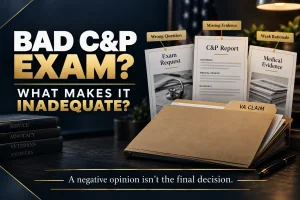


Receiving a denial or unfavorable opinion after a Compensation and Pension (C&P) examination can be discouraging. Many veterans assume that a negative outcome means their claim is over, but that is not always the case. A bad C&P exam is only one piece of the evidence used by the Department of Veterans Affairs when deciding a claim.
What happens after the examination can be just as important as the exam itself. Veterans who understand the reasons behind an unfavorable opinion and respond strategically are often in a much stronger position moving forward.

Table of Contents
Don’t Assume a Bad C&P Exam Means the Claim Is Over
One of the biggest mistakes veterans make after a bad C&P exam is believing that there is nothing else they can do. While some negative opinions are medically accurate and supported by the available evidence, others may contain incomplete information, misunderstand medical records, or overlook important factors.
Instead of panicking, it is important to recognize that a negative exam does not automatically end the claims process. Claims are built on evidence, and additional information or clarification may strengthen the case.
Review the Rating Decision and Examination Carefully
Many veterans focus on the denial itself without carefully reading the rating decision letter or the examination report.
These documents often reveal critical details, including:
- Favorable findings already recognized by the VA
- The examiner’s medical rationale
- Whether a diagnosis was acknowledged
- Whether chronicity or continuity was questioned
- Whether service connection was disputed
- Whether non-service-related risk factors were identified
Understanding these details helps determine the actual weakness in the claim. Without identifying the problem, it is difficult to know what evidence or action may be needed.
Common Errors Found in a Bad C&P Exam
Sometimes the information recorded during the examination does not match what the veteran reported.
Examples include:
- Symptoms being understated
- Incorrect timelines
- Missing complaints or treatment history
- Failure to review important records
- Misunderstanding frequency or severity of symptoms
For example, a veteran with migraines may report experiencing ten headaches per month, while the examiner records only one. Such inconsistencies can significantly affect the outcome.
Reviewing the report carefully allows veterans to identify these discrepancies.
Understand Why the Claim Was Denied
Not every unfavorable opinion stems from the same issue.
The examiner may have concluded:
- There is no current diagnosis.
- There is insufficient evidence of chronic symptoms.
- No medical connection exists between the condition and service.
- Other risk factors are more likely responsible.
- Service records do not document treatment or complaints.
These are entirely different problems, and each requires a different approach.
Understanding the actual deficiency is far more valuable than immediately seeking additional opinions or reacting emotionally.
Why Every Bad C&P Exam Doesn’t Need the Same Solution
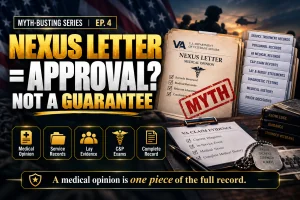
After receiving a bad C&P exam, many veterans immediately look for a nexus letter. While nexus letters can be valuable, they are not always the answer.
Consider a veteran claiming migraines secondary to tinnitus. If the examiner denied the claim because there was no documented migraine diagnosis, obtaining another causation opinion may not help.
Instead, the priority might be:
- Establishing a diagnosis
- Receiving treatment
- Building medical records
- Documenting symptoms over time
On the other hand, if the diagnosis already exists and the examiner failed to address aggravation, a targeted medical opinion discussing aggravation might be useful.
Different problems require different solutions.
Focus on the Rationale, Not Just the Conclusion
Veterans often become fixated on whether the examiner checked a positive or negative box. However, the rationale behind the opinion is usually far more important.
A strong medical opinion should explain:
- Why the condition is or is not service connected
- How the records support the conclusion
- Whether medical literature supports the opinion
- Whether alternative risk factors were considered
- Whether the timeline makes medical sense
A simple conclusion without a detailed explanation is generally less persuasive.
The reasoning behind the opinion matters much more than the checkbox itself.
Avoid Emotional Responses
A negative exam can understandably create frustration. However, emotional arguments rarely strengthen a claim.
Statements such as:
- “The examiner hates veterans.”
- “The exam only lasted five minutes.”
- “The process is unfair.”
may reflect genuine feelings, but they do not address the medical evidence.
A stronger response focuses on specific deficiencies, such as:
- Documented complaints being overlooked
- Incorrect timelines
- Failure to discuss aggravation
- Inaccurate factual assumptions
- Missing medical literature
- Incorrect symptom reporting
Targeted arguments supported by evidence typically carry more weight than emotional reactions.
Not Every Problem Is Medical
Another important misconception is believing that every unfavorable decision requires more medical evidence.
Sometimes the issue is legal rather than medical.
Examples include:
- Failure to properly weigh favorable evidence
- Duty-to-assist errors
- Presumptive service connection issues
- Effective date problems
- Misapplication of regulations
In these situations, guidance from an accredited attorney, claims agent, or Veterans Service Officer (VSO) may be beneficial.
Legal issues often require a different strategy than medical issues.
Avoid Rushing to Get a Nexus Letter
Another major mistake after a bad C&P exam is immediately purchasing medical opinions or Disability Benefits Questionnaires (DBQs) without identifying the true evidentiary gap.
Not every case requires:
- A nexus letter
- A DBQ
- An addendum opinion
- Additional testing
Sometimes the best next step is:
- Receiving treatment
- Gathering missing records
- Correcting inconsistencies
- Obtaining legal guidance
- Clarifying timelines
Evidence should address the specific weakness in the claim rather than being collected randomly.
Doctors Cannot Simply Connect Anything
Many veterans mistakenly believe that any physician can write a letter and automatically establish service connection.
Medical opinions must be evidence-based and objective.
A credible opinion should be supported by:
- Medical records
- Diagnostic findings
- Scientific literature
- Consistent timelines
- Clinical reasoning
Sometimes the evidence supports direct causation.
Other times, it supports aggravation rather than causation.
And sometimes, the medical evidence simply does not support a relationship at all.
Medical credibility matters tremendously. Unsupported opinions are unlikely to carry significant weight.
Work With Qualified Professionals
Veterans do not have to navigate the process alone.
Helpful resources include:
Veterans Service Officers (VSOs)
VSOs can help review claims, explain decisions, and guide veterans through available options.
Accredited Claims Agents
Claims agents are trained to assist with evidence and appeals.
Accredited Attorneys
Attorneys can help when legal issues, procedural errors, or appeal strategies become complicated.
Professional guidance can help veterans understand the difference between medical deficiencies and legal problems.
Beware of Panic and Misinformation
Fear and misinformation often spread quickly online. Some websites and videos encourage veterans to believe that every negative exam means disaster.
In reality, claims are built on:
- Organized records
- Credible evidence
- Thoughtful medical analysis
- Proper legal guidance
- Accurate documentation
Not fear.
Not panic.
And certainly not one unfavorable examination.
Final Thoughts
A bad C&P exam can be frustrating, but it should not automatically lead to despair. Some negative opinions are accurate, while others may contain deficiencies that can be addressed.
The key is understanding the actual issue before deciding what to do next. Veterans who carefully review their records, identify evidentiary gaps, and seek appropriate professional guidance are often better positioned to move forward successfully.
Strong claims are rarely built on emotion or fear. They are built on credible evidence, organized documentation, sound medical reasoning, and effective strategy.
A bad C&P exam is just one piece of the puzzle. It is not necessarily the end of the road.
Also Read: Why Veterans Feel Sick Even When Tests Are Normal
At Prestige Veteran Medical Consulting, a veteran-owned company, we specialize in Independent Medical Opinions (IMOs) known as Nexus letters.
Our purpose is to empower YOU, the veteran, to take charge of your medical evidence and provide you with valuable educational tools and research to guide you on your journey.
Understanding the unique challenges veterans face, our commitment lies in delivering exceptional service and support.
Leveraging an extensive network of licensed independent medical professionals, all well-versed in the medical professional aspects of the VA claims process, we review the necessary medical evidence to incorporate in our reports related to your VA Disability Claim.
Prestige Veteran Medical Consulting is not a law firm, accredited claims agent, or affiliated with the Veterans Administration or Veterans Services Organizations. However, we are happy to discuss your case with your accredited VA legal professional.