
For many veterans, a service-connected disability does not stay isolated. Over time, one condition can trigger new physical or mental health complications that affect daily life in ways that were never anticipated. Under VA rules, these are known as secondary conditions. Fortunately, the VA may recognize them when there is enough medical evidence showing that an existing service-connected disability either caused or aggravated another condition.
Understanding how secondary conditions develop helps veterans better connect the full impact of their military service and pursue the VA benefits and support they may be entitled to.
Table of Contents
What Is a Secondary Service-Connected Condition?
A secondary service-connected condition is a disability that develops because of an existing service-connected condition. In simpler terms, one service-related health issue leads to another. The VA recognizes that service-related injuries and illnesses can create a chain reaction throughout the body over time.
To understand this clearly, it helps to separate primary and secondary conditions.
- A primary service-connected condition is the original illness or injury tied to military service, such as a knee injury, tinnitus, sleep apnea, migraines, or PTSD.
- A secondary condition develops afterward because of that original disability. For example, a knee injury may affect posture and spinal alignment, or PTSD may contribute to sleep disturbances, hypertension, or anxiety.
This process is often described as a “medical domino effect”, where one condition gradually affects other parts of the body or mind over time, often leading to additional physical or mental health complications.
How Secondary Service Connection Works
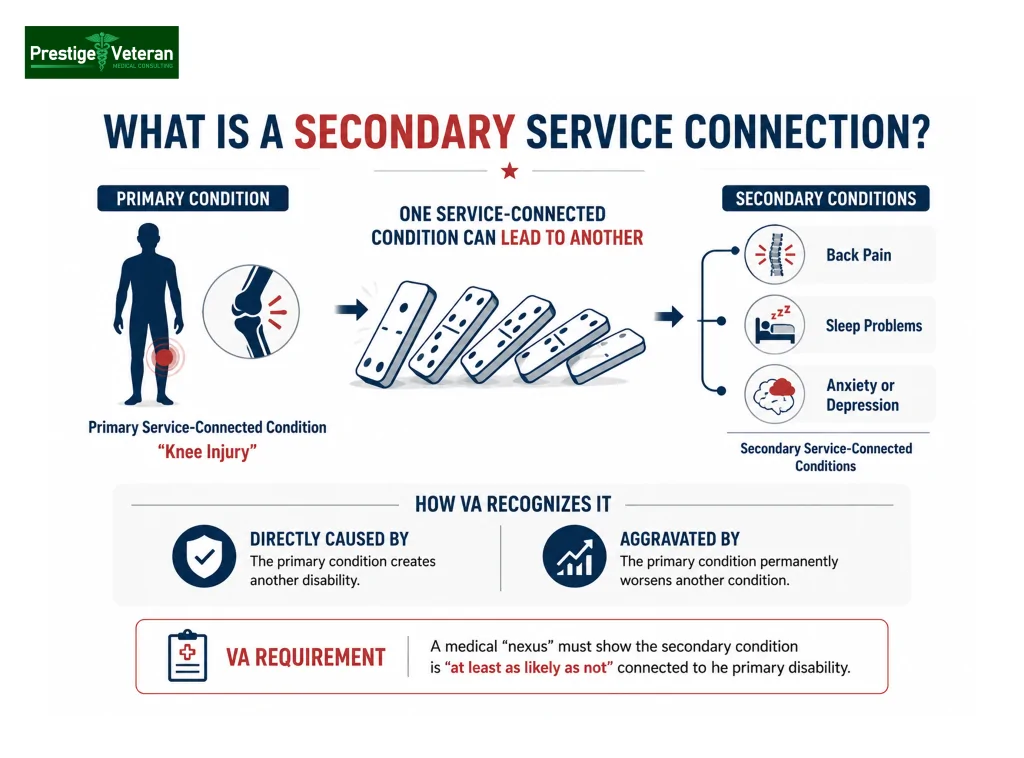
The VA evaluates secondary service connection claims under 38 C.F.R. § 3.310, which qualifies a condition as secondary if it is either directly caused by or permanently aggravated by a service-connected disability.
The VA generally recognizes two types of secondary connections:
- Proximately due to: the original condition directly causes another disability.
- Aggravated by: the service-connected condition permanently worsens an existing non-service-connected condition beyond its natural progression.
To establish a secondary connection, the VA requires a medical “nexus,” clearly showing the newer condition is at least as likely as not linked to the primary service-connected disability.
If approved, a secondary condition may receive a separate VA disability rating, which could boost the veteran’s combined disability rating and monthly compensation.
Common Examples of Secondary VA Disability Claims
Secondary VA disability claims often follow recognizable medical patterns. Below are some of the most commonly discussed secondary-service connections veterans file claims for.
Physical → Physical Conditions
- Back pain from knee injuries: A service-connected knee injury can alter the way a veteran walks, placing long-term strain on the lower back and potentially contributing to chronic back pain.
- Migraines from neck injuries: Neck and cervical spine injuries may contribute to recurring migraines due to muscle tension, nerve irritation, and restricted movement in the upper spine.
- Radiculopathy from spinal conditions: Spinal conditions can compress nearby nerves, leading to radiculopathy symptoms such as numbness, tingling, weakness, or radiating pain in the arms or legs.
Mental → Physical Conditions
- Sleep apnea secondary to PTSD: PTSD-related sleep disruption, chronic stress responses, and associated health changes may contribute to sleep apnea in some veterans.
- Hypertension linked to anxiety/PTSD: Long-term anxiety and PTSD symptoms may affect the cardiovascular system and are often discussed in connection with hypertension.
- Weight gain caused by antidepressants: Certain medications used to manage depression or PTSD may contribute to weight gain and reduced physical activity over time.
Chronic Illness Chains
- Diabetes → neuropathy: Diabetes may gradually damage nerves throughout the body, potentially leading to neuropathy symptoms such as burning pain, numbness, or weakness.
- Hypertension → heart disease: Chronic hypertension can place ongoing strain on the heart and blood vessels, increasing the likelihood of cardiovascular complications over time.
Note: The VA does not automatically approve a secondary service connection based on commonly linked conditions. The outcome of each claim typically depends on the medical evidence linking the condition to a service-connected disability.
How the VA Decides if a Secondary Condition Qualifies
When evaluating secondary claims, the VA is looking for a medically believable chain of causation that clearly explains how one condition led to or worsened another.
To approve a secondary claim, a veteran must demonstrate evidence for three critical elements.
1. A Current Diagnosed Condition
The veteran must have a formally diagnosed medical condition documented by a qualified healthcare provider.
2. An Existing Service-Connected Disability
Evidence of a disability that the VA has already recognized as service-connected. including prior VA rating decisions or disability compensation records. Even a condition rated at 0% can qualify if it has contributed.
3. A Medical Nexus Linking the Two
This is the missing bridge that links the two conditions. A nexus letter should medically explain how and why the secondary condition was caused or aggravated by the primary service-connected disability.
Example: If a veteran develops radiculopathy secondary to a service-connected lumbar spine condition, medical records and nexus opinions may explain how nerve compression from the spine issue led to symptoms in the legs.
The VA may also review treatment history, symptom progression, C&P exam results, and physician opinions when evaluating the secondary relationship. In aggravation-based claims, the VA often compares the condition’s earlier severity against its current level to determine whether measurable worsening occurred.
Because many secondary conditions develop gradually over months or years, detailed medical documentation often becomes helpful in explaining the progression.
Additional Evidence That Can Strengthen a Secondary VA Claim
The VA may evaluate secondary claims using multiple forms of evidence to determine whether the connection between conditions is medically credible and consistent over time.
Medical Records Showing Symptom Progression
Medical records help establish the timeline of when and how the condition developed. These records may also show what treatments were attempted and whether providers noted a relationship between the two conditions.
Helpful medical evidence for secondary service connection includes:
- Military, VA, and private treatment records
- Specialist evaluations
- Imaging reports, lab results, and surgical records
- Symptom timelines showing progression or worsening
- Medication history and documented side effects
- Physical therapy, sleep studies, and rehabilitation notes
For example, treatment notes documenting years of altered walking due to a knee injury before the onset of chronic back pain can help support causation. Consistent records often make the progression easier for VA reviewers to follow.
Compensation & Pension (C&P) Exam Findings
The VA may schedule a Compensation & Pension (C&P) exam to evaluate the severity of the condition and review whether the secondary condition was caused or worsened by the existing disability.
During the exam, the examiner may assess symptoms, functional limitations, treatment history, and whether the evidence supports secondary service connection.
When preparing, it is helpful to:
- Bring medical documentation of your service-connected primary condition.
- Review your medical history beforehand so you can clearly explain the timeline of symptoms.
- Provide a current list of medications, treatments, therapy records, or specialist visits that show ongoing severity and continuity of care.
- Be honest and specific when describing impact on daily life, work, sleep, mobility, or relationships.
- In case of flare-ups, it is encouraged to explain the “worst days” and not just normal days.
- Avoid exaggerating or minimizing symptoms.
If the C&P examiner provides an inadequate or negative nexus opinion, you can challenge it by obtaining an independent medical opinion or appealing the decision with supporting documentation.
Lay Evidence Describing Real-Life Functional Impact
Lay statements from spouses, family members, coworkers, or fellow veterans can describe observable changes in daily functioning that medical records often miss.
Example: A spouse may say, “I have watched him struggle with hip pain over the years from constantly shifting his weight because of his knee injury. Now it affects the way he walks, stands, and handles everyday activities.”
These lay, or buddy statements, can be supportive evidence in VA secondary claims as they help provide context about how symptoms affect real-world functioning.
Private Disability Benefits Questionnaire (DBQ)
Disability Benefits Questionnaires (DBQs) can strengthen secondary VA claims because they present medical findings in the same format VA raters use to evaluate disabilities. When completed by a private doctor, a DBQ helps connect medical evidence directly to VA rating criteria and, when paired with a strong nexus opinion, may provide VA with persuasive evidence in support of service connection.
Veterans can access all official DBQ forms directly through the VA website. You can ask your treating doctor or an independent medical examiner familiar with VA disability claims to complete the DBQ form.
Working with a VA-accredited representative or disability attorney can help ensure all evidence is properly submitted as per your claim strategy.
What Makes a Strong Nexus Letter for a Secondary Claim?
A nexus letter can be an important part of a secondary VA disability claim because it explains the medical relationship between the primary service-connected condition and the secondary condition. The goal is not just to say both conditions exist, but to explain how one may have caused or aggravated the other.
A strong nexus letter for a secondary connection usually includes:
- Provider credentials: The letter should come from a licensed healthcare professional with relevant experience, such as a physician, psychologist, orthopedic specialist, or neurologist.
- Clear medical rationale: The provider should explain the medical reasoning behind the physiological connection, backed by relevant medical studies, clinical guidelines, or peer-reviewed research.
- Review of veteran records: The provider should mention that they reviewed medical records, test results, symptom history, and prior evaluations to support the opinion.
- VA-standard language: The provider should conclude the secondary relationship using the phrase “at least as likely as not” as it meets the VA’s standard for evaluating medical connection.
- Cause or aggravation: The letter should clarify whether the service-connected condition caused the secondary condition or made it worse.
- Alternative risk factors: A nexus opinion may address why other possible causes or risk factors, such as age, lifestyle, or non-service-related injuries, are less likely to have caused the condition.
A detailed nexus letter offers the VA a clearer, more medically grounded explanation to review. Some veterans choose to work with experienced independent medical providers to obtain a thorough and well-supported nexus opinion.
How to File a Secondary VA Claim
Step 1: Confirm the Primary Condition Is Service-Connected
Verify that the primary disability already has a VA service-connected rating through your VA decision letter or VA.gov.
Step 2: Obtain a Diagnosis and Gather Nexus Evidence
- Get a current diagnosis of your condition from a licensed healthcare provider.
- Provide a nexus letter explaining how the secondary condition is linked to an existing disability.
- Include supporting documentation such as treatment records, imaging/lab results, prescriptions, doctor’s notes, therapy records, and personal or lay statements.
Step 3: Submit VA Form 21-526EZ
Veterans can file a secondary claim using VA Form 21-526EZ in the following ways:
- Online through VA.gov
- By mail
- In person at a VA regional office
- With assistance from an accredited representative or Veterans Service Organization (VSO)
When listing the condition, it should clearly state that it is “secondary to” the primary disability. For example, “lumbar strain secondary to service-connected right knee injury”.
Step 4: Attend the C&P Exam
The VA may schedule a Compensation and Pension (C&P) exam to evaluate the severity of the condition and its connection to the primary disability. Attending this exam is important, as the examiner’s findings may help the VA assess the claim.
Step 5: Monitor the Claim and Review the Decision
After reviewing the evidence, the VA issues a rating decision. Veterans can track claim status through the VA Claim Status Tool. If the VA requests additional information, responding promptly may help prevent delays.
File an Intent to File (Optional)
Veterans who need more time to gather medical records or nexus evidence may submit an Intent to File before the application process. This can preserve their potential effective date for up to one year while evidence is gathered.
If your VA secondary claim is denied, consider decision review or appeal options. You may choose to submit supplemental evidence, request a higher-level review, or appeal to the Board of Veterans’ Appeals, depending on the case.
Mistakes That Can Get a Secondary VA Claim Denied
Many veterans lose valid secondary service connection claims simply because critical evidence, timelines, or explanations were missing, and not because the connection itself was weak.
Here are the common mistakes to avoid that often lead to secondary VA claim denials.
Mistake 1: Failing to Provide the Medical Nexus
A weak or missing medical nexus can make it difficult to prove how a secondary condition is connected to a service-connected disability. For example, treatment records may confirm migraines, but without a neurologist’s opinion linking them to a service-connected TBI, the connection may not have enough support.
Mistake 2: Submitting Thin or Incomplete Medical Evidence
One common mistake that can lead to a denied secondary VA claim is missing or incomplete medical evidence. For example, if a veteran submits sleep study results without medical records showing how weight gain caused by limited mobility from an orthopedic condition contributed to the condition, it can weaken the overall claim.
Mistake 3: Overlooking Other Secondary Conditions
Many veterans only file for the most obvious condition and miss related complications that may also qualify for compensation. For instance, a veteran with PTSD may not realize that gastrointestinal issues such as IBS can be connected to chronic stress and anxiety.
Mistake 4: Assuming the VA Will Connect the Dots Automatically
The VA does not automatically link conditions, even when the relationship seems obvious. The burden is on the veteran to show a clearly explained theory of service connection, supported by evidence.
Mistake 5: Waiting Too Long to File a Secondary Claim
Filing a secondary claim years after the original disability can create evidence gaps and make it harder to prove when symptoms started or how they progressed. Tracking symptoms early helps strengthen the timeline and preserve medical records.
Mistake 6: Not Establishing a Clear Symptom Timeline
Without a documented symptom timeline, the VA may argue the condition developed independently. Veterans should explain symptom onset, progression, and how the primary condition worsened another condition over the years, backed by medical evidence.
Mistake 7: Minimizing Symptoms During the C&P Exam
Veterans who downplay symptoms or fail to explain functional impairment may receive an incomplete evaluation and a lower VA disability rating than expected.
Can You File Years After Your Original Disability?
Yes. A secondary condition can still qualify for VA compensation years or even decades after the original service-connected disability, if medical evidence supports the connection.
Many secondary conditions develop gradually over time. Chronic pain, altered gait, medication side effects, PTSD-related complications, and degenerative conditions may not appear immediately after service. The key issue is not when the condition appeared, but whether medical evidence can show it was caused or aggravated by the original service-connected disability.
Case Study: Service Connection for Erectile Dysfunction Secondary to PTSD
In Citation Nr: 23006025 (Decision Date: January 31, 2023), the Board of Veterans’ Appeals granted service connection for erectile dysfunction secondary to service-connected PTSD.
Background
The Veteran served on multiple active-duty periods between 1992 and 2012. He sought service connection for erectile dysfunction, claiming it was caused or aggravated by his service-connected PTSD medications, including Sertraline and Trazodone.
Medical Evidence
- VA examiners linked the condition mainly to hypogonadism and obesity.
- A private physician stated that PTSD medications, including Sertraline and Trazodone, could contribute to sexual dysfunction and aggravate erectile dysfunction.
Legal Analysis
The Board reviewed conflicting medical opinions and determined that the evidence was in “relative equipoise.” Applying the “benefit-of-the-doubt” rule under 38 U.S.C. § 5107, the Board favored the Veteran.
Outcome
The Board granted service connection for erectile dysfunction as secondary to the Veteran’s PTSD and related medication treatment.
Conclusion
Sometimes, veterans adapt to worsening symptoms for years without realizing that those secondary service-connected conditions may also qualify for VA compensation. The key is to track symptoms early, receive consistent medical care, and most importantly, obtain a well-supported nexus explaining how one condition caused or aggravated another. Seeking guidance from a qualified medical professional or VA-accredited representative can help strengthen the claim and ensure the long-term impact of your military service is fairly recognized.
Frequently Asked Questions (FAQs)
How are VA secondary conditions calculated?
The VA assigns a separate disability rating for each approved secondary condition and combines it with existing ratings using the VA’s combined ratings formula rather than simple addition.
Is it easy to get secondary VA claims approved?
It is possible to get secondary VA claims approved if there is strong medical evidence and a clear nexus linking the secondary condition to an already service-connected disability.
What are the top conditions secondary to lower back pain?
Radiculopathy, depression, insomnia, hip strain, and knee conditions are common secondary conditions caused by chronic lower back pain.
How to claim VA secondary conditions?
To claim a secondary VA condition, veterans must file VA Form 21-526EZ with evidence of a current diagnosis, an existing service-connected disability, and a medical nexus connecting the two conditions.
Do secondary conditions increase VA rating?
Yes, approved secondary conditions can increase your VA disability rating because each secondary condition receives its own separate rating, which is combined with your existing ratings and may increase your monthly compensation.
What VA disabilities can PTSD be secondary to?
Depression, anxiety disorders, sleep apnea, insomnia, migraines, hypertension, and gastrointestinal issues can develop secondary to PTSD.
Also Read: Nexus Letter for Secondary Condition: The Ultimate Guide (Sample Letter)
At Prestige Veteran Medical Consulting, a veteran-owned company, we specialize in Independent Medical Opinions (IMOs) known as Nexus letters.
Our purpose is to empower YOU, the veteran, to take charge of your medical evidence and provide you with valuable educational tools and research to guide you on your journey.
Understanding the unique challenges veterans face, our commitment lies in delivering exceptional service and support.
Leveraging an extensive network of licensed independent medical professionals, all well-versed in the medical professional aspects of the VA claims process, we review the necessary medical evidence to incorporate in our reports related to your VA Disability Claim.
Prestige Veteran Medical Consulting is not a law firm, accredited claims agent, or affiliated with the Veterans Administration or Veterans Services Organizations. However, we are happy to discuss your case with your accredited VA legal professional.