

Yes, it is possible to win a VA claim without a medical nexus letter if the evidence already demonstrates the connection between your current disability and military service. When evaluating a claim, the VA generally looks for three core elements: a current disability, evidence of an in-service event, injury, illness, or exposure, and a medical nexus (link) between the two. Depending on the type of claim, that link may come from service or medical records, lay evidence, a favorable C&P examination, or an independent medical opinion.
Understanding when the existing evidence may be enough to support service connection and when additional medical evidence may be needed can help veterans make more informed decisions about VA disability claims.
Table of Contents
Is a Nexus Letter Required for Every VA Claim?
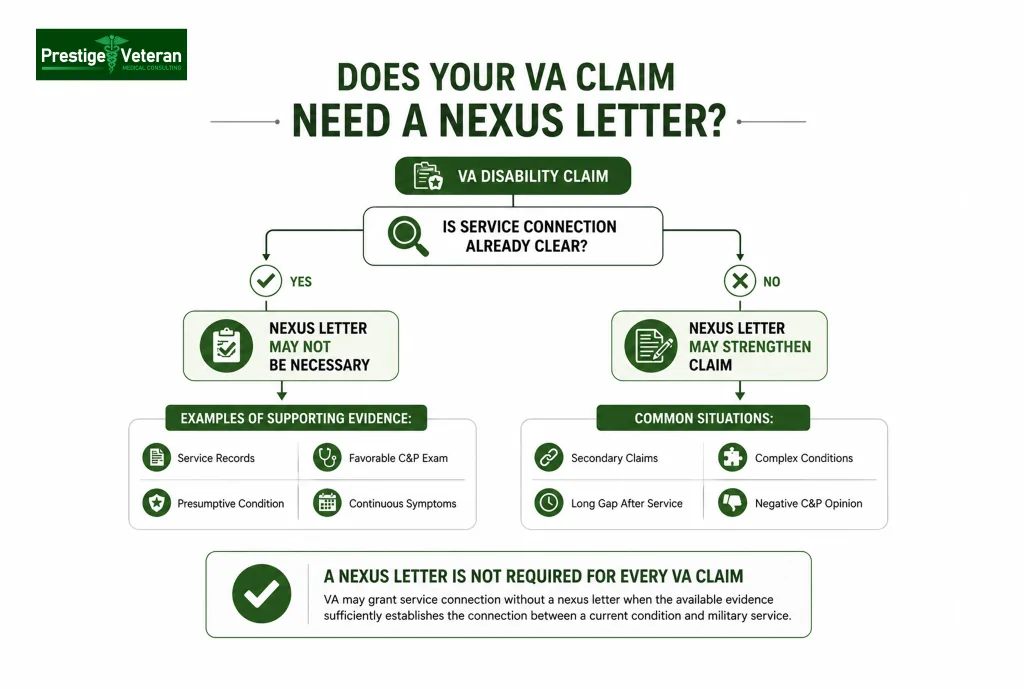
A nexus letter is not legally required for every VA disability claim. However, it can help when the medical connection between a current diagnosis and military service is unclear or disputed. To understand why, it helps to know what it actually does.
In VA claims, a nexus letter is a medical opinion written by a qualified healthcare provider that explains how a current condition is “at least as likely as not” related to military service or a service-connected disability. It is a type of Independent Medical Opinion (IMO), although an IMO can address a broader range of medical questions.
A well-supported letter typically:
- Reviews relevant records
- Explains the provider’s reasoning
- Helps establish the “nexus” when that link is not already obvious from the available evidence
However, a private nexus letter is only one possible source of supporting evidence. According to VA guidance, a link must be shown for direct and secondary claims and medical records or medical opinions can be used to support it. In certain circumstances, the VA may also accept lay evidence.
The type of VA claim also matters. For example, a secondary service-connection claim may require evidence linking a new condition to an already service-connected disability, while increased-rating claims depend on whether an existing condition has worsened.
The key question is not “Do I Need a Nexus Letter?” but:
Does My Evidence Sufficiently Establish Service Connection?
And usually the answer depends on the specific facts of the claim.
When Can You Win a VA Claim Without a Nexus Letter?
In VA disability claims, a nexus letter is only one way to establish the connection between a current disability and military service. When other evidence already makes that relationship clear, the VA may grant service connection without an additional independent medical opinion.
1. Your Service Treatment Records Clearly Show the Condition Started in Service
If the veteran’s service records show the injury, diagnosis, symptoms, or treatment during active duty, the VA may not need a separate nexus letter. The medical documentation itself makes it evident that the condition began during military service and continued afterward. In these cases, the VA often focuses more on confirming the current diagnosis than on obtaining another medical opinion.
2. You Have a Presumptive Condition
Some conditions may be presumed service-connected if the veteran meets certain service or exposure criteria. For these claims, you generally do not have to prove the medical link in the same way you would for a standard claim.
Conditions that qualify under VA presumptive service connection rules:
- Agent Orange-related conditions
- Gulf War illness-related conditions
- Camp Lejeune water contamination conditions
- Certain chronic diseases that appear within the required timeframes
- Other PACT Act toxic exposure conditions
If the veteran has a qualifying diagnosis and meets the eligibility requirements, the presumption itself may satisfy the nexus requirement.
3. A VA C&P Examiner Provides a Favorable Medical Opinion
Many veterans overlook the fact that a Compensation and Pension (C&P) examiner can effectively provide the nexus opinion needed for a claim. During the examination process, the examiner may review records, evaluate symptoms, and offer an opinion regarding service connection.
If the examiner concludes that the condition is “at least as likely as not” related to military service, that favorable opinion may be sufficient evidence. This can happen more often in straightforward orthopedic claims, tinnitus, and clearly documented injuries.
4. The Claim Is Supported by Continuous Medical Records
Consistent treatment history can be powerful evidence in supporting a VA disability claim. When medical records show ongoing symptoms, recurring treatment, and a clear timeline from service through the present, the continuity itself may help establish service connection.
For example, a veteran who sought care for migraines soon after discharge and maintained regular treatment may be able to rely on those records as evidence of service connection, even without a medical nexus letter. The absence of long gaps in treatment can strengthen the claim’s credibility and reduce questions about causation.
Under 38 C.F.R. § 3.303(b), continuity is relevant to chronic diseases listed in § 3.309(a), especially when chronicity was not clearly established during service.
5. Strong Existing VA Medical Evidence
VA physicians frequently document observations, symptom histories, and possible relationships between current conditions and military service. If VA doctors already documented the relationship between service and condition in treatment notes, that evidence may carry meaningful evidentiary weight.
While not every treatment note functions as a formal nexus opinion, strong medical documentation already present in the file can reduce the need for a separate nexus letter.
6. Lay Evidence Is Strong and Credible
VA rules allow veterans to submit lay evidence, including personal statements and buddy statements, to support a claim. While lay evidence generally cannot replace medical expertise in complex cases, it can help establish symptom history, continuity, and observable events.
Supportive lay evidence may include:
- A spouse describing noticeable symptoms that appeared after deployment and persisted over the years.
- A fellow service member confirming an injury that occurred during training or deployment.
- A personal statement explaining when symptoms first began and how they gradually worsened after service.
When lay statements are detailed, consistent, and supported by medical records, they can significantly strengthen a claim even when no independent nexus letter is submitted.
When You May Benefit From a Nexus Letter
Although some claims can succeed without one, there are situations where a nexus letter becomes far more important. These are usually cases where it is required to explain medical causation, fill evidentiary gaps, and address questions the VA may raise during review.
1. You Are Filing a Secondary Service Connection Claim
VA secondary claims often require medical evidence showing how a service-connected condition caused or aggravated another condition. For example, a veteran with service-connected PTSD who later develops sleep apnea may need a qualified clinician to explain any causal or aggravating relationship based on the individual medical record. A nexus letter can clarify the connection and explain the medical pathway to strengthen the claim.
2. Your Condition Was Diagnosed Years After Military Service
If symptoms first appear 10, 15, or even 20 years after military service ends, the VA may question whether service actually caused the condition. This is where a nexus opinion plays a critical role.
In BVA Decision 1645575, a veteran developed peripheral neuropathy more than 25 years after service. A VA physician and the veteran’s longtime treating physician cited medical studies linking long-term jet fuel exposure to nerve damage and provided opinions explaining how the military exposures could have contributed to the condition. The Board ultimately granted service connection based on this evidence.
Without a medical nexus, lengthy gaps in treatment or diagnosis often become a major obstacle.
Note: Board decisions are fact-specific and nonprecedential, so they may be informative but do not control the outcome of other claims.
3. Your Service Records Are Missing, Incomplete, or Weak
Sometimes, a veteran’s service treatment records are incomplete, lost, or simply do not document every injury or symptom experienced during service.
In VA claims where direct documentation is limited, a nexus letter can help bridge the evidentiary gap. A physician may review available records, lay statements, deployment history, and post-service treatment records before offering a reasoned opinion about service connection.
4. Your Claim Was Previously Denied Because the VA Found No Nexus
A prior denial frequently provides a clue about what evidence is missing. If the VA denied service connection because there was “no nexus” or “no link” between the disability and military service, a detailed nexus letter may directly address the reason for denial.
This is especially common during VA supplemental claims and appeals, where the dispute centers on conflicting medical evidence. A well-supported opinion can explain flaws in prior conclusions, address overlooked records, and provide a stronger rationale for service connection.
5. Your Claim Involves a Complex Medical Condition
For some VA disability claims, service connection is harder to establish without expert medical analysis and supporting rationale. These cases often involve multiple risk factors, delayed symptom onset, or medical questions that extend beyond what lay evidence can establish.
Common examples include:
- Sleep apnea
- Mental health conditions
- Autoimmune disorders
- Neurological conditions
- Toxic exposure claims
- Musculoskeletal conditions with long treatment gaps
A nexus letter allows a specialist to explain why military service is at least as likely as not responsible for the condition, despite other possible contributing factors.
6. You Received a Negative or Incomplete C&P Exam Opinion
If the C&P opinion is negative, weak, or incomplete, submitting a private nexus letter may become more important. When the VA examiner gives an unfavorable opinion concluding that a condition is less likely than not related to service, veterans often seek a competing medical opinion to rebut it.
An independent medical opinion can review the same records, identify overlooked facts, discuss relevant medical literature, and provide a more detailed explanation supporting service connection.
Because every claim is evaluated on its own facts, seeking guidance from a VA-accredited representative, attorney, or claims agent can help you know if additional medical evidence is necessary.
The VA’s “Benefit of the Doubt” Rule
Veterans do not have to prove a disability claim beyond a reasonable doubt. Under 38 U.S.C. § 5107(b), the VA must resolve a material issue in the veteran’s favor when the positive and negative evidence is in approximate balance. This is often called the “benefit of the doubt” rule.
The rule can matter when the record contains competing medical opinions. For example, a VA examiner may issue a negative nexus opinion while a treating physician provides a well-supported explanation connecting the condition to service. If the VA finds the evidence on the nexus question roughly equal in weight, the close call should go to the veteran.
What Counts as Reasonable Doubt
The rule should not be misunderstood. Under 38 C.F.R. § 3.102, reasonable doubt must fall within the range of probability, not speculation or a remote possibility. In Bufkin v. Collins, the Supreme Court explained that the VA first weighs each item of evidence and then determines whether the record, viewed as a whole, is approximately balanced.
This means the benefit-of-the-doubt rule does not compensate for a claim that lacks a current diagnosis, credible evidence of an in-service event, or a medically supported nexus to service. It helps when the evidence is close and not when a required element is missing.
Alternative Evidence That Can Support a VA Claim
A nexus letter is not required in every VA disability claim. The existing record may already connect a current condition to service, particularly when the evidence is consistent and condition-specific.
These are the most commonly accepted forms of evidence that can help fill the gap when a medical nexus letter is missing.
Service Treatment and Personnel Records
Service treatment records can document the first complaint, injury, diagnosis, or treatment during active duty. Personnel records may add context, such as combat duties, deployment locations, a performance change after an event, or circumstances related to an exposure or injury.
VA and Private Medical Records
Treatment notes, diagnostic tests, imaging reports, and specialist records can confirm a current condition and show its progression over time. Records created soon after discharge may be especially helpful when they reflect ongoing symptoms.
Lay Statements and Buddy Statements
A veteran, spouse, family member, or fellow service member can describe observable facts: when pain started, how migraines affected work, or what happened during an undocumented injury. VA Form 21-10210 is commonly used for these statements. The VA may consider this type of lay evidence when evaluating a disability claim.
C&P Examination Opinions
A favorable Compensation and Pension examination can provide the missing medical link needed for service connection. The opinion is stronger when the examiner reviews the veteran’s file, clearly explains the reasoning, and concludes that a disability is “at least as likely as not” related to service.
Supporting Medical Research
Peer-reviewed studies, clinical guidelines, and credible medical literature can support a plausible mechanism for a claimed relationship, particularly in complex or secondary claims.
For example, research showing that repeated impact from physically demanding military training can contribute to joint degeneration may support a claim involving chronic knee, hip, or back problems. Any research is more persuasive when it closely matches the veteran’s specific medical history.
Continuity of Symptom Documentation
Consistent records of symptoms after discharge, such as treatment notes, prescriptions, personal logs, and lay statements, may help show a continuous pattern.
While these forms of evidence can strengthen a claim, they do not always replace a well-supported medical opinion tailored to the veteran’s facts.
Common Challenges Veterans Face When Filing Without a Nexus Letter
Veterans who file VA disability claims without an independent medical nexus letter should ensure that the evidence already in their file clearly addresses the connection between their current condition and military service.
Here are several common evidentiary gaps that can make a claim more difficult to establish.
Challenge 1: Having a Diagnosis Without Evidence of Service Connection
A current diagnosis confirms that a medical condition exists, but it does not automatically establish that the condition is related to military service. Successful claims often include evidence of an in-service event, injury, illness, or exposure, along with documentation showing how symptoms developed or continued over time.
In some cases, veterans submit medical records that confirm a diagnosis but do not clearly explain the relationship between the condition and their service.
Challenge 2: Using Lay Evidence to Address Complex Medical Questions
Lay statements can be valuable for documenting symptoms, describing when they began, and explaining how a condition affects daily life. However, some claims involve medically complex questions that may require a professional medical opinion.
For example, determining whether a toxic exposure contributed to a cancer diagnosis or whether one medical condition caused another often requires analysis from a qualified healthcare professional.
Challenge 3: Submitting the Same Evidence After a Nexus-Related Denial
When a prior VA decision found that a medical nexus was not established, simply resubmitting the same records may not address the reason for the denial.
For Supplemental Claims, veterans generally need to provide new and relevant evidence—evidence that was not previously considered and that helps prove or disprove an issue that remains in dispute.
Challenge 4: Filing a Secondary Claim Without Addressing the Medical Relationship
Secondary service connection may be available when a service-connected condition causes or aggravates another disability.
Many veterans successfully demonstrate that both conditions exist but may not provide evidence explaining the medical relationship between them. Without addressing causation or aggravation, the VA may determine that the evidence is insufficient to establish secondary service connection.
Challenge 5: Depending Solely on the C&P Examination
A Compensation & Pension (C&P) examination may provide the medical opinion needed to support a claim, and many veterans receive favorable opinions through this process.
However, when the medical evidence is incomplete, or the relationship between conditions is disputed, relying solely on a single examination may leave important questions unanswered. Ensuring the record contains clear and well-supported medical evidence can help strengthen the overall claim.
Can a VA Claim Be Denied Even With a Nexus Letter?
Yes. A nexus letter can be powerful evidence, but it is not a guaranteed path to service connection. A claim may still be denied if the nexus opinion lacks a clear medical rationale, relies on inaccurate facts, or conflicts with stronger evidence in the file.
Courts have repeatedly emphasized that the value of a medical opinion comes from its reasoning, not simply its conclusion. In Nieves-Rodriguez v. Peake, the Court explained that a persuasive opinion should connect the medical facts to the conclusion through a well-supported analysis. As a result, generic template-style nexus letters or opinions that offer little explanation may carry limited weight.
Claims can also be denied when the veteran lacks a current diagnosis, the condition is not adequately linked to service, or the VA finds a competing medical opinion more persuasive.
What Veterans Should Look for in an Independent Medical Opinion
Not all independent medical opinions carry the same weight with the VA. Let’s understand key factors commonly found in a well-supported nexus opinion.
Review of Relevant Records
One of the first things veterans should look for in a nexus letter is whether it discusses their relevant medical and service history. While a physician does not need to review an entire claims file in every case, the opinion should still demonstrate familiarity with the facts that matter to the claim.
Clear Medical Rationale
The nexus opinion should also include a clear medical rationale that explains why the provider believes the condition is related to service. It should show how the veteran’s records, clinical findings, and relevant medical literature support the conclusion. Opinions that simply state a condition is “service connected” without explaining why may carry limited weight.
Use of VA-Compatible Language
The best nexus letters often apply the VA standard whenever possible. Phrases such as “at least as likely as not” generally align more closely with VA’s evidentiary framework than vague statements like “possibly related” or “may be connected.”
Addressing Contradictory Evidence
Check if the nexus letter provider has addressed evidence that could challenge the claim, such as negative C&P findings, gaps in treatment, or alternative causes discussed elsewhere in the record. Opinions that engage with those issues are often more persuasive because they show the provider considered the full medical picture.
Qualifications of the Provider
Finally, the nexus letter should be written by a qualified healthcare professional whose training and experience relate to the condition being evaluated. For example, a pulmonologist may be better positioned to discuss a complex respiratory condition, while an orthopedic specialist may be more qualified to evaluate joint or spine disorders.
When considering an independent medical opinion, look for providers who prioritize evidence-based medical analysis and individualized rationale rather than generic template-style opinions.
Conclusion
VA claims are rarely decided based on a single document, even if that document is a nexus letter. Instead, they are evaluated through the combined weight of medical records, service history, expert opinions, and other supporting evidence. In some cases, that existing record may already be enough. In others, additional medical support can help fill important gaps and strengthen the claim.
Veterans should carefully review the evidence already in their file before deciding whether an independent medical opinion is necessary. It is helpful to consult a Veterans Service Organization (VSO), attorney, or healthcare professional to ensure the disability claim is supported as effectively as possible.
Frequently Asked Questions (FAQs)
Can I Win a VA Claim Without a Nexus Letter?
Yes, a VA claim can be approved without a nexus letter when the existing evidence sufficiently establishes a link between the disability and military service. For example, veterans with a favorable C&P opinion or a qualifying presumptive claim may not require a separate nexus opinion.
Do I Have to Pay for a Medical Nexus Letter?
Not always. Some veterans obtain nexus opinions from their treating physicians at little or no additional cost. Others choose to hire an independent medical expert who charges a fee for reviewing records and preparing a detailed opinion.
Do I Need a Nexus Letter for a Secondary Condition?
A nexus letter for a secondary condition can be valuable when the connection between the service-connected disability and the new condition is not clearly documented in the medical evidence.
How To Get a Nexus Letter for a VA Disability Claim?
To obtain a nexus letter, veterans can consult a qualified healthcare professional who reviews the relevant medical and service records and provides a written opinion explaining why the condition is at least as likely as not related to service or a service-connected disability.
How Can I Find Nexus Letter Doctors?
To find a nexus letter doctor near you, search for licensed healthcare providers who offer nexus letters or independent medical opinions (IMOs) and verify that their expertise matches your claimed condition.
Also Read: Requesting a Nexus Letter from Your Doctor: What Veterans Should Know
At Prestige Veteran Medical Consulting, a veteran-owned company, we specialize in Independent Medical Opinions (IMOs) known as Nexus letters.
Our purpose is to empower YOU, the veteran, to take charge of your medical evidence and provide you with valuable educational tools and research to guide you on your journey.
Understanding the unique challenges veterans face, our commitment lies in delivering exceptional service and support.
Leveraging an extensive network of licensed independent medical professionals, all well-versed in the medical professional aspects of the VA claims process, we review the necessary medical evidence to incorporate in our reports related to your VA Disability Claim.
Prestige Veteran Medical Consulting is not a law firm, accredited claims agent, or affiliated with the Veterans Administration or Veterans Services Organizations. However, we are happy to discuss your case with your accredited VA legal professional.