

Many veterans live with sleep problems for years before learning that their symptoms of loud snoring, daytime fatigue, or disrupted rest may be linked to sleep apnea. When filing a VA disability claim, the challenge is often not the diagnosis itself but proving how the condition connects to military service or an existing service-connected disability. That is where a well-supported medical nexus letter can matter.
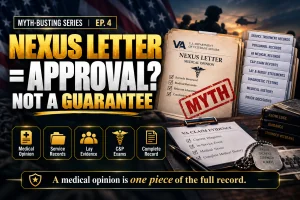
A nexus opinion does not “guarantee” approval, but it may help explain the medical reasoning behind the claim in a way the VA can review.
This guide breaks down the key elements often included in a sleep apnea nexus letter and common mistakes that may weaken a claim.
Table of Contents
Why Is a Nexus Letter Often Critical for a VA Sleep Apnea Claim?
A nexus letter for sleep apnea is a medical opinion written by a qualified healthcare provider explaining that a veteran’s condition is “at least as likely as not” caused or aggravated by military service or another service-connected condition. The word “nexus” refers to the medical link and represents one of the three elements used to establish service connection for VA disability benefits.
Direct Service Connection
VA disability claims for sleep apnea often benefit from a nexus letter because the condition is frequently diagnosed years after active duty, which can create an evidence gap. A veteran may have snored loudly in service, felt exhausted during the day, or had morning headaches but never underwent a sleep study while serving. In direct service connection claims, a nexus letter helps link those in-service symptoms to the current diagnosis.
Secondary Service Connection
Under 38 CFR § 3.310, sleep apnea may also be claimed as secondary to another service-connected condition when medical evidence supports causation or aggravation. Examples may include PTSD, chronic rhinitis, sinusitis, asthma, or weight gain that developed after a service-connected physical or mental health condition. In these cases, the nexus opinion helps explain the medical relationship between the conditions.
Also, many sleep apnea claims are not obvious from records alone. A veteran may have a confirmed diagnosis and a legitimate medical theory, but if no provider clearly connects the dots, the claim can be difficult for the VA to evaluate or assign a fair disability rating.
Hence, even though not formally required for every claim, a nexus letter may give the VA a clear, evidence-based medical opinion when evaluating the connection.
What is Included in a Nexus Letter for Sleep Apnea?
Now, let’s explore the key components included in a VA nexus letter for sleep apnea.
1. A Confirmed Sleep Apnea Diagnosis
The first thing a sleep apnea nexus letter commonly includes is a clear medical diagnosis. The VA’s Sleep Apnea Disability Benefits Questionnaire specifically notes that the diagnosis of the type of sleep apnea syndrome, such as obstructive, central, or mixed, must be confirmed by a sleep study (polysomnography).
In addition to sleep study results, the nexus letter provider may reference supporting clinical evidence such as date of diagnosis, Apnea-Hypopnea Index (AHI) score, severity level, treatment notes, and documented symptoms.
If the veteran uses a CPAP, BiPAP, oral appliance, or other breathing-assistance device, this should also be documented, as use of such treatment may support consideration of a 50% disability rating under Diagnostic Code 6847.
A letter that vaguely says, “The veteran has sleep issues,” may have limited evidentiary value.
A stronger version may say, “The veteran was diagnosed with moderate obstructive sleep apnea following a sleep study dated March 12, 2024, showing an AHI of 22.4 events per hour. CPAP therapy was subsequently recommended.”
That level of detail helps the nexus opinion remain grounded in medical evidence rather than assumption.
2. Review of Military, VA, and Civilian Medical Records
A nexus letter for sleep apnea may be considered more credible when the provider documents what records were reviewed. Because the VA generally gives more value to opinions based on a complete and accurate understanding of the Veteran’s medical and service history, instead of unsupported statements.
Important records a provider may review before drafting a nexus opinion:
- Military Service Records: Service treatment records, DD214/deployment history, exposure records (burn pits/toxic exposure if applicable), in-service complaints, and buddy statements
- VA Records: VA medical records, VA rating decisions for primary service-connected conditions, prior C&P exam reports, DBQs, and VA denial letters
- Civilian Records: Sleep studies, CPAP/BiPAP prescriptions, specialist notes, medication lists, BMI history, and lay statements from a spouse or family members
Nexus letter providers may include a “Records Reviewed” section or use phrases such as “My opinion is based upon review of the Veteran’s…” before listing the evidence considered.
Reference to the records review can be helpful when there are gaps in treatment. Many veterans do not receive a sleep study until years after discharge. That does not automatically mean the claim is weak, but the nexus letter should address the timeline of symptoms and diagnosis carefully.
If symptoms existed earlier, buddy statements and spouse statements may help show snoring, choking, gasping, daytime fatigue, or sleep disruption before the formal diagnosis.
3. Identification of the Service Event or Primary Condition Linked to Sleep Apnea
Many sleep apnea claims are filed as secondary service connections, where the nexus letter often clearly identifies the primary condition and explains the medical link with each step, with relevant records and symptom timeline. In a direct claim, the letter usually identifies the relevant in-service event, symptoms, exposure, injury, or medical history contributing to the apnea.
Common primary service-connected conditions in secondary sleep apnea claims may include:
- PTSD or depression affecting sleep, activity level, appetite, or weight
- Chronic back, knee, hip, or foot pain limiting exercise and contributing to weight gain
- Rhinitis or sinusitis causing chronic nasal obstruction
- Asthma or other respiratory conditions affecting breathing patterns
- Medications that may contribute to sedation, weight gain, or reduced activity
Example: Secondary Service Connection Linking GERD to Sleep Apnea
A veteran is already service-connected with GERD (gastroesophageal reflux disease) and has a long history of nighttime reflux symptoms, disrupted sleep, and repeated complaints of waking up coughing or choking. Over time, medical records show worsening sleep quality and increasing upper airway irritation. Several years later, a sleep study confirms obstructive sleep apnea (OSA).
In this case, the nexus letter should not make an overly broad assertion such as “GERD causes sleep apnea.” Instead, it should clearly articulate the medically supported service-connection pathway and explain the relationship through the specific causal or aggravating chain supported by the Veteran’s records:
service-connected GERD → chronic nocturnal reflux and sleep disruption → worsening sleep-related breathing issues → OSA diagnosis
The key is not to force a theory. The letter should match the veteran’s actual medical history.
4. Medical Rationale Explaining the Service Connection
Arguably, the most important part of a nexus letter for sleep apnea is the medical rationale. VA reviewers often look for a logical explanation of how and why the service connection exists, and not just a conclusion.
The nexus letter should explain the biological, behavioral, or clinical pathway connecting OSA to military service or another service-connected condition. The provider may support this explanation by discussing a veteran’s clinical history, service records, symptom timeline, or lay evidence.
For example, if the claim is sleep apnea secondary to PTSD with obesity as an intermediate step, the rationale could walk through the chain:
- The veteran is service-connected for PTSD.
- PTSD symptoms and/or treatment contributed to sleep disturbance, reduced motivation, increased appetite, or decreased physical activity.
- Medical records showed that the veteran gained significant weight after PTSD symptoms worsened or after certain medications began.
- The resulting obesity increased upper airway collapsibility and became a substantial factor in developing or worsening obstructive sleep apnea.
When supported by clinical evidence and relevant medical literature, this type of rationale can be more persuasive to VA reviewers because it connects the dots with facts.
5. Medical Literature Supporting the Sleep Apnea Nexus Opinion
A nexus opinion should be supported by credible medical research where appropriate. These references help demonstrate that the provider’s conclusion is based on accepted medical knowledge rather than speculation.
Helpful sources providers may cite include:
- Peer-reviewed studies
- Clinical practice guidelines
- Sleep medicine research
- VA-relevant medical literature
- Research examining associations between PTSD and OSA
- Research on obesity as an intermediate factor in OSA development
- Studies addressing depression, weight gain, and sleep disturbance
Example: Using Medical Literature to Support an OSA Nexus Opinion
A veteran reported symptoms such as loud snoring, fragmented sleep, and persistent daytime fatigue during active duty. Still, obstructive sleep apnea (OSA) was not formally diagnosed until years later through polysomnography.
In this situation, a nexus letter may strengthen the claim by linking in-service symptoms and the later diagnosis through supporting medical literature.
One relevant reference is Mysliwiec et al., “Sleep Disorders in US Military Personnel: A High Rate of Comorbid Insomnia and Obstructive Sleep Apnea” (CHEST Journal, 2013), which identified a high prevalence of sleep disorders, including OSA, among military personnel with post-deployment sleep disturbances.
Discussion in BVA Decisions
Supporting literature is especially useful when the claim involves secondary service connection or aggravation. For example, in BVA Citation No. 0918715, the Board discussed an examiner’s statement regarding medical literature and whether evidence supported a nexus between PTSD and sleep apnea.
Medical literature can be most helpful when used to support the veteran’s facts, not replace them.
6. VA Standard Nexus Opinion Language: “At Least as Likely as Not”
A strong sleep apnea nexus letter should include a clear, well-supported medical opinion explicitly stating that it is “at least as likely as not” that the Veteran’s sleep apnea is related to military service or was caused or aggravated by an already service-connected condition.
The phrase carries significant weight as it reflects a 50 percent or greater probability standard often used in VA medical opinions, rather than a casual possibility.
A nexus statement supporting a direct connection might read:
“After reviewing the veteran’s medical history, service records, and sleep study findings, it is my medical opinion that the veteran’s obstructive sleep apnea is at least as likely as not related to symptoms that began during military service.”
For a secondary or aggravation claim, the nexus opinion may look like:
“It is my medical opinion that the veteran’s obstructive sleep apnea is at least as likely as not proximately due to or aggravated by the veteran’s service-connected chronic rhinitis.”
7. Qualified Provider’s Credentials and Signature Information
A nexus letter should include the provider’s full professional details. Credentials help the VA understand the provider’s qualifications to give the opinion.
The letter should include provider credentials such as:
- Provider’s full name and address
- Professional title
- Medical specialty, if relevant
- License details
- NPI number, if applicable
- Contact information
- Signature and date
A sleep medicine specialist, pulmonologist, ENT physician, psychiatrist, psychologist, or primary care doctor may all be relevant, depending on the theory of connection. Many veterans obtain nexus letters from an independent medical opinion (IMO) provider to receive an unbiased medical evaluation.
Essentially, the opinion should come from a doctor qualified to discuss the medical issue and the claimed relationship.
A professional signature at the end matters because the nexus letter is medical evidence. It should reflect an individualized medical opinion, not a template filled with generic language.
Common Mistakes That Can Weaken Sleep Apnea Nexus Letters
Even when a veteran has a potentially valid sleep apnea claim, a weak nexus letter can reduce its evidentiary value if the medical reasoning and supporting evidence are not clearly explained.
Below are common mistakes nexus letter providers should avoid.
1. Using Generic Nexus Letter Templates
One common mistake is using a generic template that does not match the veteran’s records. VA reviewers evaluate many claims, and a copy-paste letter with no case-specific detail may carry less weight. The nexus letter should be specific to the veteran’s diagnosis, service history, records, and claimed theory of service connection.
2. Not Documenting Record Review
Another mistake is failing to document the record review. If the letter does not mention that the provider reviewed the veteran’s service records, sleep studies, CPAP documentation, or medical history, their opinion may appear uninformed.
3. Failing to Reference Objective Diagnostic Evidence
A nexus letter that does not reference objective diagnostic evidence, such as confirmed sleep study (polysomnography or approved home sleep test) results, may be considered incomplete. Documented findings may help support the medical rationale and show that the opinion is based on objective evidence in addition to reported symptoms.
4. Speculative Nexus Opinion Language
Vague terms such as “possibly,” “may be,” or “could be” often weaken a nexus opinion. When medically supported, providers should use probability language such as “at least as likely as not” to align with VA standards.
At the same time, they don’t need to say the connection is medically certain. In fact, overly absolute language can sound less credible if the records do not fully support it.
5. Making Unsupported Secondary Claims
For example, saying sleep apnea is secondary to PTSD without explaining the mechanism may not be enough. The letter should explain the specific pathway, such as medication effects, weight gain, sleep disruption, aggravation, or another medically supported connection.
6. Failing to Explain Causation vs. Aggravation
Some letters incorrectly treat causation and aggravation as the same issue. If a service-connected condition worsened apneic episodes rather than caused them, the provider should clearly explain aggravation and its medical basis.
7. Mishandling Obesity As an Intermediate Step
Obesity itself is generally not treated as a standalone disability for VA compensation, but VA General Counsel recognizes that it may act as an intermediate step linking a service-connected condition to a secondary disability, including sleep apnea, when supported by the medical evidence and history.
A common mistake is failing to demonstrate this relationship. A well-supported nexus letter may explain how the service-connected disability caused reduced mobility, chronic pain, or medication-related weight gain, and how the resulting obesity substantially contributed to OSA.
8. Ignoring Alternative Risk Factors
Nexus letters that overlook obesity, smoking history, age, alcohol use, neck circumference, or other non-service risk factors for OSA may appear incomplete. A well-written opinion acknowledges these factors and explains why the service-connected condition remains a medically significant cause or aggravating factor despite their presence.
What If the Sleep Apnea Claim Is Still Denied?
Even after addressing the common mistakes above, if your sleep apnea claim is denied, there is still hope. In many cases, the issue is not the diagnosis itself but how the VA evaluated the evidence, competing medical opinions, or whether additional evidence is needed to clarify the service connection.
Veterans should carefully review the VA decision letter to understand the exact reason for denial before taking the next step.
Depending on the case, review options under the Appeals Modernization Act (AMA) may include:
- Filing a Supplemental Claim with new and relevant evidence
- Requesting a Higher-Level Review if an error is believed to exist, or
- Appealing to the Board of Veterans’ Appeals (BVA) for further review.
Veterans may also consider guidance from VA-accredited attorneys, VSOs, or claims agents for information about available review options and the appeals process.
Conclusion
A VA disability claim for sleep apnea becomes more persuasive when supported by a nexus letter that is specific, evidence-based, and written in clear medical language appropriate for VA review. The goal is not to make promises or use absolute legal language but to help the VA understand the medical connection between the veteran’s sleep apnea and military service, or another service-connected condition.
For veterans, the best starting point is to gather relevant records and work with a qualified medical provider experienced in nexus evaluations and VA claims. The right provider can help ensure the opinion is medically supported, properly reasoned, and aligned with VA standards, which may strengthen the claim and support access to eligible veteran benefits.
Frequently Asked Questions (FAQs)
Can veterans obtain a nexus letter for sleep apnea?
Yes, veterans can get a sleep apnea nexus letter from qualified healthcare providers such as sleep specialists, pulmonologists, ENTs, primary care physicians, or independent medical opinion (IMO) providers experienced in VA disability evaluations.
Does receiving a VA-issued CPAP automatically mean a 50% rating?
Generally, under the current VA Diagnostic Code 6847, requiring a CPAP or similar breathing-assistance device may support a 50% rating, but service connection and medical evidence still need to be established first.
What should be included in a sleep apnea nexus letter?
A strong nexus letter should include:
- Current diagnosis
- Reviewed records
- Service or secondary connection theory
- Medical rationale
- The VA language “at least as likely as not,”
- Supporting evidence or literature
- The provider’s credentials and signature
Do all sleep apnea VA claims require a nexus letter?
No. Not every claim requires a nexus letter. If the service connection is already clearly documented in the records, a separate nexus letter may not add much value. However, sleep apnea is often diagnosed after service, so a nexus letter can be useful when the connection is not obvious from the existing evidence.
Can a denied claim for sleep apnea be reopened with a nexus letter?
Yes, if the sleep apnea claim was denied due to lack of service connection evidence, a strong medical nexus letter can often support reopening it through a VA Supplemental Claim by serving as “new and relevant” evidence.
How can you establish a VA sleep apnea disability claim?
Veterans usually establish VA disability for sleep apnea by showing a confirmed diagnosis through a sleep study, evidence of service connection (direct or secondary), medical nexus, and supporting records or lay statements.
Also Read: Central vs. Obstructive Sleep Apnea (and Complex): Does VA Rate Them Differently?
At Prestige Veteran Medical Consulting, a veteran-owned company, we specialize in Independent Medical Opinions (IMOs) known as Nexus letters.
Our purpose is to empower YOU, the veteran, to take charge of your medical evidence and provide you with valuable educational tools and research to guide you on your journey.
Understanding the unique challenges veterans face, our commitment lies in delivering exceptional service and support.
Leveraging an extensive network of licensed independent medical professionals, all well-versed in the medical professional aspects of the VA claims process, we review the necessary medical evidence to incorporate in our reports related to your VA Disability Claim.
Prestige Veteran Medical Consulting is not a law firm, accredited claims agent, or affiliated with the Veterans Administration or Veterans Services Organizations. However, we are happy to discuss your case with your accredited VA legal professional.