
Why are VA sleep apnea claims sometimes denied even when a veteran has a confirmed diagnosis and uses a CPAP machine?
This is one of the most common points of confusion surrounding sleep apnea and VA disability benefits.
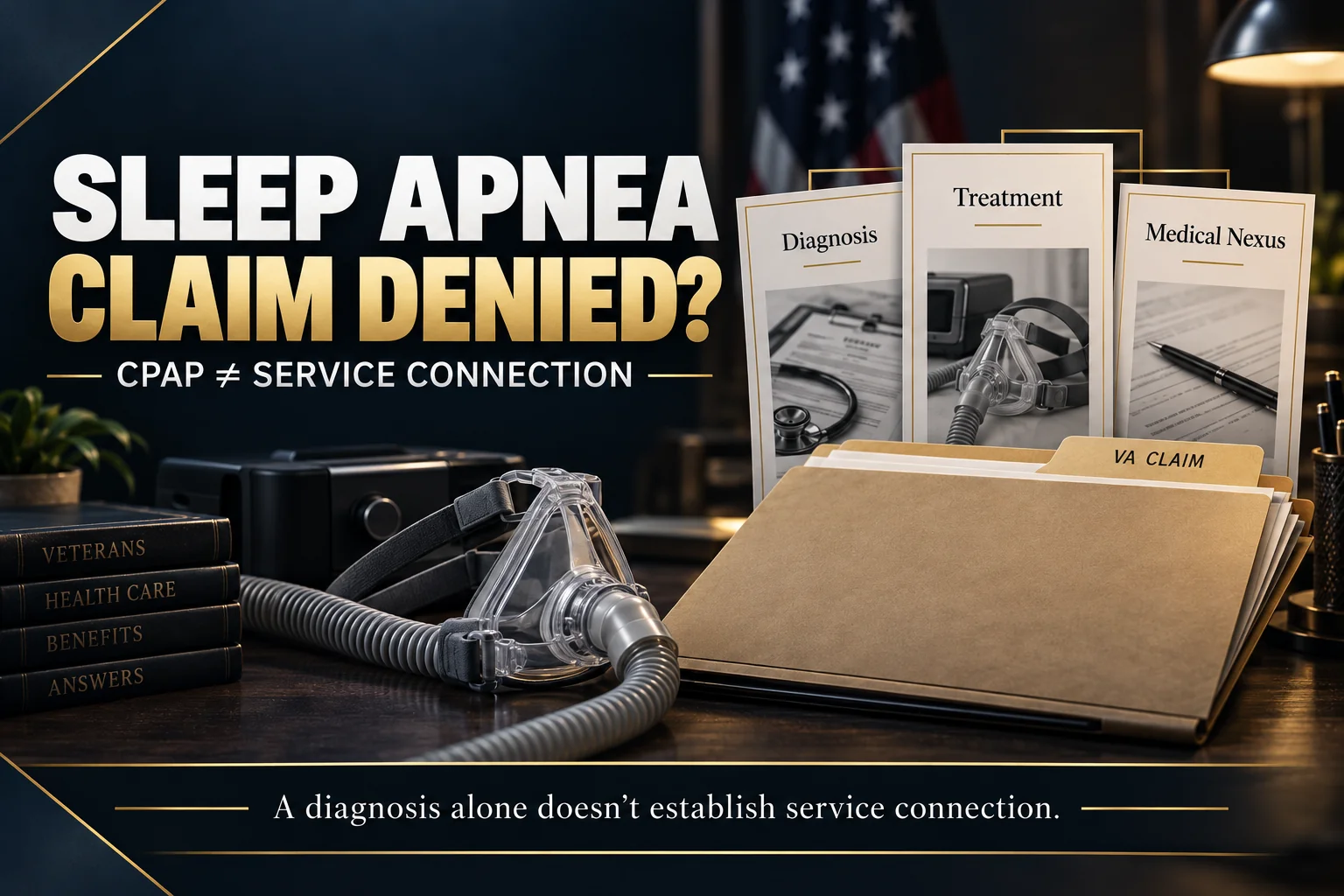
A veteran may have undergone a sleep study, received a diagnosis, and started treatment. From a medical standpoint, the condition is documented. But that does not automatically establish that the condition is related to military service.
In this episode of the Ask the Attorney series, Leah Bucholz, founder and CEO of Prestige Veteran Medical Consulting, speaks with Rebecca Deming, a VA-accredited attorney and founder of ProVet Legal, about why sleep apnea claims may be denied and what makes the medical evidence in each case different.
Their conversation addresses secondary sleep apnea claims, PTSD, obesity, CPAP treatment, delayed diagnoses, lay statements, and the medical nexus that may be necessary to explain a relationship to military service.
The central takeaway is simple:
A sleep apnea diagnosis answers one medical question. Whether the evidence supports service connection is a separate question.

Table of Contents
Why Are VA Sleep Apnea Claims Denied?
Rebecca begins the interview by identifying a recurring issue: veterans may understand that they have sleep apnea without fully understanding what medical evidence is needed to establish a relationship to service.
For a typical direct service-connection claim, VA generally considers three broad elements:
- A current disability
- An in-service event, injury, or disease
- A relationship, often called a medical nexus, between the current disability and service
Secondary service connection involves a different question: whether a current condition is related to an already service-connected disability.
VA explains these distinctions in its official evidence requirements for disability claims.
This is why two veterans with the same diagnosis may have very different evidentiary records.
One veteran may have documented symptoms and a diagnosis during service.
Another may have been diagnosed many years later.
A third may have a service-connected condition that could be medically relevant to the development or aggravation of sleep apnea.
The same diagnosis does not necessarily establish the same medical history, mechanism, or relationship to service.
Does Having a CPAP Machine Establish VA Service Connection?
One of the biggest misconceptions Rebecca discusses is the belief that being prescribed a CPAP machine should automatically result in VA disability compensation.
A CPAP machine is a treatment device. It is commonly prescribed for obstructive sleep apnea and may be an important part of the medical record.
However, having a CPAP prescription does not, by itself, explain why sleep apnea developed or whether it is related to military service.
There are two different questions:
Medical diagnosis and treatment: Does the individual have sleep apnea, and what treatment is medically appropriate?
Service connection: Does the available evidence support a relationship between the diagnosed condition and military service or another service-connected disability?
The first question does not automatically answer the second.
A sleep study, clinical evaluation, and treatment history may provide evidence about the existence and severity of the condition.
A medical nexus opinion, when needed, addresses a different issue: whether the proposed relationship is medically supportable.
This distinction also explains why a CPAP prescription should not be confused with an automatic disability rating. Rating criteria become relevant after the necessary service-connection questions have been addressed.
Why Secondary Sleep Apnea Claims Are More Complicated
Rebecca discusses another common assumption: if one veteran establishes sleep apnea as secondary to PTSD, rhinitis, or another condition, every veteran with that same service-connected disability should receive the same outcome.
That is not how individualized medical evidence works.
For example, the fact that a veteran has both PTSD and obstructive sleep apnea does not automatically demonstrate that PTSD caused or aggravated the sleep apnea.
Likewise, having rhinitis and sleep apnea does not, by itself, establish the nature of the relationship between them.
Two conditions may occur in the same person without one necessarily causing the other.
A medically supportable secondary relationship requires consideration of the individual history, relevant clinical findings, plausible mechanisms, timing, and other risk factors.
Depending on the circumstances, the medical analysis may consider whether one condition contributed to the development of another or whether an existing condition became worse.
A diagnosis shared by two veterans does not mean the medical reasoning applicable to one veteran automatically applies to the other.
This is one reason Rebecca emphasizes individualized evidence rather than relying on another person’s claim experience.
What Role Can Obesity Play in Sleep Apnea Claims?
Weight history is one of the most substantial topics in this interview.
Rebecca explains that obesity can be medically important in obstructive sleep apnea because excess weight is a recognized risk factor.
However, she also emphasizes that obesity is not the only possible factor.
People who are not obese can develop obstructive sleep apnea, and not every person with obesity has sleep apnea.
From a medical perspective, the relationship may require examination of multiple factors, including weight changes, symptom onset, anatomical or other risk factors, and the individual’s broader clinical history.
In some cases, Rebecca discusses how a service-connected orthopedic or mental health condition might affect activity levels, eating patterns, or weight.
The medical questions may include:
Did the relevant condition affect activity or weight history?
When did weight changes occur?
When were sleep apnea symptoms first reported?
Were symptoms present before significant weight gain?
Are there other medically plausible explanations?
Does the complete history support a causal or aggravating relationship?
These questions matter because the sequence of events can change the medical interpretation.
Obesity as a possible intermediate factor
Rebecca also discusses obesity as a potential intermediate step in some secondary service-connection theories.
For example, the proposed relationship may involve a service-connected condition, changes in weight, and subsequent obstructive sleep apnea.
But the existence of those three facts does not automatically establish that the conditions are medically or legally connected.
Each proposed relationship requires appropriate analysis.
A medical professional evaluates whether the clinical evidence supports the proposed mechanisms. The applicable legal framework and whether a particular theory is supported under VA law are matters for VA adjudicators and accredited representatives.
Why the Timing of Weight Gain and Sleep Apnea Symptoms Matters
Rebecca gives a particularly useful example in the interview.
Suppose a veteran developed symptoms of sleep apnea before becoming obese.
In that situation, it would be difficult to explain the original onset of sleep apnea as being caused by weight gain that occurred later.
However, a later weight increase might still be relevant when evaluating changes in the condition’s severity or progression.
That distinction shows why the medical timeline matters.
An opinion should not assume that obesity caused sleep apnea simply because both conditions are present today.
Instead, the reviewer may need to examine earlier medical records, documented weight changes, symptom reports, testing, and other risk factors.
The question is not simply whether obesity and sleep apnea coexist.
It is whether the sequence and medical evidence support the proposed relationship.
Can Sleep Apnea Be Related to Service if It Was Diagnosed Years Later?
Rebecca explains that many veterans do not receive a sleep apnea diagnosis while serving.
Some may not recognize their symptoms as signs of a medical condition.
Snoring may be dismissed as an ordinary sleep habit.
Persistent tiredness may be attributed to demanding work schedules, training, or insufficient sleep.
Witnessed breathing interruptions may never be reported to a medical professional.
As a result, the first formal diagnosis may occur years after separation.
A delayed diagnosis can make the medical history more difficult to reconstruct, but it does not automatically establish that the condition is unrelated to service.
The important distinction is between when symptoms may have begun and when a formal diagnosis was made.
Those dates are not always the same.
However, an earlier history of snoring or fatigue does not automatically prove that obstructive sleep apnea was present at the time.
Other medical explanations may be possible, and the available history must be evaluated carefully.
What Can Lay Statements and Buddy Statements Show?
Rebecca discusses the role of personal accounts and statements from people who observed the veteran’s sleep-related symptoms.
These may be particularly relevant when service treatment records do not contain a sleep apnea diagnosis.
For example, a fellow service member, spouse, roommate, or another observer may recall:
- Loud or persistent snoring
- Witnessed pauses in breathing during sleep
- Gasping or choking sounds
- Unusual sleep-related behavior
- Daytime tiredness or other observable symptoms
An accurate statement may help establish what someone observed and approximately when those observations occurred.
VA recognizes lay and witness statements as forms of evidence and evaluates them alongside the broader record.
Official resource: VA Lay or Witness Statements
Importantly, an observer’s description is not the same as a formal medical diagnosis.
A person may credibly describe snoring or witnessed breathing pauses without being qualified to determine the medical cause.
The value of the statement depends on what was actually observed and how that information fits into the complete medical history.
Why a Sleep Study and Medical Records Still Matter
Although a CPAP machine does not automatically establish service connection, objective medical documentation remains important.
A sleep study may help establish the presence and type of sleep-disordered breathing.
Clinical records may document symptoms, treatment recommendations, relevant diagnoses, and the progression of the condition.
Other records may provide important context about the veteran’s health history.
Depending on the circumstances, a medical review might consider:
- Diagnostic sleep-study findings
- Records documenting sleep-related symptoms
- CPAP or other prescribed treatment
- Relevant medical and weight history
- Service treatment and personnel records
- Post-service medical evaluations
- Statements describing observable symptoms
- Other medical conditions and risk factors
Not every item will be equally important in every case.
The goal is not to collect documents simply to increase the number of pages.
The goal is to understand what the medical record establishes and which questions remain unanswered.
What Should a Sleep Apnea Medical Nexus Opinion Explain?
The medical nexus is a major focus of Leah and Rebecca’s conversation.
A nexus opinion addresses whether the available evidence medically supports a proposed relationship between conditions or between a current disability and military service.
In a sleep apnea case, that question may be straightforward or complex.
A medical professional may need to explain whether the veteran’s reported history is consistent with the medical findings, what risk factors are relevant, and whether the proposed relationship is supported by accepted medical principles.
For secondary conditions, the analysis may need to consider causation, aggravation, or another medically relevant sequence.
A persuasive opinion should do more than state that the veteran has sleep apnea and another service-connected condition.
It should explain why the evidence does or does not support the proposed connection.
Medical literature may help explain relevant mechanisms, but general research about an association between two conditions does not automatically establish that the same relationship exists in a particular individual.
The facts of the individual case remain important.
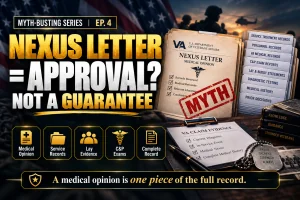
Does Every Sleep Apnea Claim Need a Private Nexus Letter?
No.
Rebecca discusses why individualized medical opinions can be especially relevant in complex secondary sleep apnea claims.
However, that does not mean every veteran must purchase a private Nexus letter.
Some records may already contain sufficient medical evidence addressing the relevant relationship.
In other cases, the medical question may remain unresolved or require a more detailed analysis.
An independent medical opinion may provide additional clinical reasoning when appropriate.
But it should never be treated as a guaranteed route to service connection.
A medical professional cannot promise a favorable VA decision.
The proper purpose of an independent medical opinion is to evaluate the evidence and explain the medical conclusion honestly, whether favorable or unfavorable.
Related reading: VA Claim Myth: Does Paying for a Nexus Letter Guarantee Approval?
Should Veterans Wait Until Their Sleep Study Is Complete Before Filing?
Near the end of the interview, Rebecca discusses delays in obtaining sleep-clinic appointments, completing testing, and receiving a formal diagnosis.
She explains that some veterans wait until every medical detail is resolved before initiating a disability claim. From her legal perspective, filing timing may have implications that should not be overlooked.
However, this is a legal and procedural question, not something a medical provider can answer for every veteran.
Filing a claim while a diagnostic evaluation is still underway does not establish that sleep apnea exists or that it is service connected.
Likewise, filing earlier does not automatically guarantee retroactive compensation or a particular effective date.
VA provides an intent-to-file process for certain benefit claims. This may preserve a potential earlier effective date when the completed claim is submitted within the applicable one-year period.
Whether to file a completed claim, submit an intent to file, or wait for additional records depends on the veteran’s individual circumstances.
Official resource: VA Intent to File Information
Rebecca also mentions possible changes to sleep apnea rating criteria. Proposed regulatory changes should not be confused with finalized rules, and veterans should not assume that filing on a particular date guarantees protection under existing criteria.
Questions about filing dates, effective dates, and regulatory applicability should be reviewed with a VA-accredited representative using current official guidance.
When Can an Accredited Attorney or VSO Help?
Rebecca explains that veterans may benefit from accredited assistance when they are unsure why a sleep apnea claim was denied or when the proposed relationship between conditions is medically and legally complex.
For example, a denial may involve questions about a current diagnosis, the history of symptoms, competing medical explanations, or whether a proposed secondary relationship was adequately evaluated.
An accredited attorney, claims agent, or Veterans Service Organization representative can explain the legal requirements, review a decision, and discuss appropriate procedural options.
A medical professional has a different role.
Medical professionals evaluate diagnoses, clinical findings, medical causation, aggravation, and the reasoning behind an opinion.
They do not determine the veteran’s legal entitlement to benefits or select the appropriate review procedure.
Maintaining that distinction helps ensure that veterans receive the appropriate type of professional assistance.
Official resource: Find a VA-Accredited Representative
Final Takeaways
A veteran can have a confirmed diagnosis of sleep apnea, receive treatment with a CPAP machine, and still have unanswered questions about VA service connection.
That does not necessarily mean the diagnosis is in doubt.
It means the relationship to military service or another service-connected condition must be evaluated separately.
The major lessons from Leah and Rebecca’s conversation are:
A CPAP machine does not automatically establish service connection.
Having PTSD, rhinitis, or another condition does not automatically mean sleep apnea is secondary to it.
Obesity may be relevant, but the timing of symptoms, weight changes, and other risk factors matters.
A diagnosis years after service is not automatically unrelated to service.
Lay statements may help explain observable symptoms without replacing a medical diagnosis.
A medical nexus opinion should provide individualized clinical reasoning, not simply a favorable conclusion.
Ultimately, every medical history is different.
The objective is to understand what the evidence supports, what questions remain, and whether the proposed medical relationship can be reasonably explained.
Also Read:
Nexus Letter for Sleep Apnea Secondary to PTSD
VA Claim Myth: No Treatment in Service Means No Claim?
VA Claim Myth: A Nexus Letter Does Not Guarantee Approval
At Prestige Veteran Medical Consulting, a veteran-owned company, we specialize in Independent Medical Opinions (IMOs) known as Nexus letters.
Our purpose is to empower YOU, the veteran, to take charge of your medical evidence and provide you with valuable educational tools and research to guide you on your journey.
Understanding the unique challenges veterans face, our commitment lies in delivering exceptional service and support.
Leveraging an extensive network of licensed independent medical professionals, all well-versed in the medical professional aspects of the VA claims process, we review the necessary medical evidence to incorporate in our reports related to your VA Disability Claim.
Prestige Veteran Medical Consulting is not a law firm, accredited claims agent, or affiliated with the Veterans Administration or Veterans Services Organizations. However, we are happy to discuss your case with your accredited VA legal professional.