
VA Claim Myth: No Treatment in Service Means No Claim?

Picture of Leah Bucholz

Leah Bucholz

Leah Bucholz, PA-C, is a Board-Certified Physician Assistant, U.S. Army combat veteran, and nationally recognized medical expert in veterans’ disability claims. A former VA Compensation & Pension examiner, she founded Prestige Veteran Medical Consulting to provide independent, regulation-based medical opinions (“nexus” letters) grounded in the VA’s Schedule for Rating Disabilities (38 CFR). Leah’s work is frequently cited in favorable Board of Veterans’ Appeals decisions, and her content draws directly from authoritative sources such as VA.gov, the eCFR, and the Federal Register.
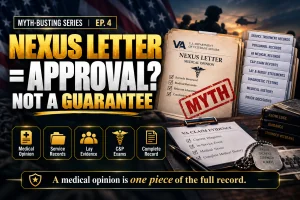
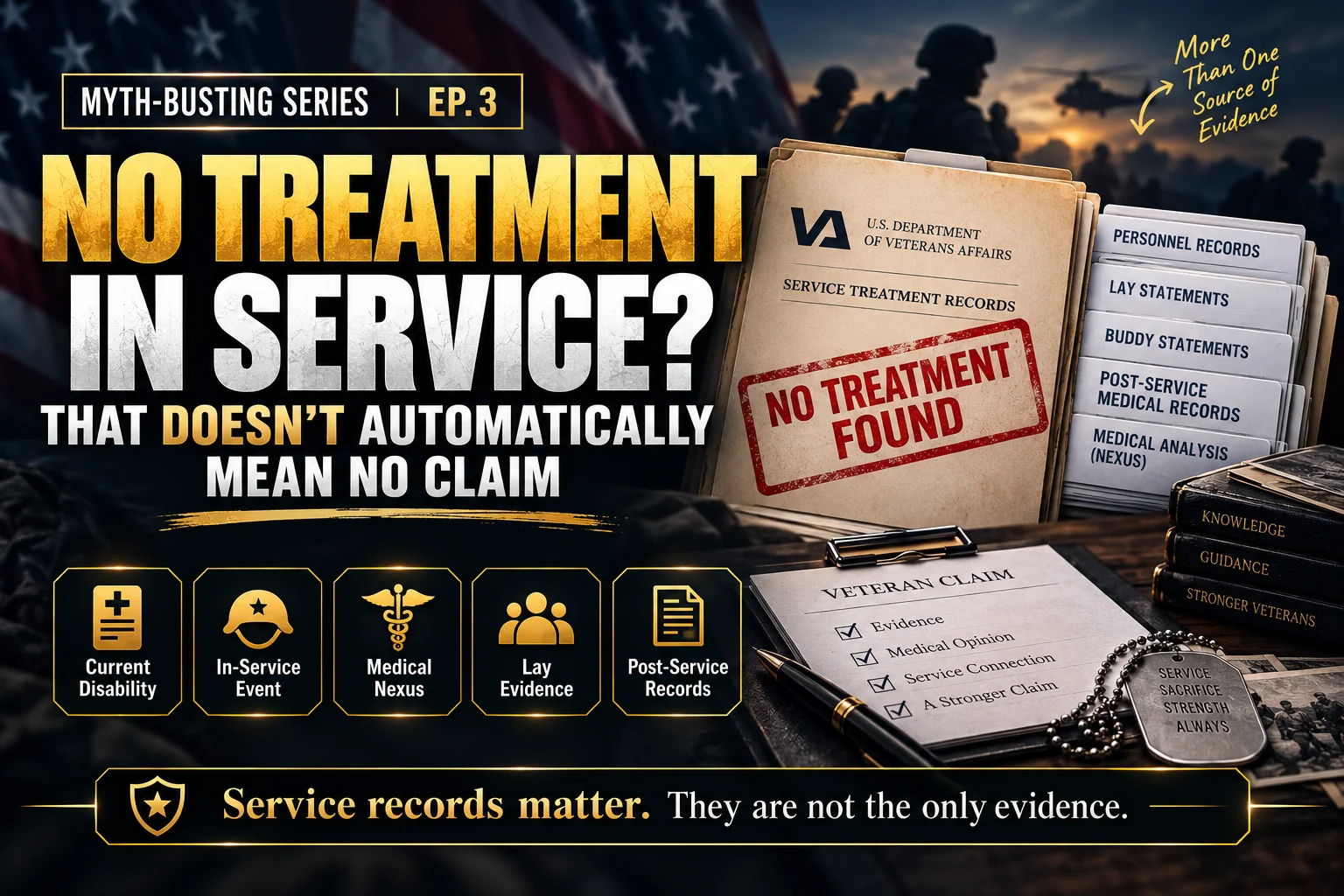
No treatment in service VA claim myth graphic showing service records, lay evidence, post-service records, and medical nexus evidence.

At Prestige Veteran Medical Consulting, our blogs are written and reviewed by licensed medical professionals or military veterans with direct experience in the VA claims process. Our team has served as healthcare providers, combat veterans, and former VA examiners — giving us unique insight into both the medical and regulatory side of benefits. Every article is designed to provide accurate, trustworthy, and practical guidance so that veterans and their families can make informed decisions with confidence.

One of the most common VA disability claim myths is this:

“If I was not treated for the condition while I was in the military, I cannot get service connected.”

Veterans may hear different versions of the same idea:

“My service treatment records are silent.”

“I never went to sick call.”

“I was not diagnosed until years after I got out.”

“I never complained about it while I was serving.”

From there, it is easy to assume that the claim is already over before it has even been fully evaluated.

But that is too simplistic.

In this episode of the Myth-Busting VA Claims series, Leah Bucholz, founder and CEO of Prestige Veteran Medical Consulting, explains why the absence of treatment during military service does not automatically answer the medical question of whether a current condition may be related to service.

At the same time, this does not mean treatment records are unimportant.

They can be extremely valuable.

The real issue is understanding the difference between:

“There is no record showing I received treatment during service.”

and

“There is no evidence of an in-service event, injury, disease, exposure, symptoms, or circumstances that could be medically relevant to my current condition.”

Those are not the same thing.

Youtube video

The myth is:

“If I did not receive treatment during service, my current condition cannot be service connected.”

That belief often comes from the assumption that every disability must appear clearly in a veteran’s service treatment records.

But many medical histories are not that simple.

A veteran may have experienced symptoms during service without going to sick call.

An injury may have occurred without creating a detailed medical record.

A disease process may have started during service but not been formally diagnosed until later.

A veteran may also have records that document the circumstances of service even if there is no contemporaneous medical treatment note.

Missing treatment documentation can certainly make the evidentiary picture more difficult.

But it does not automatically answer the entire question.

What Does VA Actually Look For?

For a typical direct service-connection claim, the basic framework generally involves three major components:

A current disability.

An in-service event, injury, or disease.

A medically supportable link, commonly called a nexus, between the two.

Notice what is not automatically required in every situation:

A sick-call visit.

A prescription during service.

An MRI or X-ray during active duty.

A formal diagnosis before separation.

A service treatment record using the exact diagnostic term that appears years later.

The broader medical question is:

What happened during service?

What condition exists now?

And does the total evidence support a medically reasonable relationship between the two?

No Treatment Record Does Not Mean No Evidence

This may be the most important point in the entire discussion:

No treatment record does not automatically mean no evidence.

Service treatment records are evidence.

But they are not necessarily the only evidence that may be relevant.

Other evidence can sometimes help reconstruct what happened during service, when symptoms began, how symptoms progressed, and whether the current condition is medically consistent with that history.

That may include:

  • Personnel records
  • Military occupational specialty information
  • Deployment records
  • Jump logs
  • Buddy statements
  • Statements from spouses or family members
  • Early post-service treatment records
  • Historical statements made to clinicians
  • Imaging and diagnostic testing
  • Medical literature
  • A competent medical analysis


The relevance of each type of evidence depends on the individual case.


Why Veterans May Not Seek Treatment During Service

Veterans may have many reasons for not seeking treatment while serving.

Someone may have been deployed.

They may have been in the field.

They may have been in the middle of a training cycle.

They may not have wanted to be removed from their duties.

They may have worried about flight status, career consequences, or how their unit would view frequent sick-call visits.

Some may simply have been young and assumed the problem would eventually resolve.

Others may have self-treated symptoms with over-the-counter medication, braces, ice, heat, rest, or activity modification.

And sometimes service members do not recognize that what they are experiencing is the beginning of a medical condition.

That context does not prove service connection.

But it may help explain why a condition was not formally documented at the time.

Symptoms Can Exist Before a Formal Diagnosis

Consider headaches.

A service member may remember experiencing frequent headaches during service.

They may have taken ibuprofen, drank water, rested somewhere dark, and returned to work.

They may never have seen a neurologist.

The word “migraine” may never appear in the service treatment records.

Years later, the veteran may receive a formal migraine diagnosis.

The absence of the word migraine during service does not, by itself, answer when the symptoms began or what caused the current condition.

The question requires a broader review of the history.

What symptoms were present?

When did they begin?

What did they look like?

How did they evolve?

What happened after service?

And does the current medical evidence support the proposed relationship?

What Other Evidence May Matter?

When treatment documentation is absent, the rest of the record becomes especially important.

For example, imagine a veteran reports injuring their back during an airborne operation.

There is no sick-call note documenting the injury.

That means contemporaneous medical documentation is missing.

But there may still be other questions to investigate.

Was the veteran actually airborne?

What was the veteran’s military occupational specialty?

What unit were they assigned to?

Are there jump logs?

Are there personnel records confirming repeated airborne activity?

Did anyone serve with the veteran and observe the event or symptoms?

Did a spouse or family member notice physical problems after the veteran returned home?

When did the veteran first seek treatment after separation?

Do early medical records describe longstanding symptoms?

What does current imaging show?

Those pieces do not automatically establish a relationship.

But they may contribute to the overall evidentiary picture.

Example: An Airborne Veteran With Back Pain

Consider a veteran who separated from the Army in 2005.

Twenty years later, the veteran has degenerative lumbar spine disease.

The veteran reports that their back began hurting during service while serving as airborne infantry.

They describe repeated ruck marches, carrying heavy equipment, parachute jumps, and several hard landings.

But there is no service treatment record documenting chronic back treatment.

Does that automatically mean the lumbar condition is related to service?

No.

Does the absence of in-service treatment automatically mean it is unrelated?

Also no.

The medical analysis still needs to consider:

When symptoms reportedly began.

Whether symptoms were continuous or intermittent.

When treatment was first documented.

What occurred during the years after service.

What imaging shows.

Whether significant post-service injuries occurred.

What kind of work the veteran performed after military service.

Whether other risk factors are present.

Whether medical literature supports the proposed mechanism.

Whether the current pathology makes sense in the context of the reported history.

That is a medical analysis.

Simply saying:

“There is no sick-call visit in the service treatment records.”

does not, by itself, answer all of those questions.

Lay Evidence: What It Can and Cannot Do

Lay evidence can be important.

But it is also important to understand its limits.

Veterans and other witnesses may be able to describe things they personally observed.

For example:

“My knee started hurting after this event.”

“My back hurt after carrying heavy equipment.”

“I began having headaches while deployed.”

“I experienced ringing in my ears after repeated weapons fire.”

“My spouse noticed that my sleep changed after I returned.”

“My roommate saw me fall.”

Those are observations.

But there is a difference between describing observable events or symptoms and providing a complex medical causation opinion.

For example, explaining whether a specific biomechanical process 20 years ago caused current multilevel degenerative disc disease may require medical expertise.

That is where medical evidence and, when appropriate, a competent medical opinion may become important.

Lay evidence is often most useful for describing:

  • Events
  • Symptoms
  • Timelines
  • Observable changes
  • Circumstances of service


It should not be treated as a substitute for medical expertise when the question itself requires medical analysis.

What About Long Gaps in Treatment?

Another common issue is a long treatment gap.

A veteran may say:

“My knee started hurting in 1998, but I did not see anyone until 2015.”

Does a long treatment gap automatically end the analysis?

No.

But is it relevant?

Absolutely.

A gap of 15 or 20 years may need to be explained and considered.

Questions may include:

Were symptoms still present during those years?

Were they intermittent?

How severe were they?

Did the veteran self-treat?

Did they use braces, over-the-counter medication, ice, or heat?

Did they modify activities?

Did family members or coworkers notice the problem?

Why did the veteran avoid medical treatment?

Do occupational examinations or other records mention the symptoms?

These details can help establish a timeline.

And timelines matter significantly when evaluating medical causation.

Can a Condition Be Diagnosed After Service?

Another common misconception is:

“I was not diagnosed until after I got out, so the condition cannot be related to service.”

Again, that is too simplistic.

Some conditions may be formally diagnosed after military service even though relevant symptoms, exposures, injuries, or disease processes occurred earlier.

VA itself recognizes post-service disability claims, including circumstances where a disability related to service does not appear until after military service has ended.

Presumptive conditions also operate under different rules when the applicable requirements are met.

And secondary service connection provides another clear example.

A veteran may already have one service-connected disability and later develop another condition alleged to be caused or aggravated by the first.

The later condition obviously did not need to exist during military service.

The question is whether the evidence supports the claimed relationship.

Why Service Treatment Records Still Matter

There is another side to this myth that should not be overlooked.

Hearing:

“You do not always need treatment during service”

does not mean:

“Service treatment records do not matter.”

They can matter a great deal.

Contemporaneous medical records may provide valuable information about:

What happened.

When symptoms began.

How severe they were.

What clinicians observed.

What treatment was provided.

How the condition progressed.

If someone is currently serving and develops symptoms or is injured, seeking appropriate medical care should come first.

From an evidentiary standpoint, records created close in time to an event may also become important later.

The point is not to minimize service treatment records.

The point is to avoid treating their absence as the end of the entire analysis.

What to Review When Service Records Are Silent

If service treatment records do not document the claimed condition, the goal should be to reconstruct the timeline as objectively as possible.

Potentially relevant information may include:

Personnel records:
Do they confirm the veteran’s duties, occupational specialty, deployments, locations, or other circumstances?

Lay statements:
Did someone actually observe the event or symptoms?

Post-service medical records:
How soon after separation did symptoms or treatment appear?

Historical statements:
Did the veteran tell clinicians about longstanding symptoms before a VA claim was ever filed?

Imaging and diagnostic testing:
What does objective testing show?

Alternative causes:
Were there car accidents, occupational injuries, sports injuries, age-related changes, genetic factors, weight-related factors, post-service exposures, or other medical conditions?

Medical literature:
Does relevant scientific evidence support the proposed relationship in circumstances similar to the veteran’s?

A credible medical analysis should consider both favorable and unfavorable evidence.

Hearing Loss Example

Hearing loss is another useful example.

A veteran may have worked around aircraft or repeated weapons fire during service but never sought treatment for hearing loss while serving.

Years later, hearing loss is documented.

The analysis should not stop at:

“Was the veteran treated for hearing loss during service?”

Other relevant questions may include:

What noise exposure occurred?

What hearing protection was used?

What do service audiograms show?

Were there threshold changes?

What happened after service?

Was there significant occupational noise exposure?

Was there recreational noise exposure?

What does the current audiogram show?

What does the medical evidence say about causation in that particular case?

That is a much more complete analysis.

Mental Health Example

Mental health conditions are another area where veterans may not seek treatment during service.

Some service members may not recognize their symptoms.

Some may worry about career consequences.

Others may try to push through the problem without seeking behavioral health care.

The absence of mental health treatment during service does not automatically establish that no symptoms or traumatic events occurred.

But evidence is still needed.

Relevant questions may include:

What happened during service?

When did symptoms begin?

How did behavior change?

Did family members notice changes?

Did performance change?

Were there disciplinary issues or other potential markers?

When did treatment eventually begin?

What diagnoses were later made?

Does the clinical evidence support the proposed relationship?

Again, the analysis is broader than simply asking whether the veteran visited behavioral health while serving.

Missing Evidence Can Make a Case Harder

Perhaps the best way to summarize the issue is:

A weaker evidentiary record is not the same thing as an impossible medical relationship.

If two cases were otherwise identical and one veteran had extensive contemporaneous records documenting injury, symptoms, treatment, follow-up, and persistence while the other had none of that documentation, those cases would not have identical evidence.

Documentation matters.

But that is very different from saying:

“No in-service treatment automatically means no service connection.”

The more useful question is:

What does the total evidence show?

Why Consistency and Negative Evidence Matter

When service records are silent, the answer is not to manufacture a more favorable story.

Consistency matters.

If a veteran does not remember something, they should not pretend that they do.

If symptoms were intermittent, that should be described accurately.

If another significant injury occurred after service, it should not be hidden.

If medical records contain conflicting information, those conflicts should be addressed.

A credible medical analysis should be able to acknowledge unfavorable facts.

Sometimes explaining evidence that weighs against the claimed relationship is one of the most important parts of a medical opinion.

The goal is not to create the most favorable narrative possible.

The goal is to accurately reconstruct the medical history and determine whether the claimed relationship is medically supportable.

Final Thoughts

The myth is:

“You must have been treated during service for the condition to be service connected.”

The more accurate understanding is:

Treatment during service can be extremely valuable evidence, but it is not a universal requirement in every claim.

For a typical direct claim, the basic framework involves:

A current disability.

An in-service event, injury, or disease.

A nexus between the two.

If service treatment records do not document the condition, other evidence may become especially important.

That may include:

Personnel records.

Lay statements.

Buddy statements.

Post-service medical history.

Diagnostic testing.

The chronology of symptoms.

The circumstances of military service.

Alternative causes and risk factors.

And, when the question requires medical expertise, a competent medical analysis.

No treatment record does not automatically mean no in-service event.

No in-service diagnosis does not automatically mean no potential service connection.

And a diagnosis years after discharge does not automatically mean the condition cannot be related to military service.

Every veteran’s medical history is different.

The key is to review the evidence, reconstruct the timeline honestly, understand the type of service connection being considered, and determine whether the medical evidence supports the proposed relationship.

Also Read: VA Claim Myth: When VA Has Your Records, Is That Enough?

At Prestige Veteran Medical Consulting, a veteran-owned company, we specialize in Independent Medical Opinions (IMOs) known as Nexus letters.

Our purpose is to empower YOU, the veteran, to take charge of your medical evidence and provide you with valuable educational tools and research to guide you on your journey.

Understanding the unique challenges veterans face, our commitment lies in delivering exceptional service and support.

Leveraging an extensive network of licensed independent medical professionals, all well-versed in the medical professional aspects of the VA claims process, we review the necessary medical evidence to incorporate in our reports related to your VA Disability Claim.

Prestige Veteran Medical Consulting is not a law firm, accredited claims agent, or affiliated with the Veterans Administration or Veterans Services Organizations. However, we are happy to discuss your case with your accredited VA legal professional.
Picture of Alan Bucholz, PA-C

Alan Bucholz, PA-C

Board-Certified Physician Assistant | U.S. Army Combat Veteran | Co-founder & CFO, Prestige Veteran Medical Consulting

This article was medically reviewed and fact checked by Alan Bucholz, PA-C, a board-certified Physician Assistant and retired U.S. Army combat veteran with experience in emergency medicine and two combat deployments (Iraq & Afghanistan). As Co-founder of Prestige Veteran Medical Consulting, Alan provides evidence-based medical opinions to support veterans’ VA disability claims with accuracy, compliance, and ethics.

Leave a Reply

Your email address will not be published. Required fields are marked *

You might also enjoy

Graphic showing a VA medical records folder, claim checklist, and missing nexus piece with the text “VA Records Myth,” explaining that records are not always the same as evidence.
VA Claim Myth: When VA Has Your Records, Is That Enough?

One common VA claim myth is that if VA already has your medical records, there is nothing else to submit. But medical records and medical evidence are not always the same thing, especially when a claim needs evidence explaining nexus, aggravation, or service connection.

Screenshot

Autumn Thiegart

Client Relations Support Coordinator

Autumn serves as a Client Relations Support Coordinator at Prestige Veteran Medical Consulting, where she helps create a smooth, respectful experience for veterans seeking medical consulting services. As a Navy Veteran, she brings a service-minded perspective to her role and values clear communication, accountability, and professionalism.

Autumn’s background includes human resources, administrative support, personnel records, scheduling, customer service, and confidential data handling. Her experience has shaped a detail-oriented approach to organization, documentation, and client communication. She understands the importance of accuracy and clarity when helping veterans navigate medical consulting services and related documentation.

Known for being dependable, thoughtful, and organized, Autumn takes pride in helping others feel informed and prepared. She is proud to contribute to a veteran-focused organization that values integrity, compassion, and respect for those who have served.

IMG_2671

Danielle Vann

Client Relations Specialist

Danielle is the Client Relations Specialist I at Prestige Veteran Medical Consulting, where she channels her passion for helping veterans into practical, supportive support. She brings empathy, reliability, and clear communication to every effort she makes on veterans’ behalf.

Danielle also has a strong medical background, including five years as a medical assistant, which has given her hands-on experience supporting patients and strengthening day-to-day healthcare workflows.

As a veteran’s wife, she draws on lived understanding of what service members and their families face, fueling her commitment to help veterans feel seen, supported, and connected to the care they need.

me_professional_photo

Helana Evans

Junior Client Relations Specialist

As a Jr. Client Relations Specialist at Prestige Veteran Medical Consulting, Helena Evans is dedicated to supporting veterans with the respect, clarity, and advocacy they deserve. With a background in customer experience, healthcare support, and administrative coordination, she brings a steady, empathetic presence to every interaction. Helena is committed to ensuring that each veteran feels heard, valued, and guided throughout the complex process of navigating medical evidence and service‑connected documentation.

Helena excels at building trust through clear communication, attention to detail, and a genuine passion for helping others. She approaches each case with professionalism and patience, recognizing the importance of accuracy and compassion when working with those who have served. Her ability to simplify complex information and provide timely, reliable support helps veterans move forward with confidence in their claims journey.

Driven by a deep appreciation for the sacrifices made by service members, Helena is proud to contribute to Prestige Veteran Medical Consulting’s mission of empowering veterans through high‑quality medical consulting services. She strives to make every interaction meaningful, ensuring that each veteran receives the care, dignity, and support they have earned.

EFA10391-A3E1-4F05-96EA-3DF77F584FCB

Aminah Holloway

Client Relations Specialist

Aminah Holloway serves as a Client Relations Specialist at Prestige Veteran Medical Consulting, bringing her experience as a U.S. Army veteran, social worker, and advocate into every interaction with the veteran community. With a Master of Social Work (MSW) degree and over 10 years of customer service and client support experience, Aminah is committed to ensuring veterans feel heard, respected, and supported throughout their journey.


During her time in the U.S. Army, Aminah served as a Supply Specialist working in brigade logistics, where she developed strong organizational skills, adaptability, and the ability to support mission readiness in high-pressure environments. Her military experience continues to shape her dedication to serving fellow veterans with empathy, professionalism, and understanding.


Aminah’s professional background includes extensive experience in veteran support services, client relations, intake coordination, crisis intervention, peer support, and behavioral health services. She has worked closely with veterans, individuals in crisis, and diverse populations, providing compassionate communication, resource coordination, and emotional support during difficult and often life-changing situations.

Known for her calm demeanor, strong communication skills, and client-centered approach, Aminah is passionate about advocating for veterans and helping them navigate services with confidence and dignity. Her combined experience in military service, social work, and customer support allows her to connect with clients in a meaningful and supportive way while fostering trust and positive relationships.

ChatGPT_Image_May_12__2026_at_04_39_59_PM

Matthew Jefferson

Client Relations Supervisor

Matthew Jefferson is a proud Houston, Texas native whose roots have shaped his resilience, compassion, and commitment to service. His personal story is deeply influenced by his late father, a Navy Veteran who once had to navigate a challenging and often overwhelming process just to access the services he needed to survive. Watching his father push through those obstacles left a lasting impression on Matthew, giving him a firsthand understanding of how vital support, clarity, and advocacy are for Veterans and their families.


Because of this, Matthew’s work is more than a career path — it is a continuation of his father’s legacy. He carries a genuine sense of purpose into every role he steps into, driven by the desire to make the journey easier for others than it was for his family. His background has instilled in him a deep respect for those who serve and a strong motivation to contribute meaningfully wherever he can.


Matthew looks forward to growing with the company and is genuinely excited to begin this new chapter surrounded by great, like‑minded individuals. He values teamwork, integrity, and shared mission, and he brings a positive, forward‑thinking energy to every environment he joins. For Matthew, this new journey represents both personal growth and an opportunity to honor where he comes from while helping others move forward with confidence and support.

Modern-background~~acp-1775256126

Edward Jenkins

Client Relations Specialist

With over a decade of experience in customer service, Edward, a proud Navy veteran, brings a strong track record of delivering exceptional support with empathy, efficiency, and integrity. Currently serving at Prestige Veteran Medical Consulting, he specializes in assisting veterans with care, ensuring each individual receives the attention, respect, and guidance they deserve.

Throughout his career, Edward has developed expertise in client relations, problem resolution, and navigating complex service environments. His approach is grounded in active listening, clear communication, and a deep understanding of the unique needs of the veteran community. He is known for building trust quickly and advocating effectively on behalf of clients.

Driven by a genuine commitment to those who have served, Edward takes pride in contributing to a mission that makes a meaningful difference in veterans’ lives. His professionalism, compassion, and dedication consistently enhance the customer experience and reflect the core values of service and respect.

Screenshot

Brianna Mayle

Clinical Case Review Coordinator

Brianna serves as a Clinical Case Review Coordinator, supporting the integrity and accuracy of the medical case review process for veterans. In this role, she evaluates case pathways, medical expert correspondence, and documentation alignment to ensure consistency, clarity, and quality across every case.

With more than ten years of experience in healthcare operations, Brianna brings a strong background in documentation review, compliance, and process-driven workflows. She is committed to serving the veteran community and approaches her work with respect, precision, and a deep sense of responsibility. She understands that each case represents a veteran’s story and takes pride in supporting a process grounded in accuracy, fairness, and trust.

She holds a Bachelor of Science in Healthcare Administration and remains focused on continued growth while contributing to meaningful, mission-driven work in support of those who have served.
 
Profile_Pic

Latifah “Jo” Johnson

Junior Client Relations Specialist

Latifah “Jo” Johnson is a seasoned customer service professional with more than 15 years of experience dedicated to delivering exceptional client support and building trusted relationships. Known for her professionalism, empathy, and strong communication skills, Jo has built a career centered on service, advocacy, and meaningful human connection.

Currently serving as a Junior Customer Relations Specialist at Prestige Veteran Medical Consulting, Jo is committed to supporting veterans as they navigate the medical consulting process. She understands that each veteran’s journey is unique and often complex, and she approaches every interaction with patience, respect, and compassion. Her role allows her to combine her extensive customer service background with her passion for helping those who have served our country.

Jo is recognized for her ability to listen attentively, resolve concerns efficiently, and ensure veterans feel informed and supported every step of the way. Guided by integrity and a genuine desire to make a difference, she remains dedicated to advocating for veterans and delivering service that reflects gratitude for their sacrifice and commitment.

Sarah

Sarah

Customer Relations Specialist

Sarah is a Customer Relations Specialist at Prestige Veteran Medical Consulting who is passionate about creating a smooth, respectful, and Veteran-first experience. She brings a diverse background in financial services, municipal public service, and emergency medical response, giving her a unique blend of professionalism, attention to detail, and genuine compassion.

Known for her clear communication and strong problem-solving skills, Sarah takes the time to explain each step of the process in a way that helps Veterans feel comfortable, informed, and confident about what comes next. With close personal ties to the military community, her husband and his family are Veterans, along with several of her cousins, she deeply values the sacrifices made by those who have served.

Sarah is proud to support Veterans with care, consistency, and respect, and is dedicated to making sure every Veteran feels heard, supported, and well cared for from the very first conversation to the final step.

Dyani Robinson

Customer Relations Department Manager

Dyani Robinson serves as the Customer Relations Department Manager at Prestige Veteran Medical Consulting, bringing her U.S. Air Force experience, discipline, and deep-rooted commitment to the veteran community into every aspect of her leadership. As a disabled veteran, Dyani understands the importance of being heard, respected, and supported — and she carries that understanding into the way she leads her department and interacts with every client.

Dyani served in the Logistics Readiness Squadron (LRS) in Mobility, supporting Airmen preparing for deployment during Operations Enduring Freedom and Iraqi Freedom. That experience strengthened her ability to lead with structure, urgency, and care — ensuring people feel prepared, supported, and confident during high-stakes moments.

Dyani’s professional background spans veteran services, federal programs, client advocacy, and high-volume case management across healthcare, education, and government sectors. She is known for her steady professionalism, exceptional communication skills, and ability to bring clarity and reassurance to complex situations. Her work supporting military families and diverse veteran populations has shaped her into a leader who is both mission-driven and deeply empathetic.

In her role as Customer Relations Department Manager, Dyani is responsible for setting the standard for communication excellence, operational consistency, and the overall client experience. She leads with a veteran-first mindset — ensuring every interaction is handled with integrity, accuracy, and respect. Dyani takes pride in fostering a department culture where service, accountability, and attention to detail are at the forefront.

For Dyani, this role is more than management — it is a continuation of her service. She is dedicated to creating an environment where veterans feel valued, supported, and confident throughout their experience with Prestige. Her leadership reflects both the strength of her military foundation and her genuine passion for serving those who have served.

 
2024 VA Disability Rates

Danielle McClaskey

Client Relations Specialist U.S. Navy Veteran

In her active-duty service in the United States Navy, Danielle undertook a variety of responsibilities, ranging from essential administrative duties to providing crucial medical care. Her multifaceted contributions played a pivotal role in enhancing her fellow service members’ operational effectiveness and well-being.

As a disabled veteran, she developed a profound understanding of the unique challenges faced by her fellow service members. Now, in her civilian role, Danielle is a valued member of the Prestige Veteran Medical Consulting team, where she continues to leverage her extensive background and educational achievements to provide exceptional support to veterans.

Leticia

Leticia Mendiola

ADMINISTRATIVE ASSISTANT

Leticia has been in the medical field for nearly 14 years. She has always had a passion for medicine and caring for her community. Leticia has spent the last 4 years caring for veterans and first responders with alcohol and substance abuse in a medical rehabilitation setting whilst continuing her education working towards a degree in software development.

Someday she hopes to develop medical software that further enhances the patient’s experience in medical care. Leticia has a deep respect and love for those who have served as she comes from a family of law enforcement and military veterans.

alan bucholz

ALAN BUCHOLZ, PA-C:

U.S ARMY VETERAN, CHIEF FINANCIAL OFFICER

Alan enlisted in the US Army as a combat medic, where he deployed in support of Operation Iraqi Freedom.
Influenced by his time as a combat medic, he attended the Interservice Physician Assistant program while on
active duty, was commissioned as an officer, and subsequently deployed to Afghanistan.  

Alan’s military and medical background inspired him to form Prestige Veteran Medical Consulting with his
wife, Leah Bucholz, a Physician Assistant and Army Combat Veteran.  He has devoted himself to using his
knowledge gained in the military as a medical professional to serve the Veteran community.

Alan Bucholz

ALAN BUCHOLZ, PA-C:

U.S ARMY VETERAN, CHIEF FINANCIAL OFFICER

Alan enlisted in the US Army as a combat medic, where he deployed in support of Operation Iraqi Freedom.
Influenced by his time as a combat medic, he attended the Interservice Physician Assistant program while on
active duty, was commissioned as an officer, and subsequently deployed to Afghanistan.  

Alan’s military and medical background inspired him to form Prestige Veteran Medical Consulting with his
wife, Leah Bucholz, a Physician Assistant and Army Combat Veteran.  He has devoted himself to using his
knowledge gained in the military as a medical professional to serve the Veteran community.

Julie Pereira

JULIE PEREIRA:

ADMINISTRATIVE ASSISTANT

During her Active-Duty time in the US Navy as a Hospital Corpsman, Julie provided medical administration
and patient care services in the field, the hospital, and base medical office settings.  This military medical and
administrative background has given Julie the hands-on experience and extensive knowledge necessary to
provide unparalleled service to her fellow Veterans through the Prestige Veteran Medical Consulting team.

Julie’s educational achievements include a Bachelor of Arts with a minor in Human Services and a pre-nursing associate in arts and science.

Julie has been inspired by her firsthand knowledge of navigating the VA Benefits process. She has dedicated
most of her adult life to serving Veterans through her knowledge derived from her military and civilian medical
education and training.

Jennifer Januta

JENNIFER JANUTA

U.S ARMY VETERAN, CHIEF OPERATIONS OFFICER

During her Active-Duty service in the Army, Jennifer supported various research efforts centered on combat casualty care and Soldier performance. Her military background gave her unique insights into veterans’ distinct challenges, ultimately inspiring her to join the Prestige Veteran Medical Consulting team.

Jennifer’s educational achievements include a master’s in molecular biology from George Washington University and a master’s in data science from Texas Tech University. Jennifer wholeheartedly dedicates herself to utilizing her knowledge and expertise gained from 15 years of healthcare experience to impact the well-being of those who have served positively.

Aragon-Headshot-Alan-Bucholz-2026-03-15-3

ALAN BUCHOLZ, PA-C:

U.S ARMY VETERAN, CHIEF FINANCIAL OFFICER

Alan enlisted in the US Army as a combat medic, where he deployed in support of Operation Iraqi Freedom.
Influenced by his time as a combat medic, he attended the Interservice Physician Assistant program while on
active duty, was commissioned as an officer, and subsequently deployed to Afghanistan.  

Alan’s military and medical background inspired him to form Prestige Veteran Medical Consulting with his
wife, Leah Bucholz, a Physician Assistant and Army Combat Veteran.  He has devoted himself to using his
knowledge gained in the military as a medical professional to serve the Veteran community.

Leah - Meet the Team

LEAH BUCHOLZ, PA-C

U.S ARMY VETERAN, MEDICAL EXPERT & FORMER C & P EXAMINER

Meet Leah, the founder, and leader of our organization. ​​A combat veteran herself, she understands the unique challenges veterans face, making her mission about much more than running a successful business. It’s about the opportunity to provide a legacy of exceptional service for our heroes.​

​“It is essential to remember that there is no greater honor than caring for service members on the battlefield. Continuing to care for Veterans after separation is an opportunity that I have been afforded to extend that care in this new battlefield related to service-incurred disabilities.”

Her inspiration comes from years of military experience working alongside her fellow servicemembers, particularly key leaders who have influenced her journey, applying their wisdom to her path. She values her team deeply, most of whom are also disabled combat veterans, each member a trusted individual sharing her vision.

 “Driven by passion and purpose, I aim to create a sustainable change that empowers veterans and future generations.”

Leah’s journey hasn’t been without challenges. From overcoming and living with her service-related disabilities to navigating work-life balance, she’s learned to face each hurdle head-on with resilience.  Like many of her veteran brothers and sisters, her early background consisted of limited resources and opportunities. Her military service has helped shape her into a steadfast leader, offering relatable inspiration to others.

Join us in celebrating Leah, a compassionate leader, and resilient veteran, driving our mission to serve those who served our nation.

Prestige Veteran
Privacy Overview

This website uses cookies so that we can provide you with the best user experience possible. Cookie information is stored in your browser and performs functions such as recognising you when you return to our website and helping our team to understand which sections of the website you find most interesting and useful.