

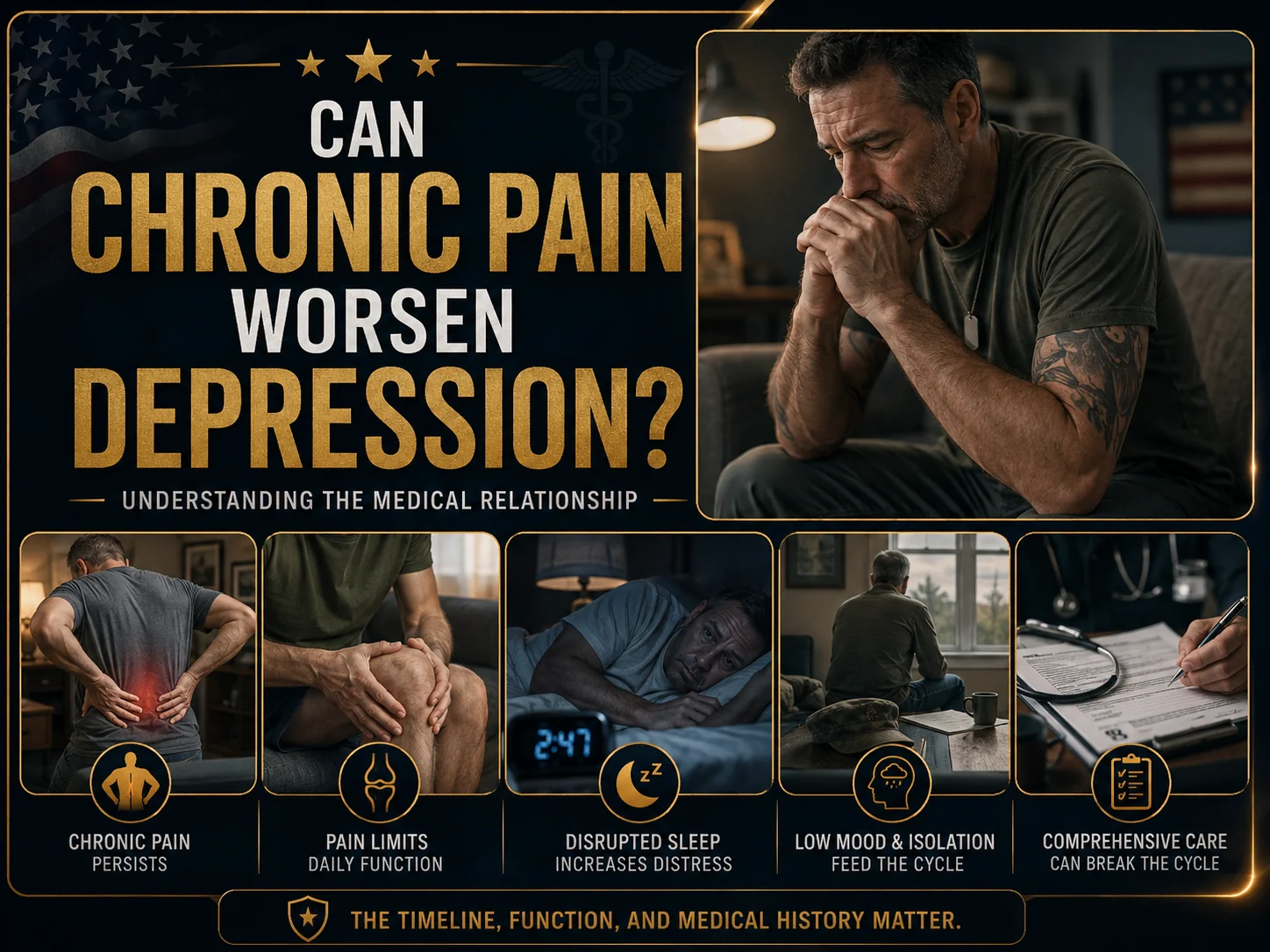
For many veterans, chronic pain does not stay limited to the body.
A service-connected back condition, knee injury, shoulder problem, neuropathy, or multiple orthopedic conditions may start as physical issues. But over time, chronic pain can affect sleep, activity, work, relationships, independence, and mood.
Some veterans may notice they are no longer exercising, no longer participating in hobbies, sleeping poorly, becoming more isolated, or feeling more irritable and frustrated. Eventually, depression may enter the picture.
That raises an important question: can chronic pain actually cause or worsen depression?
Medically, chronic pain and depression can be connected. But having both conditions does not automatically mean one caused the other.
In this video, Leah Bucholz, founder and CEO of Prestige Veteran Medical Consulting, explains how chronic pain may contribute to or worsen depression, why causation and aggravation are different, and what kind of medical evidence may matter when veterans are considering depression as a potential secondary condition.

Table of Contents
What Does “Secondary to Chronic Pain” Mean?
When veterans talk about depression secondary to chronic pain, they are usually referring to a possible secondary service connection.
Generally speaking, a secondary condition is a disability that is caused or aggravated by an already service-connected condition.
For example, a veteran may have a service-connected back condition. Over time, that back condition may cause significant chronic pain. The veteran may have trouble sleeping, difficulty exercising, reduced ability to work, less involvement in hobbies, or changes in relationships.
Over time, the veteran may develop symptoms of depression.
The medical question then becomes whether there is evidence that the veteran’s chronic pain caused or aggravated the depression.
That is different from simply saying:
“I have chronic pain, therefore my depression is secondary.”
That is not how a strong medical analysis works. The relationship needs to be evaluated based on the veteran’s individual medical history.
Chronic Pain and Depression Can Have a Complicated Relationship
Chronic pain is not only a physical sensation.
When someone experiences pain every day, especially over a long period of time, it can affect many areas of life, including:
- Sleep
- Physical activity
- Employment
- Relationships
- Independence
- Social interaction
- Hobbies
- Daily functioning
For a veteran, that impact can be significant.
Maybe they used to run every morning and now they cannot. Maybe they used to play sports with their children and now they watch from the sidelines. Maybe they had a physically demanding job and can no longer perform the same duties. Maybe they wake up multiple times each night because they cannot get comfortable.
Those changes can affect mood, motivation, frustration, and overall mental health.
For some veterans, chronic pain may contribute to or worsen symptoms of depression over time.
The Pain-Depression Cycle
One helpful way to understand this relationship is the pain-depression cycle.
It may look something like this:
A veteran is in pain.
Because they are in pain, they become less active.
Because they are less active, they stop doing things they enjoy.
They may become more isolated.
Their sleep becomes worse.
Their mood declines.
As depression worsens, their ability to cope with pain may also change.
Then they become even less active, and the cycle continues.
Pain affects mood. Mood affects sleep. Sleep affects pain. Pain affects activity. Activity affects mental health.
Over time, everything can start interacting.
That is one reason why looking at the veteran’s entire medical history is so important.
What Types of Conditions Can Lead to Chronic Pain?
When discussing chronic pain, veterans sometimes assume it refers to one specific diagnosis. That is not the case.
Chronic pain may be associated with many different conditions, including issues involving the:
- Back
- Neck
- Shoulders
- Knees
- Hips
- Ankles
- Feet
- Nerves
- Musculoskeletal system
There may also be chronic pain associated with other medical diagnoses.
The underlying diagnosis matters, but so does the severity and duration of the pain.
A veteran with occasional mild knee discomfort has a very different medical history than a veteran who has experienced severe daily pain for many years.
That is why every case needs to be evaluated individually.
Why the Timeline Matters
The timeline is one of the most important parts of evaluating a potential secondary relationship.
For example, if a veteran is considering depression secondary to chronic back pain, important questions may include:
- When did the back condition start?
- When did the chronic pain begin?
- When did the depression symptoms begin?
- When was depression first diagnosed?
- Was there mental health treatment before the chronic pain developed?
- Were there other major life events happening at the same time?
- Did the depression worsen as the pain worsened?
These questions matter because if one condition is being described as causing or aggravating another condition, the medical history needs to make sense.
The timeline does not have to be perfect. Real life rarely is.
But the medical reasoning should be consistent with the evidence.
Causation Versus Aggravation
Veterans sometimes focus only on causation.
In other words, they ask:
“Did chronic pain cause my depression?”
But that is not always the only medical question.
Sometimes the issue is whether chronic pain aggravated an existing mental health condition.
For example, a veteran may already have some symptoms of depression. Then their service-connected orthopedic conditions progressively worsen. Their pain increases, mobility decreases, sleep deteriorates, and depression becomes significantly worse.
That is a different medical question.
Instead of asking only whether chronic pain caused depression, the question may become whether chronic pain aggravated depression.
Causation and aggravation are two different theories, and the medical evidence may need to address them differently.
Why Sleep Can Be an Important Part of the Picture
Sleep can be a major part of the chronic pain and depression relationship.
A veteran with chronic pain may have difficulty falling asleep because they are uncomfortable. They may wake up repeatedly throughout the night. They may struggle to find a comfortable position.
After months or years of poor sleep, that can affect daytime functioning, energy, concentration, motivation, mood, and irritability.
Poor sleep does not automatically prove that chronic pain caused depression. But sleep history may be an important part of understanding the overall medical picture.
Loss of Function and Identity
Another part of chronic pain that may not get discussed enough is loss of function.
For many veterans, physical activity is not just exercise. It may be part of their identity.
A veteran may have spent years being physically capable in military environments – running, rucking, lifting, deploying, training, and working in physically demanding roles.
Then, gradually or suddenly, they cannot do the same things anymore.
Maybe they cannot train the way they used to. Maybe they cannot work the same job. Maybe they cannot participate in family activities. Maybe they feel like they have lost part of who they were.
That loss can be significant.
When evaluating depression in someone with chronic pain, it may be important to understand how the pain has affected daily function, independence, work, family life, and identity.
Other Causes Still Have to Be Considered
This is where a credible medical opinion is different from a generic opinion.
A medical analysis should not ignore everything else happening in a veteran’s life.
Depression can have many contributing factors, including:
- Family history
- Prior mental health symptoms
- Traumatic experiences
- Relationship difficulties
- Employment problems
- Financial stress
- Other medical conditions
- Medication side effects
- Substance use
- Major life events
A strong medical analysis should consider alternative explanations and contributing factors. If there are other significant risk factors, they should not simply be left out because they are inconvenient.
The question is whether the veteran’s service-connected chronic pain caused or aggravated the depression based on the complete medical picture.
Sometimes the evidence supports that conclusion. Sometimes it does not. Sometimes multiple factors may be contributing.
What Evidence Can Be Important?
If a veteran is considering whether depression may be related to chronic pain, several parts of the medical history may be relevant.
These may include:
- Orthopedic treatment records
- Pain management records
- Mental health records
- Medication history
- Physical therapy records
- Imaging
- Documentation of sleep problems
- Statements describing changes in daily functioning
- Records showing the timeline of pain and mood symptoms
Sometimes the most important evidence is not one single document. It is the pattern.
For example, records may show worsening back pain, then increasing sleep difficulty, then decreased physical activity, then worsening mood, then mental health treatment.
When those records are reviewed chronologically, they may provide a clearer picture than any one record by itself.
What About Multiple Painful Conditions?
Sometimes the issue is not one painful condition.
A veteran may have a service-connected back condition, bilateral knee conditions, a shoulder condition, and radiculopathy.
Individually, each condition may cause a certain level of pain. But collectively, the veteran may be dealing with significant chronic pain affecting multiple areas of the body.
That cumulative impact may be relevant when evaluating the veteran’s overall medical history.
Again, the analysis should be individualized.
Why a Diagnosis Matters
Feeling frustrated because of pain is not always the same thing as having a diagnosed depressive disorder.
Everyone has difficult days. Everyone can feel frustrated, especially when dealing with chronic pain.
But when discussing a potential secondary mental health condition, there generally needs to be an actual diagnosed condition.
That is where qualified mental health professionals become important.
If a veteran is experiencing symptoms of depression, the first priority should be appropriate evaluation and treatment.
Medical Evidence Versus Legal Strategy
It is also important to separate medical questions from legal or claims strategy questions.
The medical question is:
Does the evidence support that a veteran’s chronic pain caused or aggravated their depression?
That is a medical question.
But questions about what condition to claim, how to file it, how to appeal a denial, or what legal theory is best for an individual case are different questions.
For those issues, veterans should consider speaking with a VA-accredited attorney, accredited claims agent, or Veterans Service Organization representative.
Medical professionals and accredited representatives have different roles. Understanding that distinction can help veterans seek the right type of guidance from the right professional.
Final Thoughts
Chronic pain and depression can interact in complicated ways.
Physical health can affect mental health. Mental health can affect how someone experiences and copes with physical symptoms. Sleep, activity, work, relationships, independence, and identity can all become part of the picture.
But every veteran’s situation is different.
Veterans should look at the timeline, medical records, treatment history, functional changes, and other possible contributing factors. Any medical opinion evaluating the relationship between chronic pain and depression should be based on the veteran’s individual circumstances, not a generic template.
The goal of a medical opinion should not be to force a connection.
The goal should be to objectively determine what the medical evidence actually supports.
Also Read: VA Rating for Vertigo Secondary to Tinnitus Explained
At Prestige Veteran Medical Consulting, a veteran-owned company, we specialize in Independent Medical Opinions (IMOs) known as Nexus letters.
Our purpose is to empower YOU, the veteran, to take charge of your medical evidence and provide you with valuable educational tools and research to guide you on your journey.
Understanding the unique challenges veterans face, our commitment lies in delivering exceptional service and support.
Leveraging an extensive network of licensed independent medical professionals, all well-versed in the medical professional aspects of the VA claims process, we review the necessary medical evidence to incorporate in our reports related to your VA Disability Claim.
Prestige Veteran Medical Consulting is not a law firm, accredited claims agent, or affiliated with the Veterans Administration or Veterans Services Organizations. However, we are happy to discuss your case with your accredited VA legal professional.