

Secondary VA claims have become one of the most discussed topics in the VA disability space, especially as veterans continue hearing conflicting information online.
Some veterans are being told that secondary claims are no longer viable. Others are being told that almost any condition can be connected to another condition with a simple Nexus letter.
Neither extreme tells the full story.
In this video, Leah Bucholz, founder and CEO of Prestige Veteran Medical Consulting, explains what secondary VA claims actually are, why medical reasoning matters, and why evidence-supported analysis is becoming increasingly important in 2026.

Table of Contents
Secondary VA Claims Are Still Recognized
One of the biggest misconceptions circulating online is the idea that VA somehow eliminated secondary claims in 2026.
That is not accurate.
Secondary claims are still recognized by VA. Veterans may still pursue secondary service connection when a service-connected condition causes another disability, contributes to another disability, or aggravates another disability beyond its natural progression.
What has changed is not the existence of secondary claims.
The bigger issue is the level of scrutiny being applied to the medical reasoning behind them.
A secondary claim is not strengthened by broad statements, unsupported assumptions, or simple one-line conclusions. The most credible claims tend to rely on clear medical analysis, detailed timelines, organized records, and rationale that explains why the relationship is medically supportable.
What Is a Secondary VA Claim?
A secondary VA claim generally involves a condition that is connected to an already service-connected disability.
In simple terms, this may involve a service-connected condition that:
- Causes another disability
- Contributes to another disability
- Aggravates another disability beyond its natural progression
This is not a loophole. It reflects the way medical conditions can interact in real life.
For example, a veteran with a service-connected knee condition may develop altered movement patterns over time. That altered gait may affect the hips, low back, or other parts of the kinetic chain. Reduced activity may contribute to weight gain. Weight changes may then become relevant to conditions such as sleep apnea, hypertension, diabetes, or worsening orthopedic strain.
However, the fact that a relationship is medically possible does not automatically mean it is medically supportable in a specific veteran’s case.
That distinction matters.
Why Medical Possibility Is Not Enough
Many conditions can theoretically affect one another. The human body is interconnected, and one medical problem can influence another.
But a medically possible relationship is not the same as a medically defensible relationship.
For a secondary theory to be persuasive from a medical standpoint, the evidence usually needs to show more than a general possibility. It should explain how the veteran’s actual medical history supports the claimed relationship.
That may involve questions such as:
- What condition is already service connected?
- What secondary condition is being discussed?
- When did symptoms begin?
- How did the condition progress over time?
- Are there documented treatment records?
- Are there alternative risk factors?
- Does the timeline make medical sense?
- Does the medical literature support the relationship where applicable?
Without that level of explanation, a secondary claim may be vulnerable to challenge even if the general medical theory sounds plausible.
Why Generic Nexus Opinions Are Being Challenged
In the past, some secondary claims may have been submitted with very generic opinion language.
For example:
“Condition X is secondary to condition Y.”
That type of statement does not explain very much.
A stronger medical opinion should explain why the provider reached that conclusion. It should discuss the veteran’s medical records, timeline, symptom progression, treatment history, risk factors, and the medical reasoning behind the relationship.
Generic or boilerplate opinions may be easier to challenge because they often fail to answer the most important question:
Why does the evidence support this conclusion in this specific veteran’s case?
Experienced attorneys, accredited representatives, and qualified medical professionals often understand that the most useful opinions are not merely favorable. They are specific, consistent, and able to withstand careful review.
Aggravation Matters in Secondary Claims
One of the most important concepts in secondary claims is aggravation.
Many veterans focus only on direct causation. In other words:
“Did my service-connected condition directly cause this other condition?”
But aggravation asks a different question:
Did the service-connected condition worsen another condition beyond its natural progression?
That distinction can matter because not every condition begins because of service. Some conditions may have other causes, such as age, genetics, injury history, lifestyle factors, or unrelated medical conditions.
However, a service-connected condition may still potentially worsen another condition over time.
For example, a veteran may have mild degenerative changes in the cervical spine related to age. If that veteran also has a severe service-connected lumbar spine condition, the medical question may not be whether the lumbar condition originally caused the cervical degeneration. The question may be whether years of altered movement, compensation, pain behavior, or biomechanical strain contributed to worsening beyond natural progression.
That is a different medical analysis.
Why Timelines and Medical Records Matter
Secondary claims often depend heavily on timing.
A persuasive medical analysis usually needs to explain how the timeline supports the claimed relationship.
For example:
- When was the primary service-connected condition diagnosed?
- When did the claimed secondary condition begin?
- Were symptoms documented consistently?
- Did the records show a gradual progression?
- Did treatment notes describe altered gait, reduced mobility, weight gain, medication effects, or worsening symptoms?
- Were other risk factors considered?
A conclusion without a timeline may be incomplete.
In many cases, the timeline helps clarify whether the theory is medically plausible, speculative, or defensible. That is especially important when multiple factors may be involved.
Medical records can help show whether the claimed relationship developed in a way that makes sense clinically.
Obesity as an Intermediate Step
Another topic that creates confusion is obesity as an intermediate step.
Veterans may hear that obesity itself is not directly compensable and assume it can never matter in a VA claim. That is not the full picture.
In certain situations, obesity may be relevant as an intermediate step between a service-connected condition and another disability.
For example, a service-connected orthopedic condition may reduce mobility. Reduced mobility may contribute to weight gain. Weight gain or obesity may then contribute to another condition, such as obstructive sleep apnea, hypertension, diabetes, or worsening orthopedic strain.
However, each step in that chain needs to be supported.
It is not enough to say:
“Knee pain caused obesity, and obesity caused sleep apnea.”
A more complete medical discussion would look at the veteran’s actual mobility limitations, weight history, treatment records, symptom progression, alternative risk factors, and whether the claimed relationship is medically supported.
This is where nuance matters.
Not every veteran with knee pain develops obesity because of service-connected limitations. Not every veteran with obesity develops sleep apnea because of obesity alone. Not every claim involving obesity as an intermediate step is medically defensible.
The medical reasoning has to connect the dots carefully.
Why a Nexus Letter Is Not a Magic Wand
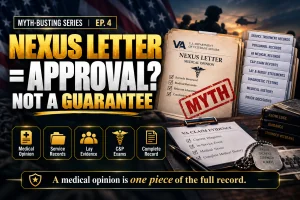
A Nexus letter is not magic.
It is not simply paperwork that guarantees a claim will be approved.
A legitimate medical opinion is only as strong as the records, reasoning, and medical defensibility behind it. A credible opinion should sometimes conclude that a claimed relationship cannot be supported.
That may not be what a veteran wants to hear, but it matters ethically.
A strong opinion is not one that connects every possible condition. A strong opinion is one that remains objective, evidence-based, and medically supportable.
Credibility matters.
A medical opinion that appears to connect every condition without meaningful analysis may be less persuasive than an opinion that carefully explains what the evidence does and does not support.
Why Some Secondary Claims Fail
A secondary claim may fail for many reasons, and not every denial means the medical theory itself is impossible.
Sometimes the issue is inadequate explanation.
For example, the opinion may have failed to:
- Discuss aggravation
- Address obesity as an intermediate step
- Consider medication side effects
- Review relevant treatment records
- Explain the timeline
- Address alternative risk factors
- Discuss symptom progression
- Explain why the relationship is medically supportable
- Distinguish between possibility and probability
In some cases, the theory may be medically reasonable but poorly explained. In other cases, the records may not support the theory. In other situations, the issue may be legal or procedural rather than medical.
This is why veterans often benefit from qualified professional review rather than relying on broad social media claims.
Avoid Chasing Conditions
One of the most harmful messages online is the idea that secondary claims are simply a pathway to chase a higher rating.
That approach can lead veterans away from the evidence.
Secondary claims should not begin with the question:
“What can I connect?”
A better evidence-focused question is:
“What conditions are genuinely related to my service-connected disability based on records, medical reasoning, and credible evidence?”
That mindset matters.
The strongest secondary claims are usually not built on hype, shortcuts, or broad assumptions. They are built on organized records, consistent histories, clear medical reasoning, and realistic theories.
What Strong Secondary Claims Usually Have in Common
Strong secondary claims often have several things in common from a medical evidence standpoint.
They tend to include:
- A clearly identified service-connected condition
- A clearly identified claimed secondary condition
- A medically reasonable theory
- A consistent timeline
- Relevant treatment records
- Discussion of causation or aggravation
- Consideration of alternative risk factors
- Clear rationale
- Evidence that connects the facts to the conclusion
- A professional tone that avoids exaggeration
A strong opinion should explain the medicine, not simply state the conclusion.
That is especially important in complex secondary claims where multiple conditions, risk factors, and timelines may overlap.
Final Thoughts
Secondary VA claims are still real, still recognized, and still important for many veterans.
The issue in 2026 is not whether secondary claims exist. The issue is whether the medical theory is clearly explained, evidence-based, and defensible.
A secondary claim is not strengthened by broad statements or boilerplate conclusions. It is strengthened by medical records, chronology, detailed rationale, and analysis that explains why the claimed relationship makes sense in that veteran’s specific case.
Not every theory is supportable. Not every Nexus letter is equal. Not every medical relationship is as simple as it may sound online.
The strongest secondary claims are usually medically grounded, evidence-based, well explained, and professionally presented.
Also Read: VA Rating for Vertigo Secondary to Tinnitus Explained
At Prestige Veteran Medical Consulting, a veteran-owned company, we specialize in Independent Medical Opinions (IMOs) known as Nexus letters.
Our purpose is to empower YOU, the veteran, to take charge of your medical evidence and provide you with valuable educational tools and research to guide you on your journey.
Understanding the unique challenges veterans face, our commitment lies in delivering exceptional service and support.
Leveraging an extensive network of licensed independent medical professionals, all well-versed in the medical professional aspects of the VA claims process, we review the necessary medical evidence to incorporate in our reports related to your VA Disability Claim.
Prestige Veteran Medical Consulting is not a law firm, accredited claims agent, or affiliated with the Veterans Administration or Veterans Services Organizations. However, we are happy to discuss your case with your accredited VA legal professional.