
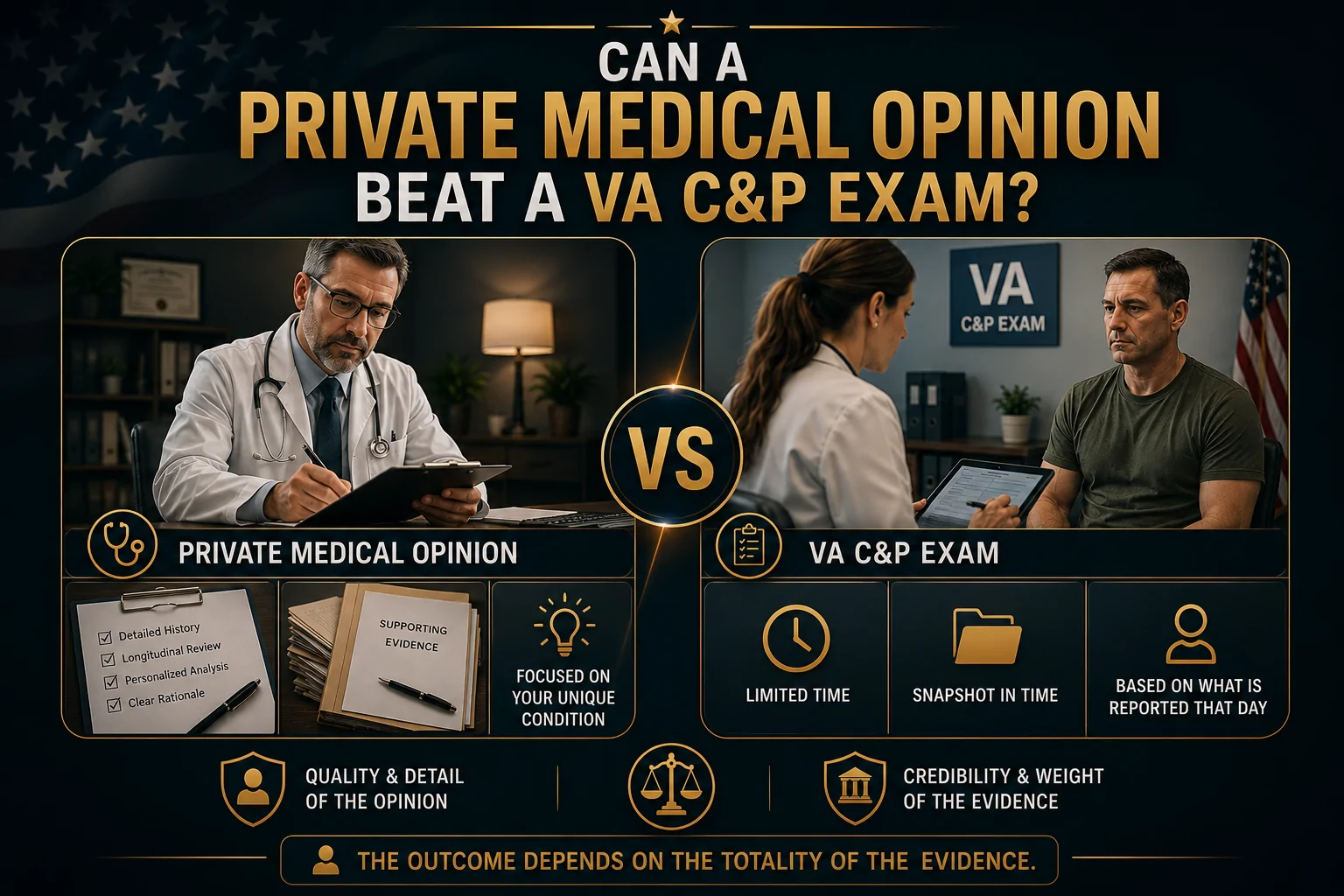
Receiving a negative VA Compensation and Pension (C&P) examination can be frustrating, especially when a veteran believes the medical evidence supports a different conclusion. One of the most common questions veterans ask is whether a private medical opinion can outweigh, challenge, or “beat” a VA C&P exam.
The answer is that, in some situations, a strong private medical opinion can carry significant probative value. However, this is not automatic. A private opinion is not persuasive simply because it disagrees with the VA examiner. The strength of the opinion depends on the quality of the medical analysis, the evidence reviewed, and the clarity of the rationale.

Table of Contents
A Private Medical Opinion Is Not Automatically Strong
One of the biggest misunderstandings online is the idea that a private medical opinion automatically outweighs a VA C&P exam because it comes from a provider outside the VA system.
That is not how medical evidence is supposed to be evaluated.
A VA examiner is not automatically wrong simply because the opinion is unfavorable. In some cases, the VA examiner’s conclusion may be medically reasonable based on the evidence available at the time of review.
However, there are also situations where a C&P exam may contain problems, such as:
- Incomplete rationale
- Factual inaccuracies
- Unsupported medical conclusions
- Failure to address important medical records
- Failure to discuss aggravation
- Failure to explain why the evidence does or does not support a relationship
This is where private medical evidence may become important. The question is not simply which provider said “yes” and which provider said “no.” The question is which opinion is more thorough, medically reasoned, and consistent with the evidence.
VA Is Supposed to Weigh Competent Medical Evidence
A common misconception is that VA is automatically required to favor its own examiner over a private medical provider.
In reality, medical evidence should be evaluated based on competence, credibility, reasoning, and support in the record. A well-supported VA medical opinion can be persuasive. A well-supported private medical opinion can also be persuasive.
What matters is not where the opinion came from.
What matters is whether the opinion explains the medicine clearly.
A strong medical opinion should help answer questions such as:
- What records were reviewed?
- What diagnosis is being discussed?
- What medical relationship is being considered?
- Does the timeline make medical sense?
- Were alternative risk factors considered?
- Does the medical literature support the opinion where applicable?
- Does the provider explain why the evidence supports the conclusion?
These details are often what give a medical opinion probative value.
Rationale Matters More Than the Conclusion
A medical opinion is not strong simply because a provider checked a box or used favorable language such as “at least as likely as not.”
The provider must explain the medical reasoning behind the opinion.
A persuasive opinion should not sound like:
“The condition is related because I said so.”
Instead, it should explain:
- How the medical records support the conclusion
- Why the timeline is medically significant
- Whether symptoms progressed in a consistent way
- Whether other risk factors were considered
- Whether current medical literature supports the relationship
- Why the provider agrees or disagrees with another medical opinion
The conclusion matters, but the rationale is what gives the conclusion weight.
Example: Sleep Apnea Secondary to PTSD
Consider a veteran who files a claim for obstructive sleep apnea secondary to service-connected PTSD.
The veteran receives a negative C&P exam. The examiner states that there is no medical literature supporting a relationship between PTSD and obstructive sleep apnea.
Now consider a private medical opinion from a qualified provider who reviews the veteran’s records in detail. That provider discusses the veteran’s documented symptom progression, addresses weight fluctuations, reviews sleep impairment, considers aggravation if relevant, references current medical literature, and explains how the veteran’s PTSD-related symptoms or associated factors may have contributed to or worsened the sleep apnea.
Those are two very different levels of medical analysis.
The issue is not simply that one examiner said “no” and one provider said “yes.” The issue is whether one opinion provides a more complete, medically supported explanation than the other.
That level of analysis can matter tremendously.
A “Rebuttal” Should Not Be an Emotional Attack
The word “rebuttal” is often used online, but it can be misleading.
A strong medical opinion should not be an emotional attack against a VA examiner. It should not criticize the examiner’s character, motives, or professionalism. Medical professionals should stay within their medical role and focus on the evidence.
A useful medical response may identify medical deficiencies such as:
- Documented complaints being overlooked
- Inaccurate factual assumptions
- Failure to address aggravation
- Failure to discuss relevant medical literature
- Failure to explain the rationale adequately
- Failure to consider important parts of the medical history
These are legitimate medical issues.
A weaker opinion may simply say:
“I disagree with the examiner.”
That alone is usually not enough. A stronger opinion explains why the prior opinion may be medically incomplete, inconsistent with the record, or unsupported by the available evidence.
Credibility Matters
A credible medical opinion is usually objective, balanced, and evidence-based.
If a provider appears willing to connect every condition to military service regardless of the records, that can damage credibility. Strong medical opinions should not read like advertisements, emotional arguments, or promises.
They should read like professional medical analysis.
That means the opinion should be:
- Clear
- Objective
- Evidence-based
- Medically reasoned
- Specific to the veteran’s records
- Careful about alternative explanations
- Within the provider’s professional scope
The goal is not to sound dramatic. The goal is to explain the medical evidence in a way that is clear, credible, and supported.
Medical Professionals and Legal Professionals Have Different Roles
Another important point is that medical professionals and legal professionals serve different roles in the VA disability process.
Medical professionals are generally focused on issues such as:
- Diagnosis
- Causation
- Aggravation
- Symptoms
- Functional impact
- Medical rationale
- Medical literature
- Consistency of the medical record
Legal professionals may address different issues, such as:
- Whether VA properly weighed favorable evidence
- Whether there were procedural concerns
- Whether duty-to-assist issues are present
- Whether effective dates are involved
- Whether a legal interpretation of presumptive service connection is at issue
Not every problem is medical.
In some situations, a veteran may benefit from guidance from an accredited attorney, accredited claims agent, or Veterans Service Officer (VSO), especially when the issue involves legal strategy, appeals, procedures, or interpretation of VA rules.
Length Does Not Equal Quality
Another misconception is that a longer medical opinion is automatically better.
That is not always true.
Some complex cases may require a longer opinion because the medical history, literature, and rationale require detailed explanation. However, length alone does not make an opinion persuasive.
A short opinion can be strong if it is fact-filled, medically logical, and clearly supported by the evidence. A long opinion can still be weak if it contains little actual medical reasoning.
Quality depends on substance.
A strong private medical opinion should clearly explain:
- The medical basis for the opinion
- The relevant evidence reviewed
- How the evidence supports the conclusion
- Why the timeline matters
- Whether other risk factors were considered
- Whether the opinion is medically consistent with the record
The best opinions are not necessarily the longest. They are the clearest, most accurate, and most medically supported.
A Private Medical Opinion Is Not About “Beating” VA
The phrase “beat a VA C&P exam” is common, but it can create the wrong mindset.
A private medical opinion should not be about attacking VA or trying to overpower another examiner. It should be about providing competent, credible medical analysis that helps clarify the evidence in the claim.
Sometimes the VA examiner’s opinion may be more persuasive.
Sometimes the private medical opinion may be more persuasive.
Sometimes the record may show that additional development, clarification, or professional review is still needed.
The strongest medical evidence is usually built on:
- Organized records
- Consistent medical history
- Credible evidence
- Clear rationale
- Objective analysis
- Professional scope
- Medical reasoning
It is not built on hype, emotion, or promises.
Final Thoughts
A private medical opinion can sometimes carry significant probative value and may outweigh a negative VA C&P exam when it is thorough, objective, medically reasoned, and supported by the evidence.
However, a private opinion is not automatically strong simply because it disagrees with a VA examiner.
The most persuasive medical opinions explain the medicine clearly. They address the records, discuss the rationale, consider alternative explanations, and remain focused on objective medical analysis.
In the end, persuasive medical evidence is not about who is louder. It is about who explains the medical issue more clearly, more credibly, and more consistently with the evidence.
Also Read: What Does “At Least as Likely as Not” Mean in a Nexus Letter?
At Prestige Veteran Medical Consulting, a veteran-owned company, we specialize in Independent Medical Opinions (IMOs) known as Nexus letters.
Our purpose is to empower YOU, the veteran, to take charge of your medical evidence and provide you with valuable educational tools and research to guide you on your journey.
Understanding the unique challenges veterans face, our commitment lies in delivering exceptional service and support.
Leveraging an extensive network of licensed independent medical professionals, all well-versed in the medical professional aspects of the VA claims process, we review the necessary medical evidence to incorporate in our reports related to your VA Disability Claim.
Prestige Veteran Medical Consulting is not a law firm, accredited claims agent, or affiliated with the Veterans Administration or Veterans Services Organizations. However, we are happy to discuss your case with your accredited VA legal professional.