

Many veterans hear the phrase “at least as likely as not” when filing a VA disability claim, especially when a doctor prepares a nexus letter. This is not casual wording. It is one of the most important phrases in VA disability evidence because it tells the VA whether a medical professional believes a condition is connected to service at the required probability level. A nexus letter is a medical opinion linking a diagnosis to military service, a service-connected condition, or an in-service event, injury, illness, or exposure.
In this blog, we explain the standard, its purpose, common applications, and the importance of a clear, evidence-based medical rationale.
Table of Contents
What Does “At Least as Likely as Not” Mean?
In a VA nexus letter, the phrase “at least as likely as not” means that a medical professional believes there is a 50 percent or greater probability that a current condition is connected to military service. Put another way, the condition is at least as likely to be related to service as it is unrelated.
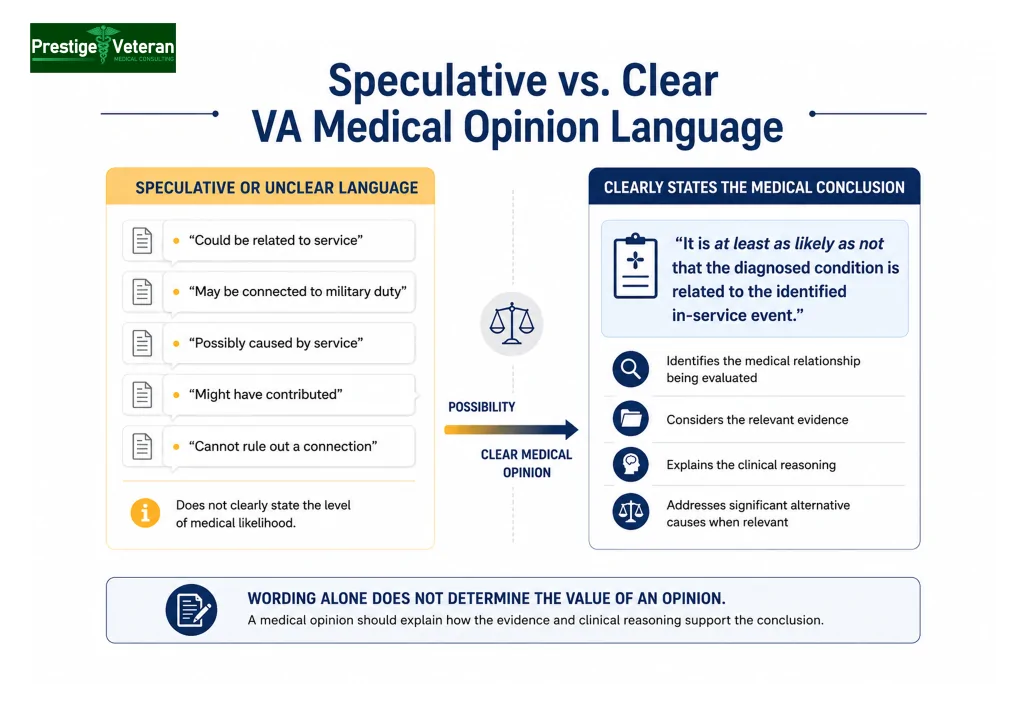
This does not mean the connection is guaranteed or that the provider is 100 percent certain. It means the evidence supporting the medical relationship is “at least approximately balanced or nearly equal to the evidence against it, if not higher.” This is stronger than saying a condition is “possibly” or “maybe” related to service, which does not clearly state whether the evidence meets VA’s standard for service connection.
Example: If a veteran has chronic knee pain today and service records show a knee injury during active duty, a clinician may review the veteran’s medical records, service history, imaging, and symptom pattern. If the evidence supports a connection, the clinician may state that the current knee condition is at least as likely as not related to the in-service injury.
The 50% Probability Standard
This wording is commonly used in medical nexus opinions because it reflects the VA’s 50/50 evidentiary standard. Common probability phrases have different meanings:
- Less likely than not: The likelihood is below 50 percent.
- At least as likely as not: The evidence is at least approximately balanced or nearly equal, if not higher.
- More likely than not: The likelihood is greater than 50 percent.
- Possibly related: The relationship is uncertain or speculative
This wording helps explain where the medical opinion falls on the probability scale VA uses when reviewing service connection evidence.
Why This Phrase Matters in a VA Nexus Letter
A Nexus Letter Connects Your Condition to Service
A nexus letter is a medical opinion that explains how a veteran’s current condition may be linked to an in-service event, injury, illness, exposure, or another service-connected disability.
In VA disability claims, service connection is usually established through three key elements:
- A current diagnosis
- An in-service event or exposure
- A medical nexus connecting the two
The nexus letter is where a qualified medical provider explains that connection using medical facts, records, clinical findings, and professional reasoning.
The VA Looks for Clear Medical Opinion Language
The phrase “at least as likely as not” matters because it gives the VA a clear way to understand the provider’s medical conclusion. A letter that only repeats symptoms, treatment history, or the veteran’s timeline may leave the main medical question unanswered: Is the veteran’s condition at least as likely as not related to military service?
That phrase appears in medical nexus opinions because it directly states the provider’s level of medical certainty. Still, the wording alone is not the strongest part of the letter. A useful nexus opinion should explain why the provider reached that conclusion. The phrase matters, but the medical rationale behind it matters more.
How “Benefit of the Doubt” Relates to “At Least as Likely as Not”
What the Benefit of the Doubt Rule Means
The benefit-of-the-doubt rule is applied by VA when deciding the claim. The VA must consider the lay and medical evidence of record. Under 38 U.S.C. § 5107(b), when the positive and negative evidence concerning a material issue is in approximate balance, the benefit of the doubt is given to the veteran.
In practical terms, the evidence does not need to establish a service connection with absolute certainty or meet the standard of “beyond a reasonable doubt.” However, under 38 C.F.R. § 3.102, reasonable doubt must be supported by the record and not based on speculation or a remote possibility.
Why a Balanced Medical Opinion Matters
In a VA nexus letter, “at least as likely as not” indicates that the evidence supporting a service-related cause is approximately balanced with the evidence supporting another explanation. VA medical forms describe this as a likelihood that is “at least approximately balanced or nearly equal.”
Example: Consider a veteran who repaired generators beside an unusually loud flight line and later developed hearing problems. A clinician might find that military noise exposure and post-service occupational noise are equally plausible explanations. An “at least as likely as not” opinion can place the medical nexus question at the balance point.
But that wording alone is not enough to determine how the record is evaluated. A credible nexus opinion should identify the records reviewed and explain the medical reasoning connecting the veteran’s specific history to the current condition.
How “At Least as Likely as Not” Applies in VA Disability Claims
The phrase “at least as likely as not” may appear in C&P examination reports, VA-requested medical opinions, private nexus letters, and independent medical opinions. It indicates that the clinician considers the claimed medical relationship at least approximately balanced with the evidence against it.
- Service connection claims: The standard may be used to address distinct medical questions, so the opinion should clearly identify which relationship is being evaluated.
- In a direct service connection claim, a clinician may consider whether a current disability began during service or is related to an in-service event, injury, illness, or exposure.
- In a secondary claim, the question may be whether a service-connected disability caused or aggravated another condition.
- For a condition that existed before service, the provider may be asked whether military service worsened it beyond its natural progression.
- C&P examinations and VA-requested medical opinions: When VA needs additional medical evidence, an examiner may be asked to provide a favorable or unfavorable nexus opinion using probability-based language. The examiner should support the conclusion with clinical findings and a clear medical rationale.
- Private nexus letters and independent medical opinions: A private clinician may apply the same probability language when supporting a claim or responding to an unfavorable C&P opinion. The opinion may be stronger when it considers the veteran’s relevant records, medical history, lay statements, risk factors, and alternative explanations.
Some Disability Benefits Questionnaires (DBQs) also use this probability standard when asking about a medical relationship, although many primarily document diagnoses, symptoms, treatment, and functional impairment. VA’s Diabetes Mellitus DBQ, for example, uses the phrase when addressing specified conditions caused or aggravated by diabetes.
However, the phrase does not automatically establish a service connection. VA evaluates the opinion’s reasoning, the provider’s qualifications, the accuracy of the facts relied upon, and how the opinion compares with the remaining evidence.
Examples of “At Least as Likely as Not” in Nexus Letters
The wording of a medical nexus opinion may vary depending on the relationship being evaluated. The examples below show how the probability standard may be applied to several common types of VA disability claims.
| Nexus Type | Example Opinion Language |
| Direct service connection | “After reviewing the veteran’s service records, medical history, and current diagnosis, it is at least as likely as not that the veteran’s lumbar spine condition is related to the documented in-service lifting injury.” |
| Secondary service connection | “It is at least as likely as not that the veteran’s left knee condition was aggravated by the altered gait associated with the service-connected right ankle condition.” |
| Toxic exposure | “Based on the veteran’s documented exposure history, relevant medical records, and current diagnosis, it is at least as likely as not that the veteran’s respiratory condition is related to military environmental exposures.” |
| Mental health | “It is at least as likely as not that the veteran’s diagnosed anxiety disorder is related to the reported events experienced during military service.” |
Note: These examples are simplified illustrations rather than templates for every case. The wording should reflect the provider’s independent medical judgment and be supported by an explanation of the relevant evidence, clinical findings, and medical reasoning.
What If VA Has a Difference of Opinion?
A veteran may encounter conflicting medical opinions. For example, a private pulmonologist may find that obstructive sleep apnea is at least as likely as not related to a service-connected nasal condition. A VA examiner may disagree, identifying other medical factors as more likely causes. This difference of opinion does not mean that either conclusion is automatically accepted or rejected.
VA weighs the probative value of each medical opinion by examining the provider’s reasoning, credentials, review of relevant records, and reliance on accurate facts. A detailed opinion that addresses competing risk factors may therefore include more helpful context than a conclusion with little explanation.
In this context, a private nexus letter may offer a different medical perspective or discuss areas that may not have been fully considered in the VA examination.
When a VA decision relies on one medical opinion over another, the veteran may choose from the available review options:
- Higher-Level Review: A senior reviewer reexamines the existing record and may grant the benefit under review based on a difference of opinion. New evidence cannot be added in this review lane.
- Supplemental Claim: When new and relevant evidence exists, such as an updated medical opinion, this option allows VA to consider it.
- Board Appeal: A Veterans Law Judge at the Board of Veterans’ Appeals reviews the disputed decision. The veteran may choose Direct Review, Evidence Submission, or a Hearing.
The appropriate option depends on the reason for the denial and whether the veteran has additional evidence. Consult a VA-accredited VSO representative, attorney, or claims agent to get guidance on the appropriate decision review and navigate the claims process.
When a Nexus Letter Does Not Say “At Least as Likely as Not”
Ask the Provider for Clarification
A nexus letter does not automatically become unusable because it omits the exact phrase. The opinion should be read as a whole, but language such as “could have contributed,” when used alone, may not clearly show whether the likelihood is at least 50 percent.
You may ask the provider to clarify whether the opinion reflects the ‘at least as likely as not’ probability level. The provider should use that phrase only when it honestly reflects their independent medical judgment. They should not be asked to reach a conclusion that the evidence does not medically support.
Support the Conclusion With a Stronger Medical Rationale
Sometimes, the larger issue may be a thin explanation rather than the missing phrase. Depending on the medical question, the provider may offer a detailed rationale that discusses the relevant records, diagnosis, symptom history, medical literature, service-related exposures, and alternative risk factors.
For example, a veteran with chronic shoulder pain may have documented an in-service lifting injury, continuing symptoms, imaging findings, and no significant post-service trauma. A useful nexus letter may explain how those facts medically support or do not support a relationship between the current shoulder condition and the in-service injury.
Consider a Qualified Independent Medical Opinion
When the original provider cannot clarify the letter or lacks experience with the condition, an independent evaluation from another clinician may provide a more complete medical opinion. For complex or previously denied VA claims, an independent medical opinion (IMO) may provide additional medical context or address issues that were not fully explained earlier.
The opinion should be evidence-based, condition-specific, and supported by a detailed rationale. Qualified IMO providers may identify the exact nexus question, address favorable and unfavorable facts, and explain how the evidence led to the stated conclusion rather than relying on probability language alone.
Conclusion
In a VA nexus letter, “at least as likely as not” means there is a 50% or greater chance that a current condition is connected to military service. It is an important phrase, but the words alone don’t guarantee that an opinion will be persuasive. A clear nexus letter should also include the veteran’s diagnosis, relevant service history, medical evidence, and an explanation of how the provider reached the opinion. Before submitting a nexus letter with a VA disability claim, veterans should read it carefully. When the wording is unclear or the medical reasoning is missing, they may ask the provider for clarification or speak with a VA-accredited representative.
Frequently Asked Questions (FAQs)
What Is the Difference Between “At Least as Likely as Not” and “More Likely Than Not”?
“At least as likely as not” means the medical relationship is approximately balanced or more likely. “More likely than not” indicates a probability greater than 50 percent.
What if the C&P Examiner Says “Less Likely Than Not”?
“Less likely than not” generally means the examiner believes the probability of the stated medical relationship is below 50 percent. A negative C&P opinion can hurt the claim, but it may be challenged with stronger evidence, a better-supported medical opinion, or by pointing out errors in the examiner’s reasoning.
Does “At Least as Likely as Not” Mean a VA Disability Rating Will Increase?
No, this language generally addresses a medical relationship, while an increased rating is based on current evidence showing that an already service-connected disability has worsened under the applicable rating criteria.
Is the Phrase “At Least as Likely as Not” Enough by Itself in a Nexus Letter?
The phrase “at least as likely as not” may be more meaningful when the doctor also explains the medical reasoning behind the opinion. The VA may give less consideration to the opinion if it appears copied, generic, inconsistent with records, or unsupported by clinical evidence.
Can a VA Claim Be Approved Without a Nexus Letter?
Sometimes, yes, especially if the evidence already establishes the connection or the condition is presumptive. But for many VA disability claims, a clear nexus opinion can be very helpful.
Also Read: Requesting a Nexus Letter from Your Doctor: What Veterans Should Know
At Prestige Veteran Medical Consulting, a veteran-owned company, we specialize in Independent Medical Opinions (IMOs) known as Nexus letters.
Our purpose is to empower YOU, the veteran, to take charge of your medical evidence and provide you with valuable educational tools and research to guide you on your journey.
Understanding the unique challenges veterans face, our commitment lies in delivering exceptional service and support.
Leveraging an extensive network of licensed independent medical professionals, all well-versed in the medical professional aspects of the VA claims process, we review the necessary medical evidence to incorporate in our reports related to your VA Disability Claim.
Prestige Veteran Medical Consulting is not a law firm, accredited claims agent, or affiliated with the Veterans Administration or Veterans Services Organizations. However, we are happy to discuss your case with your accredited VA legal professional.