

Veterans living with anxiety, depression, and sleep apnea may notice that the conditions affect sleep, energy, concentration, and daily functioning in overlapping ways. When sleep apnea develops after a mental health condition or becomes more severe over time, the medical relationship may deserve closer review. VA generally looks for evidence showing how one condition caused or aggravated the other, supported by a diagnosis, treatment records, and a reasoned medical opinion.
This guide explains how the conditions may be connected, what evidence VA considers, and how a secondary rating may affect overall disability compensation.
Table of Contents
Sleep Apnea and Its Prevalence Among Veterans
Sleep apnea is a sleep disorder in which breathing repeatedly stops or becomes shallow, often because the upper airway collapses. Common signs include loud snoring, gasping or choking at night, morning headaches, poor concentration, and persistent daytime sleepiness.
A national study of 15,166 veterans and 4,654 nonveterans, 21% of veterans reported having received an OSA diagnosis from a healthcare provider, compared with 9% of nonveterans. Veterans were also diagnosed about five years earlier on average, while deployment was linked to higher odds of OSA.
The condition can also share symptoms with anxiety, depression, and general fatigue. A systematic review of 73 studies found depressive symptoms in 35% and anxiety symptoms in 32% of patients with OSA. Because these can be difficult to distinguish, a medical evaluation and sleep study may become important.
Can Sleep Apnea Be Secondary to Anxiety or Depression?
Sleep apnea may qualify as secondary to service-connected anxiety or depression when medical evidence shows that the psychiatric condition caused or worsened the sleep disorder beyond its natural progression.
Under 38 C.F.R. § 3.310, key elements generally reviewed to establish a secondary service connection are:
- A current diagnosis of sleep apnea
- An existing service-connected mental health condition
- Medical evidence explaining how the psychiatric condition caused or aggravated the sleep apnea
Causation and Aggravation Are Not the Same
Aggravation is different from causation. Anxiety or depression may not have caused a veteran’s sleep apnea to develop but may still have contributed to a measurable worsening of existing sleep apnea. When aggravation is considered, earlier medical records may help establish the condition’s baseline severity before the claimed worsening occurred.
However, a diagnosis alone is not enough, as obstructive sleep apnea and mental health disorders may coexist without either condition causing the other. A clinician should identify the veteran-specific pathway and consider alternative risk factors when providing a medical opinion.
Example: One veteran may have documented medication-associated weight gain followed by worsening respiratory events. Another may have an anatomical airway obstruction that existed before depression began. The same diagnoses can therefore lead to different medical conclusions.
How Can Anxiety or Depression Be Medically Related to Sleep Apnea?
OSA is a respiratory disorder that involves repeated upper-airway collapse during sleep, and its development is usually influenced by several anatomical and nonanatomical factors. The possible relationship depends on the type of sleep apnea and the veteran’s individual history.
Weight Gain as an Intermediate Step
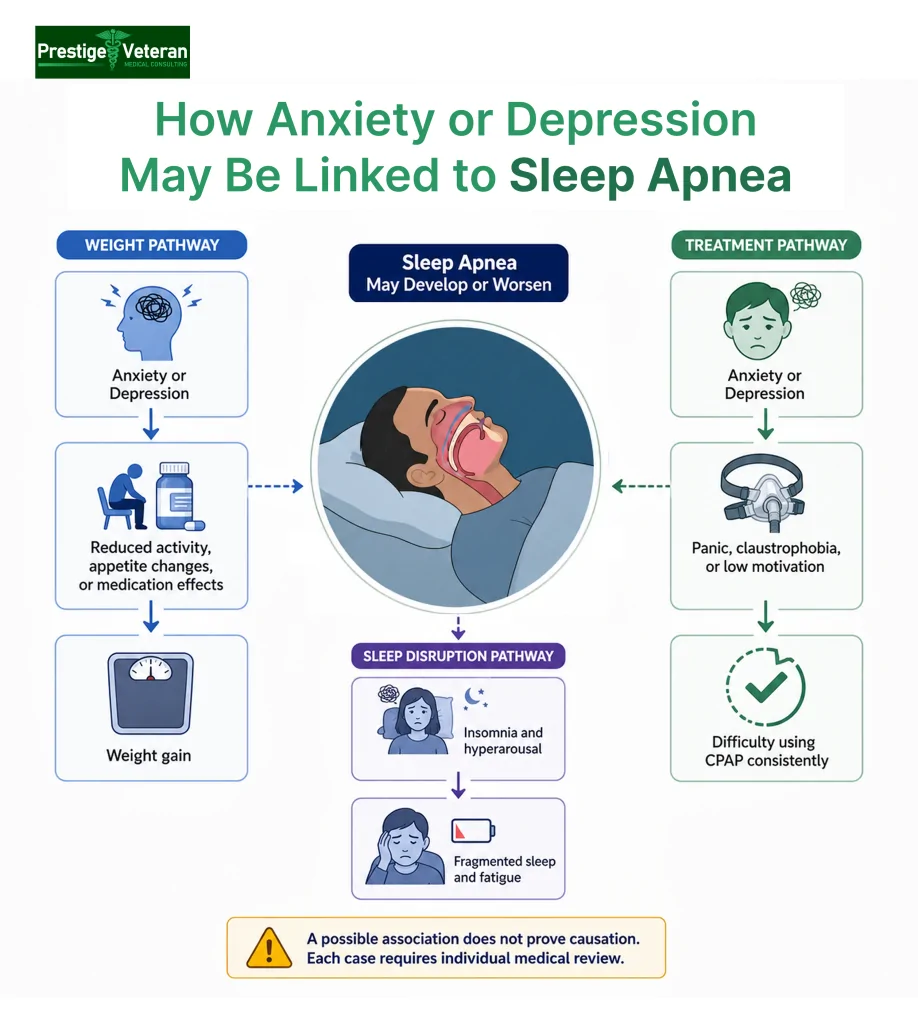
One possible pathway is:
Service-connected anxiety or depression → reduced activity, appetite changes, or treatment effects → weight gain or obesity → onset or worsening of obstructive sleep apnea.
Depression may be accompanied by reduced activity, appetite changes, emotional eating, low motivation, and gradual weight gain. Anxiety can interfere with exercise, meal planning, or regular medical care. Also, certain psychiatric medications may be associated with weight gain. These changes may contribute to a medically plausible pathway when they are documented over time.
Obesity is a recognized risk factor for OSA because excess tissue around the neck and upper airway may reduce airway space and contribute to obstruction during sleep. Research has also linked depression with a higher risk of later obesity, while a 10% weight gain has been associated with a 32% increase in AHI and a sixfold higher odds of moderate-to-severe sleep-disordered breathing.
Obesity in Secondary Service Connection
Obesity is not generally treated as a compensable disability on its own, but VA General Counsel recognizes it may serve as an intermediate step between a service-connected condition and another diagnosed condition. A medical analysis should hence consider when the weight change occurred, whether it followed the mental health condition or its treatment, and whether it contributed to the onset or progression of OSA.
Side Effects of Anxiety or Depression Medications
Depending on the medication and the veteran’s response, psychiatric medications may cause weight gain, sedation, altered sleep patterns, or reduced daytime activity. These effects may support a plausible pathway, but a medication list alone does not establish causation.
A credible review should identify the medication, treatment dates, documented side effects, weight or symptom changes, and the biological pathway connecting those changes to the veteran’s form of sleep apnea. Other medications, alcohol use, medical conditions, and independent risk factors should also be considered.
Sleep Fragmentation, Insomnia, and Hyperarousal
Anxiety and depression can disrupt sleep continuity through insomnia, racing thoughts, nightmares, hyperarousal, irregular sleep timing, and frequent awakening. These disturbances may increase fatigue and worsen a veteran’s perception of unrefreshing sleep.
However, poor sleep quality is not the same as obstructive sleep apnea. Insomnia does not necessarily cause the airway collapse, oxygen desaturation, or respiratory events that define OSA. Similarly, anxiety-related fatigue may overlap with sleep apnea symptoms without showing that the underlying respiratory disorder has worsened.
Treatment Adherence
Psychiatric symptoms may still affect sleep apnea management. For example, panic symptoms or claustrophobia may make CPAP use more difficult, while depression may reduce consistency with equipment cleaning, follow-up care, or nightly treatment. The evidence should clarify whether these barriers caused significant worsening, ineffective treatment, or mainly greater functional impairment.
Aggravation of Existing Sleep Apnea
Sometimes the question is not whether anxiety or depression originally caused sleep apnea. It is whether mental health symptoms, treatment effects, weight changes, or barriers to effective therapy chronically increased the condition’s severity beyond its expected course.
A medical opinion addressing aggravation should distinguish a temporary period of poor sleep from a measurable worsening of sleep apnea. Changes in sleep-study findings, prescribed treatment, pressure requirements, symptoms, weight, or respiratory complications may help clarify the progression.
Other Risk Factors a Medical Reviewer May Need to Consider
A balanced medical opinion should consider other factors that may contribute to the development or worsening of OSA. These may include:
- Age, sex, and body composition
- Neck circumference and craniofacial anatomy
- Enlarged tonsils or other upper-airway obstruction
- Smoking, alcohol use, or sedative use
- Endocrine, neurologic, or respiratory disorders
- Family history
These factors do not rule out a secondary relationship, but the opinion should explain why the mental health condition was medically significant in the veteran’s individual history.
Evidence That May Help Explain the Secondary Connection
Supporting evidence can confirm the diagnosis, establish a clear timeline, and explain how the service-connected psychiatric condition caused or aggravated sleep apnea.
Sleep Study Results
A sleep study can confirm the diagnosis and provide objective findings about the type and severity of sleep apnea. Relevant records may include overnight polysomnography or an accepted home sleep apnea test, along with:
- The study and diagnosis dates
- The type of sleep apnea
- Apnea-hypopnea index or other respiratory-event findings
- Oxygen-desaturation data
- Treatment recommendations
- CPAP, BiPAP, or another breathing-assistance prescription
Home testing may be appropriate for some patients, although not everyone is a suitable candidate.
Proof of the Service-Connected Mental Health Condition
The record should clearly identify the mental health condition on which the secondary sleep apnea claim is based. Relevant evidence may include the VA rating decision, mental health evaluations, treatment notes, medication history, and diagnostic records.
The specific diagnosis is important because anxiety, depression, PTSD, adjustment disorders, and other mental health conditions may have different symptoms, treatment courses, and medical histories. The evidence should therefore show how the veteran’s particular condition and treatment history relate to the claimed sleep apnea pathway.
Medical Records Showing a Clear Timeline
VA or private medical records can help show how the relevant conditions and changes developed over time.
Treatment records may show:
- When psychiatric symptoms began
- When medications changed
- Whether weight or activity levels changed
- When snoring or witnessed apneas appeared
- When sleep apnea was diagnosed
- When CPAP or other treatment began
- Whether symptoms or treatment requirements later worsened
Chronology is particularly important when the proposed relationship involves an intermediate step or aggravation.
Consider a veteran whose treatment records show stable weight for several years, a period of severe depression followed by reduced activity and progressive weight gain, and then a sleep study confirming OSA. That sequence does not prove a connection by itself, but it gives a clinician a documented history to evaluate.
An Independent Medical Opinion or Nexus Letter
A private nexus letter is not legally required in every case. VA may obtain a medical opinion through a C&P examination, while a treating clinician or qualified independent medical professional may also provide a competent opinion based on the veteran’s records.
An independent nexus opinion may help when the existing record does not clearly explain whether anxiety or depression caused or aggravated the veteran’s sleep apnea. It can address gaps in the evidence, evaluate competing risk factors, and explain whether the veteran’s medical history and timeline support a secondary relationship.
Lay and Buddy Statements
A spouse, roommate, relative, friend, or fellow service member may provide a lay or buddy statement describing symptoms and changes they personally observed. Relevant observations may include:
- Loud or disruptive snoring
- Witnessed breathing pauses
- Gasping or choking during sleep
- Increased daytime exhaustion
- Changes in activity, eating habits, or weight
- The approximate timing of symptom changes
- Panic or claustrophobia affecting CPAP tolerance
For example, a spouse might report that the veteran regularly fell asleep during the day, woke irritable and unrefreshed, or removed the CPAP mask during episodes of anxiety or panic. A former roommate might describe witnessing gasping or choking during sleep before the veteran received a formal diagnosis.
Lay witnesses can help establish the timing, frequency, and progression of observable symptoms. They may also support the chronology described in medical records. Although establishing complex medical links usually requires an opinion from a qualified healthcare professional.
What Is the VA Rating for Sleep Apnea Secondary to Anxiety and Depression?
VA rates sleep apnea under 38 C.F.R. § 4.97, Diagnostic Code 6847, which provides 0%, 30%, 50%, and 100% ratings based on the severity, symptoms, and treatment requirements.
The same criteria apply whether the service connection is direct or secondary to anxiety, depression, or another disability. This diagnostic code mainly covers obstructive, central, and mixed sleep apnea syndromes.
| VA Rating | Current Diagnostic Code 6847 Criteria |
| 0% | Asymptomatic but documented sleep-disordered breathing |
| 30% | Persistent daytime hypersomnolence |
| 50% | Requires use of a breathing-assistance device such as CPAP |
| 100% | Chronic respiratory failure with carbon dioxide retention or cor pulmonale, or requires tracheostomy |
Important Note About Proposed Rating Changes
Status as of July 4, 2026: VA proposed changes to the sleep-apnea rating criteria in February 2022. Under that proposal, ratings would focus more on how well treatment controls the condition. These changes have not been finalized and are not currently part of Diagnostic Code 6847. Until VA publishes a final rule with an effective date, the current criteria remain in effect.
Source: VA’s February 15, 2022, proposed rule published in the Federal Register.
VA Compensation for Sleep Apnea Secondary to Anxiety and Depression
VA does not pay a separate fixed monthly amount for each service-connected condition. VA compensation for sleep apnea secondary to anxiety and depression is based on the veteran’s overall combined rating.
Current VA Compensation Rates for Sleep Apnea
For a veteran without dependents, the current monthly compensation amounts corresponding to the sleep apnea rating levels are:
- 0% rating: $0 per month
- 30% rating: $552.47 per month
- 50% rating: $1,132.90 per month
- 100% rating: $3,938.58 per month
These amounts apply when the veteran’s overall combined disability rating is 30%, 50%, or 100%. A separate sleep apnea rating may change the combined rating, but VA does not simply add disability percentages together.
The current compensation rates became effective December 1, 2025. Because VA periodically adjusts these amounts, veterans should review the latest payment tables on VA.gov.
How VA Combines Disability Ratings
VA does not add separate disability percentages using ordinary arithmetic. Instead, it applies each additional rating to the portion of the veteran considered not disabled.
Example: A veteran with an existing 70% combined rating that includes anxiety and depression is considered 30% not disabled. If VA later assigns a separate 30% rating for sleep apnea, that rating is applied to the remaining 30%, adding 9 percentage points. The result is 79%, which VA rounds to an 80% combined rating.
Dependents and Payment Rates
Besides the combined disability rating, the monthly payment amount may also depend on whether the veteran has a qualifying spouse, child, or dependent parent.
Additional compensation for dependents may be available when the veteran has a combined rating of 30% or higher. Veterans rated at 10% or 20% receive the same basic payment regardless of dependent status.
Consult a VA-accredited representative or VSO for guidance on how combined ratings and payment rules may apply to your individual case.
Sleep Apnea, Mental Health Conditions, and TDIU Compensation
In some cases, the combined occupational effects of service-connected sleep apnea, anxiety, and depression may also raise the question of Total Disability Based on Individual Unemployability (TDIU). TDIU may permit payment at the 100% rate when service-connected disabilities prevent substantially gainful employment, even when the combined schedular rating is below 100%.
Eligibility depends on the applicable requirements and work-related evidence.
How a Medical Nexus Letter Can Support a Secondary Sleep Apnea Claim
A medical nexus letter can explain the clinical relationship between service-connected anxiety, depression, and obstructive sleep apnea (OSA). Rather than noting that these conditions occur together, the opinion should connect the veteran’s medical history, treatment records, and relevant research to a clear, specific conclusion.
What the Letter Can Cover
The nexus letter for sleep apnea secondary to anxiety and depression may document:
- The clinician’s qualifications
- OSA confirmed by a sleep study
- The history and severity of anxiety or depression
- Mental health medications and possible side effects
- Changes in sleep, weight, and activity
- OSA risk factors, including age, airway anatomy, alcohol use, and sedating medications
These details create a timeline and help the provider assess whether the mental health condition may have contributed to the onset or worsening of sleep apnea.
Building the Medical Rationale
Research has found an association between OSA and mental health disorders, but correlation alone does not establish causation. The letter should explain the mechanism supported by the record. For example, depression may coincide with reduced activity or weight gain, while some antidepressants may affect weight or sleep.
Because excess weight is a recognized OSA risk factor, the opinion may examine whether it acted as an intermediate factor. It may also address whether sedating medication, alcohol use, anatomical airway features, age, or other established risks offer a more likely explanation.
Separating Causation From Aggravation
The nexus letter should consider two questions:
- Did anxiety or depression contribute to causing OSA?
- Did either condition aggravate OSA beyond its expected course?
When medically supported, the provider may conclude that a relationship is “at least as likely as not,” meaning the evidence is approximately balanced or nearly equal.
This conclusion should be followed by an explanation supported by objective evidence such as sleep-study results, oxygen levels, CPAP requirements, or symptom progression. If aggravation is discussed, the provider should identify the earlier baseline and describe a measurable increase in severity.
A clear nexus letter supports the record by connecting medical facts to a reasoned conclusion without relying on generic statements or guarantees.
The Sleep Apnea DBQ and C&P Examination
A VA Compensation and Pension (C&P) exam for sleep apnea is a medical evaluation requested to document the condition, its symptoms, and its functional effects. The scope depends on VA’s request, especially when sleep apnea is evaluated as secondary.
The examiner may review the claims file, records, and sleep-study results, then ask questions based on the DBQ. The Sleep Apnea Disability Benefits Questionnaire is a standardized medical form used to document the diagnosis, treatment, symptoms, testing, and functional impact of sleep apnea. It may be completed as part of a VA C&P exam or by an eligible private healthcare professional.
The examiner may document:
- The type of sleep apnea and date of diagnosis
- The condition’s history, including onset and course
- Sleep-study results and documented sleep-disordered breathing
- Symptoms, such as persistent daytime hypersomnolence
- Whether continuous medication or a breathing-assistance device, such as CPAP, is required
- Other pertinent findings or complications
- The condition’s effect on the ability to work
A new sleep study may not be necessary when results in the medical record reflect the current condition.
For sleep apnea secondary to anxiety and depression, a medical opinion may also involve reviewing mental health records, medication history, weight changes, and the timing of each condition to address possible causation or aggravation. If aggravation is part of the requested medical opinion, the examiner may address baseline and current severity.
When Preparing: Veterans can prepare by reviewing their records before the C&P exam. They should answer questions accurately and describe how OSA affects daily functioning and work, without minimizing or exaggerating symptoms.
The examiner provides medical findings and an opinion, but VA weighs the complete record and makes the final claim decision.
Common Gaps That May Affect the Medical Evaluation
The following weaknesses may limit how clearly the medical evidence explains the claimed secondary relationship.
Diagnosis Is Not Clearly Documented
A medical evaluation should identify the type of sleep apnea and review the available sleep-study findings. The current Sleep Apnea DBQ notes that the diagnosis must be confirmed by a sleep study.
The Medical Explanation Is Too General
Simply stating that anxiety, depression, and sleep apnea exist together does not establish a medical relationship. The opinion should explain the individual mechanism, chronology, and supporting clinical findings.
Research Is Not Applied to the Individual
Medical studies can provide useful context, but general associations should be connected to the person’s diagnosis, treatment history, symptoms, and relevant records.
Other Risk Factors Are Not Considered
When an evaluation does not address other relevant causes of sleep apnea, the medical opinion may appear incomplete because it does not explain why the service-connected condition is more medically significant than competing risk factors.
Causation and Aggravation Are Not Evaluated Separately
Whether a condition contributed to the development of sleep apnea is different from whether it measurably worsened existing sleep apnea.
The Timeline or Weight-Change Pathway Is Unclear
When weight change is discussed, the evidence should address three questions:
- Did the service-connected mental health condition, its symptoms, or prescribed treatment cause or aggravate obesity?
- Was obesity a substantial factor in causing or worsening OSA?
- Would the OSA have developed or worsened without the obesity linked to the service-connected condition?
A more complete VA claim may include a weight timeline, treatment and medication records, lay statements, and a well-reasoned medical nexus opinion tied to the veteran’s history.
What Happens When Veterans Face a Denial?
A denial does not always mean the medical evidence was absent. In some cases, it may mean the relationship between the conditions was not clearly addressed in the record.
If a claim is denied, the VA provides three decision-review options:
- A Supplemental Claim, which allows new and relevant evidence
- A Higher-Level Review, which is based on the existing evidentiary record and doesn’t allow submission of new evidence
- A Board Appeal, in which a Veterans Law Judge reviews the matter
A new medical opinion may be relevant when a denial cited no nexus, omitted important evidence, relied on an incomplete record, or offered conclusions without adequate medical reasoning.
Consider speaking with a VA-accredited attorney, accredited claims agent, or Veterans Service Organization (VSO) to understand the procedures that apply to each review option.
Veteran Case Study: OSA Secondary to MDD With Anxiety
In Citation No. A25004274, decided January 16, 2025, the Board granted service connection for obstructive sleep apnea secondary to major depressive disorder with anxiety. The veteran had severe OSA and a 50% rating for MDD with generalized anxiety.
A private sleep specialist linked the conditions through depression-related serotonin changes, medication-associated weight gain, and aggravation. The VA examiner addressed causation but did not adequately consider aggravation, medication effects, or the private specialist’s reasoning.
The Board gave greater weight to the private opinion, found the evidence approximately balanced, and resolved reasonable doubt in the veteran’s favor.
Note: Board decisions are case-specific, nonprecedential, and do not predict the outcome of another claim.
Conclusion
VA compensation for sleep apnea secondary to anxiety and depression depends on whether the medical evidence supports a clear connection between the conditions. A clear medical timeline can help show whether mental health disorders, treatment effects, weight changes, or other health factors played a meaningful role. Sleep-study results, treatment records, and a well-supported medical opinion can bring those details together and help explain the connection in a practical way.
For guidance based on your circumstances, consider speaking with a VA-accredited attorney, claims agent, or VSO representative.
Frequently Asked Questions (FAQs)
What Should a Nexus Letter for Sleep Apnea Secondary to Depression Include?
A strong nexus letter should identify both conditions, review the veteran’s medical history and clearly explain with supporting medical reasoning how service-connected depression caused or aggravated the sleep apnea.
Does a CPAP Prescription Qualify for a 50% VA Rating?
Under the current rating schedule, requiring a breathing-assistance device such as CPAP corresponds to the 50% criteria. Although an old prescription alone may not prove that the device is still medically necessary.
Does a Secondary Service Connection Change the VA Rating?
No. Once service connection is established, the condition is rated according to its qualifying symptoms and treatment requirements, rather than receiving a different percentage solely because it is secondary. When service connection is based on aggravation, VA may compensate only for the additional worsening.
Also Read: VA Sleep Apnea Ratings: 2025 Proposed Changes (and Current Rules)
At Prestige Veteran Medical Consulting, a veteran-owned company, we specialize in Independent Medical Opinions (IMOs) known as Nexus letters.
Our purpose is to empower YOU, the veteran, to take charge of your medical evidence and provide you with valuable educational tools and research to guide you on your journey.
Understanding the unique challenges veterans face, our commitment lies in delivering exceptional service and support.
Leveraging an extensive network of licensed independent medical professionals, all well-versed in the medical professional aspects of the VA claims process, we review the necessary medical evidence to incorporate in our reports related to your VA Disability Claim.
Prestige Veteran Medical Consulting is not a law firm, accredited claims agent, or affiliated with the Veterans Administration or Veterans Services Organizations. However, we are happy to discuss your case with your accredited VA legal professional.