

A nexus letter can serve as a key piece of medical evidence in a VA disability claim when evaluating the relationship between a veteran’s current condition and their military service. While medical records often document diagnoses and treatment history, the VA typically relies on clear, well-reasoned medical opinions to determine whether a condition is “at least as likely as not” related to service. In certain cases, a VA nexus letter or independent medical opinion may help provide that level of clarity.
When this connection is not already clearly established within the medical record, a veteran may consider obtaining an independent medical opinion from a qualified provider. The manner in which this request is approached can influence the quality, clarity, and overall usefulness of the opinion.
The information below is intended to provide general context on how to request a nexus letter, with an emphasis on maintaining a professional, appropriate, and collaborative dynamic between the veteran and their medical provider.
Table of Contents
What Is a Nexus Letter?
A nexus letter is a formal medical opinion provided by a qualified healthcare professional that addresses the relationship between a veteran’s current medical condition and their military service. Within the context of a VA disability claim, it serves as medical evidence by explaining whether a condition is causally related to, or aggravated by, service.
This type of opinion helps address the nexus requirement for service connection under 38 C.F.R. § 3.303, which generally includes evidence of a current diagnosis, an in-service event, and a medical link between the two. While medical records often document symptoms, diagnoses, and treatment history, they do not typically address causation.
A medical nexus opinion may help provide that additional context when it is not already clearly established in the record. A well-supported nexus letter generally includes several key elements. For example:
- A current diagnosis of the claimed condition.
- The condition is “at least as likely as not” related to service, which reflects the VA’s 50% probability standard.
- The provider reviewed relevant medical and service records.
- Outline the veteran’s history.
- Provide a detailed medical rationale explaining the connection.
- Supporting literature or clinical reasoning may also be included to strengthen credibility.
- Provider credentials and signature.
Professionals Eligible To Write a Medical Opinion
A nexus letter converts your symptoms and treatment history into medical evidence that the VA can use to evaluate service connection. A licensed healthcare professional can write a nexus opinion, including:
- Primary care physicians (MD or DO)
- Specialists (orthopedists, cardiologists, etc.)
- Private doctors
- Nurse practitioners
- Physician assistants
- Psychologists or psychiatrists
- Independent medical examiners (IMEs)
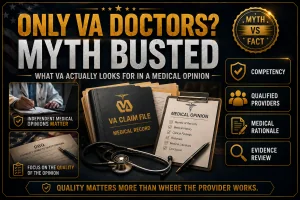
However, letters from providers who are familiar with your condition and can explain how your service contributed to or aggravated the disability using VA standards may carry more weight.
When Do You Need a Nexus Letter for a VA Disability Claim?
The VA approves disability claims based on medical evidence, not assumptions. Even when the connection between service and a condition seems obvious, the VA still requires a professional medical opinion establishing that link. A nexus letter provides that critical connection between current symptoms and in-service events, exposures, or injuries, which often determines whether a claim is approved, denied, or delayed. Although not mandatory, medical nexus letters can be especially helpful when:
- Your condition developed after military service
- Service treatment records are missing or incomplete
- The condition was not documented during service
- You’re filing a secondary condition claim
- Your claim was previously denied
- You’re submitting an appeal
A well-supported nexus can strengthen both initial claims and appeals. The medical document clarifies service connection, supports disability ratings, and improves chances of getting benefits approved.
Examples of VA claims where a nexus letter may be helpful:
- Conditions appearing after service (e.g. sleep apnea, arthritis, or migraines)
- Mental health claims tied to service experiences (e.g. PTSD, anxiety, or depression)
- Toxic exposure-related illnesses (e.g. respiratory conditions from burn pits, cancers, or hypertension linked to Agent Orange exposure)
- Aggravation of pre-existing conditions (e.g. worsened scoliosis, flat feet, or hearing loss)
- Secondary disabilities linked to already service-connected issues (e.g. hip pain caused by a service-connected ankle injury or radiculopathy from a spine condition)
By clearly explaining the medical relationship, a well-supported nexus opinion may help strengthen the overall evidentiary picture of a claim.
Requesting a Nexus Letter from Your Doctor: Key Considerations
Obtaining a VA nexus letter often begins with how the request is approached. Thoughtful preparation, clear communication, and an understanding of the provider’s role can help support a more effective and professional interaction when seeking a medical opinion.
Below are several considerations that may be helpful when initiating this process:
Scheduling a Dedicated Appointment
It may be helpful to address this type of request outside of a routine or time-limited visit. In some cases, setting aside dedicated time allows the provider to more thoroughly understand the context of the request and review relevant medical history. Some veterans choose to notify the office in advance that the appointment relates to VA documentation. This can help ensure the discussion is approached with appropriate context and preparation.
Maintaining a Clear and Professional Approach
When initiating the conversation, a clear and respectful approach is generally appropriate. This may include explaining that you are pursuing a VA disability claim and are seeking a medical opinion regarding the relationship between your condition and military service.
Providing relevant background, such as your condition and service history, can help support a more informed discussion. Maintaining a collaborative and professional tone may also help facilitate a productive interaction.
Example phrasing: “Doctor, I am in the process of filing a VA disability claim related to my migraines. Given your familiarity with my care, I wanted to ask if you would be open to reviewing my records and providing a medical opinion regarding whether this condition may be related to my military service.”
Provide Context about the Request
Some healthcare providers may be unfamiliar with the term nexus letter. In those situations, it may be helpful to briefly explain that it is a medical opinion used in a VA disability claim to address whether a current condition is related to military service.
A concise explanation is often sufficient. For example, a veteran may clarify that the opinion is intended to address whether a condition is at least as likely as not related to service. It can also be helpful to make clear that the request is for the provider’s independent medical judgment rather than any form of legal advocacy or testimony.
Because the phrase at least as likely as not reflects the VA evidentiary standard, the opinion should be based on medical reasoning, relevant history, and the provider’s clinical judgment. Keeping this explanation clear and limited in scope may help avoid unnecessary confusion.
Provide Your Evidence and Supporting Documentation
A provider may be in a better position to evaluate the request when the relevant documentation is organized and readily available. Depending on the circumstances, this may include service treatment records, applicable military records, post-service treatment records, prior VA decisions, or other materials relevant to the condition at issue.
In some cases, veterans may also choose to provide lay statements, witness statements, or medical literature if those materials help provide additional context. When appropriate, it may be helpful to identify key in-service events, injuries, exposures, or treatment history that are relevant to the opinion being requested.
Organized documentation does not determine the outcome of the opinion, but it may assist the provider in reviewing the record more efficiently and forming a clear, well-supported medical assessment.
Potentially relevant documentation may include:
- VA claims file (C-file), if possible
- Service treatment records (STRs)
- DD-214 / military personnel records
- Post-service medical records, both VA and private, including current diagnosis
- Personal statements
- Buddy/witness statements
- Prior VA rating decisions or C&P exam reports, if any
When appropriate, it may be helpful to identify key in-service events, injuries, or exposures that are relevant to the condition being evaluated. In some cases, additional context, such as medical literature or a brief summary of how the condition impacts daily functioning, may also be provided for the provider’s consideration.
Organizing this information in a clear and accessible manner may assist the provider in reviewing the materials efficiently and forming a well-reasoned medical assessment based on the available evidence.
How to Approach the Conversation
Once you’ve explained your situation and provided organized documentation, the next step is simply having the conversation with your provider.
Many veterans find it helpful to approach this in a way that is clear, professional, and respectful of the provider’s clinical judgment. The goal is not to persuade, but to request a medical opinion if it is medically appropriate. Some veterans choose to use language like:
- “Would you be willing to write a medical opinion connecting my condition to my military service?”
- “Can you review my records and provide a nexus opinion if medically appropriate?”
- “I’m filing a VA disability claim and need a medical opinion. Would you feel comfortable evaluating my records and providing one?”
This type of phrasing keeps the request open-ended and acknowledges that the provider may or may not feel comfortable offering an opinion.
If a provider is open to reviewing the request, it can also be helpful to clarify expectations around timing or whether additional information is needed. If they are not, maintaining a positive relationship remains important for ongoing care.
Example: What This Conversation Might Look Like
Every provider interaction will be different, but many conversations follow a similar general flow:
Veteran: “Dr. [Last Name], I’m filing a VA disability claim for [condition], and they’re asking for a medical opinion about whether it’s related to my military service.”
Doctor: “What does that involve?”
Veteran: “It’s often called a nexus letter. It’s essentially a medical opinion based on my records, addressing whether it’s at least as likely as not that my condition is connected to my service. Since you’ve been treating me, I wanted to ask if that’s something you’d feel comfortable reviewing.”
Doctor: “I’m not very familiar with that.”
Veteran: “That’s completely understandable. Some providers find it helpful to have a brief summary of the records and a template to reference, but I understand if it’s not something you’re comfortable with.”
If Reaching Out by Email
For those who prefer email, keeping the request concise and organized often helps. Many providers appreciate:
- A brief explanation of the condition and request
- A focused summary of relevant records
- Only the most pertinent documents, rather than a full file
Providing clear, organized information can make it easier for a provider to review and determine whether they can offer a medical opinion.
These phrases acknowledge the doctor’s expertise while leaving space for them to decline without pressure. If they agree, ask about the expected timeline for the nexus letter and whether they need additional information on your VA disability claim.
Even if they cannot assist, thank them for their time and maintain a positive relationship, so your ongoing care remains uninterrupted.
Tips That May Help When Requesting a Nexus Letter
While there is no way to guarantee that a provider will be able to offer a nexus opinion, many veterans find that preparation and professionalism can make the process smoother.
These considerations are often helpful in making it easier for a provider to review your request and determine whether a medical opinion is appropriate.
Tip 1: Be Organized
Instead of handing over a large file, provide your doctor only the most relevant documents and highlight key sections. Keep your summary to one page. Explain your condition, when symptoms began, how it continues to affect your daily functioning, and how it relates to service to help the provider quickly understand the context. Doctors may be more willing to write a nexus letter when the information is easy to review.
Tip 2: Be Respectful of Their Time
Acknowledge that writing a nexus opinion is a detailed and time-consuming process. Keep your request concise, avoid repeated follow-ups too quickly, and give the provider space to evaluate your records. If additional information is needed, respond promptly.
Tip 3: Provide a Draft Template (Optional)
Many doctors hesitate because they don’t know the VA language requirements. Providing a nexus letter template helps the provider structure the letter with the necessary elements. For example, the current diagnosis, records reviewed, explanation of service connection, medical rationale, and the nexus statement. This removes guesswork and saves time.
Refer to this guide for a sample template: How to Get a Nexus Letter for Sleep Apnea.
Tip 4: Offer to Pay a Documentation Fee
Writing a nexus letter for VA requires reviewing records and drafting a detailed opinion. Some nexus letter doctors charge documentation fees, which can range widely based on the complexity of your VA disability claim. Let them know you understand this upfront and are willing to pay.
Tip 5: Follow Up Professionally
If the doctor agrees, ask for a timeline. Most letters take 2 to 4 weeks. If you haven’t received it, send a polite message or call the office. A respectful follow-up maintains your relationship and helps ensure the letter meets VA requirements.
Reviewing Your Nexus Letter Before Submission
Receiving a medical nexus letter is an important step in the VA disability process. However, taking a moment to review the document can help ensure it is clear, complete, and accurately reflects your medical history.
Many veterans find it helpful to carefully look over their nexus letter before submitting it as part of their claim. This review can help confirm that the condition being addressed is correct, the history aligns with what is documented in the record, and the medical opinion is easy to understand.
While nexus letters are written by medical professionals, making sure everything is consistent and clearly presented can help avoid unnecessary delays or confusion during the VA’s review process.
Look for Clear Medical Opinion Language
The VA uses a specific probability standard when evaluating medical opinions. Your nexus letter should clearly state that your condition is “at least as likely as not” related to your military service (or use equivalent language). If this standard is not met, the opinion may carry less weight during review.
Keep Copies
It’s a good idea to retain both a digital and printed copy of your nexus letter. This can be helpful for future claims, appeals, or higher-level reviews.
If anything appears unclear or inconsistent, some veterans choose to follow up with their medical provider for clarification. Taking time to ensure the letter is clear and well-supported can help avoid confusion during the VA’s evaluation process.
Reasons Your Doctor May Say No (And What to Do)
Some doctors hesitate to write nexus letters, but the reasons are usually practical and not personal. Understanding these concerns helps you respond effectively.
- Liability Concerns: Doctors may worry they’re getting involved in a legal dispute. Reassure them you’re only asking for a medical opinion based on records, not legal testimony.
- Lack of Time: Writing a nexus letter requires reviewing records and drafting a detailed explanation. Offer a concise evidence packet and template to reduce their workload.
- Not Enough Evidence: If the doctor feels the connection isn’t medically supported, they may decline to avoid giving a weak opinion. Provide additional service records, symptom timelines, buddy statements, or medical research supporting the link.
- Clinic Policy Restrictions: Some hospitals, group practices, or VA facilities restrict providers from writing disability opinions. In these cases, the refusal may be outside the doctor’s control.
What You Can Consider
Ask for a Referral
Your treating doctor may refer you to a specialist familiar with your condition and VA nexus letter requirements.
Considering a Specialist
In some cases, veterans choose to work with a specialist when seeking a medical opinion. Providers who focus on a specific area, such as a psychiatrist for PTSD, an audiologist for tinnitus, or a pulmonologist for respiratory conditions, may be more familiar with the condition and its potential causes.
Because of their focused expertise, specialists may feel more comfortable evaluating the medical evidence and providing a detailed opinion when appropriate.
Use an Independent Medical Opinion Provider
Independent medical examiners review records and write nexus letters for a fee. These licensed physicians or advanced practice providers understand VA standards and often produce detailed, compliant letters. Many offer standard and expedited options, with fees typically charged per letter.
If you need help with a claim, evidence, or a decision review, consider working with a VA-accredited representative, attorney, claims agent, or Veterans Service Organization (VSO).
To Conclude
Asking the right way can make a meaningful difference when requesting a nexus letter. Approaching the conversation with respect, providing a clear explanation, and organizing your records can help your provider understand the request without added pressure.
A well-supported medical nexus letter can strengthen a VA claim by clearly connecting a condition to military service. Taking time to prepare and focusing on a collaborative approach can help ensure the opinion is thorough and easy to understand.
It’s also important to remember that one “no” does not end the process. Some veterans choose to seek a second opinion from another qualified medical professional when appropriate.
Frequently Asked Questions (FAQs)
How to get a nexus letter from a doctor?
Consider scheduling a dedicated appointment, explain your VA disability claim, provide supporting records, and respectfully ask your doctor to review the evidence and write a nexus letter if medically appropriate.
Can a regular doctor write a nexus letter?
Yes, any licensed healthcare provider, including a primary care doctor, can write nexus letters if they can medically explain how a condition is connected to military service.
Can I get a nexus opinion from my VA doctor?
Some VA doctors may provide a nexus letter, but many decline due to workload limits, facility guidance, or reluctance to provide legal opinions. You may need to ask a private provider or specialist.
How much does a VA nexus letter cost?
The cost of a nexus letter varies widely, typically ranging from $500 to over $3,000, depending on the complexity of your VA disability claim and the number of records that need to be reviewed. Some providers charge a documentation fee, while others may not. It’s best to ask about fees in advance before moving forward.
Is it possible to get a nexus letter online?
Yes, independent medical opinion providers can review your records remotely and provide a nexus letter online if sufficient medical evidence is available.
What if my doctor refuses to write a nexus letter?
If they decline, thank them for their time and consider another qualified provider, such as a specialist or independent medical examiner.
Also read: What to Do if Your Doctor Won’t Write a VA Nexus Letter
At Prestige Veteran Medical Consulting, a veteran-owned company, we specialize in Independent Medical Opinions (IMOs) known as Nexus letters.
Our purpose is to empower YOU, the veteran, to take charge of your medical evidence and provide you with valuable educational tools and research to guide you on your journey.
Understanding the unique challenges veterans face, our commitment lies in delivering exceptional service and support.
Leveraging an extensive network of licensed independent medical professionals, all well-versed in the medical professional aspects of the VA claims process, we review the necessary medical evidence to incorporate in our reports related to your VA Disability Claim.
Prestige Veteran Medical Consulting is not a law firm, accredited claims agent, or affiliated with the Veterans Administration or Veterans Services Organizations. However, we are happy to discuss your case with your accredited VA legal professional.