


Last reviewed November 8, 2026. Prices checked November 8, 2026.
Most private nexus letters cost about $500 to $1,500 for one condition. Specialists and independent medical examiners can charge more than $3,500. At Prestige, you pay a one-time $200 records review. Then the letter is $600 per condition (standard) or $800 (express).
The price matters less than what you get for it. I was a VA Compensation & Pension examiner from 2018 to 2019, and a cheap letter with no reasoning wasn’t a bargain in the files I reviewed. This guide covers what letters cost, what the fee should cover, and how to tell a strong opinion from a weak one.
Table of Contents
Typical nexus letter prices
| Provider | Typical cost | What to know |
|---|---|---|
| Your VA or private treating provider | Often free, or the cost of a visit | VA providers must help with medical statements when asked. Causation opinions are optional and need a rationale (see below). |
| Flat-fee nexus letter services | About $400 to $1,200 | Check whether the records review is included or billed separately. |
| Publicly priced private services | About $549 to $1,500 for one letter | Some charge a separate $100 to $300 records review. |
| Specialists and independent medical examiners | About $1,000 to over $3,500 | Higher credentials and complex cases cost more. |
Where these numbers come from: CCK Law’s nexus letter guide (updated October 20, 2026) and The Pricer’s comparison of public price lists (updated September 14, 2026). Providers include different things in their prices, so compare the total cost, including review fees, exams and rush charges.
What should the fee cover?
These are quality markers, not a VA-required format. VA doesn’t require a specific letter layout. A strong opinion usually includes:
- The records the clinician actually reviewed, listed by type and date
- A clear opinion, usually stated as “at least as likely as not” (a 50% or greater probability)
- A rationale that explains the medical reasoning using facts from your records, with medical literature where it helps
- The clinician’s credentials, so VA can judge whether they’re qualified on the medical question
The rationale carries the weight. The Court of Appeals for Veterans Claims has held that most of a medical opinion’s value comes from its reasoning, and an opinion with only data and conclusions isn’t entitled to any weight (Nieves-Rodriguez v. Peake, 22 Vet. App. 295 (2008)).
Why cheaper letters get rejected
When I reviewed outside opinions as a C&P examiner, the weak ones usually failed in the same few ways:
- A conclusion with no reasoning. “This condition is at least as likely as not related to service” with nothing behind it. The phrase alone doesn’t prove anything.
- No sign the records were reviewed. If a letter doesn’t mention the service treatment records, the timeline or the prior C&P exam, the rater has no reason to prefer it over an examiner who did.
- Facts that don’t match the file. A letter that says the veteran “injured his back in 2009” when the records show 2011, or that misses a post-service injury, loses credibility for the whole opinion.
- Ignoring the evidence against the claim. A strong opinion deals with the gap in treatment or the unfavorable C&P opinion. A weak one pretends they don’t exist.
- A template. If the same paragraph could fit any veteran, it doesn’t explain this veteran’s case.
- Writing outside competence. VA considers medical evidence from someone qualified by education, training or experience (38 CFR § 3.159). That doesn’t make every clinician qualified on every question.
What affects the price?
- How complex the case is. Several conditions, long records, secondary claims and aggravation questions take more review time.
- The clinician’s credentials. Specialists often charge more. For many conditions, a physician assistant or nurse practitioner trained in VA standards is well qualified.
- Turnaround. Rush service usually costs extra.
- Exams or testing. If your case needs an in-person exam or a diagnostic test, expect to pay more.
- The records review. Some providers include it; others charge for it separately.
What Prestige charges
| Service | Price | Details |
|---|---|---|
| Records review | $200, one time | Required first step. Not refundable, but it never expires and covers unlimited re-reviews when you get new records. |
| Standard nexus letter | $600 per condition | Typically 7 days or less, once we have all the required information |
| Express nexus letter | $800 per condition ($600 + $200 express fee) | As fast as 48 hours, once we have all the required information |
| 24-hour turnaround | Case by case | Ask us. An additional charge may apply. |
What it costs in practice
- One condition, standard: $200 review + $600 letter = $800
- One condition, express: $200 review + $800 letter = $1,000
- Two conditions, standard: $200 review + $1,200 in letters = $1,400
Each letter addresses one claimed condition; some exceptions may apply. The price is the same for every condition, including sleep apnea, PTSD and back claims.
What you get for $800
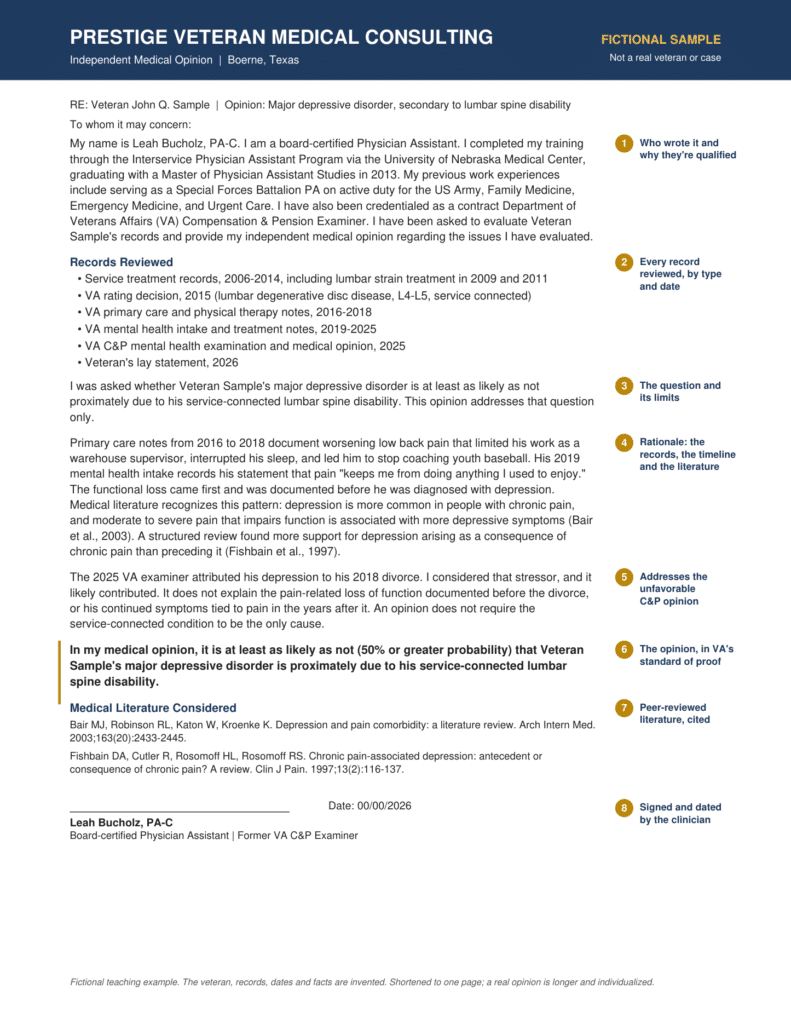
Every Prestige letter includes:
- the clinician’s written opinion,
- a rationale tied to your records and the medical literature,
- the clinician’s credentials,
- a list of every record the clinician reviewed.
What happens if the records don’t support a favorable opinion?
The $200 records review is a real clinical review, not a sales call. The clinician reads your records and forms an honest opinion before anyone discusses a letter.
- If the records support a favorable opinion, we tell you and you decide whether to order the letter.
- If they don’t, we tell you that plainly and explain why, such as a missing diagnosis, a gap in the timeline or no medical mechanism the records support. We don’t write a letter in that case, and you aren’t billed for one.
The letter fee pays for the clinician’s time to write and document the opinion. It doesn’t buy a conclusion. The opinion comes first, and it doesn’t change based on whether a letter is ordered.
The $200 review isn’t refundable, but it never expires. If you get new records later, such as a new diagnosis, a sleep study or a C&P exam, we can review them again without another review fee. Ready to see whether our clinician can help? Start your records review.
Do multiple conditions cost more?
Yes. Each claimed condition needs its own letter, at $600 (standard) or $800 (express). There’s no multi-condition discount, but you pay the $200 records review only once.
Does the condition change the price?
No. We charge the same per letter for sleep apnea, PTSD, back conditions and other claims. Each type of opinion has to answer different medical questions, though. See our sleep apnea, PTSD and MST nexus letter pages for what those opinions need to cover.
Do you offer payment plans?
Yes. We can work with you on a payment plan based on your needs. All fees must be paid in full before your letter is completed and released. Our fees are flat and listed up front, so you’ll know the total before you start. Contact us to set up a plan. If cost is a concern, you can also start with the free options below, or ask your accredited representative whether an independent opinion is needed for your claim.
Can you get a nexus letter for free?
Sometimes. Start here:
- Your VA provider. VA policy says VA providers, when asked, must help patients complete medical forms and provide medical statements about their condition and how it affects them (VHA Directive 1134(3)). The same directive says service connection is a legal decision that belongs to VBA. It also says VA providers who choose to give causation opinions must include a clear rationale. So a VA provider may describe your condition but decline to write a nexus opinion.
- Your private doctor. Some will write one at little or no cost.
- Your accredited representative. VSOs help with claims for free. Accredited attorneys and agents handling an appeal sometimes arrange or advance the cost of an opinion.
If your doctor won’t write one, see What to Do If Your Doctor Won’t Write a Nexus Letter.
Red flags to avoid
VA warns veterans about unaccredited “claims predators” who charge large fees, use high-pressure tactics and make false promises (VA News). Federal law also bars accredited attorneys and agents from charging fees for VA claim services before VA issues its initial decision (38 U.S.C. § 5904(c)(1)). Paying for medical services, such as a records review or an independent medical opinion, is a separate matter.
Be cautious of anyone who:
- charges a percentage of your future benefits for medical evidence,
- guarantees approval or a specific rating,
- asks for your VA.gov login or bank account access,
- offers to write a “favorable” letter before reviewing your records.
A medical opinion provider should charge a clear flat fee for the medical work and should never promise an outcome.
How to choose a provider
- Ask who will write the opinion and what their credentials are.
- Ask for the total cost and the turnaround in writing, including any review fee.
- Ask what happens if the records don’t support a favorable opinion.
- Ask to see a redacted sample.
- Ask your accredited representative whether an independent opinion makes sense for your case.
FAQs
How much does a nexus letter cost?
Most private letters cost about $500 to $1,500 per condition. At Prestige, it’s a one-time $200 records review, then $600 per letter (standard) or $800 (express).
Is the records review included in the $600?
No. The $200 records review is a separate, one-time fee. It never expires and covers unlimited re-reviews when you get new records.
How long does a nexus letter take?
Standard letters are typically done in 7 days or less once we have all the required information. Express is as fast as 48 hours. We can sometimes do 24 hours, case by case, for an additional charge.
Do you offer payment plans?
Yes. We can set up a payment plan based on your needs. All fees must be paid before your letter is completed.
What if the records don’t support a favorable opinion?
We tell you why, and we don’t bill you for a letter. The $200 review isn’t refundable, but it covers re-review when you have new records.
Is a nexus letter worth it?
It can be, if your records don’t already show a clear medical link or a C&P examiner gave an unfavorable opinion. A letter doesn’t guarantee approval. VA weighs all the evidence, and when the evidence for and against is about evenly balanced, VA must give you the benefit of the doubt (38 U.S.C. § 5107(b)).
Can any doctor write one?
Any clinician qualified by education, training or experience on the medical question can (38 CFR § 3.159). What matters most is the reasoning.
Market prices were checked against the sources linked above on November 8, 2026.
Disclaimer: Prestige Veteran Medical Consulting is not a law firm, accredited claims agent or VSO, and isn’t affiliated with VA. We’re happy to work with your accredited representative.