

Eligibility for Total Disability based on Individual Unemployability (TDIU) generally depends on whether a veteran meets specific VA requirements related to service-connected disabilities and occupational impairment. Sometimes, they are denied or delayed because rating thresholds, employment history, medical evidence, and functional limitations were not clearly presented.
Understanding what factors the VA looks for can help whether you’re applying for the first time or appealing a denial.
According to the Disabled American Veterans, over 4 million U.S. veterans receive VA compensation benefits, including about 350,000 receiving TDIU. Of those, nearly 200,000 are age 65 or older.
 For TDIU qualification, the VA generally considers whether a veteran can maintain substantially gainful employment, often defined as work producing earnings above the poverty level. There is no single fixed “salary cap” for TDIU because the VA often compares annual earned income to the current federal poverty threshold, updated annually by the U.S. Census Bureau.
For reference, the 2026 federal poverty level for one person is $15,960 and increases by $5,680 per family member.
If earnings exceed the amount, the VA may look further at whether the job is genuinely competitive employment or a protected work environment.
For TDIU qualification, the VA generally considers whether a veteran can maintain substantially gainful employment, often defined as work producing earnings above the poverty level. There is no single fixed “salary cap” for TDIU because the VA often compares annual earned income to the current federal poverty threshold, updated annually by the U.S. Census Bureau.
For reference, the 2026 federal poverty level for one person is $15,960 and increases by $5,680 per family member.
If earnings exceed the amount, the VA may look further at whether the job is genuinely competitive employment or a protected work environment.
What Is TDIU?
TDIU is a VA benefit that pays veterans at the 100% disability rate whose service-connected disabilities prevent them from securing or maintaining substantially gainful employment, even if their schedular combined rating is less than 100%. Through this program, the VA looks beyond rating percentages and considers an important question: Can this veteran realistically maintain employment that provides meaningful financial support? If the answer is no due to service-connected conditions, TDIU may allow payment at the same level as a veteran rated 100% disabled. Common disabilities linked to TDIU claims include:- PTSD, anxiety, or depression
- Chronic pain and back injuries
- Migraines
- Knee, shoulder, or orthopedic limitations
- Heart disease
- Respiratory conditions
- Neurological disorders
- Multiple combined disabilities that reduce work capacity
VA TDIU Pay Rate
As of 2026, veterans approved for TDIU are paid at the same rate as a 100% VA disability rating, which starts at $3,938.58 per month for a single veteran with no dependents. This monthly compensation increases if the veteran has a spouse, children, dependent parents, or qualifies for certain additional benefits. You can verify the latest rates directly on the official VA website.What are TDIU Requirements?
Under 38 C.F.R. § 4.16, TDIU benefits may be granted when the following key requirements are met:- You must have at least one service-connected disability, and
- That disability (or multiple disabilities together) must keep you from securing or following substantially gainful work.
1. You Must Have Service-Connected Disabilities
For a veteran to qualify for TDIU, the condition that limits their ability to work must be connected to military service. Non-service-connected conditions, age, or unrelated limitations are generally not the basis for approval. Qualifying disabilities may be physical, mental, or a combination of both, such as PTSD, orthopedic injuries, migraines, heart disease, or chronic pain.2. Rating Thresholds (Schedular TDIU)
Many TDIU claims are reviewed under the schedular rating thresholds in 38 CFR 4.16(a), which apply when a veteran satisfies the minimum disability percentage standards. The 70/40 Rule A veteran may qualify if either of these applies:- One service-connected disability rated at 60% or higher
- Two or more service-connected disabilities with:
-
- at least one disability rated 40% or higher, and
- a combined rating of 70% or more
3. You Must Be Unable to Maintain Substantially Gainful Employment
According to 38 CFR § 4.16, the VA may assign total disability ratings for IU compensation when the veteran is unable to secure or follow a “substantially gainful occupation” as a result of service-connected disabilities. For TDIU purposes, “substantially gainful employment” generally means work that provides earnings above the poverty threshold. The phrase, central to most TDIU claims, reflects whether the work is stable and competitive in the regular job market. However, income is not the only consideration. Under Ray v. Wilkie, the VA can assess your ability to engage in substantially gainful work using both economic and non-economic factors.- Economic Factors – annual earned income, hours worked, and consistency of earnings.
- Non-Economic Factors – education, training, work history, and physical/mental ability to sustain reliable employment.
- Nature of the Job – whether the job role is sheltered, protected, or requires unusual accommodations due to service-connected conditions.
What Happens If You Do Not Meet TDIU Rating Requirements?
If veterans do not meet the percentage requirements for schedular TDIU, but their service-connected disabilities still prevent substantially gainful employment, then VA may consider extraschedular TDIU under 38 C.F.R. § 4.16(b). When the evidence reasonably indicates eligibility, VA refers the claim to the Director of Compensation Service for extraschedular consideration. Evidence related to the veteran’s service-connected limitations, work history, earnings records, education, and vocational background may be assessed before issuing a decision. After the Director issues a decision, the Board independently reviews the case and may grant the veteran 100% TDIU compensation if unemployability due to service-connected disabilities is established.Important Distinction
Extraschedular TDIU differs from an extraschedular rating under 38 C.F.R. § 3.321(b)(1). An extraschedular rating may be considered when a veteran’s exceptional or unusual disability is not adequately reflected by the VA rating schedule, potentially resulting in a higher rating if granted. In some appropriate cases, a veteran may still work full-time. Overall, TDIU requirements are not only about ratings, but also about how service-related disabilities affect real employability. Consulting a VA-accredited representative may help you understand the process.What Are VA TDIU Income Limits?
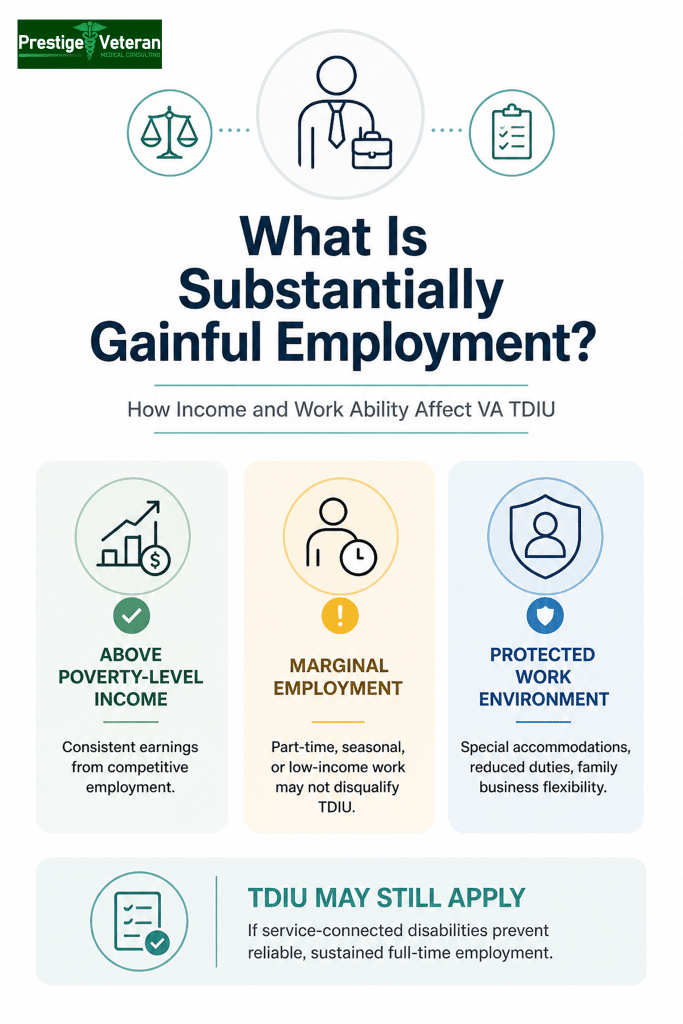 For TDIU qualification, the VA generally considers whether a veteran can maintain substantially gainful employment, often defined as work producing earnings above the poverty level. There is no single fixed “salary cap” for TDIU because the VA often compares annual earned income to the current federal poverty threshold, updated annually by the U.S. Census Bureau.
For reference, the 2026 federal poverty level for one person is $15,960 and increases by $5,680 per family member.
If earnings exceed the amount, the VA may look further at whether the job is genuinely competitive employment or a protected work environment.
For TDIU qualification, the VA generally considers whether a veteran can maintain substantially gainful employment, often defined as work producing earnings above the poverty level. There is no single fixed “salary cap” for TDIU because the VA often compares annual earned income to the current federal poverty threshold, updated annually by the U.S. Census Bureau.
For reference, the 2026 federal poverty level for one person is $15,960 and increases by $5,680 per family member.
If earnings exceed the amount, the VA may look further at whether the job is genuinely competitive employment or a protected work environment.
Protected Work Environment
The VA may also consider whether the veteran works in a protected work setting. A veteran may earn above the poverty threshold but still receive accommodations not normally found in competitive employment. When working in a family business, a sheltered workplace, or with a flexible employer, special accommodations may include:- Tolerance for missed work
- Reduced workload
- Extra breaks beyond normal standards
- Flexible duties
- Excused productivity expectations
Marginal Employment
Work below the poverty threshold is often considered marginal employment, which may not necessarily bar VA consideration for a TDIU claim. Though it is not deemed as substantially gainful, marginal employment may involve:- Low-income part-time work
- Temporary odd jobs
- Seasonal side work
- Some protected work environments
How to File a VA TDIU Application
Here are the common steps to apply for VA unemployability benefits.1. Confirm Your Eligibility
To apply for VA Total Disability Individual Unemployability (TDIU), check if you meet the eligibility requirements. If you have not filed for disability compensation yet, submit that claim first, often using VA Form 21-526EZ.2. Complete VA Form 21-8940
The main TDIU application requires VA Form 21-8940, officially called Veteran’s Application for Increased Compensation Based on Unemployability. It asks for:- Your service-connected conditions
- The date your disability started preventing you from working
- Treatment received in the last 12 months
- Education and training
- Your last five years of employment history (the last five years you worked, not the previous five calendar years)
3. Submit VA Form 21-4192
Ask your recent employers to complete VA Form 21-4192 (Request for Employment Information in Connection with Claim for Disability Benefits). Submitting this form will help you verify how your disability affected your work.4. Gather Evidence Showing Unemployability
When filing for VA TDIU disability, you can strengthen your claim with supporting documents, such as:- Doctor’s opinion
- VA and private medical records
- Vocational expert opinion
- SSD records, earnings records, and tax returns
- Personal statement
- Lay statements from colleagues, supervisors, or family members
5. File Your TDIU Claim
Applications can be filed online through VA.gov, by mail, in person at a local VA office, or through an accredited claims agent.6. Prepare for a VA C&P Examination
As your claim progresses, the VA may schedule a Compensation & Pension exam to assess your condition and eligibility for TDIU benefits. Attending the appointment as scheduled can avoid delays.7. Track Your Claim
Check your claim status regularly through VA.gov, calling the VA at 800-827-1000, or by working with your accredited representative. Quickly respond to any further VA requests.Getting the Correct TDIU Effective Date
If approved for TDIU, the effective date determines when your monthly payments and retroactive back pay begin. While VA often uses the date you filed the application, earlier evidence already showing you were unemployable because of service-connected disabilities may support an earlier date. Since the assigned date can significantly affect back pay, review your decision letter carefully and discuss with an accredited representative if the date appears incorrect.Evidence That Can Help Fulfill TDIU Requirements
To support a claim for Individual Unemployability, evidence must show how service-connected conditions affect the ability to secure or maintain substantially gainful work. Strong supporting evidence can influence how clearly the VA understands unemployability.1. Income and Earnings Records
Financial records help establish marginal employment or reduced earning capacity. Helpful documents may include:- Tax returns (recent years)
- W-2s or 1099s
- Pay stubs
- Social Security earnings history statements
- Payroll records showing reduced hours or intermittent work
2. Medical Records
Medical evidence is often the foundational part of a successful TDIU claim as it explains why work is difficult or no longer sustainable. Useful records include:- VA and private treatment notes
- Diagnostic testing and specialist reports
- Compensation & Pension (C&P) exam findings, if available
- Functional assessments
- Medication side effects
3. Medical or Vocational Opinion Letters
When proving eligibility for TDIU, an independent medical opinion (IMO) that clearly explains how your “service-connected” disability or disabilities limit your earning capacity can be persuasive. These letters should come from qualified professionals such as licensed physicians, psychologists, psychiatrists, or vocational experts. A medical opinion should state that it is “more likely than not” that you’re unable to secure or maintain gainful employment due to your service-connected disabilities. Strong opinions that connect symptoms like problems with attendance, focus, lifting, sitting, standing, or social interaction directly to occupational impairments may carry greater weight than general statements. Make sure the provider reviews all your service-connected conditions together and supports the opinion with medical records, work history, and ongoing symptoms.4. Work History and Employer Documentation
The VA considers your education, training, and past job duties when reviewing a TDIU claim. Apart from VA Form 21-8940 and VA Form 21-4192, supporting evidence that may demonstrate your limited work capacity includes:- Attendance records
- Performance warnings
- Reduced hours notices
- Termination or resignation records tied to limitations
- Statements explaining failed work attempts
5. Vocational Expert Opinions
A vocational expert can analyze your medical records, education, job history, and transferable skills to explain why you cannot maintain competitive employment. These reports may be especially useful when multiple disabilities combine to prevent steady work that individual VA medical exams may not fully address.6. Social Security Disability Decisions
If you were approved for SSDI or SSI, those records may contain medical and work capacity findings that can support your claim. While Social Security uses different legal rules, VA may still consider the evidence for an IU claim.7. Lay Statements and Personal Testimony
Statements from you, family members, friends, or former coworkers can describe daily struggles that medical records may miss. For instance, a coworker’s statement may include, “He often had trouble concentrating during meetings, forgot simple tasks, and had to leave early because of mental exhaustion”.8. VA Vocational Rehabilitation Records
Records from VA Vocational Rehabilitation & Employment (VR&E) may also help, particularly if they show barriers to retraining, your inability to complete rehabilitation goals, or findings that employment was not currently feasible. Consult a Veterans Service Officer (VSO) or attorney to ensure your submission meets expected standards and leads to a more persuasive VA claim.Is It Allowed to Work With TDIU?
Yes, in some situations. A common misunderstanding is that TDIU means a veteran cannot do any work at all. That is not always accurate. Some veterans may still do limited work, such as:- Part-time work
- Seasonal work
- Self-employment with low earnings
- Gig or odd jobs
- Work in a protected setting, such as a family business or sheltered workplace
Can the VA Terminate TDIU?
TDIU benefits can be reviewed and, in some cases, reduced or terminated if the VA finds you no longer meet eligibility requirements. These benefits are not always considered permanent, so periodic review may occur.Possible Reasons May Include:
Significant Improvement If updated medical records or re-examinations show your service-connected condition has improved enough that you can maintain substantially gainful employment, the VA may propose ending TDIU. Sustained Gainful Employment Under 38 C.F.R. § 3.343(c)(2), if a veteran returns to substantially gainful work and maintains that employment for 12 consecutive months, the VA may move to discontinue TDIU. Short-term or unsuccessful work attempts usually do not automatically trigger termination. Income or Employment Verification Issues The VA may compare wage data with records from agencies such as the Social Security Administration. If employment is suspected, the veteran may receive VA Form 21-4140 (Employment Questionnaire). Failure to respond to this form can place benefits at risk. Fraud or Misrepresentation Knowingly hiding employment, submitting false statements, or receiving benefits dishonestly can lead to termination and possible legal consequences. Protected Work Environment Work involving major accommodations, family assistance, or sheltered duties may not count the same as ordinary, substantially gainful employment, depending on the facts.Important Protection for TDIU Benefits
The VA generally cannot stop TDIU without proper notice and due process. Veterans are typically sent a proposed reduction letter and given time to submit evidence. They may request a hearing within 30 days, with 90 days to respond. As mentioned in 38 C.F.R. § 3.343(c), the VA must show actual employability with clear and convincing evidence before final action is taken. If benefits are ended unfairly, the decision can be appealed.Can TDIU Be Permanent and Total?
Yes, in some cases. When the VA believes a veteran’s service-connected conditions are unlikely to significantly improve, TDIU benefits may be considered permanent and total (P&T). Though it pays compensation at the 100% disability rate due to unemployability, TDIU does not automatically grant P&T status. Veterans may notice possible signs of P&T status by reviewing language in rating decisions or benefit summaries, such as:- Permanent and Total designation
- No routine future exams scheduled
- Eligibility for related dependent benefits like Chapter 35 DEA or CHAMPVA
Common Misunderstandings About TDIU Requirements
Let’s debunk some of the most common misunderstandings about TDIU so you can better understand how eligibility is actually evaluated.“I Need a 100% Rating First”
No. TDIU often exists for veterans who are not schedularly rated 100%.“If I Work at All, I’m Disqualified”
Not necessarily. Marginal, low-income, or protected work may still fit within TDIU eligibility.“My Age Helps My Claim”
Age is generally not a factor in TDIU decisions.“Non-Service Conditions Count the Same”
The VA primarily evaluates service-connected disabilities for TDIU purposes.Why TDIU Claims May Be Denied
Many veterans assume that having a severe disability automatically qualifies them for TDIU, but their claims can get denied if the evidence doesn’t clearly show their inability to perform work. Understanding the most common reasons behind claim denials can help strengthen a claim from the start.1. Inadequate Medical and Functional Evidence
A TDIU claim may be denied when medical records verify a diagnosis but inadequately explain how the condition affects work ability. Missing evidence on functional impact, such as pain, flare-ups, absenteeism, lifting limits, or inability to maintain pace, can weaken VA unemployability claims.2. Weak Link Between Disability and Job Loss
The VA typically looks for evidence showing that service-connected conditions caused employment challenges. When medical records fail to clearly link job-related issues such as absences, conflicts at work, declining performance, or termination to those disabilities, a claim can be denied.3. Assumptions About “Sedentary Work” Standards
Sometimes, veterans are denied IU benefits if the VA determines they can do sedentary or desk work. However, desk jobs still require sitting for long hours, focusing consistently, and using a computer, which may be difficult or impossible due to severe pain, PTSD, memory issues, or drowsiness.4. Rating Requirements Not Met
TDIU claims can be denied when disability ratings do not satisfy standard schedular criteria. Still, extraschedular consideration is an available option if the evidence shows that service-related disabilities are a barrier to substantially gainful employment.5. Misunderstanding Substantially Gainful Employment
TDIU claims may be denied when the nature of part-time, sheltered, protected, or low-income work is not fully explained. Without clear documentation, the VA may treat this type of employment as proof that a veteran can still work, even when the job income is limited or specially accommodated.Appeals Options After a Denial
Under the Appeals Modernization Act (AMA), veterans have multiple ways to challenge an unfavorable decision, based on what went wrong in the TDIU claim.- A Higher-Level Review asks a senior reviewer to reexamine the file for errors.
- A Supplemental Claim allows new and relevant evidence, such as updated medical opinions or employment records.
- An appeal to the Board of Veterans’ Appeals offers a deeper review when the dispute is more complex.
Final Thoughts
TDIU requirements are often misunderstood because approval is not based on ratings alone. A veteran may have less than a 100% schedular rating yet still qualify for full compensation when service-connected conditions make reliable employment unrealistic. The strongest claims present the full picture: medical limitations, failed work attempts, reduced earnings, and how daily symptoms affect job consistency and productivity. For veterans whose ability to work has been reduced by service-related disabilities, TDIU can provide 100% benefits and the greater financial stability they have earned.Frequently Asked Questions (FAQs)
What are the types of VA TDIU?
Schedular and extraschedular are the two types of TDIU, both regulated under 38 CFR 4.16.How to get approved for TDIU VA?
When filing for TDIU, submit medical records, work history, and vocational and lay evidence showing that your service-connected disabilities prevent you from keeping substantially gainful employment.Which is better, Individual Unemployability or Permanent and Total Benefits?
Neither can be viewed as “better,” as they serve different purposes. If you cannot maintain gainful employment, TDIU can be valuable. If your condition is total and not expected to improve, P&T may provide longer-term stability.What TDIU benefits can the spouse of a veteran get?
If a veteran’s TDIU is designated as permanent and total, their spouse may become eligible for benefits such as CHAMPVA healthcare, DEA Chapter 35 education assistance, and, in the case of a death, certain survivor benefits.Can veterans over the age of 65 qualify for VA unemployability?
Yes, veterans aged 65 or older can still qualify for TDIU since the VA evaluates how service-connected disabilities affect employability rather than age alone.Also Read: How Much are Monthly TDIU Benefits for Veterans in 2026?
At Prestige Veteran Medical Consulting, a veteran-owned company, we specialize in Independent Medical Opinions (IMOs) known as Nexus letters. Our purpose is to empower YOU, the veteran, to take charge of your medical evidence and provide you with valuable educational tools and research to guide you on your journey. Understanding the unique challenges veterans face, our commitment lies in delivering exceptional service and support. Leveraging an extensive network of licensed independent medical professionals, all well-versed in the medical professional aspects of the VA claims process, we review the necessary medical evidence to incorporate in our reports related to your VA Disability Claim. Prestige Veteran Medical Consulting is not a law firm, accredited claims agent, or affiliated with the Veterans Administration or Veterans Services Organizations. However, we are happy to discuss your case with your accredited VA legal professional.