

The VA disability system is built on evidence, not sympathy. Yet many veterans are told their case cannot be proven, leading to years of appeals, denials, and frustration. This guide explains what “unprovable” means, why some claims are harder to win than others, and what steps veterans can take to support denied or stalled cases.
Table of Contents
The Truth About “Unprovable” VA Disability Claims
When veterans hear about VA disability claims that cannot be proven, it often reflects a misunderstanding of VA rules rather than an absolute legal barrier. A veteran’s disability claim becomes “unprovable” only when it fails to meet foundational requirements of a valid service connection (as discussed later).
Some claims also fail because the VA does not legally recognize the condition as a disability or is barred from awarding compensation under federal regulations. Understanding why the VA considers a claim unprovable is the first step toward restructuring it into a viable path for service connection.
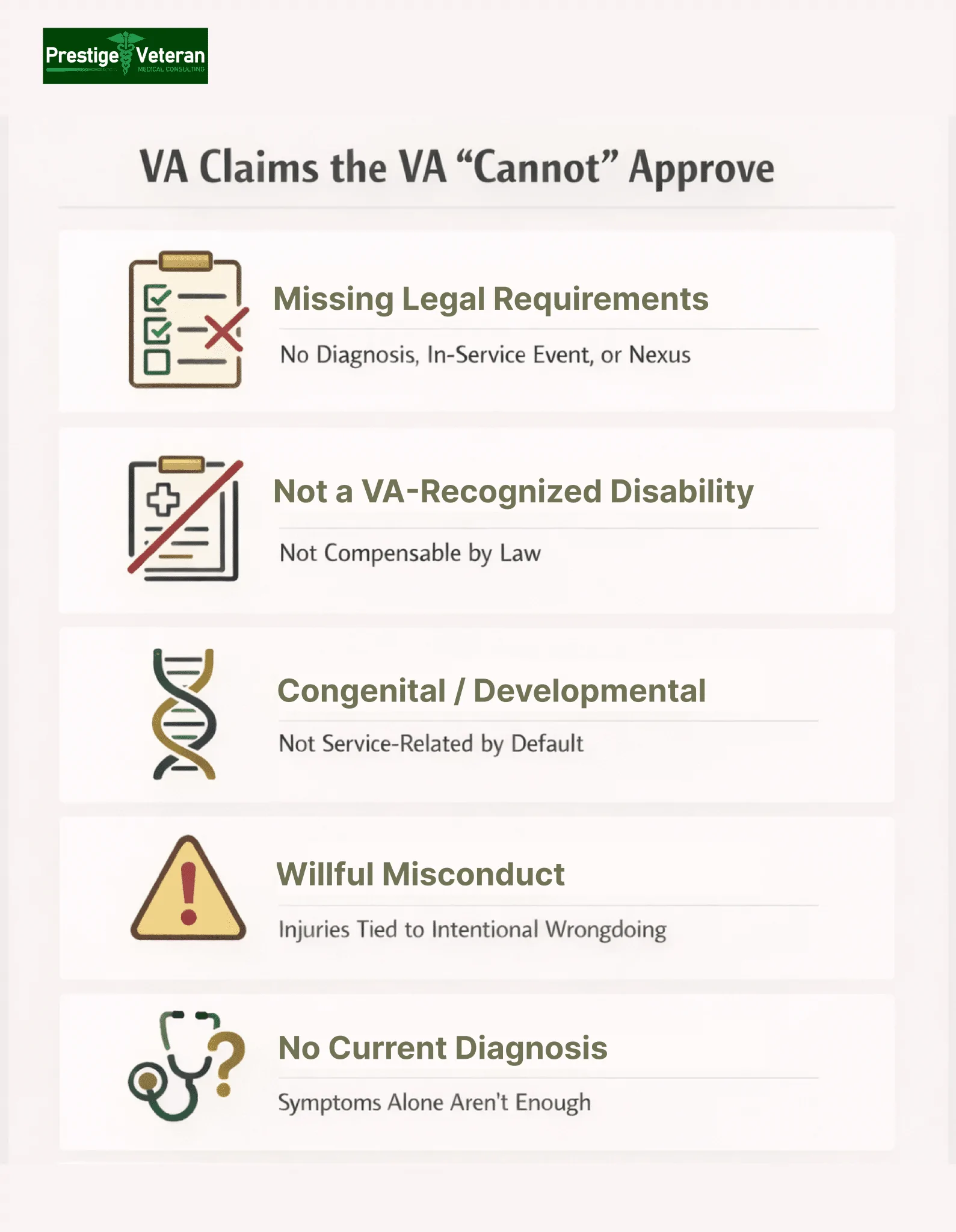
Veteran Disability Claims The VA “Cannot” Approve
Despite widespread belief, there are very few VA disability claims that cannot be proven in absolute terms. Let’s explore each of them.
1. Claims That Do Not Meet the Basic Eligibility Requirements
Every VA claim must satisfy three elements:
- A current medical diagnosis,
- An in-service event, injury, disease, or aggravation, and
- A nexus showing the two are “at least as likely as not” related.
If any one of these is missing, the VA generally cannot grant the claim. For example, a veteran filing for knee pain without a medical diagnosis has no legally recognizable disability to rate though there are limited exceptions in cases where pain alone results in functional impairment.. Similarly, a diagnosis without proof of an in-service event leaves nothing to connect the condition back to military duty.
These claims are not rejected because they are unbelievable; they fail because the law requires specific proof.
2. Conditions the VA Does Not Recognize as Disabilities
Some conditions exist but cannot be rated under VA regulations as a compensable disability. Others are treated as clinical indicators rather than diseases causing functional impairment. When a claim is based on one of these findings, the VA has no disability to evaluate or service connect.
Hyperlipidemia (High Cholesterol):
High cholesterol, elevated triglycerides, or abnormal lipid panels are classified as laboratory findings but not disabilities. The VA does not assign ratings to test results. However, if high cholesterol contributes to a diagnosable condition such as coronary artery disease or hypertension, veterans may seek compensation for that underlying illness instead.
Obesity:
Obesity is not recognized as a disability by the VA. It is treated as a contributing factor rather than a condition that independently causes functional limitation. However, obesity may serve as an “intermediate step” in secondary service connection, as explained in VAOPGCPREC 01-17 (Jan. 6, 2017). It is important to note that this particular condition is in high debate and obesity is being considered as a stand alone disability but there are many legal actions going on to solidify this as a long term option.
For example, when a service-connected joint injury leads to weight gain, it then causes sleep apnea or diabetes.
Infertility:
Infertility by itself is not compensable because it is viewed as a symptom or outcome rather than a diagnosable disease. VA compensation may be available when infertility results from an underlying condition such as prostate cancer, endometriosis, or a service-connected hormonal condition.
These VA claims get denied because veterans often file for the symptom instead of the disease causing it.
3. Congenital, Genetic, and Developmental Conditions
Conditions present at birth, such as sickle cell disease, retinitis pigmentosa, or Huntington’s disease, are not considered military-related. The VA will deny claims unless there is clear medical evidence that military service permanently worsened the condition beyond its natural progression. Developmental defects like refractive eye error, personality disorders, and intellectual disabilities are also excluded from compensation.
Without documented proof of service-related aggravation, veterans will have these claims denied as legally barred.
4. Disabilities Resulting from Willful Misconduct
The VA does not award disability compensation for conditions caused directly by a veteran’s own intentional or reckless behavior. Injuries from illegal acts, deliberate self-harm, or voluntary substance abuse are generally excluded from service connection.
However, there is an important exception. If the misconduct was the result of a service-connected condition, such as PTSD leading to substance abuse, a secondary service connection may still apply. This distinction is frequently misunderstood and misapplied by VA examiners.
5. Claims Without a Current Diagnosis
A VA disability claim cannot proceed without a present, documented medical diagnosis. Past injuries that no longer cause impairment are not generally ratable. General complaints like “pain,” “fatigue,” or “trouble sleeping” do not qualify unless tied to a medically recognized condition that causes functional limitation. Even when veterans know a problem exists, the VA cannot evaluate or compensate for it without medical confirmation.
In many cases, an “unprovable” claim can be restructured under a proper diagnosis, secondary service connection, or aggravation theory that meets VA standards.
Hard vs. Easy VA Claims: What Gets Approved Most Often
While no claim is guaranteed, some successful patterns consistently emerge. Knowing which claims the VA considers more straightforward can help veterans focus their efforts and avoid unnecessary denials.
Conditions Often Considered Easiest VA Disability Claims to Win
Certain VA claims are the easiest to get approved because they rely on objective medical findings, are well-documented in service records, or are recognized as presumptively service-connected. For example:
- Tinnitus and hearing loss linked to documented occupational military noise exposure from aircraft, weapons, or machinery.
- Scars and musculoskeletal injuries (knee, back, and joint conditions) supported by service treatment records, imaging, range-of-motion testing, or surgical history.
- Combat-related PTSD established by verified stressors, combat awards, or service in hostile environments.
- Migraines documented in service or linked to secondary conditions such as traumatic brain injury (TBI), tinnitus, or PTSD through medical nexus opinions.
- Presumptive conditions tied to Agent Orange, Gulf War, burn pits, and Camp Lejeune contaminated water remove the need to prove direct causation under the VA law.
When the evidence is properly assembled and aligned, the VA can more easily establish the required nexus between service and disability.
VA Disabilities That Are Harder to Prove
Some VA disability claims face higher scrutiny, not because the conditions are uncommon, but because they rely on subjective symptoms, delayed onset, or strict evidentiary rules. The following claims are among the most challenging to prove and require a more strategic approach when filing.
Non-combat PTSD and other mental health disorders: Mental health claims require proof of a verified in-service stressor, a DSM-5 diagnosis and a medical nexus. In Military Sexual Trauma (MST) cases, the VA relies on “markers” such as sudden performance declines, counseling notes, or behavior changes.
Sleep apnea: The VA typically demands a polysomnography (sleep study) and a clear service connection or secondary theory (e.g., to rhinitis, deviated septum, PTSD, or obesity as an intermediate step).
Chronic fatigue syndrome and fibromyalgia: These invisible injuries are difficult to prove because they rely heavily on self-reported symptoms like fatigue, widespread pain, and cognitive impairment rather than objective testing.
Gulf War Illness: Gulf War Syndrome is often unprovable because symptoms often appear years after service. Veterans typically report medically unexplained chronic multisymptom illnesses (MUCMI) like fatigue, joint pain, headaches, memory problems, respiratory issues, and indigestion. These symptoms could be subjective and, hence, difficult to link to Gulf War service.
Toxic exposure claims: Exposure-based claims are tricky due to delayed onset and insufficient medical causation linking conditions to hazards, for instance, Agent Orange chemicals or burn pits.
Tinnitus and Hearing Loss: VA proposes to move from assigning a separate 10% tinnitus rating to treating it as a symptom of hearing loss or another service-connected disability (Federal Register, 2022). Also, veterans may lose their benefits if they fall outside the VA’s strict audiometric thresholds.
In reality, the difficulty lies not in legitimacy but in evidentiary standards.
Top Reasons Why VA Claims Are Denied
Even legitimate claims fail due to common procedural and evidentiary problems. The following issues are responsible for the majority of unfavorable decisions:
- Missing service records: Fires, deployments, classified missions, or failure to report injuries can erase proof of in-service events, leaving no documented trigger for the claim.
- Delayed treatment: Long gaps between discharge and medical care make it harder to show continuity, especially for conditions with gradual or delayed onset.
- No medical nexus: Providers may confirm a diagnosis but fail to state it is “at least as likely as not” related to service or a service-connected condition.
- Inconsistent reporting: Variations in symptoms, timelines, or stressor details can undermine credibility, especially in PTSD, MST, or chronic pain claims.
- Weak C&P exams: During VA Compensation and Pension exams, examiners may overlook functional impact, minimize severity, or rely on incomplete records.
These obstacles explain why some veterans believe they are filing “easy VA claims,” only to face denial. With clearer evidence and proper documentation, many disability claims can be strengthened and successfully reconsidered.
How to Prove a Claim That Seems Impossible
The VA’s burden of proof (“at least as likely as not” or 50/50 probability) is lower than many veterans realize. If the evidence is in relative balance, the law requires the decision to favor the veteran. Hence, claims labeled as unprovable can often be strengthened using evidence the VA is required to consider.
1. Consider Obtaining a Well-Reasoned Medical Nexus Letter
Most denials happen because the veteran’s C-file lacks a medical nexus between in-service events and today’s diagnosis, preventing the VA from linking the disability to military service.
A strong nexus letter explains the mechanism, onset, and continuity of the claimed disability using the legal phrase “at least as likely as not” required under VA evidentiary standards. For instance, “the veteran’s tinnitus is at least as likely as not due to high-decibel flight-line exposure documented by MOS.”
When establishing service connection, a detailed medical opinion should:
- Use the VA terminology: “at least as likely as not” related to service
- Reference your service history and medical records
- Explain the medical reasoning supported by peer-reviewed studies and clinical literature
- Address missing or delayed documentation
A veteran with migraines may fail on a direct claim but succeed when a specialist explains that the headaches are secondary to service-connected PTSD. For harder-to-prove disabilities such as PTSD, Gulf War illness, or fibromyalgia, this nexus letter bridges gaps when testing is limited.
Independent medical opinion providers who understand 38 C.F.R. Part 4 (Schedule for Rating Disabilities) can identify overlooked links and turn medical evidence into a winning claim.
2. Form the Service Connection with Lay or “Buddy” Evidence
When service records are incomplete, credible lay statements can corroborate service connection for VA disabilities, relying on subjective evidence such as mental health disorders, fibromyalgia, tinnitus, or chronic fatigue.
The VA accepts statements from veterans, family, coworkers, and fellow service members who can describe when symptoms began and how they continue to affect daily functioning.
When filing for impossible claims, lay evidence can supply powerful evidence of:
- Symptoms and injuries began during service but were never reported or treated
- Behavioral changes supporting military sexual trauma (MST) or mental health claims
- Continuity of symptoms after discharge
- Functional impact on work, relationships, and daily activities
If a traumatic event occurred during service but was never reported, statements from a fellow service member narrating the incident, plus family accounts of emotional distress after discharge, can establish continuity. Veterans can submit lay or witness statements to humanize the record and often fill gaps in missing documentation.
3. Consider Secondary Service Connection
Some conditions are easier to prove indirectly. If a service-connected disability caused or worsened another problem, file it as secondary (e.g., back injury leading to nerve pain). Likewise, conditions that develop secondary to a presumptive disability are rarely unprovable because the primary condition is already presumed service-connected.
Many disabilities are frequently approved when linked to an already service-connected condition, for instance:
- Sleep apnea secondary to rhinitis
- Migraines secondary to TBI
- Radiculopathy secondary to lumbar strain
Secondary VA claims, in certain cases, are easier to prove because they rely on medical causation (often explained by a nexus letter) rather than historical service records.
4. Leverage Presumptive Service Connection When Eligible
For certain exposures and timeframes, the VA presumes the nexus. Presumptive conditions tied to toxic exposure or specific deployments can remove the burden of proving direct causation if qualifying service criteria are met.
For example, Type 2 diabetes in Vietnam veterans or asthma diagnosed post burn pit exposure can convert a complex case into one of the easiest VA claims to win. Veterans only need to show qualifying service and a diagnosis.
5. Reframe Non-Ratable Conditions into Ratable Disabilities
Some claims truly fail as filed. While conditions like obesity, infertility, or high cholesterol are not disabilities in VA terms, the underlying disease, not the symptom, can be service-connected.
For example, chronic pain alone may not be rated unless tied to a diagnosed condition such as degenerative disc disease. This underrated strategy converts “unprovable” issues into possible VA claims.
6. Document Severity and Functional Impact in VA Language
Approval is not only about establishing service connection, but also about clearly demonstrating how the condition affects daily life, work, and overall functioning. Consistent treatment records, symptom diaries, and statements from employers or caregivers help show the true frequency, severity, and duration of your symptoms.
Translate your real-life limitations into the VA’s rating language: “panic attacks more than once weekly,” “requires continuous medication,” “missed 3–4 workdays/month.”
Submitting clear evidence of severity and functional impact strengthens VA disability claims that are otherwise difficult to prove.
Denied by the VA? Your Options for Appeals and Refiling
If your claim was rejected as “unproven,” the VA offers three review options under the Appeals Modernization Act (AMA) to transform it into a successful one.
Carefully review the VA’s decision letter to understand why your claim was denied and what evidence is needed.
- Supplemental Claim: Ideal when your denial was based on missing proof. Add new and relevant evidence that was not previously considered, such as a nexus letter, updated test results, or buddy statements, to directly address the evidentiary gap.
- Higher-Level Review (HLR): If you believe the VA made a legal or factual error based on the existing record, an HLR requests a fresh review by a more senior adjudicator. No new evidence is allowed; however, you may request an informal conference to point out mistakes.
- Board of Veterans’ Appeals (BVA): For complex denials, an appeal to the Board allows a Veterans Law Judge to review your claim. You can choose evidence submission, a hearing, or a direct review of the record.
Choosing the right appeal path depends on why your claim was denied and whether you can strengthen it with additional proof or review. Many veterans benefit from assistance from VA-accredited representatives or Veterans Service Organizations (VSOs).
Find out more about your decision review options on the VA’s official page.
Case Study: Winning a “Hard-to-Prove” VA Claim for Vestibular Disorder
After eight years in the Navy as a radar technician aboard guided-missile destroyers, Petty Officer Mark R. began suffering from sudden vertigo, nausea, and loss of balance about two years after leaving service. Civilian doctors eventually diagnosed him with a vestibular disorder, but his initial VA claim was denied as “unprovable” due to no in-service diagnosis and a delayed onset. Mark knew his symptoms began after repeated exposure to shipboard solvents and high-frequency noise, but lacked medical documentation from active duty.
With the help of a VA-accredited attorney and an independent medical specialist, Mark reframed his case and built evidence around medical causation and continuity rather than missing records. His team gathered targeted proof and resubmitted it as a Supplemental Claim.
Key evidence that turned the case around:
- An independent medical nexus letter stating the condition was “at least as likely as not” caused by chronic exposure to ototoxic chemicals and noise, documented by his MOS
- Buddy statements from two shipmates confirming frequent solvent use in enclosed radar rooms
- Employment records showing post-service work limitations due to vertigo episodes
- A specialist report explaining delayed-onset vestibular damage in similar occupational exposures
The VA granted service connection within four months, acknowledging the medical rationale and credible lay evidence. In this case, professional advocacy and a properly structured nexus transformed a seemingly “unprovable” claim into an approved disability award.
Final Thoughts
Claims labeled “unprovable” are rarely hopeless. The VA decides cases on structure and documentation, not on how deserving a story feels. When you secure a clear diagnosis, establish the in-service link, and present a strong medical nexus, many denials can become approvals. Seek qualified medical opinions, document how your condition affects your daily life, and work with VA-accredited representatives if needed. With the right strategy and guidance, many claims once rejected can ultimately be granted.
Frequently Asked Questions (FAQs)
What claims can the VA not prove?
The VA cannot prove claims as service-connected when there are:
- Absence of a diagnosis, in-service event, or medical nexus
- Non-compensable issues like high cholesterol, obesity, infertility, and congenital defects
- Willful misconduct
- Symptoms without a current diagnosis in many cases
What VA claims get approved the most?
Claims are approved most often when supported by strong medical documentation, clear service records, or qualifying presumptive exposure rules that reduce the burden of proof.
What is the hardest VA claim to get?
The hardest VA claims to get approved are often those involving mental health conditions, subjective symptoms, delayed diagnoses, or secondary conditions without a strong medical nexus.
How to refile my denied VA claim?
If your claim was denied due to missing information, you or your accredited legal professional may consider refiling using VA Form 20-0995 (Supplemental Claim) or one of the other appeal options mentioned previously and attach the new evidence when applicable depending on the appeal lane. Submit it online through VA.gov, by mail, or with the help of an accredited representative.
Also Read: 12 Signs Your VA Disability Claim May Get Approved: What to Look for
At Prestige Veteran Medical Consulting, a veteran-owned company, we specialize in Independent Medical Opinions (IMOs) known as Nexus letters.
Our purpose is to empower YOU, the veteran, to take charge of your medical evidence and provide you with valuable educational tools and research to guide you on your journey.
Understanding the unique challenges veterans face, our commitment lies in delivering exceptional service and support.
Leveraging an extensive network of licensed independent medical professionals, all well-versed in the medical professional aspects of the VA claims process, we review the necessary medical evidence to incorporate in our reports related to your VA Disability Claim.
Prestige Veteran Medical Consulting is not a law firm, accredited claims agent, or affiliated with the Veterans Administration or Veterans Services Organizations. However, we are happy to discuss your case with your accredited VA legal professional.