
Many veterans assume a 100% VA disability rating is the highest benefit available, but that is not always the case. VA Special Monthly Compensation (SMC), a tax-free monthly benefit, can pay significantly more when service-connected disabilities cause severe functional loss, housebound status, or the need for daily personal care. Yet many veterans do not realize this.
This guide covers the 2026 VA SMC rates, dependent increases, and who may qualify. Also, learn what medical evidence the VA may review when evaluating your claim.
Table of Contents
What is VA Special Monthly Compensation?
Special Monthly Compensation (SMC) is an additional tax-free benefit paid when qualifying disabilities or a combination of disabilities create severe functional loss, homebound status, or the need for daily personal assistance. Under 38 U.S.C. § 1114 and 38 C.F.R. § 3.350, the VA awards SMC on top of regular disability compensation to recognize hardships a service-connected injury or illness causes.
You may want to review SMC eligibility if you have:
- Amputation of one or more limbs or extremities
- Loss of use of a hand, foot, arm, or leg (where effective function is essentially gone)
- Physical loss of one or both eyes
- Blindness or severe loss of sight
- Permanent bedridden status
- Need for daily personal assistance with eating, dressing, bathing, mobility, or safety (Aid and Attendance)
- Loss of use of a creative organ
Why SMC Matters for Veterans
It is possible for two veterans with the same disability rating to face very different daily challenges. One may live independently, while another may need full-time care or live with severe multiple injuries. VA Special Monthly Compensation (SMC) helps recognize those differences by considering the overall impact of disabilities, not just individual ratings.
The purpose of SMC is to provide added financial support when service-connected conditions significantly limit independence, mobility, or quality of life.
VA Special Monthly Compensation 2026 Rates
The 2026 VA compensation rates became effective December 1, 2025, following the annual Cost-of-Living Adjustment (COLA). By law, VA disability and SMC rates must match the same COLA percentage applied to Social Security benefits. This yearly increase helps veterans maintain purchasing power as inflation raises everyday living costs.
That means eligible veterans saw their monthly Special Monthly Compensation rise for 2026 compared with prior-year rates.
VA SMC-K and SMC-Q Rates
These are special payment variations.
| SMC Level | Monthly Rate |
| SMC-K | $139.87 (added on top of another disability compensation rate) |
| SMC-Q | $67.00 (a protected rate the VA hasn’t awarded since August 19, 1968) |
VA SMC Rates for Veterans Without Children
SMC L through N Rates
| Dependent Status | SMC-L | SMC-L½ | SMC-M | SMC-M½ | SMC-N |
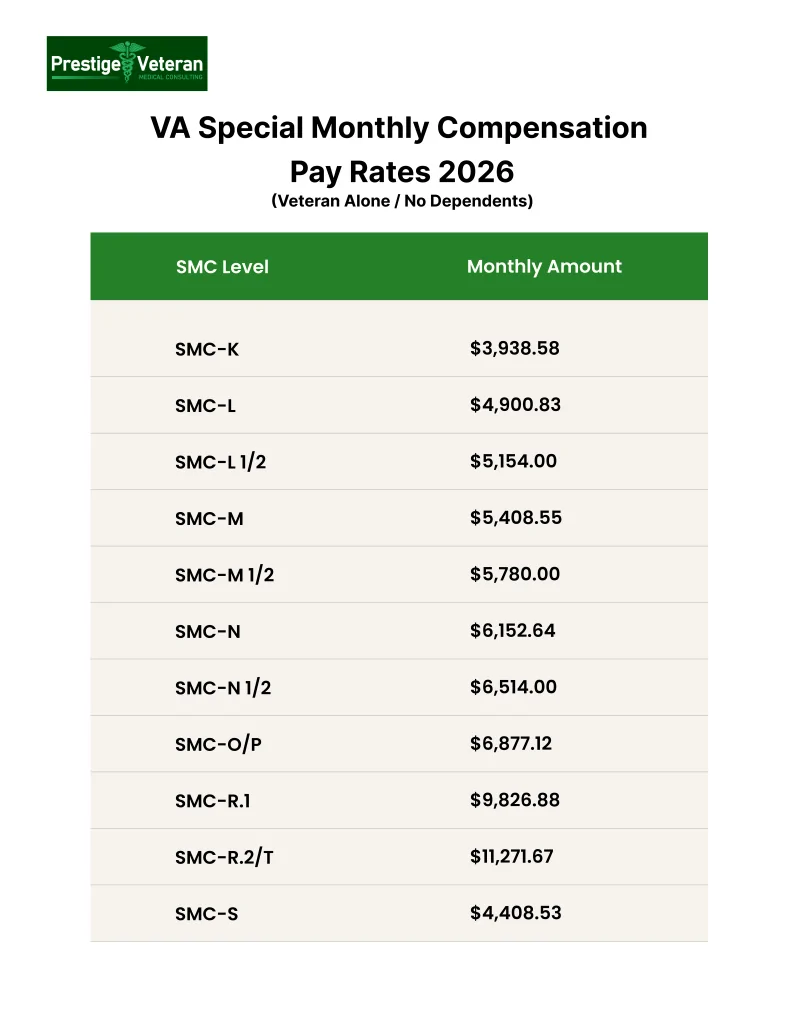
| Veteran alone | $4,900.83 | $5,154.00 | $5,408.55 | $5,780.00 | $6,152.64 |
| With spouse | $5,120.42 | $5,373.59 | $5,628.14 | $5,999.59 | $6,372.23 |
| With spouse + 1 parent | $5,296.66 | $5,549.83 | $5,804.38 | $6,175.83 | $6,548.47 |
| With spouse + 2 parents | $5,472.90 | $5,726.07 | $5,980.62 | $6,352.07 | $6,724.71 |
| With 1 parent | $5,077.07 | $5,330.24 | $5,584.79 | $5,956.24 | $6,328.88 |
| With 2 parents | $5,253.31 | $5,506.48 | $5,761.03 | $6,132.48 | $6,505.12 |
Added Amount
| Additional Benefit | Amount |
| Spouse receiving Aid & Attendance | $201.41 |
SMC N½ through S Rates
| Dependent Status | SMC-N½ | SMC-O/P | SMC-R1 | SMC-R2/T | SMC-S |
| Veteran alone | $6,514.00 | $6,877.12 | $9,826.88 | $11,271.67 | $4,408.53 |
| With spouse | $6,733.59 | $7,096.71 | $10,046.47 | $11,491.26 | $4,628.12 |
| With spouse + 1 parent | $6,909.83 | $7,272.95 | $10,222.71 | $11,667.50 | $4,804.36 |
| With spouse + 2 parents | $7,086.07 | $7,449.19 | $10,398.95 | $11,843.74 | $4,980.60 |
| With 1 parent | $6,690.24 | $7,053.36 | $10,003.12 | $11,447.91 | $4,584.77 |
| With 2 parents | $6,866.48 | $7,229.60 | $10,179.36 | $11,624.15 | $4,761.01 |
Added Amount
| Additional Benefit | Amount |
| Spouse receiving Aid & Attendance | $201.41 |
VA SMC Rates for Veterans With Dependents (Including Children)
SMC L through N
| Dependent Status | SMC-L | SMC-L½ | SMC-M | SMC-M½ | SMC-N |
| Veteran with 1 child | $5,047.68 | $5,300.85 | $5,555.40 | $5,926.85 | $6,299.49 |
| 1 child + spouse | $5,281.24 | $5,534.41 | $5,788.96 | $6,160.41 | $6,533.05 |
| 1 child + spouse + 1 parent | $5,457.48 | $5,710.65 | $5,965.20 | $6,336.65 | $6,709.29 |
| 1 child + spouse + 2 parents | $5,633.72 | $5,886.89 | $6,141.44 | $6,512.89 | $6,885.53 |
| 1 child + 1 parent | $5,223.92 | $5,477.09 | $5,731.64 | $6,103.09 | $6,475.73 |
| 1 child + 2 parents | $5,400.16 | $5,653.33 | $5,907.88 | $6,279.33 | $6,651.97 |
Added Amounts
| Additional Dependent | Amount |
| Each additional child under 18 | $109.11 |
| Each additional child over 18 in a qualifying school | $352.45 |
| Spouse receiving Aid & Attendance | $201.41 |
SMC N½ through S
| Dependent Status | SMC-N½ | SMC-O/P | SMC-R1 | SMC-R2/T | SMC-S |
| Veteran with 1 child | $6,660.85 | $7,023.97 | $9,973.73 | $11,418.52 | $4,555.38 |
| 1 child + spouse | $6,894.41 | $7,257.53 | $10,207.29 | $11,652.08 | $4,788.94 |
| 1 child + spouse + 1 parent | $7,070.65 | $7,433.77 | $10,383.53 | $11,828.32 | $4,965.18 |
| 1 child + spouse + 2 parents | $7,246.89 | $7,610.01 | $10,559.77 | $12,004.56 | $5,141.42 |
| 1 child + 1 parent | $6,837.09 | $7,200.21 | $10,149.97 | $11,594.76 | $4,731.62 |
| 1 child + 2 parents | $7,013.33 | $7,376.45 | $10,326.21 | $11,771.00 | $4,907.86 |
Added Amounts
| Additional Dependent | Amount |
| Each additional child under 18 | $109.11 |
| Each additional child over 18 in a qualifying school | $352.45 |
| Spouse receiving Aid & Attendance | $201.41 |
Before making financial or claims decisions, verify the latest payment amounts through the official page: VA Special Monthly Compensation Rates.
What is the Highest VA SMC Rate in 2026?
The highest VA SMC monthly rate in 2026 is for SMC-R2/T with a spouse, two parents, and one child. The monthly compensation amount for this category is $12,004.56.
Additional Compensation for Eligible Dependents
Veterans receiving SMC may qualify for higher monthly payments when they have eligible dependents, including a spouse, child, or parent. This can significantly increase total VA benefits, especially for larger households or families with special care needs.
2026 Added Monthly Dependent Amounts
- Each additional child under age 18: $109.11
- Each additional child over age 18 in a qualifying school program: $352.45
- Spouse receiving Aid and Attendance: $201.41
Updating Dependents to Receive Full VA Benefits
To receive these higher payments, veterans should make sure all dependents are properly listed with the VA. Update Aid and Attendance status when required.
If your family situation changes due to marriage, divorce, a child turning 18, school enrollment, or a parent becoming financially dependent, update the VA records to avoid any delay or reduced benefits.
How to Calculate Your 2026 SMC Payment
- Find your approved SMC category (such as L, M, N, S, R1) from your VA rating decision.
- Locate your family status in the VA rate chart (alone or with spouse, parent, child)
- Use that number as your base monthly payment.
- Add amounts for any qualifying extras (additional children under 18, children in approved school programs, or spouse Aid and Attendance benefits).
- Include SMC-K add-ons, if awarded.
Example 1: Veteran with Spouse and One Child
A veteran rated SMC-L with a spouse and one child receives a base monthly payment of $5,281.24.
No other dependents apply.
Total Monthly Payment = $5,281.24
Example 2: Veteran with Spouse, 3 Children, One College Child
A veteran rated SMC-L with spouse, 3 children under 18 total, and 1 child over 18 in school:
- Base rate (spouse + 1 child): $5,281.24
- 2 additional children under 18: $109.11 × 2 = $218.22
- 1 college child: $352.45
- Spouse Aid and Attendance: $201.41
Total Monthly Payment = $6,053.32
Note: These payment examples are for illustration only. Actual VA decisions and payment amounts may vary depending on individual cases.
Because SMC categories can be complex, many veterans benefit from having a VA-accredited representative review their file.
Levels of Special Monthly Compensation (and What Qualifies You)
SMC levels are assigned by letter designations, commonly K through O, with additional higher levels such as S, R and T in certain circumstances.
Below is a practical overview of how VA determines eligibility for different categories:
SMC-K (Add-On for Specific Losses)
SMC-K is an additional payment that can be added to other VA compensation levels. It applies to specific anatomical losses or loss of use caused by service-connected disabilities.
Common qualifying examples include:
- Loss or loss of use of a hand or foot
- Blindness in one eye (light perception only)
- Loss of use of a creative organ
- Certain qualifying deafness
- Inability to speak without prosthetic assistance
- Loss of use of both buttocks
Veterans may receive more than one SMC-K award when separate qualifying losses exist.
SMC-L through O
These levels cover varying combinations of serious disabilities involving major limb loss, blindness, paralysis, or the need for A&A. As the letter increases, the severity and compensation generally increase.
Typical qualifying conditions across these levels include:
- Loss or loss of use of both hands, feet, arms, or legs
- Multiple amputations
- Blindness in both eyes or severe visual impairment
- Permanent bedridden status
- Need for daily help with bathing, dressing, eating, toileting, or protection from hazards
- Certain combinations of blindness, deafness, and limb loss
- Two separate qualifying severe disabilities at the same time
Some half-step levels (such as L½, M½, N½) may apply when disabilities fall between standard levels.
SMC-S (Housebound Benefits)
SMC-S is for veterans who are substantially confined to their home due to service-connected disabilities, or who meet specific rating combinations.
You may qualify if you have:
- One disability rated 100%, plus separate disabilities totaling 60% or more, or
- Permanent housebound status because service-connected conditions make leaving home very limited, except for medical care or essential needs.
This level usually does not apply when a higher SMC level (such as L through O) is already granted.
SMC-R (R1 / R2)
SMC-R is among the highest levels of compensation and is for veterans with extremely severe disabilities who also need ongoing Aid and Attendance. A veteran usually must already qualify for very high SMC levels first.
- R1: Requires regular personal help with daily activities.
- R2: Requires a higher level of care provided by, or supervised by, licensed medical professionals. Without that care, institutional placement or hospitalization would likely be necessary.
SMC-T (Traumatic Brain Injury)
SMC-T is a special category for veterans with severe residuals of Traumatic Brain Injury who require a high level of regular care and supervision.
Generally, eligibility involves:
- Need for Aid and Attendance due to TBI-related limitations
- Ongoing caregiver support that allows the veteran to remain at home
- Without such support, institutional care would likely be required
- The veteran does not otherwise qualify for SMC-R2
Because these cases are highly fact-specific, careful review of medical records and guidance from a VA representative or veterans law attorney can be valuable.
How to Apply for SMC Benefits
The VA may consider granting Special Monthly Compensation automatically if records already show you qualify, but many veterans still need to ask for it. Discussing your case with a VA-accredited representative can help, and if you believe you meet the required criteria, here are the steps to apply for SMC.
Step 1: Confirm Your Eligibility
Review your existing VA disability ratings and medical conditions to assess whether you may qualify for a specific SMC level. For example, a veteran with PTSD rated 100% and a separate back condition rated 60% may qualify for SMC-S (Housebound).
Step 2: Gather Strong Evidence
Collect updated medical and lay evidence, including:
- Physician statements confirming severe anatomical loss or need for Aid and Attendance (A&A) or confinement to home
- Specialist opinions (psychologist, orthopedists, neurologist, etc.)
- Disability Benefits Questionnaire, if applicable
- Physical or occupational therapy records
- Caregiver notes
- Lay statements from yourself or family members
Step 3: Complete VA Form 21-2680
Submit VA Form 21-2680 (Examination for Housebound Status or Permanent Need for Regular Aid and Attendance) along with medical evidence supporting your claim.
Step 4: Submit Your Claim
You can file for SMC benefits online through VA.gov, by mail, in person at a VA regional office, or with help from a VSO, accredited representative, or VA attorney.
If you already receive VA disability pay, Special Monthly Compensation can often be requested as a standalone claim or alongside an increased rating claim. Keep copies of everything submitted.
Step 5: Attend VA Exams and Track Decision
Attend any scheduled Compensation and Pension (C&P) exams without any delay. Track your claim status closely through VA.gov.
Step 6: If Denied, Review Appeal Options
If your claim is denied or underpaid, you have multiple appeal options under the Appeals Modernization Act (AMA):
- Supplemental Claim (VA Form 20-0995) with new and relevant evidence
- Higher-Level Review (VA Form 20-0996) for a senior reviewer to reassess your existing claim
- Board Appeal (VA Form 10182) for review by a Veterans Law Judge
Consider seeking free help from a qualified VSO or attorney who can help you pursue the full benefits you may be entitled to.
Step 7: Review Your Back Pay
Check whether Special Monthly Compensation should have been granted earlier. If the VA determines you were eligible before the approval date, you may receive retroactive payment (back pay) covering the period from the date you first qualified.
Service-Connected Conditions That May Be Linked to SMC Claims
Many service-connected disabilities may support an SMC consideration when they cause serious dependence on others, loss of use, or major limits in daily living.
Conditions that may qualify when supported by medical evidence include:
- PTSD, TBI, or severe depression causing supervision needs or inability to manage daily tasks
- Parkinson’s disease, multiple sclerosis, ALS, muscular dystrophy, or stroke residuals affecting walking, balance, swallowing, or hand use
- Spinal cord injuries, paralysis, radiculopathy, or severe back conditions causing mobility loss or bladder/bowel impairment
- Diabetes with neuropathy causing falls, numbness, weakness, or amputations
- Seizure disorders requiring regular monitoring
- Severe heart or lung disease causing housebound status or major activity limits
- Kidney disease or cancer residuals requiring regular assistance or causing severe weakness
- Vision or hearing loss that reduces safe independence
- Loss of reproductive organs, erectile dysfunction, or breast tissue loss that may qualify for specific SMC categories
Note – A service-connected condition itself doesn’t qualify a veteran for SMC, but the related, documented impact may help establish eligibility.
Supporting Evidence for SMC Based on Functional Impairment
A veteran may have a serious condition, but if the record does not clearly show how that condition limits daily functioning, the VA may not award the correct SMC level. Here are key considerations when submitting evidence.
1. Submit a Detailed Physician Statement
Ask your treating physician or specialist to clearly document what help you need, how often, and whether the limitations are permanent or worsening.
For example, instead of “needs assistance,” a strong medical opinion would say, “Veteran requires help dressing lower body daily due to severe lumbar pain, poor balance, and limited bending.”
2. Document Activities of Daily Living (ADLs)
SMC claims involving Aid and Attendance (A&A) often depend on whether a veteran needs help with:
- Bathing
- Dressing
- Feeding
- Toileting
- Moving safely
- Medication management
- Protection from household hazards
Ask healthcare providers to note these issues during appointments when applicable. You can also keep a weekly log showing how often assistance is required.
3. Include Occupational or Physical Therapy Evaluations
Occupational and physical therapy reports can be valuable because they provide highly useful functional assessments. They may measure:
- Grip strength
- Walking endurance
- Transfer safety
- Fall risk
- Range of motion
- Need for assistive devices
Example: A physical therapist documenting that a veteran cannot safely transfer from bed to wheelchair without help can be relevant in supporting higher-level SMC review.
4. Submit Personal and Caregiver Statements
Veterans may submit a personal statement using VA Form 21-4138 (Statement in Support of Claim) describing daily limitations, how often assistance is required, injuries, pain flare-ups, and how symptoms have worsened over time.
Lay statements from a spouse, adult child, or caregiver help explain what support they actually provide, something that medical records miss. A wife may give a statement like, “Every evening I organize his medications because he forgets doses and double-takes pills.”
5. Prepare Thoroughly for the C&P Exam
The Compensation & Pension (C&P) exam can play a major role in an SMC decision because it helps evaluate how your condition affects independence. It’s also helpful to describe your average days and worst days honestly.
Before the scheduled exam, consider bringing:
- A written list of daily tasks you need help with
- Mobility aids such as a cane, walker, brace, wheelchair, or prosthetics you normally use
- Medication list and side effects (drowsiness, dizziness, confusion, tremors)
- Notes about recent falls, injuries, missed medications, or emergency visits
- Proof of home safety modifications such as grab bars, ramps, shower chairs, or hospital beds
- Caregiver schedule
6. Show Consistency Across Records
Conflicting records can weaken a claim. If one note says “independent” and another says “requires full assistance,” the VA may question the severity. Make sure providers understand your actual day-to-day limitations.
7. Update Evidence When Conditions Worsen
If your mobility declines, vision worsens, or supervision becomes necessary, submit updated records without delay. SMC eligibility can increase over time, and updated records can provide a clearer basis for a higher-level review.
When SMC Can Increase Pay Beyond a 100% Rating or TDIU
Many veterans assume a 100% disability rating is the maximum monthly benefit possible. However, in some cases, Special Monthly Compensation can increase payments above the standard 100% rate.
A Common Example: SMC-S (Housebound)
SMC-S may apply when you have:
- One service-connected disability rated at 100%, and
- Other separate service-connected disabilities combining to 60% or more
Important Note for Veterans Receiving TDIU
Under Bradley v. Peake, TDIU based on a single disability may satisfy the “total disability” requirement for SMC-S consideration. If unemployability was granted from multiple conditions together, it may not meet this rule.
For example:
- TDIU based on PTSD alone + separate back and nerve conditions totaling 60% may support SMC-S in addition to TDIU.
- TDIU based on PTSD plus those same other conditions together. Then, those conditions usually cannot be reused to meet the extra 60% requirement.
Other Ways Veterans May Qualify for SMC
Special Monthly Compensation is not limited to the 100% + 60% rule. You may also qualify if you:
- Need regular help with daily activities (Aid and Attendance)
- Are substantially confined to the home due to service-connected disabilities
- Have loss of use of limbs, blindness, deafness, or similar severe impairments
Bottom Line: A 100% rating does not always mean every available benefit has been awarded. Some veterans may still qualify for higher compensation through SMC if the criteria are met.
Other Benefits Veterans May Receive with SMC
VA Special Monthly Compensation may provide more than higher monthly payments. Depending on your SMC level and personal circumstances, you may also qualify for other federal or state benefits. These can include:
- VA Healthcare Priority Access
- CHAMPVA Healthcare for dependents
- Specially Adapted Housing (SAH) Grants for mobility needs
- Automobile Allowance and Adaptive Equipment
- Clothing allowance for qualifying medical devices or appliances
- State-level property tax exemptions
- Caregiver support programs
Final Thoughts
Some service-connected disabilities impact far more than a percentage rating can reflect, and VA Special Monthly Compensation is intended to address that added burden. If your conditions affect mobility, vision, hearing, independence, or require daily caregiver support, it may be worth reviewing your eligibility. Strong medical documentation and clear functional evidence are often key factors in these claims.
Frequently Asked Questions
How much will SMC pay in 2026?
In 2026, a single veteran with no dependents can receive SMC monthly payments ranging from $4,408.53 for SMC-S to $11,271.67 for the highest qualifying SMC-R2/T categories.
How is the VA special monthly compensation amount determined?
VA Special Monthly Compensation is paid above regular disability compensation, with the exact amount based on the veteran’s SMC level and family status.
What are the benefits of using VA Special Monthly Compensation?
SMC provides additional tax-free monthly payments for veterans with severe service-connected disabilities, caregiver needs, loss of use, housebound status, or other serious impairments not fully covered by standard ratings.
Do children increase SMC?
Yes, dependents, including children, can increase VA Special Monthly Compensation. Many SMC tables already include one dependent child in the base amount, and each additional qualifying child adds extra monthly pay.
How much will the VA pay for ED SMC 2026?
Veterans awarded SMC-K for erectile dysfunction or loss of use of a creative organ may receive an additional $139.87 per month in 2026, usually added to their regular VA disability compensation if approved.
Also Read: VA Disability Pay Chart 2026: Current Rates, 2.8% COLA & Benefits
At Prestige Veteran Medical Consulting, a veteran-owned company, we specialize in Independent Medical Opinions (IMOs) known as Nexus letters.
Our purpose is to empower YOU, the veteran, to take charge of your medical evidence and provide you with valuable educational tools and research to guide you on your journey.
Understanding the unique challenges veterans face, our commitment lies in delivering exceptional service and support.
Leveraging an extensive network of licensed independent medical professionals, all well-versed in the medical professional aspects of the VA claims process, we review the necessary medical evidence to incorporate in our reports related to your VA Disability Claim.
Prestige Veteran Medical Consulting is not a law firm, accredited claims agent, or affiliated with the Veterans Administration or Veterans Services Organizations. However, we are happy to discuss your case with your accredited VA legal professional.