


A VA disability rating is not just a number; it reflects how service-connected conditions continue to shape a veteran’s daily life, work, and family responsibilities. Over time, conditions can worsen, new complications can appear, and the original rating may no longer capture the true impact of your disabilities. Understanding when and how to seek a higher rating can open the door to greater financial stability and access to care.
This guide will explain how the VA reviews increase requests, how to recognize opportunities for increased benefits, and prepare the right evidence. In the end, the aim is to ensure your rating accurately reflects your current level of disability and secures the compensation you deserve.
Table of Contents
How the VA Reviews a Disability Rating Increase Request
When you request an increase in disability rating, the Department of Veterans Affairs (VA) reviews the claim to confirm your eligibility and identify which service-connected conditions are being reevaluated. Instead of reviewing your current symptoms alone, the VA compares your past and present condition under the guidance of the M21-1 manual.
The VA closely examines:
1. New and Relevant Evidence
The VA reviews new medical records, test results, and statements that show your condition has worsened. This includes:
- Updated VA or private treatment records
- Diagnostic tests and imaging results (MRIs, X-rays, lab work)
- Medical nexus letter linking your progressing disability to military service
- Hospitalizations or emergency visits
- Lay statements describing how worsened symptoms affect your daily life and work
If your condition now prevents employment, you may qualify for 100% VA rating through Total Disability Based on Individual Unemployability (TDIU).
2. Past Medical Records
The VA often compares your current condition to:
- Records from your original claim file
- Prior Compensation and Pension (C&P) exam reports
- Earlier treatment notes
If the VA denies your request based on outdated records, you have the right to appeal or request a new exam.
3. A New Compensation & Pension (C&P) Exam
If your records do not reflect your current condition, the VA has a duty to assist by scheduling a new C&P exam, which often plays a decisive role in rating increases. During the exam, a VA-contracted physician assesses the current severity of your condition and documents symptoms, functional limitations, and any changes since the last rating decision.
After evidence gathering is complete, a VA rater compares your current symptoms to the applicable rating criteria and decides if your percentage should increase, stay the same, or decrease.
Proven Methods to Increase Your VA Disability Rating
Although there is no single path to VA disability increase, you can use these strategies to challenge an underrated decision, document worsening conditions, or qualify through new legal and medical pathways.
1. File an Appeal (Within One Year of Your Rating Decision)
Best for: Veterans who believe the VA underrated their condition from the start.
If it has been less than one year since your rating decision, filing an appeal can preserve your original effective date and result in substantial back pay. Under the Appeals Modernization Act, you can choose:
- Higher-Level Review (HLR): A senior VA rater reexamines the same evidence for legal or factual errors. No new evidence is allowed.
- Supplemental Claim: Submit new and relevant evidence not included in your original claim that may strengthen the severity of your case.
- Board of Veterans’ Appeals: A Veterans Law Judge reviews your case. You can choose direct review, submit additional evidence (within 90 days), request a hearing, or both.
2. File a Claim for an Increased Rating (New or Worsening Symptoms)
Best for: Veterans whose service-connected condition has worsened.
When symptoms intensify, limitations worsen, or new treatments begin, you can submit a VA increase claim using VA Form 21-526EZ (Application for Disability Compensation and Related Compensation Benefits). The VA treats this as a fresh claim and usually schedules a Compensation & Pension (C&P) exam to document the current severity of your condition. Apply online through VA.gov, by mail, or in person with help from a Veterans Service Organization (VSO).
When filing for a VA benefits increase, include strong evidence demonstrating worsening of symptoms, such as:
- Updated VA and private medical records
- Diagnostic imaging or lab results
- Disability Benefits Questionnaire (DBQs) completed by a VA examiner or a private provider
- Personal and buddy statements describing functional decline, missed work, or affected relationships
Note: A medical nexus letter is usually not required for an increased-rating claim since service connection has already been established. However, if you are filing a claim for an entirely new condition, let’s say, you’re already rated at 50% for anxiety, but are now seeking service connection for hypertension. In that case, a nexus opinion linking your condition to military service is often required.
3. Apply for Total Disability Based on Individual Unemployability (TDIU)
Best for: Veterans who can’t work due to service-connected disabilities.
TDIU or Individual Unemployability allows veterans to be paid at the highest 100% VA disability rate even if their combined rating is below 100%. You must prove your service-connected conditions prevent “substantially gainful employment” (jobs paying above the poverty level).
There are two ways to qualify for TDIU benefits:
- Schedular TDIU: You generally need either one service-connected disability rated at 60% or higher, or a combined rating of 70% or higher with at least one disability rated at 40% or more.
- Extraschedular TDIU: If you do not meet the percentage thresholds, you may still qualify if your service-connected conditions alone make you unable to work. These cases receive special VA review.
Submit your TDIU claim using VA Form 21-8940 (Veteran’s Application for Increased Compensation Based on Unemployability). The VA will also request VA Form 21-4192 from your former employers to verify your work history and reasons for leaving.
Additional evidence, such as medical opinions and vocational assessments, can further show how your disabilities limit your ability to work.
4. File for Secondary Service Connection
Best for: Veterans whose service-connected conditions caused or worsened other disabilities.
Although this method doesn’t increase an existing disability rating, filing for secondary conditions can significantly raise your combined rating. Under 38 C.F.R. § 3.310, the VA allows compensation for conditions that are “proximately due to or aggravated by” a service-connected disability.
The VA uses a formula known as ‘VA math’ to calculate your total disability rating, which combines multiple conditions based on your remaining efficiency instead of simply adding the percentages (38 C.F.R. § 4.25).
Common examples of secondary claims include:
- PTSD → sleep apnea, hypertension, or depression
- Back injury → sciatica, knee, or hip problems
- Traumatic brain injury (TBI) → headaches or dizziness
- Medication side effects → GERD or erectile dysfunction
An independent nexus letter stating that the secondary condition is “at least as likely as not” caused or aggravated by the primary service-connected condition is highly recommended.
5. File for Presumptive Service Connection
Best for: Veterans who served in qualifying locations or during specific periods.
Presumptive conditions are automatically considered service-connected under VA law. If you served at a specific location (e.g., Vietnam, Southwest Asia, Camp Lejeune) and later developed a listed illness, you may qualify for a new presumptive disability without a nexus letter.
The Honoring Our PACT Act of 2022 greatly expanded the VA’s presumptive condition list, including:
- Agent Orange–related cancers: prostate cancer, bladder cancer, non-Hodgkin’s lymphoma
- Gulf War illnesses: chronic fatigue syndrome, fibromyalgia, functional gastrointestinal disorders
- Burn pit–related respiratory diseases: asthma, chronic bronchitis, constrictive bronchiolitis
- Camp Lejeune–related conditions: kidney cancer, Parkinson’s disease, leukemia
Using this approach, a Vietnam veteran already rated for a knee condition who later develops Agent Orange–related prostate cancer could receive an additional disability rating.
You only need proof of service location (DD-214 or deployment records) and a current diagnosis to file a successful presumptive claim. Because a “nexus” is often not required, presumptive service connection is one of the easiest ways to secure a VA benefits increase.
6. File for Service Connection via Aggravation
Best for: Veterans whose pre-service or non-service-connected conditions permanently worsened due to service or another service-connected disability.
Suppose you had mild shortness of breath before joining the military, but toxic exposure and strenuous physical training permanently made your asthma and breathing problems worse. In this case, you can file a new claim for aggravation-based service connection.
The VA recognizes two types of aggravation claims:
- Aggravation of a pre-service condition (e.g., childhood asthma worsened by dust exposure during active duty)
- Secondary aggravation (e.g., GERD worsened by obesity resulting from inactivity caused by a service-connected injury)
The VA can compensate you for the degree of worsening of a condition beyond natural progression, and this additional compensable severity can boost your existing VA rating.
To prove this, a detailed nexus letter is critical to medically explain how and why your condition was aggravated beyond its normal course by service or by another service-connected condition.
7. Request an Earlier Effective Date for a Higher Rating
Best for: Veterans who believe the VA used the wrong start date for payments.
Sometimes the VA grants a higher rating but assigns an incorrect effective date, which is the date your increased compensation should legally begin. If the VA overlooked earlier medical evidence, an informal claim, or proof that your condition worsened before the date they chose, you can challenge the effective date through an appeal or Supplemental Claim. Correcting the effective date won’t change your percentage, but it can result in thousands of dollars in additional VA compensation.
Example: A veteran filed for a PTSD rating increase in January 2022, but the VA used a 2023 exam date as the start. Treatment records showed severe symptoms in 2021. By appealing the effective date, the veteran recovered two years of back pay at the higher rate.
8. File for Special Monthly Compensation (SMC)
Best for: Veterans with severe disabilities, a need for daily assistance, or who are housebound.
Special Monthly Compensation (SMC) provides extra compensation beyond standard VA ratings to veterans or their eligible dependents with specific disabilities or a combination of disabilities, such as:
- Loss of use of one or more limbs
- Blindness or deafness
- Need for aid and attendance (A&A)
- Housebound status
- Loss of use of a creative organ
When applying for SMC benefits, certain forms may be applicable depending on the case, such as VA Form 21-2680 (Examination for Housebound Status or Permanent Need for Regular Aid and Assistance), either as an independent claim or as part of a claim for increased compensation.
Provide medical records, specialist opinions, C&P exam reports confirming functional losses, and lay or caregiver statements proving your need for daily aid and attendance (bathing, dressing, eating, or mobility).
SMC can dramatically increase your monthly pay, with top-tier benefits such as SMC-R.2/T for a veteran with a child, a spouse, and two parents exceeding $12,000 per month.
Here are the official current Special Monthly Compensation rates.
9. Request a Temporary 100% Rating for Surgery or Convalescence
Best for: Veterans who undergo surgery or require extended recovery for a service-connected condition.
If you’re facing surgery related to a service-connected disability and need significant recovery time, you may temporarily increase your VA disability rating to 100% under 38 CFR §4.30. This applies when surgery requires at least one month of doctor-ordered convalescence, involves severe postoperative complications, or results in immobilization (such as a cast or brace).
Qualifying procedures include spinal surgery, knee replacement, or shoulder reconstruction. To support your claim, you must submit operative reports, hospital records, and a doctor’s statement specifying recovery duration. If approved, the VA pays you at the 100% disability rate for 1 to 6 months, and sometimes longer if an extension is granted.
10. Request a Temporary 100% Rating for Hospitalization Over 21 Days
Best for: Veterans hospitalized long-term for a service-connected condition.
Under 38 CFR §4.29, if your service-connected disability requires you to stay hospitalized for more than 21 consecutive days, the VA can award you a temporary total (100%) rating. This can be a possible way to receive increased compensation for the time you spent in the hospital.
For example, extended inpatient treatment for PTSD, major surgery complications, or severe infections linked to a service-connected condition may qualify for temporary 100% ratings. When granted, the VA pays at the 100% rate for your entire hospitalization period plus one additional month after discharge.
You must submit hospital admission and discharge records and proof that the hospitalization was directly related to a service-connected condition.
Note: Temporary 100% ratings do not replace your permanent VA rating, but they can result in thousands of dollars in additional VA compensation during periods of medical crisis or recovery.
New Claim vs. Increase Claim: Which One Should You File?
File a New Claim If:
You are seeking compensation for a condition that was never claimed before or for a newly developed disability that may be directly related to your military service. This also applies to presumptive or secondary conditions caused or aggravated by an existing service-connected disability.
File an Increase Claim If:
The condition is already service-connected at 0% or higher, and your symptoms, limitations, or functional impairments have worsened since your last rating. In this case, submit VA Form 21-526EZ with updated medical evidence showing progression or increased severity.
VA Disabilities That Could Qualify for a Higher Rating
Many veterans rated too low don’t realize how many service-connected conditions can lead to higher compensation. Here are some opportunities you shouldn’t miss:
Mental Health Conditions (PTSD, Anxiety, Depression, etc.)
VA ratings for mental health conditions like PTSD, anxiety, and depression are rated under 38 CFR §4.130 and commonly yield ratings at 30%, 50%, 70% or higher. Since ratings depend on occupational and social impairment and not just a diagnosis, documenting symptoms like panic attacks, impaired judgment, suicidal ideation, or difficulty maintaining work or relationships can justify higher rating percentages.
Knee Disabilities (Instability, Limited Motion, Arthritis)
Knee conditions, rated under 38 CFR §4.71a using multiple diagnostic codes, can receive separate ratings for limited flexion, extension, instability, and painful motion due to arthritis. Meaning one knee can qualify for more than one compensable rating if symptoms affect different functions, significantly boosting your combined rating. Also, when both knees are service-connected, the VA applies the “bilateral factor” under 38 CFR §4.26, adding an extra 10% to the combined rating overall.
Radiculopathy (Nerve Pain from the Spine)
Radiculopathy is rated separately from spinal conditions under 38 CFR §4.124a and is commonly granted as a secondary condition to a back or neck disability. Each affected extremity (left leg, right leg, left arm, right arm) can receive its own rating based on mild, moderate, or severe incomplete paralysis, with bilateral involvement further increasing the combined rating. Many veterans can grab this opportunity to claim increased ratings as nerve symptoms are clearly documented.
Migraines and Chronic Headaches
Migraines are rated under Diagnostic Code 8100 and can receive ratings of 0%, 10%, 30%, or 50% based on frequency and severity of attacks. You can qualify for the maximum 50% rating if you document how frequent prostrating attacks force you to lie down in a dark room, miss work, and lose productivity.
Sleep Apnea
Sleep apnea is rated under Diagnostic Code 6847 and can be evaluated at 0%, 30%, 50%, or 100%. A 50% rating is granted when a CPAP or other breathing-assistance device is required, and veterans can frequently claim this rating increase as a secondary to PTSD, obesity as an intermediate step, sinusitis, or rhinitis.
To know how upcoming VA rule changes may affect your benefits, explore the proposed VA sleep apnea rating criteria.
Can the VA Automatically Increase My Disability Rating?
No, the VA does not automatically increase a disability rating. In most cases, veterans must file a claim for an increased rating and submit medical evidence showing that their service-connected condition has worsened since the last decision.
While the VA can schedule future or routine examinations, these reviews are more often intended to confirm improvement and may even lead to a reduction. Automatic reviews mainly occur for temporary ratings, such as after surgery or hospitalization, or when a condition was expected to improve.
How to Prepare for a C&P Exam to Maximize Your VA Disability Rating
The Compensation & Pension (C&P) exam is often the most important piece of evidence in a VA disability claim. If the exam is scheduled for a new claim, the examiner will determine whether your condition has a medical “nexus” to your military service. If the exam is for a VA disability increase, the focus will be on the current severity of your condition and how it limits your daily life and employment.
Before the exam, review the VA rating criteria for your specific condition. VA ratings are based on frequency, severity, and functional impact, so you must describe your worst days, not your best days.
Explain the Severity of Your Symptoms
Do not minimize or exaggerate symptoms. Be specific about:
- Flare-ups and how often they occur
- Pain levels and when pain begins
- Missed work, reduced productivity, or job accommodations
- Limitations in standing, walking, lifting, concentrating, or sleeping
- Disruptions in relationships
A veteran suffering from sciatica may say:
“By the time I’ve been on my feet for a little while, the pain shoots from my lower back down into my leg, and my foot starts to go numb. On those days, I can’t walk more than a short distance without stopping, and I avoid stairs because I’m afraid I’ll fall.”
Veterans should bring recent VA and private treatment records, imaging reports, medication lists, and any employer statements showing missed work or job accommodations related to the condition.
Use DBQ to Strengthen Your Claim
When the VA examiner completes a Disability Benefits Questionnaire (DBQ), ensure your answers accurately reflect the full severity and functional impact of your condition. If possible, submit a DBQ completed by a private physician that can make your claim “decision-ready” and speed up processing.
A DBQ can be an effective tool for providing medical evidence for conditions that are primarily self-reported. Conditions such as migraines and IBS typically cannot be objectively tested to measure symptom severity. One of the best ways to ensure the highest possible rating for conditions like migraines or IBS is to submit a completed DBQ from a licensed medical provider. A properly filled out and signed DBQ is generally viewed by the VA as clinical evidence of your symptoms and carries significantly more probative value than a personal statement alone
Finally, be honest, consistent, and thorough. The C&P examiner’s report often carries decisive weight in maximizing your VA disability rating and compensation.
Case Study – Increased Rating for Sexual Assault-Related PTSD
A Veteran served honorably in the United States Navy from December 1994 to December 1998. She filed an initial claim for service connection for posttraumatic stress disorder (PTSD) stemming from a documented in-service sexual assault. Her claim, effective December 27, 1998, was initially underrated for many years, beginning as noncompensable and later increased to 50 percent and then 70 percent.
Despite these staged ratings, the evidentiary record showed severe and persistent psychiatric symptoms resulting in total occupational and social impairment. Lay statements from the Veteran and supporting witnesses described an inability to leave home, periods of remaining in bed, profound isolation, and an inability to function in work or social settings.
Although some VA examinations suggested less than total impairment, the Board gave greater probative weight to the Veteran’s detailed accounts and corroborating lay evidence.
On October 3, 2023, the Board granted a 100 percent schedular rating for PTSD effective December 27, 1998, finding that total occupational and social impairment existed since separation from service. Because the full schedular award compensated her unemployability due to PTSD, the claim for TDIU was dismissed as moot.
Citation: Veterans Law Judge Decision, Docket No. 23054699 (B.V.A. Oct. 2023).
Getting Professional Help to Increase Your VA Benefits
Veterans Service Organizations (VSOs) like DAV, VFW, and the American Legion offer free guidance with gathering evidence, completing forms, and filing rating increase claims.
VA-accredited attorneys or agents provide skilled advocacy in appeals and Board hearings, protecting your rights throughout the process.
Independent medical examiners (IMEs) also play a vital role by performing evaluations and writing Nexus Letters that link your condition to service or show worsening.
Working with the right professionals at the right time can strengthen your evidence and improve your chances of approved benefits.
Conclusion
Increasing a VA disability rating is rarely automatic, but it is often achievable with the right strategy, timing, and evidence. Careful documentation and a clear understanding of the VA’s process can significantly affect both your outcome and potential back pay. Veterans should clearly describe how their service-connected conditions affect work and daily life and act promptly when symptoms worsen. Patience and persistence are essential when facing complex rules or delayed decisions. While many VA claims can be handled independently, professional assistance from accredited representatives can greatly strengthen your case and protect your rights.
Frequently Asked Questions (FAQs)
What is the best way to increase your VA disability rating?
The best way to increase your VA disability rating is to file a claim or appeal with strong new medical evidence showing your service-connected condition has worsened or that you qualify through secondary conditions or TDIU.
When should I consider a VA disability rating increase?
You can request a VA disability increase if:
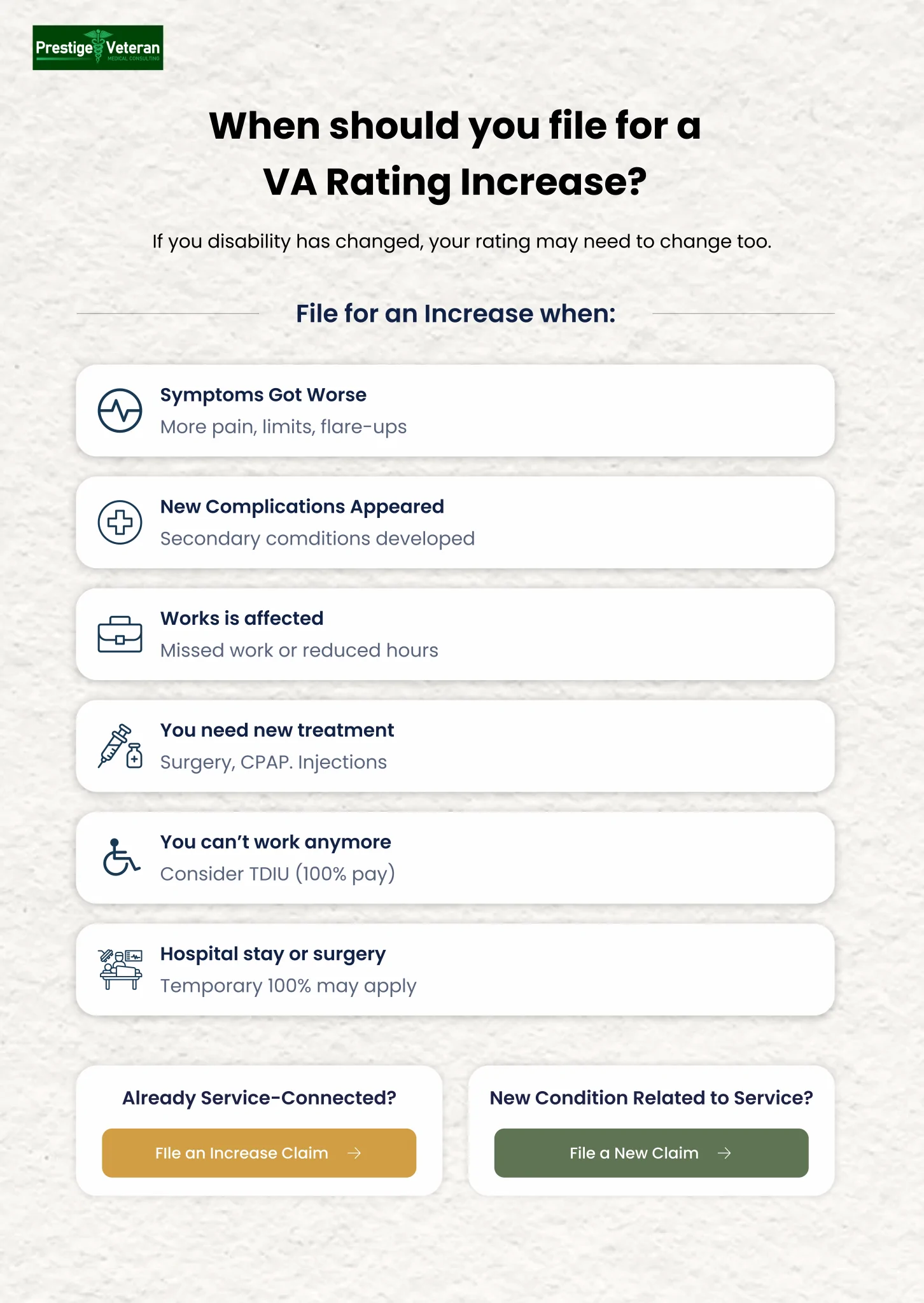
- Your service-connected condition has worsened
- You have developed new symptoms, complications, or secondary conditions
- Your work or social functioning has declined
- You now require assistive devices such as a cane, brace, or CPAP
- Your current rating no longer reflects your daily limitations
How to boost my VA disability rating from 80% to 100?
You can increase VA disability from 80% to 100% by filing for higher ratings on worsened conditions, establishing additional or secondary service-connected conditions, or qualifying for TDIU if your disabilities prevent substantially gainful employment.
Does the VA automatically apply the bilateral factor?
Yes, when applicable, the VA automatically applies the bilateral factor by adding an extra 10% to the combined rating of compensable disabilities affecting both paired extremities.
What evidence helps VA claim approval?
To get your VA disability claim approved, fulfill three fundamental requirements to establish service connection:
- Current medical diagnosis
- An in-service event, injury, or illness, and
- A medical nexus linking the disability to military service
Can my VA disability rating be reduced if I file for an increase?
Yes, there is a small risk that your VA disability rating could be reduced if you reopen a claim or request an increase. But this only occurs if new medical evidence shows sustained improvement, and the VA must follow strict due-process rules before lowering your rating.
Also Read: VA 5, 10, and 20-Year Rules: Protect Your Disability Rating
At Prestige Veteran Medical Consulting, a veteran-owned company, we specialize in Independent Medical Opinions (IMOs) known as Nexus letters.
Our purpose is to empower YOU, the veteran, to take charge of your medical evidence and provide you with valuable educational tools and research to guide you on your journey.
Understanding the unique challenges veterans face, our commitment lies in delivering exceptional service and support.
Leveraging an extensive network of licensed independent medical professionals, all well-versed in the medical professional aspects of the VA claims process, we review the necessary medical evidence to incorporate in our reports related to your VA Disability Claim.
Prestige Veteran Medical Consulting is not a law firm, accredited claims agent, or affiliated with the Veterans Administration or Veterans Services Organizations. However, we are happy to discuss your case with your accredited VA legal professional.