

Diabetes mellitus, particularly Type 2 diabetes, is one of the most commonly compensated service-connected disabilities, affecting a significant number of U.S. veterans. According to the Department of Veterans Affairs (VA), over 25% of VA healthcare patients are diabetic, many of whom developed the disease due to factors related to their military service.
Whether the cause is direct exposure or secondary effects, veterans are entitled to seek compensation for diabetes under the VA disability benefits system. This informative blog explores how the VA rates diabetes, how you can file a successful claim, and what conditions are commonly associated with this disease to increase your overall VA rating.
Table of Contents
Understanding Type 2 Diabetes and Risk Factors in Veterans
Type 2 diabetes is a metabolic disorder where the body either does not produce enough insulin or becomes resistant to insulin. This hormone is critical for regulating blood sugar, and when its function is impaired, glucose builds up in the bloodstream, leading to serious complications.
Unlike Type 1 diabetes, which is usually genetic and diagnosed in childhood, Type 2 diabetes typically develops in adulthood and is often linked to lifestyle factors like smoking, obesity, hypertension, and high cholesterol.
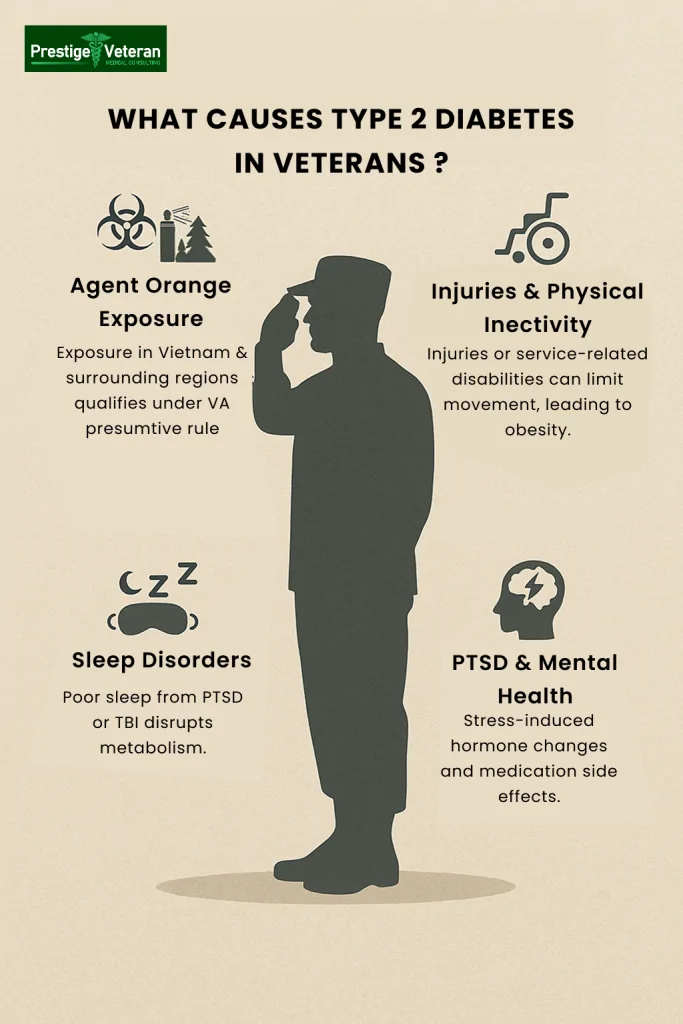
Veterans in military service are at increased risk of developing Type 2 diabetes for several key reasons:
- Agent Orange exposure, particularly during the Vietnam War, has been conclusively linked to the development of Type 2 diabetes. Veterans who served in Vietnam, Thailand, Laos, Cambodia, and even offshore as “Blue Water” Navy veterans may automatically qualify under the VA’s presumptive condition rule.
- Injuries or service-connected disabilities can lead to physical inactivity and obesity, a primary trigger for Type 2 diabetes.
- Mental health conditions, especially post-traumatic stress disorder (PTSD), are linked to higher rates of diabetes due to stress-induced hormone changes and medication side effects.
- Sleep disorders such as obstructive sleep apnea, also commonly linked to PTSD or traumatic brain injury (TBI), are increasingly recognized as secondary causes of diabetes.
Common symptoms of diabetes include frequent urination, excessive thirst, fatigue, unexplained weight loss, and blurry vision. Left untreated, diabetes can lead to heart disease, kidney failure, nerve damage (diabetic neuropathy), vision loss (diabetic retinopathy), and even limb amputation.
Gestational Diabetes
Women veterans with PTSD are at increased risk of developing gestational diabetes during pregnancy, a condition that can later lead to chronic Type 2 diabetes. This link is supported by research showing that PTSD, often resulting from military trauma, contributes to metabolic disorders. When gestational diabetes or subsequent Type 2 diabetes is connected to service-related PTSD, it may support a VA disability claim for compensation.
For these reasons, the VA recognizes diabetes as a serious disabling condition that deserves financial compensation when service-connected. The two main types that qualify for VA disability ratings and compensation are diabetes mellitus and diabetes insipidus.
How the VA Rates Diabetes Mellitus
The VA uses Diagnostic Code 7913 (38 CFR § 4.119 – endocrine system) in the Schedule for Rating Disabilities to evaluate diabetes mellitus, particularly type 2 diabetes. The VA assigns ratings based on the severity of the condition, how well it is managed, the treatment required and its impact on the veteran’s daily life and employment.
Here’s a breakdown of the diabetes VA rating chart:
| VA Rating | Criteria |
| 10% Rating | Manageable by a restricted diet alone |
| 20% Rating | Requires daily insulin or oral hypoglycemic agents, plus a restricted diet |
| 40% Rating | Requires daily insulin use, dietary restrictions, and regulation of physical activities |
| 60% Rating | One or two hospitalizations per year or biweekly visits for ketoacidosis or hypoglycemia |
| 100% Rating | Requires multiple daily insulin injections, restricted diet, regulation of activities, plus 3+ hospitalizations or weekly visits, and progressive complications (e.g., weight loss, strength decline, separate compensable conditions) |
These percentages directly correlate to monthly compensation amounts. For instance, a 60% VA disability rating for diabetes offers a single veteran with no dependents $1,395.93 per month, while a 10% rating provides $175.51.
Proper documentation of your condition is crucial. Your medical records, insulin prescriptions, dietary requirements, and physician recommendations should all be included in your VA claim for diabetes. A well-documented DBQ (Disability Benefits Questionnaire) for diabetes mellitus will significantly strengthen your case.
Diabetes Insipidus VA Rating Chart
Diabetes Insipidus is a rare condition unrelated to blood sugar. It results from a deficiency or insensitivity to antidiuretic hormone (ADH), causing the kidneys to release excessive urine. Common causes include brain injury, pituitary gland disorders, or certain medications.
The VA evaluates Diabetes Insipidus under 38 CFR § 4.119, Diagnostic Code 7909, with disability ratings of 10% and 30%, based on the severity and treatment needs.
| VA Rating | Criteria |
| 30% Rating | Assigned for the first three months post the initial medical diagnosis of diabetes insipidus. |
| 10% Rating | Assigned if the condition is persistent with polyuria (excessive urination) or requires continuous hormonal therapy. |
Note: After the initial 3-month period, if diabetes insipidus has subsided, any remaining symptoms should be rated under the appropriate diagnostic code(s) for the affected body system(s).
Diabetes Insipidus is not presumptively linked to any exposures. A direct connection to military service or a service-connected condition must be established with medical evidence.
Evidence and Service Connection for Your VA Diabetes Claim
To receive VA disability compensation, veterans must show that their diabetes is caused or aggravated by active duty. There are three primary paths to establish this service connection:
- Presumptive Service Connection: The VA automatically considers Type 2 diabetes to be a service-connected condition if the veteran either received at least a 10% disability rating for it within one year of discharge or qualifies under the presumptive exposure rules for Agent Orange, which we will discuss later.
- Direct Service Connection: Requires proof that the diabetes began during or shortly after service. Veterans need medical records and service documentation to show that the onset occurred during their time in the military.
- Secondary Service Connection: Diabetes may also result from or worsen due to a service-connected condition. PTSD, chronic pain, and even certain medications can lead to or aggravate diabetes.
To effectively support a VA diabetes claim, you should satisfy the VA’s three key requirements for service connection, including:
- A current diagnosis of diabetes.
- A proof of an in-service event, exposure (such as to Agent Orange), or an existing service-connected disability.
- A medical nexus from a licensed medical professional providing a well-supported opinion that links your diabetes to your military service or an existing service-connected condition.
Diabetes and Agent Orange: Presumptive Condition for Vietnam Veterans
One of the most powerful ways to a successful VA claim for diabetes is through presumptive service connection due to Agent Orange exposure. Agent Orange, a herbicide used extensively during the Vietnam War, has long been linked to numerous health conditions. Among the most common is Type 2 diabetes mellitus, which the VA lists as a presumptive condition.
Veterans who served in the following locations and time periods are eligible under diabetes presumptive rules:
- In Vietnam (including “Blue Water” Navy veterans) between January 9, 1962, and May 7, 1975,
- Along the Korean DMZ from September 1, 1967, to August 31, 1971,
- On C-123 aircraft involved in herbicide spray missions post-Vietnam War,
- Or on Thailand military bases near perimeter fences (Feb 28, 1961 – May 7, 1975)
If you meet any of these service criteria and are diagnosed with Type 2 diabetes (or even prediabetes in some cases), you do not have to prove a direct medical nexus between your service and your condition.
Veterans with Agent Orange exposure who were previously denied may now qualify under expanded eligibility rules, particularly since the PACT Act and updates to 38 CFR diabetes regulations. You may be entitled to retroactive VA compensation for diabetes.
Benefits for Surviving Family Members
If a Vietnam-era veteran passed away due to complications from Type 2 diabetes and met the criteria for presumptive exposure, surviving spouses or parents may be eligible for Dependents and Indemnity Compensation (DIC) or Parents’ DIC.
Secondary Conditions to Diabetes: Boost Your Combined VA Rating
Type 2 diabetes is rarely an isolated health issue. Over time, it causes numerous secondary conditions that can significantly affect your life and increase your combined VA disability rating.
The following are VA-recognized secondary conditions to diabetes:
- Peripheral Neuropathy: Diabetes often causes nerve damage in the hands and feet, resulting in tingling, numbness, or burning sensations. You can receive separate VA ratings for each affected limb.
- Diabetic retinopathy – Vision loss or blindness caused by damage to the blood vessels in the retina.
- Chronic Kidney Disease: Also called diabetic nephropathy, this often results from long-term elevated blood sugar and can lead to renal failure and dialysis.
- Cardiovascular disease – Diabetes is a major risk factor for heart attacks, strokes, and high blood pressure.
- Erectile dysfunction (ED) – Erectile dysfunction is common in men living with diabetes. While not compensable directly, it may qualify veterans for Special Monthly Compensation (SMC).
- Amputations/Foot Ulcers: Severe diabetic neuropathy may result in infection and surgical amputation.
- Depression or Memory Loss: Mental health effects related to chronic illness and neurological impact.
Each of these secondary conditions could receive its own VA rating, and your overall disability percentage is determined using the VA Combined Ratings Table. For instance, a veteran with diabetes mellitus rated at 40% and severe peripheral neuropathy in the right leg rated at 40% and in the left leg at 20% could receive a combined VA disability rating of around 70%.
If your total disability limits your ability to work, you may be eligible for TDIU benefits, which pay at the 100% rate even if your combined rating is lower.
Can Diabetes Make You Eligible for TDIU?
Yes, diabetes and its related complications may make you eligible for TDIU (Total Disability based on Individual Unemployability) if they hinder your ability to maintain substantially gainful employment. This is especially important for veterans who don’t meet the 100% rating threshold but whose combined conditions severely limit their ability to work.
To qualify for TDIU, you must have:
- At least one disability rated at 60% or more, or
- A combined rating of at least 70%, with one disability rated at 40% or more.
If granted, TDIU entitles you to compensation at the 100% rate, which is currently $3,831.30 per month (as of 2025).
A strong case for TDIU should include medical documentation detailing how diabetes limits physical and mental capacity or causes severe fatigue or frequent hospitalizations. Statements from former employers describing work disruptions can also validate your VA disability claim.
Prediabetes and VA Ratings: Where Do They Stand?
Prediabetes is a condition where your blood sugar levels are elevated but not high enough to qualify as full-blown diabetes. While not currently compensable as a stand-alone diagnosis, it becomes relevant in two situations:
- If diabetes develops later, your prediabetes history helps establish a timeline.
- If prediabetes is aggravated by a service-connected condition, you may be able to file under the aggravation theory once it develops into diabetes.
Always discuss changes in your health with your VA provider and get updated testing when needed. Tracking your progression from prediabetes to diabetes can be valuable when filing or upgrading a claim.
What to Expect During a VA C&P Exam for Diabetes
A Compensation & Pension (C&P) exam for diabetes is a key step in the VA disability claim process, evaluating the severity of the condition and its potential connection to military service. Expect a review of your full medical history, a physical examination, and lab tests, such as A1C levels, kidney function, and cholesterol checks.
The examiner will assess diabetes-related complications like neuropathy, vision issues, or kidney problems. You may be asked about diabetes symptoms (e.g., fatigue, frequent urination), treatment effectiveness, and any past episodes of hypoglycemia or hyperglycemia.
Tips for a Successful C&P Exam:
- Be honest and specific about your daily symptoms.
- Bring updated medical records and lab results.
- Understand there are no “right” answers—just facts.
Afterward, the examiner’s report is sent to the VA to support your disability claim decision. If denied or underrated, consider gathering further evidence or appealing the decision.
Why a Nexus Letter is Helpful in Some VA Diabetes Claims
A nexus letter plays a critical role in VA disability claims for type 2 diabetes by medically linking the condition to a veteran’s military service. It acts as key evidence for these reasons:
- Formal Medical Nexus: Because type 2 diabetes involves complex diagnostic criteria and treatment protocols, informal or lay statements alone don’t carry weight. Instead, a well-written medical opinion from a qualified healthcare professional can be beneficial to support the VA claim.
- Expert Analysis of Invisible Symptoms: Unlike visible conditions, such as joint injuries, diabetes symptoms are often invisible to non-experts. That’s why professional medical analysis is essential.
- Supports Denied Claims: If a VA examination leads to a denial, a detailed nexus letter from a private doctor can provide compelling evidence, especially when diabetes is secondary to or worsened by another service-connected issue.
- Helps in Non-Presumptive Cases: An independent nexus letter becomes even more vital when there’s no clear record of Agent Orange exposure or when the case doesn’t fit the VA’s presumptive guidelines.
Ultimately, this letter often serves as the cornerstone for proving service connection, making it a powerful tool in securing the VA benefits for diabetes that a veteran rightfully deserves.
Many veterans rely on trusted providers like Prestige Veteran for expert, independent medical opinions to strengthen their case.
Tips to Increase VA Rating for Diabetes
If you are a veteran diagnosed with diabetes, filing a claim with the Department of Veterans Affairs (VA) is the first step to receiving the compensation you have earned. The process begins by submitting VA Form 21-526EZ, either online through the VA.gov portal, by mail, or with the help of a Veterans Service Organization (VSO).
Veterans filing for compensation should take these steps into consideration to increase their VA disability rating for diabetes:
Document Your Diagnosis:
Include blood tests, insulin prescriptions, and notes from diabetic specialists advising you to avoid strenuous work or exercise, which are key for ratings of 40% and above.
Obtain a Disability Benefits Questionnaire:
The DBQ (Diabetes Mellitus – Endocrinology) form helps standardize evidence for your condition. Filled out by a licensed medical provider, a DBQ form outlines the severity of your condition and how it affects your daily life. You are never required to submit this yourself or obtain one in advance, as the VA will provide one at the compensation and pension exam when applicable.
Include Medical and Service Records:
Gather VA and private medical records showing the onset, progression, and ongoing treatment of your diabetes mellitus. Also, collect service records proving exposure to Agent Orange or other toxic substances, especially if you are filing a presumptive claim.
Include a Nexus Letter When Needed:
A strong nexus letter from your doctor clearly linking your diabetes (or secondary conditions) to service can be vital in complex or non-presumptive cases.
File for Secondary Conditions:
Include all diabetes-related secondary conditions, such as peripheral neuropathy, vision impairment, or kidney disease and file them separately to significantly raise your combined VA rating when applicable.
Attend Your C&P Exam:
The C&P exam allows the VA to evaluate the current severity of your diabetes and related conditions. Missing it means the VA may decide your claim without key medical input, often leading to an underrated claim or denial.
Submit Buddy Statements:
Testimonies from family, friends, or former service members can demonstrate how diabetes and related conditions affect your daily life and work.
A well-prepared claim backed by strong medical and service documentation can lead to higher compensation and better access to healthcare benefits.
Work with a VSO or VA-accredited attorney to ensure your claim is complete and accurately reflects the full scope of your condition.
Case Study: Peripheral Neuropathy Secondary to Type 2 Diabetes
A 55-year-old Army veteran who served from 1988 to 1996 was diagnosed with Type 2 diabetes in 2011. By 2016, the veteran developed peripheral neuropathy in his hands and feet, with symptoms like numbness, burning sensations, and sharp, stabbing pain.
There was no presumptive service connection, as he wasn’t diagnosed within one year of discharge and had no Agent Orange exposure. Hence, key supporting evidence that helped the army veteran win this VA disability claim includes:
- Medical Nexus Letter:
A physician’s letter stated that his peripheral neuropathy is “at least as likely as not” caused by his service-connected Type 2 diabetes, establishing secondary service connection. - Private Medical Records:
An endocrinologist documented ongoing diabetes-related nerve damage, noting progressive sensory loss and pain, consistent with diabetic peripheral neuropathy linked to long-standing Type 2 diabetes. - VA Compensation & Pension (C&P) Exam Findings:
The VA examiner noted decreased sensation, diminished reflexes, and confirmed peripheral neuropathy symptoms likely secondary to poorly controlled diabetes. - Lay Statement from Spouse:
The former veteran’s wife described daily struggles, including difficulty walking, pain at night, fatigue, and lifestyle limitations, supporting the impact and timeline of his worsening diabetic and nerve symptoms.
With this strong evidence, the veteran was granted service connection for Type 2 diabetes and peripheral neuropathy of the upper and lower extremities as secondary to the diabetes. He received a combined disability rating of 70%, which improved his access to VA healthcare and monthly compensation.
This case highlights the importance of clear medical nexus and documentation, C&P exam results, and credible lay evidence in winning diabetes-related VA claims.
Final Thoughts
Gaining a clear picture of the VA rating criteria for diabetes is essential to accurately pursuing the compensation you deserve. While the process may seem overwhelming, focusing on strong medical evidence, service connection, and clearly documented symptoms will give your claim the best chance of success. To strengthen your case, present relevant, accurate information that highlights how diabetes affects your daily life.
Whether you are filing a new claim or seeking a rating increase, be thorough, stay proactive, and consider getting professional support when needed. With the right approach, you can navigate the VA system confidently and ensure your service-connected diabetes is properly recognized and compensated.
FAQs
What VA rating can you get for diabetes?
You can receive a VA disability rating of 10%, 20%, 40%, 60%, or 100% for type 2 diabetes based on your insulin use, dietary restrictions, activity limitations, hospitalizations, and complications.
How much does the VA pay for diabetes?
VA compensation ranges from $175.51/month at 10% to $3,831.30/month at 100% in 2025, depending on the diabetes rating and additional factors.
What is the average VA disability rating for diabetes?
While there’s no official “average,” most veterans with service-connected diabetes receive between 20% and 60%, depending on management complexity and secondary conditions.
What is a presumptive service connection for diabetes?
A presumptive service connection for diabetes means the VA automatically considers it service-related if the veteran served in specific conditions like exposure to Agent Orange, or if the disease was diagnosed to a compensable degree (at least 10%) within one year of discharge.
How to prove diabetes for VA disability?
To prove your diabetes is service-connected, submit medical evidence of diagnosis, show service connection (direct, secondary, or presumptive), and include a nexus letter when applicable linking your condition to military service.
Also read: Sleep Apnea and Diabetes in Veterans Disability
At Prestige Veteran Medical Consulting, a veteran-owned company, we specialize in Independent Medical Opinions (IMOs) known as Nexus letters.
Our purpose is to empower YOU, the veteran, to take charge of your medical evidence and provide you with valuable educational tools and research to guide you on your journey.
Understanding the unique challenges veterans face, our commitment lies in delivering exceptional service and support.
Leveraging an extensive network of licensed independent medical professionals, all well-versed in the medical professional aspects of the VA claims process, we review the necessary medical evidence to incorporate in our reports related to your VA Disability Claim.
Prestige Veteran Medical Consulting is not a law firm, accredited claims agent, or affiliated with the Veterans Administration or Veterans Services Organizations. However, we are happy to discuss your case with your accredited VA legal professional.