
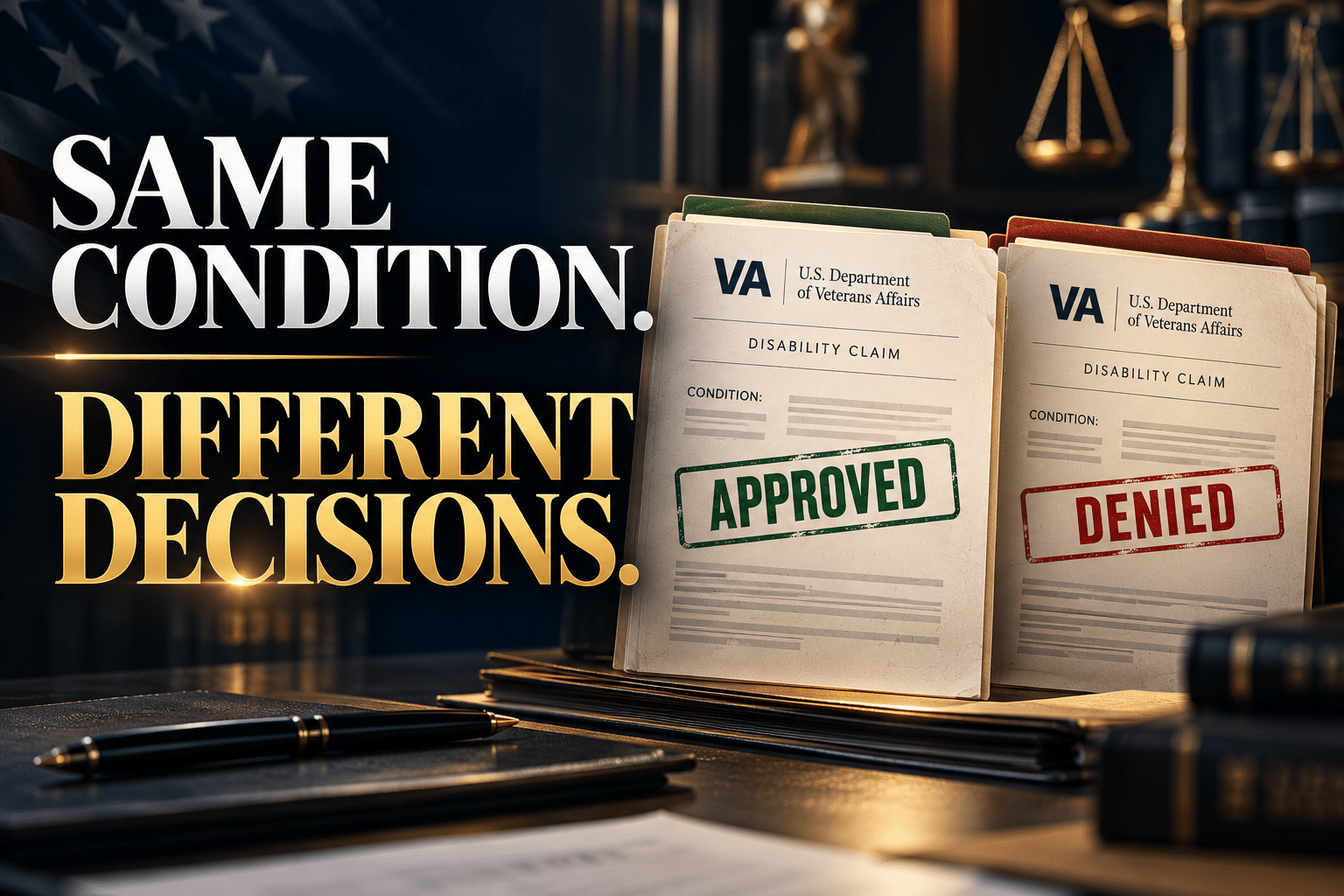
Two veterans can have the same medical diagnosis, report similar symptoms, and file VA disability claims for the same condition, yet receive completely different decisions.
One veteran may be granted service connection while the other is denied. In some cases, both may receive favorable decisions but with different disability ratings.
Why does that happen?
In this episode of Ask the Attorney, Leah Bucholz, PA-C, founder and CEO of Prestige Veteran Medical Consulting, joins Rebecca Deming, founder of ProVet Legal, to discuss why seemingly similar VA claims can have different outcomes.
Their conversation explores the role of medical evidence, service histories, C&P examinations, VA adjudicators, and the importance of understanding what a particular claim actually needs to establish.

Table of Contents
Why the Same Medical Condition Does Not Mean the Same VA Claim
A diagnosis is only one part of a VA disability claim.
Two veterans might both have migraines, sleep apnea, or a back condition. But their medical histories, service circumstances, and supporting evidence may be considerably different.
One veteran might have documented symptoms beginning during military service. Another might not have received a diagnosis until several years after separation.
One may have service records, relevant buddy statements, and a detailed medical opinion. The other may have a different symptom timeline, potential risk factors, or medical evidence that does not address the same questions.
As Leah and Rebecca explain, comparing the name of the condition alone does not provide the full picture.
Even when two claims initially appear similar, the underlying evidence may tell very different stories.
Three Elements That Can Make a Difference in a VA Claim
For a typical claim involving direct service connection, VA generally considers three central elements:
A current disability: Evidence establishing that the veteran has the claimed condition.
An in-service event, injury, or disease: Evidence of something that occurred during military service.
A nexus: A relationship between the current disability and the in-service event, injury, or disease.
These elements help explain why one veteran may receive a favorable decision while another does not.
For example, two veterans may both have a confirmed sleep apnea diagnosis. But the question VA needs to resolve in each case may be entirely different.
In one claim, the medical relationship to service may be well supported. In another, VA may determine that additional information is needed to establish the claimed relationship or an underlying service event.
A medical diagnosis alone does not necessarily answer those other questions.
There are also different evidentiary rules for certain presumptive conditions and secondary service-connection claims. The specific requirements depend on the type of claim.
The key is understanding which element is established and which remains in question.
How Medical Records and Evidence Quality Affect VA Decisions
Medical documentation is one of the most important differences between otherwise similar VA disability claims.
A veteran’s record may contain treatment notes, diagnostic testing, examination findings, statements from fellow service members, or information about the history and progression of symptoms.
But the amount of documentation is not necessarily the same as its relevance or quality.
For example, a medical opinion that simply states a condition is related to military service may offer less explanatory value than an opinion that carefully addresses:
- The veteran’s current diagnosis and relevant symptoms.
- Military service history and potentially relevant events or exposures.
- The timing and progression of the condition.
- Other medical conditions or risk factors.
- Relevant diagnostic findings and medical literature.
- Conflicting evidence or alternative explanations.
- The clinical reasoning supporting the conclusion.
Rebecca emphasizes that a medical opinion is more useful when it explains why a relationship is medically supportable, rather than offering a conclusion without a meaningful rationale.
That distinction can matter when VA evaluates competing medical opinions.
A private medical opinion is not automatically stronger than a VA C&P opinion, and a VA examiner’s opinion is not automatically stronger simply because it was prepared through the VA examination process.
The quality and relevance of the medical reasoning matter.
Can a Favorable C&P Exam Still Be Followed by a Denial?
One particularly interesting question Leah raises is whether VA can deny a claim even when a C&P examiner provides a favorable medical opinion.
The answer depends on the circumstances.
A favorable medical nexus opinion may support the connection between a diagnosed disability and a reported in-service event. However, VA may still need to establish that the event itself occurred or that another required element is satisfied.
Rebecca discusses an example involving PTSD, where an examiner may find that a condition is medically related to a reported stressor, while VA separately questions whether the claimed stressor has been established under the applicable requirements.
In such a situation, the disagreement may not be about the examiner’s medical conclusion. Instead, it may involve another part of the service-connection analysis.
That is why a favorable C&P opinion should not be treated as a guarantee of approval.
It is also important to distinguish a missing element from a situation in which an adjudicator improperly substitutes a personal medical judgment for a qualified medical opinion.
Understanding the reason for the decision is essential.
Can Different VA Raters Reach Different Conclusions?
Another issue discussed in the interview is the human element of VA decision-making.
VA adjudicators review evidence, apply applicable rules, and determine how much weight to give different parts of the record.
That can involve evaluating competing medical opinions, inconsistencies in documentation, and other evidence relevant to a claim.
Rebecca explains that adjudicators may give different weight to particular evidence, but their conclusions must be supported by appropriate reasoning.
A decision should not simply favor one medical opinion because the adjudicator personally prefers the type of clinician who provided it.
The reasoning must be connected to the evidence and the applicable requirements.
Mistakes can also occur, including overlooked records or incorrect applications of the relevant standards.
However, different outcomes do not automatically mean that one claim was handled incorrectly. The underlying facts, evidence, and applicable legal requirements must be examined before reaching that conclusion.
What Happens When Service Treatment Records Are Missing?
Not every medical condition is documented during active military service.
As Rebecca notes, service members may avoid or delay medical treatment for several reasons, including operational demands, command culture, and mission responsibilities.
A veteran may have experienced symptoms or an injury without creating a formal treatment record at that time.
The absence of a service treatment record does not automatically establish that an in-service event or medical relationship never existed.
However, missing documentation can make it more difficult to reconstruct the history of a condition.
Depending on the circumstances, other relevant evidence may include statements from the veteran or fellow service members, personnel records, post-service treatment records, and medical opinions that consider the reported timeline.
There is also an important distinction between records that exist but are missing from the claim file and treatment that was never documented in the first place.
Each situation raises different evidentiary questions.
For a more detailed discussion, see our article on why no treatment during service does not automatically mean no VA claim.
Does Another Veteran’s Successful BVA Appeal Apply to Your Claim?
Veterans sometimes search the Board of Veterans’ Appeals (BVA) decision database and find a case involving a condition similar to their own.
It may seem reasonable to assume that if the Board granted another veteran’s claim, the same result should follow in their case.
But individual Board decisions generally do not establish binding precedent for unrelated claims.
Under 38 CFR § 20.1303, a previously issued Board decision is binding only with respect to the particular case decided. Other Board decisions may be considered when reasonably relevant, but they do not automatically determine another veteran’s outcome.
For example, a previous Board decision involving sleep apnea and PTSD does not establish that every veteran with those diagnoses has the same medical relationship or is entitled to the same result.
The diagnosis, medical history, evidence, and circumstances still require individualized consideration.
This is one reason comparing claim outcomes without reviewing the underlying files can be misleading.
Does the VA Regional Office Affect a Claim’s Outcome?
Leah and Rebecca also address whether the office processing a claim can influence the result.
VA uses a national work-distribution system, which means a claim does not necessarily remain with the regional office closest to the veteran’s home.
Some matters may also involve offices with specialized responsibilities.
Rebecca notes that differences in staff experience, training, and workflows can exist. However, that does not mean veterans can assume one particular regional office will consistently produce better decisions.
More importantly, veterans generally cannot choose their preferred regional office as a way to secure a particular outcome.
The evidence and applicable requirements remain central to the decision.
Does Every Veteran Need a Private Nexus Letter?
Not necessarily.
A private medical opinion may be helpful when a claim involves an unresolved medical relationship, competing opinions, or a question that needs a more detailed clinical explanation.
However, obtaining a private Nexus letter should not be an automatic step for every veteran.
For example, if VA has already established a medical nexus but is questioning whether a particular in-service event occurred, obtaining another opinion about that same medical relationship may not address the actual issue.
Similarly, some presumptive conditions may not require a separate medical nexus opinion when the applicable requirements are satisfied.
Understanding what VA has already accepted, what remains disputed, and what the record currently establishes can help clarify whether additional medical evidence may be useful.
A Nexus letter is evidence, not a guaranteed outcome.
You can also read our article on why paying for a Nexus letter does not guarantee VA approval.
What Should Veterans Focus on When Their Claim Is Denied?
Rather than comparing the outcome with another veteran’s claim, it may be more useful to understand the specific reasons for the decision.
Some important questions to consider include:
- What condition or disability has VA recognized?
- What favorable findings are identified in the decision?
- Is the in-service event, injury, disease, or exposure established?
- Is the medical relationship supported or disputed?
- Were relevant treatment records and other evidence considered?
- Does the record contain conflicting medical opinions?
- What specific issue does the decision identify as the reason for denial?
The answers can help distinguish a missing evidentiary element from a disagreement over existing evidence or a potential decision-making error.
If a veteran disagrees with a VA decision, different review options may be available, including a Supplemental Claim, Higher-Level Review, or Board Appeal. Each has different procedures and rules governing evidence.
A VA-accredited representative can help explain the available options based on the individual circumstances.
Veterans can also review the VA’s official decision review information.
Final Thoughts
Two veterans can have the same medical condition and receive different VA disability decisions because their claims are not necessarily supported by the same facts or evidence.
Differences in service histories, medical documentation, nexus opinions, examination findings, and evidentiary assessments can all matter.
And while errors in the claims process are possible, a different outcome alone does not establish that an error occurred.
The central takeaway from Leah and Rebecca’s discussion is that the question is not simply whether another veteran received approval for the same diagnosis. It is what the evidence establishes in each individual claim.
Understanding that distinction can help veterans better appreciate the role of medical evidence and why an individualized review matters.
Also Read
Bad C&P Exam? What Makes an Opinion Inadequate and What Happens Next
Can a Private Medical Opinion Beat a VA C&P Exam?
VA Claim Myth: Does Paying for a Nexus Letter Guarantee Approval?
At Prestige Veteran Medical Consulting, a veteran-owned company, we specialize in Independent Medical Opinions (IMOs) known as Nexus letters.
Our purpose is to empower YOU, the veteran, to take charge of your medical evidence and provide you with valuable educational tools and research to guide you on your journey.
Understanding the unique challenges veterans face, our commitment lies in delivering exceptional service and support.
Leveraging an extensive network of licensed independent medical professionals, all well-versed in the medical professional aspects of the VA claims process, we review the necessary medical evidence to incorporate in our reports related to your VA Disability Claim.
Prestige Veteran Medical Consulting is not a law firm, accredited claims agent, or affiliated with the Veterans Administration or Veterans Services Organizations. However, we are happy to discuss your case with your accredited VA legal professional.