

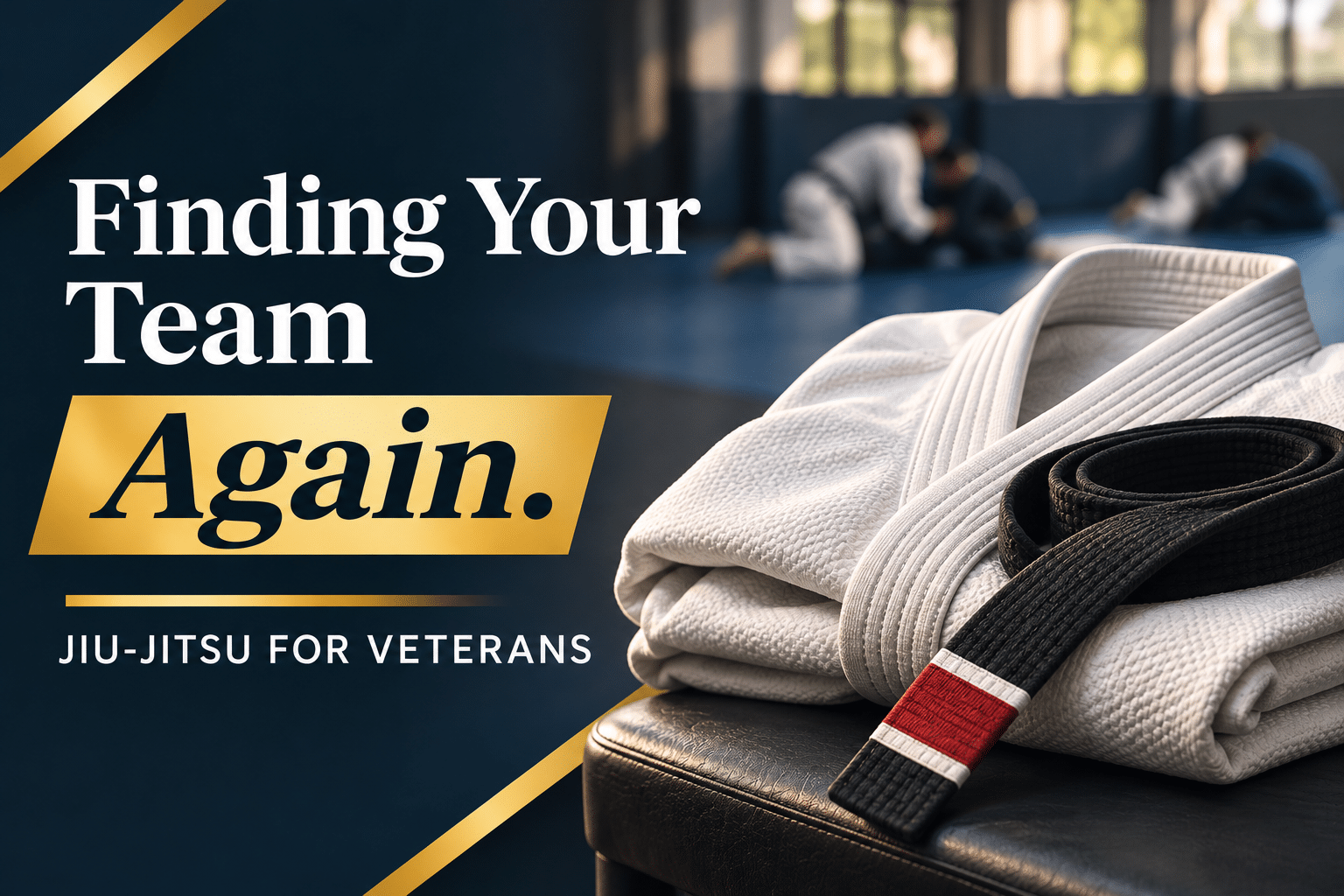
Leaving the military often means adjusting to more than a different routine. For some veterans, it also means leaving behind the camaraderie, structure, shared responsibility, and sense of belonging that were part of everyday military life.
Finding those connections again can be challenging.
For veterans who miss being part of a team, Brazilian jiu-jitsu may offer an opportunity to reconnect with others, develop new skills, and work toward personal goals in a structured environment.
But getting started can feel intimidating, particularly for veterans managing physical disabilities, chronic pain, anxiety, or trauma-related symptoms.
In this episode, Leah Bucholz, PA-C, U.S. Army veteran, former Compensation and Pension (C&P) examiner, and founder of Prestige Veteran Medical Consulting, welcomes TJ Kreutzer of We Defy Foundation.
They discuss TJ’s transition from military aviation to jiu-jitsu, the foundation’s mission, its year-long training scholarships, the importance of community, and emerging research into the experiences of veterans who participate in Brazilian jiu-jitsu.

Table of Contents
What Is We Defy Foundation?
We Defy Foundation is a nonprofit organization that helps eligible disabled combat veterans access Brazilian jiu-jitsu training.
Through its scholarship program, the foundation sponsors qualifying veterans for one year of training at approved facilities.
Its mission extends beyond physical exercise.
The program aims to introduce veterans to a supportive training community where they can develop skills, build relationships, participate in shared challenges, and regain aspects of the camaraderie they may have missed after leaving military service.
During the interview, TJ explains that We Defy works with training facilities that understand the needs of veterans, including individuals living with service-connected disabilities.
The foundation’s approach centers on three interconnected ideas:
- Community: Helping veterans develop meaningful connections with other participants.
- Health: Encouraging participation in a physically engaging activity adapted to individual circumstances.
- Service: Creating opportunities for veterans to remain connected to and support a broader community.
From Flying F-16s to Finding a New Purpose
TJ’s involvement with We Defy began with his own experience transitioning away from active military service.
After attending the U.S. Air Force Academy, he became an F-16 pilot and served on active duty for 11 years.
He later transitioned to the Air Force Reserve, where he flew T-38 aircraft as an instructor pilot, while also pursuing a civilian airline career.
Despite remaining connected to aviation and military service, TJ describes experiencing a loss of purpose and camaraderie after leaving active duty.
The relationships and shared routines that had once been central to his daily life were no longer present in the same way.
He began searching for another activity that could provide challenge, structure, and a meaningful connection with others.
That search eventually brought him to martial arts.
TJ initially trained in Muay Thai before transitioning toward grappling and Brazilian jiu-jitsu.
As his interest grew, he began attending different gyms while traveling for his airline career.
One particularly meaningful conversation occurred after a training session in Chicago, when he met a veteran who had recently returned from Iraq and was experiencing significant personal challenges.
The conversation prompted TJ to consider how he could support other veterans.
Shortly afterward, he encountered We Defy Foundation through a jiu-jitsu event and became involved as one of its early volunteers.
What began as a personal search for connection evolved into a commitment to helping other veterans discover similar opportunities.
Why Jiu-Jitsu Can Feel Familiar to Veterans
One of the most compelling themes in Leah and TJ’s conversation is the relationship between jiu-jitsu training and military camaraderie.
Leah explains that jiu-jitsu has provided one of the closest experiences she has found to the sense of belonging she felt during military service.
TJ describes several similarities.
Familiar Structure and Progression
Brazilian jiu-jitsu uses a belt-ranking system that reflects experience and technical development.
For veterans accustomed to military rank structures, clear expectations, instruction, and progression, this environment may feel familiar.
New students begin as beginners, learn from more experienced participants, and gradually build their abilities through regular training.
There is a defined process for learning and improving.
Shared Challenges and Mutual Responsibility
Although jiu-jitsu is a combat sport, successful training depends heavily on cooperation.
Training partners practice techniques together, learn to recognize one another’s limits, and are expected to respect safety boundaries.
TJ emphasizes that students must look after one another.
The goal is not simply to overcome another person. It is to develop skills within an environment where participants share responsibility for training safely.
Building Connections Beyond the Military
Training partners may come from very different professions, backgrounds, and experiences.
TJ describes how jiu-jitsu can create common ground between veterans and civilians who might otherwise have little in common.
That shared commitment to learning can make it easier to build relationships through regular, meaningful interaction.
For veterans who miss a close-knit team environment, this social connection may be one of the most valuable aspects of training.
Can Jiu-Jitsu Help Veterans Experiencing PTSD or Anxiety?
During the discussion, Leah asks whether jiu-jitsu may help veterans who experience heightened anxiety, trauma-related symptoms, or difficulty regulating their responses to stressful situations.
TJ discusses several possible benefits based on his training experience and the research being conducted.
He describes how grappling requires participants to focus on what is happening in the present moment.
A person practicing a technique must pay attention to body positioning, movement, breathing, and the actions of a training partner.
For some participants, that concentration may provide a temporary break from repetitive worrying or distressing thoughts.
TJ also discusses how training can involve gradually becoming more comfortable with physically challenging situations.
However, these experiences vary considerably from person to person.
Brazilian jiu-jitsu should not be presented as a proven cure for PTSD, depression, anxiety, or other mental health conditions.
Research is exploring whether structured participation may provide useful benefits, but further controlled studies are needed to determine the extent, mechanisms, and consistency of those effects.
Veterans receiving mental health care should not discontinue prescribed treatment or medication based on an exercise program or personal testimonial.
Jiu-jitsu may be considered a complementary activity when appropriate for a veteran’s health, preferences, and circumstances.
How Jiu-Jitsu May Help Build Confidence and Trust
Another important section of the interview focuses on what happens when someone feels uncomfortable with close physical contact.
Leah shares that when she first began grappling, her stress response could become extremely heightened.
TJ explains that nervousness during early training is common, even among people who do not have a diagnosed mental health condition.
A new student may be uncertain about the techniques, unfamiliar with the environment, or uncomfortable with another person controlling their movement.
Jiu-jitsu training introduces an important safety principle: participants can signal that they want an exercise or submission to stop.
This is commonly called tapping.
When someone taps, the training partner is expected to stop immediately.
TJ explains how this can give students a greater sense of control over their participation.
Over time, some people may become more confident recognizing discomfort, communicating boundaries, and responding to challenges.
However, training must remain voluntary and appropriately supervised.
A veteran who finds close contact overwhelming should never feel pressured to continue a particular exercise.
The quality of the instructor, gym culture, safety practices, and ability to accommodate individual needs are essential.
Can Veterans With Physical Disabilities Participate in Jiu-Jitsu?
Leah also asks about veterans managing conditions such as traumatic brain injury (TBI), back pain, knee injuries, and other physical limitations.
TJ acknowledges that jiu-jitsu involves physical demands and potential injuries.
He explains that learning to distinguish ordinary training discomfort from an actual injury is important.
One of the examples he shares concerns We Defy’s founding story.
TJ describes how one of the foundation’s founders, Joey, a veteran with multiple limb amputations, began receiving private instruction from a black-belt instructor named Alan.
Joey eventually joined a regular group class.
According to TJ, one of the most meaningful parts of that experience was being accepted as a full participant in the training community.
The story illustrates an important principle of adaptive participation: people with disabilities should not automatically be excluded from activities they wish to pursue.
At the same time, individual medical needs and physical limitations must be taken seriously.
A veteran with a history of TBI, joint instability, chronic pain, spinal injury, or other conditions may need medical guidance before beginning contact-based training.
Participation may require adapted techniques, modified intensity, individual instruction, or other accommodations.
Inclusion does not mean ignoring injuries or encouraging people to train beyond safe limits.
How Does the We Defy Foundation Scholarship Work?
One of the most useful parts of Leah and TJ’s conversation is his explanation of the foundation’s scholarship program.
We Defy sponsors qualifying veterans for 12 months of Brazilian jiu-jitsu training at an approved training facility.
According to the foundation’s published program details, the scholarship generally includes:
- One year of sponsored jiu-jitsu training.
- Two jiu-jitsu uniforms, commonly called gis, with We Defy patches.
- Access to an approved training facility.
- Additional private coaching or specialized equipment in certain cases, subject to approval.
The program aims to remove a significant financial barrier to getting started.
It also connects veterans with training facilities reviewed by the organization.
Who Is Eligible for a We Defy Scholarship?
TJ explains that the scholarship is intended for eligible disabled combat veterans who are relatively new to jiu-jitsu.
We Defy’s published requirements include:
- Qualifying service in an area of combat operations.
- Separation or retirement from active-duty military service.
- An 80% or higher VA disability rating.
- Documentation of honorable discharge.
- A VA entitlement or rating letter.
- Less than one year of formal jiu-jitsu or mixed martial arts training, consistent with its beginner eligibility rules.
- Willingness to train at least twice per week for one year at an approved facility.
Certain National Guard and Reserve veterans may also qualify when they meet the other requirements.
We Defy also describes a special-criteria waiver process for some exceptional circumstances.
Eligibility decisions are made by the foundation. Veterans should consult the current official requirements before applying.
Review We Defy Foundation’s official scholarship requirements.
When Does the Next We Defy Scholarship Application Open?
According to We Defy’s application information available as of November 20, 2026, the next listed application opening is:
December 6, 2026, at 2:00 p.m. Eastern Time.
The foundation notes that scholarship application windows may fill quickly because of demand and available funding.
Veterans interested in applying should review the application instructions and prepare any required documentation in advance.
We Defy currently lists required records including discharge documentation, a VA rating or entitlement letter, and a short video explaining what the applicant hopes to gain from participation.
Because application dates and requirements may change, confirm the latest details directly with the foundation.
Visit the official We Defy scholarship application page
How Can Veterans Find an Approved Jiu-Jitsu Gym?
We Defy maintains an online directory of approved training facilities.
TJ explains that the organization considers factors such as the instructor’s qualifications, the gym’s community, and its ability to support veterans with disabilities.
Veterans can use the directory to locate approved facilities near their homes.
The foundation’s network extends across the United States and includes certain international locations.
TJ also describes a process through which the foundation may consider reviewing a gym that is not already affiliated, particularly when a selected scholarship applicant does not have an approved facility nearby.
Those arrangements depend on the foundation’s policies and approval.
Find a We Defy approved training facility
Gym owners who want to support the program can also explore the foundation’s training-facility partnership information.
What Does the Research Say About Jiu-Jitsu and Veteran Mental Health?
Toward the end of the interview, Leah asks TJ about research involving veterans participating in the We Defy program.
TJ describes a pilot study involving approximately 40 participants and observations over several months of training.
The research examined self-reported measures related to mental health and adjustment to civilian life.
He discusses preliminary improvements in areas such as depression, anxiety, and military-to-civilian transition difficulties.
A public preprint of research involving 40 We Defy participants was available in 2026.
These findings are promising, but important limitations must be considered.
The study used a single-group, before-and-after design. Without a randomized comparison group, changes observed during participation cannot automatically be attributed to jiu-jitsu alone.
Other influences, including social support, personal circumstances, continued medical care, and selection factors, may also contribute.
Additionally, a preprint is not the same as a peer-reviewed published article.
For this reason, the research should be interpreted as preliminary evidence supporting further investigation rather than proof that jiu-jitsu treats PTSD, anxiety, or depression.
TJ also describes plans for additional research to explore whether early findings can be replicated and which participants may benefit most.
The broader research question is valuable: Can structured physical activity, shared challenges, and supportive community participation contribute to veterans’ well-being?
Answering that question more precisely will require further study.
For background, see the 2026 We Defy research preprint and the earlier 2019 Brazilian jiu-jitsu study in Military Medicine.
What If a Veteran Is Nervous About Starting?
For veterans considering their first jiu-jitsu class, TJ emphasizes that it is normal to feel uncertain.
Learning an unfamiliar physical activity, entering a new gym, and training with strangers can feel intimidating.
Veterans can start by learning more about the program, reviewing the facility, and discussing any relevant medical or physical limitations with a qualified healthcare professional.
When appropriate, they may benefit from speaking with an instructor about their concerns before participating.
A supportive gym should encourage clear communication, respect individual boundaries, and allow participants to progress at an appropriate pace.
There is no need to approach the first class as a test of toughness.
The goal is to learn, participate safely, and determine whether the activity is a good fit.
How Can Veterans and Supporters Get Involved With We Defy?
TJ closes the conversation by encouraging viewers to explore We Defy’s online resources and connect with the organization.
There are several ways to get involved.
For eligible veterans: Review the scholarship criteria and application process.
For gym owners: Learn how to become an approved training facility.
For volunteers and supporters: Explore opportunities to support the foundation’s work.
For anyone wanting to learn more: Follow We Defy’s official channels and contact its team with questions.
Official resources:
- We Defy Foundation website
- Scholarship applications
- Approved training facilities
- Get involved
- Foundation inquiries: info@wedefyfoundation.org
Final Thoughts
One of the most meaningful points in Leah and TJ’s conversation is that leaving the military does not necessarily mean leaving behind every opportunity for camaraderie, shared purpose, and personal growth.
For some veterans, Brazilian jiu-jitsu provides a setting where these experiences can develop again.
There are challenges to learn from, people to train alongside, instructors who provide guidance, and opportunities to build confidence through consistent practice.
We Defy Foundation helps qualifying disabled combat veterans explore that environment through sponsored training and connections with approved gyms.
The program will not be appropriate for every veteran, and it is not a substitute for medical or mental health treatment.
Nevertheless, its focus on community and meaningful participation illustrates another way organizations can support veterans during and after their transition to civilian life.
For veterans looking for opportunities to reconnect, the first step may simply be learning what resources are available.
Also Read:
At Prestige Veteran Medical Consulting, a veteran-owned company, we specialize in Independent Medical Opinions (IMOs) known as Nexus letters.
Our purpose is to empower YOU, the veteran, to take charge of your medical evidence and provide you with valuable educational tools and research to guide you on your journey.
Understanding the unique challenges veterans face, our commitment lies in delivering exceptional service and support.
Leveraging an extensive network of licensed independent medical professionals, all well-versed in the medical professional aspects of the VA claims process, we review the necessary medical evidence to incorporate in our reports related to your VA Disability Claim.
Prestige Veteran Medical Consulting is not a law firm, accredited claims agent, or affiliated with the Veterans Administration or Veterans Services Organizations. However, we are happy to discuss your case with your accredited VA legal professional.