


For many veterans, proving that a current medical condition is connected to military service can be one of the most difficult parts of a VA disability claim. Even when symptoms clearly stem from service, the VA requires strong medical evidence to recognize service connection. A nexus letter is a medical document written by a qualified medical professional that helps bridge gaps in the evidence. In this guide, we’ll discover what a nexus letter for veterans is, how it can often improve your chances of receiving VA disability benefits, and the steps you can take to get one.
Table of Contents
What Is a Nexus Letter in a VA Disability Claim?
A nexus letter is a medical opinion written by a licensed healthcare professional that establishes a connection between a veteran’s current medical condition and their military service. The term “nexus” simply means a link or connection, and in VA disability claims, it refers to the medical relationship between an in-service event and a present-day disability.
Why Does the VA Require a Nexus Letter?
The Department of Veterans Affairs requires credible medical evidence to confirm that a veteran’s condition is service-connected, meaning the illness, injury, or disability was caused or aggravated by military service.
Under 38 CFR § 3.303, the VA requires three essential elements to prove service connection:
- Current Diagnosed Condition
The veteran must have a confirmed medical diagnosis of the claimed disability from a qualified healthcare professional. This diagnosis can be supported by treatment records, specialist evaluations, or diagnostic tests (imaging, scans, etc.).
- In-Service Event, Injury, or Exposure
The VA requires documented evidence that an injury, illness, or exposure occurred during active duty that could have caused or worsened the condition. For instance, a training injury, combat trauma, environmental exposure, or repetitive physical strain from military duties.
- Medical Nexus (Connection)
The third and most critical element of service connection is a medical opinion linking the current disability to the in-service event. This is where a nexus letter plays an important role in influencing whether a VA disability claim is approved or denied. It is important to note that while a nexus is required, a nexus letter is not. A medical nexus can be as simple as a positive opinion at the compensation and pension (C&P) exam, or a quick note in your records from your doctor.
In a nexus letter, a doctor explains the relationship between military events and the current condition using the VA’s standard of proof “at least as likely as not,” meaning there’s a 50% or greater probability that the condition is service-related. This phrasing is important because it can help meet the VA’s benefit-of-the-doubt (38 CFR § 3.102) if it is well supported, which allows claims to be granted when the evidence supporting the connection is at least equal to the evidence against it.
When Should You Request a Nexus Letter?
Veterans should obtain a nexus letter for VA disability claims when the connection between their current condition and military service is not clearly documented in their records. A nexus opinion is especially helpful when:
- A condition is diagnosed after leaving the military
- Service treatment records are incomplete or missing
- Filing a secondary service-connected disability claim
- The medical relationship between the service and the condition is complex or requires a specialist’s opinion
- Appealing a denied VA disability claim
Though not necessary in every claim, a nexus letter can provide the medical link the VA needs to approve service-connected disability benefits. Remember, it doesn’t guarantee winning a VA disability claim, but can serve as compelling medical evidence that adds weight to your claim.
How Nexus Letters Help in Winning VA Disability Claims
A strong nexus letter can be one of the most persuasive pieces of evidence in a VA disability claim if well supported. It provides a credible medical analysis that links your current diagnosis to military service, helping the VA understand the full picture behind your disability.
It is true that medical nexus letters don’t guarantee claim approvals, but there are some effective ways they can strengthen claims and help veterans win VA disability benefits.
Provides Medical Credibility for Your Claim
A nexus letter can be written by licensed healthcare professionals such as physicians (MD or DO), medical specialists (e.g. cardiologists or PhD psychologists), nurse practitioners, or physician assistants who add expert medical authority to a VA claim. When a doctor with relevant clinical expertise reviews your medical records, service treatment history, and current diagnosis, their professional opinion carries greater probative value.
For example, a nexus statement written by an audiologist concluding that a veteran’s hearing loss or tinnitus is “at least as likely as not” related to military noise exposure may carry more weight than an opinion from a general practitioner in some cases.
Veterans also obtain nexus letters from independent medical opinion (IMO) providers or specialists who conduct a detailed review of the veteran’s records before offering an evidence-based opinion.
Because the opinion comes from a qualified healthcare professional, it provides credible medical evidence to the VA, supporting the service connection.
Explains Complex or Unreported Medical Connections
Many service-connected conditions are not clearly documented in service records or may develop years after military service. For example, degenerative joint and back conditions, sleep apnea, neurological disorders, PTSD, or toxic exposure illnesses that may not be immediately obvious as service-connected. Nexus letters may help win such complicated VA claims by medically explaining how an in-service event or exposure caused or worsened present disability, even if the symptoms developed later.
For instance, an Army veteran who performed airborne training may suffer a knee injury during service but only develop severe degenerative arthritis decades later. Without a medical explanation, VA reviewers might not automatically connect the arthritis to the earlier injury.
An orthopedic specialist can review the veteran’s service records and imaging results and explain in a nexus opinion how repeated impact from parachute landings likely caused joint damage that gradually progressed into arthritis. This clinical rationale, supported by peer-reviewed medical literature on post-traumatic osteoarthritis, can help establish the nexus required for service connection.
Strengthens Claims When Evidence Is Limited
In some cases, service treatment records are incomplete or missing. This often happens for veterans who served in combat zones or remote deployments where injuries were treated informally and not thoroughly documented.
A nexus letter can help fill the gaps between current medical evidence and the veteran’s service history. After reviewing available records and the veteran’s medical timeline, a medical professional can explain how the condition is consistent with the reported service event or exposure.
Veteran Case in Focus
In Citation Nr. 22002397 (2022), a veteran’s claims for right shoulder, cervical spine, and bilateral knee disabilities were initially weakened by a negative VA opinion citing missing service records. A private nexus letter clarified how in-service trauma and intense training caused the veteran’s joint degeneration later.
The Board of Veterans’ Appeals ultimately found the nexus highly probative and granted service connection, demonstrating how a well-reasoned medical explanation can fill the evidentiary gap left by insufficient service records.
Justifies Secondary Service-Connected Conditions
Sometimes, veterans develop additional health conditions caused or aggravated by an already service-connected disability. A nexus letter plays a valuable role, especially in getting secondary connections approved, as it establishes the medical relationship between a primary service-connected disability and a new or worsening condition.
It outlines the causal pathway and underlying mechanism, such as altered biomechanics, chronic pain effects, medication side effects, or reduced mobility, that can lead to the development or worsening of another health condition. It may also explain how a service-connected disability aggravates an existing condition beyond its natural progression, strengthening the evidence needed for VA approval.
Examples of VA secondary claims that veterans commonly file under 38 CFR § 3.310 include:
- Chronic pain conditions leading to depression or anxiety disorders.
- Limited mobility from orthopedic injuries contributing to weight gain and resultant hypertension.
- Plantar fasciitis causing knee, hip, or lower back strain.
- Sleep apnea associated with PTSD-related sleep disturbances.
To support your claim, a VA nexus letter provider must clearly state that it is “at least as likely as not” that the secondary condition was caused or aggravated by the primary service-connected disability. This opinion can be strengthened by known medical relationships, references to clinical studies, or pathophysiological mechanisms linking the two conditions.
By describing a cause-and-effect relationship, nexus letters help establish a secondary service connection, potentially increasing the veteran’s overall disability rating and compensation.
Helps Counter Negative VA Compensation & Pension (C&P) Opinions
Sometimes, the VA’s Compensation and Pension (C&P) examiner may give a medical opinion that a condition is not related to military service. When this happens, an independent nexus letter can serve as a strong counterargument.
An independent provider may spend more time thoroughly reviewing the veteran’s service records, medical history, and clinical findings. When their opinion includes a clear explanation and supporting medical evidence, it can effectively counter a negative VA opinion.
Real-World VA Disability Claim
In Citation Nr: A25037422 (Apr. 23, 2025), the Board granted service connection for obstructive sleep apnea secondary to service-connected musculoskeletal disabilities. A private nexus letter explained that chronic pain limited exercise, causing obesity, which led to OSA. Although VA examiners provided negative opinions, the Board found the evidence balanced and granted the claim using the benefit-of-the-doubt rule.
These well-supported independent medical opinions can not only challenge the VA examiner’s findings but also strengthen your claim during a higher-level review or appeal.
Strengthens Appeals After a Claim Denial
Many veterans only learn the importance of nexus letters after their VA disability claim has been denied. In many cases, the denial happens because the VA did not find enough medical evidence connecting your condition to service. When you challenge an unfavorable decision by filing a Board of Veterans’ Appeal, submitting a comprehensive nexus letter can strengthen your case in some circumstances. It helps clarify the service connection, provide additional medical evidence, and directly address the reasons for claim rejection.
Veteran’s Appeal Case
In Citation Nr. 24032379 (Oct. 30, 2024), the BVA granted service connection for COPD after finding the Veteran’s lung disease was at least as likely as not related to military service. Although VA examiners emphasized the Veteran’s heavy smoking history, they acknowledged toxic pollutants in the Persian Gulf War/Southwest Asia, such as dust, chemicals, asbestos, and sandstorms, may have contributed. A private medical opinion confirmed that occupational exposures are known COPD risk factors and may equal or exceed smoking risk. Applying the “benefit of the doubt” rule, the Board concluded the veteran’s COPD was service-connected.
For veterans pursuing supplemental claims or BVA appeals, this type of medical documentation can significantly improve the chances of reversing a previous decision depending on the specifics. It is always best to consult with a VA-accredited legal professional to get insight into your case.
Note: These BVA decisions are examples of how nexus evidence may be evaluated, but each VA claim is decided individually, and the outcomes are not guaranteed to be the same.
States Clear Medical Rationale Backed by Evidence
A high-quality nexus letter does more than simply state an opinion; it provides medical reasoning supported by evidence. The VA may not accept nexus statements without a strong medical rationale explaining why the doctor believes that the condition is related to military service.
Generally, nexus letter providers may reference the following to support their opinion:
- Review of service and post-service medical records
- Diagnostic findings from imaging tests (MRI, X-ray, labs)
- References to medical literature and peer-reviewed studies linking the exposure/event to the disability
- Observations from physical examinations
- Chronology of symptoms
Additionally, providers may rule out other possible causes based on the medical evidence.
The VA tends to give more weight to nexus opinions that provide clear explanations and supporting evidence rather than brief, unsupported statements. Because this evidence-based reasoning shows the opinion is a professional conclusion grounded in medical science and documented facts, not speculation.
Let’s now see a sample nexus letter written by a qualified doctor in a professional format.
Nexus Letter Example for a VA Claim
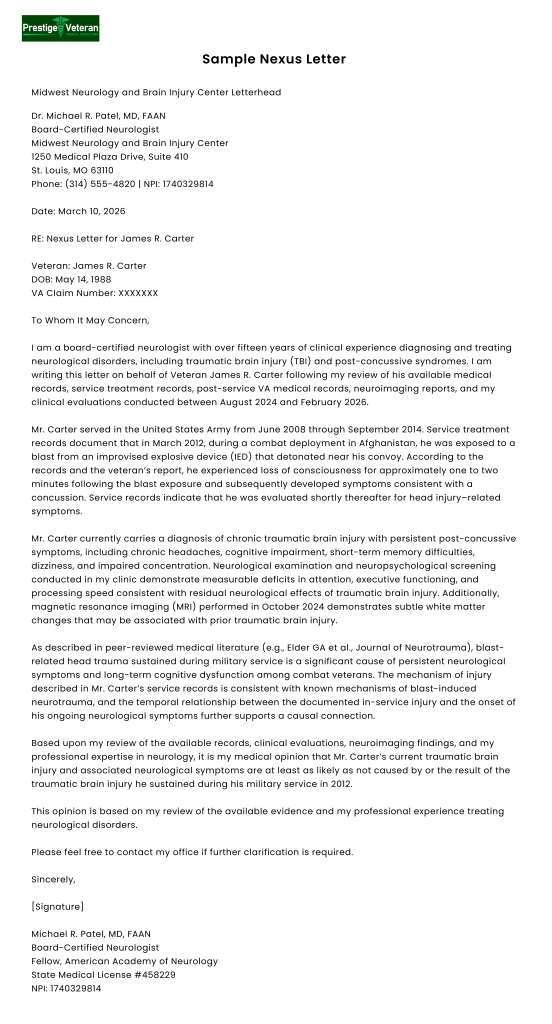
Disclaimer: The sample nexus letter is for educational purposes only to illustrate structure and does not guarantee a successful claim.
How to Get a Strong Nexus Letter for Your VA Claim
By working with the right nexus letter provider, veterans can strengthen their disability claim and increase the likelihood of a favorable VA decision.
Here are some considerations for obtaining a well-written nexus opinion for your disability claim:
Ask Your Treating Physician or Specialist
Start by asking the healthcare provider who already treats your condition. A treating physician often understands your medical history, symptoms, and progression of the disability better than a new provider. Because they have firsthand experience treating you, their opinion may carry more credibility with the VA. When requesting the letter, explain that the VA requires a medical opinion linking your current condition to your military service.
Work With Doctors Experienced in VA Disability Evaluations
Not every doctor is familiar with VA disability standards. Ideally, work with a licensed medical professional who understands VA nexus letter requirements, including the terminology used in disability claims. Medical opinions written by specialists like orthopedic surgeons, oncologists, psychiatrists, and or other condition-specific providers often carry more probative value because of their expertise.
Tip: You can find these providers by searching online for “nexus letter doctors near me” experienced in VA claims or contacting Veterans Service Organizations (VSOs).
Provide the Doctor With Complete Evidence
The effectiveness of a nexus letter depends largely on the quality of evidence the medical provider reviews. Veterans should therefore gather and supply their provider with complete documentation before requesting a nexus opinion.
Share the following key evidence with your doctor:
- Service treatment records and military personnel records showing injuries, exposures, or events during active duty.
- Post-service medical records documenting diagnosis, treatment, and symptom progression.
- Deployment or exposure records (e.g., burn pit exposure records, Agent Orange registry participation, MOS duty descriptions, etc.).
- A personal statement describing when symptoms began and how the condition developed after separation.
- Lay statements (“buddy statements”) from fellow service members, family, or friends describing in-service events or observed symptoms post service.
- Prior VA rating decisions or C&P exam reports that show previously granted or denied conditions.
Providing a complete package of records helps the doctor form a well-supported medical opinion, increasing its credibility and your chances of an approved VA disability claim.
Ensure the Nexus Opinion Clearly Explains the Service Connection
When getting a medical nexus letter, request the doctor to include the phrase “at least as likely as not” when giving their opinion. The letter should describe the diagnosis, relevant in-service exposure or injury, medical history, and professional reasoning supporting the connection between the veteran’s current disability and active duty. Following a proper nexus letter format helps the VA clearly understand the medical basis for the claim and strengthens the credibility of the opinion.
Consider Professional Nexus Letter Services
If your physician cannot write the letter, you may consult independent medical examiners (IMEs) who specialize in veterans’ disability claims. These providers review service records, conduct evaluations, and prepare independent nexus opinions tailored to VA standards.
While nexus letter services often cost $500 to $2,000 or more, they can be valuable in strengthening complex claims, secondary service-connection cases, or appeals after a denial. It is wise to avoid low-quality services that provide generic or template-based opinions without a meaningful record review. Before paying for an opinion, veterans should carefully evaluate providers and consider whether the clinician’s specialty aligns with their claimed condition.
Submit the VA Nexus Letter With Supporting Evidence Independently or Through an Accredited Legal Professional
Once the nexus letter is complete, submit it with your initial VA disability claim or as evidence during an appeal. Attach it alongside supporting documentation such as service treatment records, deployment records, private/VA medical records, buddy statements, and diagnostic reports.
VA.GOV provider instructions for Veterans to submit a nexus letter with supporting evidence using VA Form 21-526EZ through:
- Online: Upload via VA.gov
- Fax: Send to the VA Evidence Intake Center.
- Mail: Evidence Intake Center, P.O. Box 4444, Janesville, WI 53547-4444.
Providing a nexus opinion early in the process may help support the evidentiary record and, in some cases, reduce the need for additional VA examinations.
Conclusion
Securing VA disability benefits often depends on presenting a clear and well-supported claim, and the right medical evidence can make that process smoother. A thoughtfully prepared nexus letter for a VA claim can help veterans ensure their service history and health conditions are better understood during the evaluation process. More importantly, it empowers veterans to advocate for themselves with stronger documentation and professional medical support.
If you are pursuing a VA disability claim, take time to organize your records and work with knowledgeable medical experts to ensure your nexus letter is clear, evidence-based, and aligned with VA standards. When needed, seek guidance from experienced veterans’ advocates or VA-accredited representatives.
Frequently Asked Questions (FAQs)
Will a Nexus letter help my VA claim?
A well-supported nexus letter may help strengthen a VA disability claim by providing medical evidence linking a veteran’s current condition to their military service.
How successful is a Nexus letter?
While not a guarantee of approval, a well-supported nexus letter from a qualified medical professional may help support a VA disability claim.
Will the VA ignore a Nexus letter? If so, then why?
In some cases, the VA may give less weight to a nexus letter if it lacks a clear medical rationale or is not based on a review of the veteran’s relevant records.
Can I write my own Nexus letter for the VA?
In most cases, a nexus letter is expected to come from a qualified healthcare professional, as the VA relies on medical expertise to establish a service connection. If you are a licensed healthcare provider, you may be able to provide your own medical opinion, but it must still meet VA standards and be supported by appropriate medical rationale and record review.
Can AI write a Nexus letter?
AI can help draft or structure a nexus letter, but it must ultimately be reviewed, validated, and signed by a licensed medical professional for the VA to consider it credible evidence.
Also Read: What to Do if Your Doctor Won’t Write a VA Nexus Letter
At Prestige Veteran Medical Consulting, a veteran-owned company, we specialize in Independent Medical Opinions (IMOs) known as Nexus letters.
Our purpose is to empower YOU, the veteran, to take charge of your medical evidence and provide you with valuable educational tools and research to guide you on your journey.
Understanding the unique challenges veterans face, our commitment lies in delivering exceptional service and support.
Leveraging an extensive network of licensed independent medical professionals, all well-versed in the medical professional aspects of the VA claims process, we review the necessary medical evidence to incorporate in our reports related to your VA Disability Claim.
Prestige Veteran Medical Consulting is not a law firm, accredited claims agent, or affiliated with the Veterans Administration or Veterans Services Organizations. However, we are happy to discuss your case with your accredited VA legal professional.