

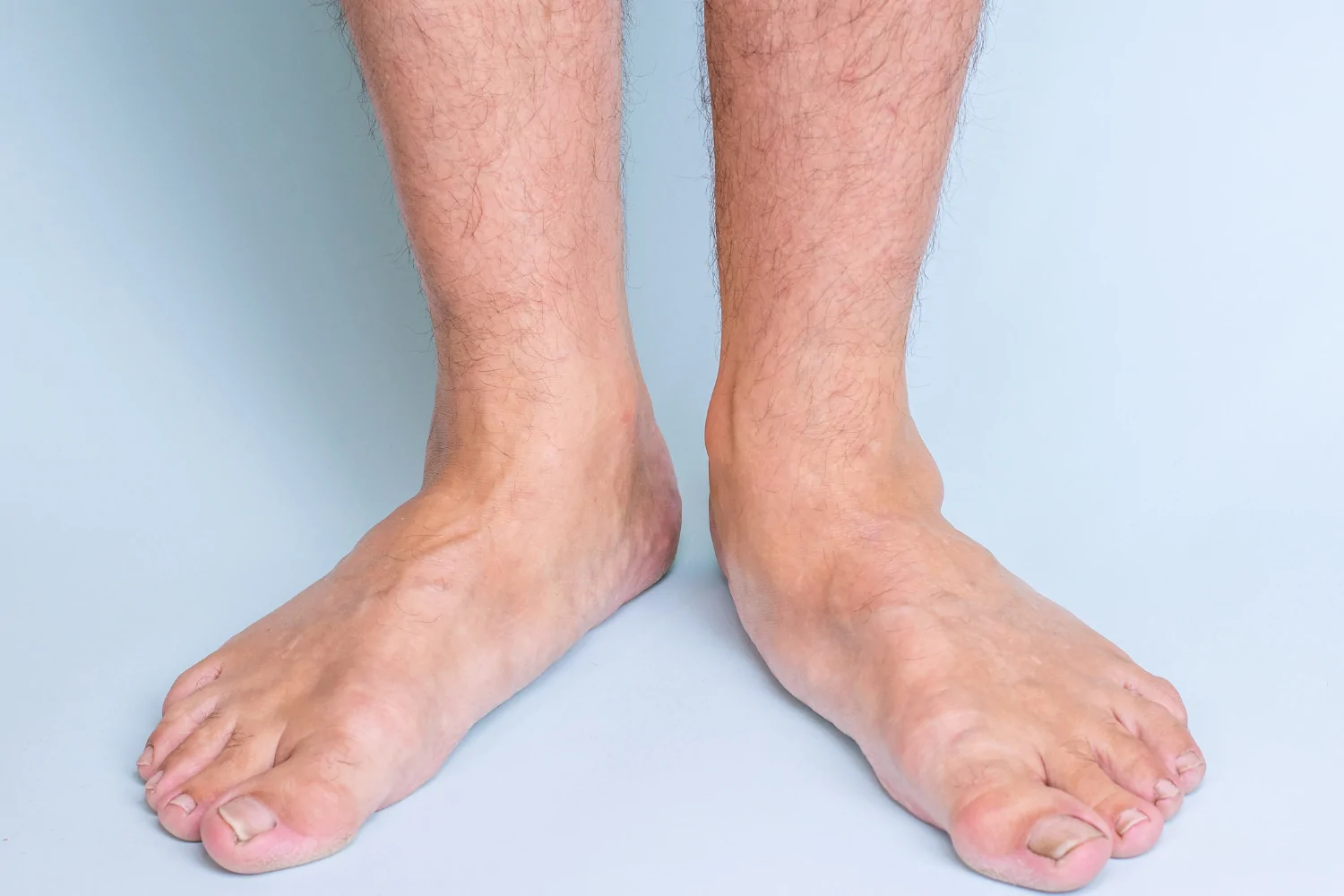
Flat feet, medically known as pes planus, occur when the arches of the feet flatten while standing or bearing weight for extended periods. For veterans, the VA evaluates acquired flatfoot under Diagnostic Code 5276 and may assign a rating from 0% to 50% based on symptom severity, whether one or both feet are affected, and the extent to which orthotics or supportive footwear provide relief. Understanding these criteria can help veterans identify the medical findings and evidence most relevant to their claims.
This guide explains VA rating criteria, service-connection requirements, supporting evidence, C&P examinations, and other factors that may affect a flat foot disability claim.
Table of Contents
Flat Feet VA Rating Chart
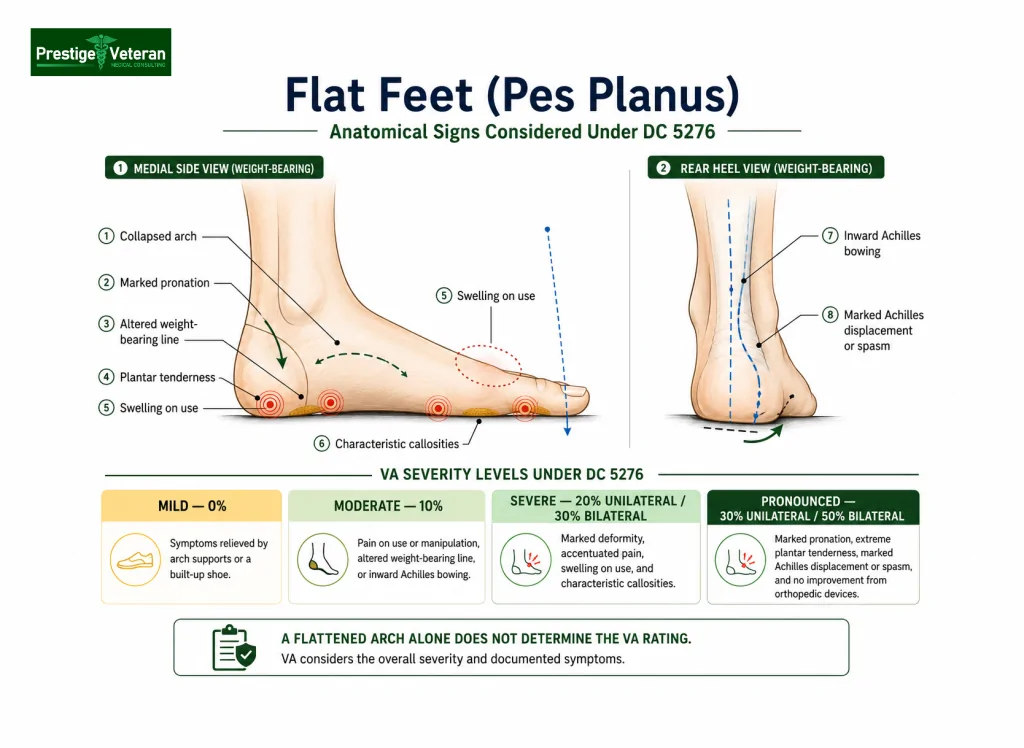
VA evaluates acquired flatfoot under 38 CFR § 4.71a, Diagnostic Code 5276, which provides disability ratings of 0%, 10%, 20%, 30%, and 50%.
| Severity | One Foot | Both Feet | Core VA Rating Criteria |
| Mild | 0% | 0% | Symptoms relieved by a built-up shoe or arch support |
| Moderate | 10% | 10% | Altered weight-bearing line, inward Achilles bowing, and pain on use or manipulation |
| Severe | 20% | 30% | Marked deformity, accentuated pain, swelling on use, and characteristic callosities |
| Pronounced | 30% | 50% | Marked pronation, extreme plantar tenderness, Achilles displacement or spasm, and no improvement from orthopedic devices |
The symptoms listed in the regulation describe the overall disability picture associated with each level. Note that the VA reviews medical findings, examination results, treatment history, and relevant lay evidence when assigning a flat feet disability rating.
VA does not assign a 40% schedular rating for pes planus under Diagnostic Code 5276.
How VA Rates Flat Feet Under Diagnostic Code 5276
Under 38 CFR § 4.71a, Diagnostic Code 5276, acquired flatfoot (pes planus) is evaluated in four levels: mild, moderate, severe, and pronounced, with ratings based on severity and whether one or both feet are affected.
Here’s a breakdown of the criteria for each rating level.
0% VA Rating for Mild Flat Feet
A 0% rating applies to mild flat feet affecting one or both feet when symptoms are relieved by a built-up shoe or arch support.
A 0% evaluation is described as noncompensable, which means the condition is service-connected but does not result in monthly disability compensation by itself.
10% VA Rating for Moderate Flat Feet
A 10% rating applies to moderate pes planus, whether it affects one foot or both feet.
The regulation describes moderate acquired flatfoot through findings that may include:
- The weight-bearing line falling over or medial to the great toe
- Inward bowing of the Achilles tendon
- Pain on manipulation and use of the feet
Weight-bearing line refers to how body weight passes through the foot while standing, and a line over or toward the inside of the great toe may indicate altered foot mechanics.
Inward bowing of the Achilles tendon occurs when the tendon curves inward instead of following a straight vertical course.
Pain on manipulation and use means pain occurs when the foot is physically examined and during activities such as standing or walking.
20% VA Rating for Severe Unilateral Flat Feet
A 20% flat foot VA disability rating applies to a severe acquired flatfoot affecting one foot.
The severe criteria include:
- Objective evidence of marked deformity, such as pronation or abduction
- Pain on manipulation and use that is accentuated
- Indication of swelling on use
- Characteristic callosities
Marked deformity is a significant change in the alignment or position of the foot, rather than mild arch flattening.
Pronation is the inward rolling or collapse of the foot during weight-bearing, while abduction is the outward movement of the front portion of the foot.
Accentuated pain means pain on use or manipulation is more pronounced than under the moderate criteria.
Characteristic callosities are recurring calluses caused by abnormal pressure or weight distribution.
30% VA Rating for Severe Bilateral Flat Feet
A 30% rating applies when the severe bilateral flatfoot criteria affect both feet, including objective evidence of marked deformity, accentuated pain on manipulation and use, swelling on use, and characteristic callosities.
20% versus 30%: Within the severe pes planus category, the main schedular distinction is generally whether the condition affects one foot or both feet. Severe unilateral flatfoot is listed at 20%, while severe bilateral flatfoot is listed at 30%.
30% VA Rating for Pronounced Unilateral Flat Feet
A 30% pes planus VA rating can represent either:
- Severe bilateral flat feet, or
- Pronounced flatfoot affecting one foot
Note: The duplicated percentage can be confusing because the underlying disability pictures are different. Severe bilateral pes planus affects both feet but falls within the severe category. Pronounced unilateral pes planus affects only one foot but includes findings from the highest severity category.
Pronounced symptoms may include:
- Marked pronation
- Extreme tenderness of the plantar surface
- Marked inward displacement
- Severe Achilles tendon spasm on manipulation
- A lack of improvement from orthopedic shoes or appliances
The side affected and the severity of the documented findings therefore both matter when interpreting a 30% VA rating for fallen arches.
Plantar surface means the sole of the foot.
Marked inward displacement is a substantial inward shift of the Achilles tendon or heel alignment.
Achilles tendon spasm on manipulation is an involuntary tightening of the tendon when the foot is moved during an examination.
50% VA Rating for Pronounced Bilateral Flat Feet
A 50% evaluation is the highest schedular flat feet VA rating under Diagnostic Code 5276 that applies to pronounced acquired flatfoot affecting both feet.
The regulation describes pronounced bilateral flatfoot through findings that may include:
- Marked pronation
- Extreme tenderness of the plantar surfaces
- Marked inward displacement of the Achilles tendon
- Severe Achilles tendon spasm on manipulation
- Symptoms that are not improved by orthopedic shoes or appliances
Not every person will have an identical collection of symptoms. VA considers the overall disability picture and the evidence describing the affected foot.
How VA Evaluates Service Connection for Flat Feet
Veterans seeking a flat feet VA rating must first establish that pes planus is connected to military service. Service connection may be established directly, through aggravation, or on a secondary basis.
Direct Service Connection
Direct service connection may apply when flat feet began during active duty or resulted from a service-related event.
Under 38 CFR § 3.303, a VA disability claim generally requires three elements:
- A current diagnosis of flat feet (pes planus)
- An in-service event, injury, or onset of symptoms
- A medical nexus linking the current condition to military service
Military circumstances that may be relevant to the foot condition include repetitive marching, running in military boots, carrying heavy equipment, prolonged standing, parachute or impact injuries, and documented foot or ankle trauma.
Supporting evidence may consist of service treatment and personnel records, lay statements, C&P exam findings, nexus opinions, and post-service medical records showing continuity of symptoms.
Service Connection Through Aggravation
Some veterans enter military service with flat feet that developed earlier in life. Under 38 CFR § 3.306, a preexisting condition may be service-connected when military duties caused it to permanently worsen beyond its expected natural progression.
For example, flat feet recorded as mild and asymptomatic during the entrance examination may later cause persistent pain, swelling, calluses, reduced mobility, or the use of prescribed orthotics.
A measurable increase in the severity of the condition during service may be more helpful to show than an occasional or temporary flare-up. Reports of new or worsening symptoms, ongoing treatment, or continuing symptoms may show a permanent increase in the underlying condition.
Secondary Service Connection
Veterans with service-connected flat feet who develop additional medical conditions may be considered for secondary service connection under 38 CFR § 3.310. For example, pes planus can alter gait and posture, placing abnormal stress on the ankles, knees, hips, and lower back. These changes in biomechanics and weight distribution may contribute to or worsen separately diagnosed musculoskeletal disorders.
Common secondary conditions that may be linked to flat feet include:
- Plantar fasciitis
- Ankle instability or chronic ankle pain
- Knee conditions
- Hip conditions
- Lower back conditions
- Degenerative disc disease
- Shin splints
- Achilles tendon problems
These conditions are not presumed to be secondary simply because they coexist with flat feet. A medical nexus opinion may be needed to explain whether service-connected pes planus led to the onset or worsening of a secondary condition and, for aggravation, identify the baseline severity when possible. The same principle applies when a veteran has both flat feet and pain elsewhere in the lower extremities.
Secondary service-connected conditions may be evaluated under VA’s combined ratings system, which may result in a higher overall disability rating and monthly compensation when supported by evidence.
Evidence That May Support a Flat Feet VA Claim
For VA disability rating evaluation of pes planus, evidence plays a central role in showing both the presence of the condition and how it affects foot function over time. Strong evidence usually builds a complete picture of how flat feet developed and progressed rather than relying on a single report.
Medical Diagnosis and Treatment Records
Medical records can document the presence and progression of pes planus.
- A formal diagnosis of flat feet, especially when documented with descriptions like pronation, arch collapse, or plantar pain
- Podiatry or orthopedic evaluations
- Imaging reports
- Ongoing treatment notes
- Prescribed orthotics or supportive footwear
- Pain medications
- Physical therapy records
Documentation of treatment response may also reflect whether symptoms improve with orthotics or not, or whether foot pain persists despite treatment. This is notable because “not improved by orthopedic shoes or appliances” is one of the thresholds for higher ratings. Consistent documentation across years tends to show persistence rather than a temporary issue.
For example, a veteran might have repeated clinic visits for heel pain after long-standing duties, with notes showing worsening arch flattening over time.
Service Treatment and Personnel Records
Military records may help show when symptoms began, whether foot mechanics changed, and to what extent the condition affected military duties.
Relevant documentation may include:
- Complaints of arch, heel, or foot pain
- Sick call or clinical visits
- Early documentation of flat feet during active duty exams
- Temporary or permanent physical profiles
- Records showing activities involving running, marching, standing, or load-bearing
- Entrance and separation examinations noting foot condition
- Documentation of a foot or ankle injury
- Records of issued orthotics or supportive footwear
For instance, a veteran whose STRs show repeated complaints of foot strain during infantry training, followed by a diagnosis of “flexible flat feet” during a separation physical. These records form part of the complete medical and service history considered during review.
Lay Statements
Veterans and their family members, friends, fellow service members, or colleagues may report symptoms and functional changes that they have personally observed. These lay, or buddy statements, are especially useful for showing day-to-day impact, such as difficulty standing for long periods, visible arch collapse, or changes in gait.
For instance, a spouse might describe how the veteran avoids walking long distances due to persistent foot pain, or a fellow service member may recall the veteran frequently removing boots during breaks because of discomfort. While they do not replace medical evidence, lay or buddy statements help add real-world detail about the condition over time.
Medical Nexus Opinion
A medical nexus letter explains how service activities or another service-connected disability may have contributed to or aggravated flat feet (pes planus). This is typically written by a licensed healthcare professional who reviews veteran records and provides a clinical explanation of cause and effect.
A nexus opinion may be particularly relevant when:
- Pes planus was diagnosed after service
- The medical records contain a substantial gap
- Flat feet were noted at the entrance, and worsening is disputed
- Another lower-extremity condition may have affected gait or weight-bearing
- Multiple possible causes appear in the record
Strong nexus letters often reference the records reviewed, discuss relevant clinical findings, and explain the medical reasoning connecting biomechanics, reported symptoms, and the progression of the condition to the conclusion.
Example:
An orthopedic specialist may state that it is “at least as likely as not” that the veteran’s pes planus was aggravated beyond natural progression by infantry ruck marching, noting pre-service mild flat feet. The opinion may also reference post-service factors such as an ankle fracture and weight gain, along with records showing progressive arch collapse during active duty.
C&P Examination Findings (Including DBQ)
Findings from a C&P exam documented through the Disability Benefits Questionnaire may provide important evidence about the current severity and functional impact of pes planus.
In some cases, a private DBQ completed by a licensed healthcare provider may also be submitted to support the medical record. These examination findings are explained in detail later in this article.
Congenital vs. Acquired Flat Feet in VA Claims
Diagnostic Code 5276 is titled “Flatfoot, acquired.” VA adjudicators must distinguish between congenital, which is present from birth, and acquired forms of pes planus when evaluating disability claims.
38 CFR § 4.57 – Congenital Flatfoot Criteria
Under 38 CFR § 4.57, congenital flatfoot with arch depression but without associated symptoms such as abnormal callosities, pressure areas, strain, or demonstrable tenderness is generally described as a developmental condition. In such cases, the condition may not be considered disabling on its own.
The regulation also clarifies that arch depression alone is not the defining feature of acquired flatfoot. Instead, evaluation focuses on findings such as structural changes, plantar tenderness, Achilles alignment, altered biomechanics, and other objective signs.
VA Evaluation of Congenital vs Acquired Flatfoot Claims
VA analysis of flatfoot claims may also involve distinguishing between a congenital defect and a disease process, as well as determining whether a condition was noted at entry or later aggravated by service. These factors can influence how the condition is evaluated under VA rating criteria.
An entrance examination that notes pes planus can therefore be relevant, but it does not determine the outcome by itself. The overall severity at entry, progression of symptoms, and medical evidence of aggravation or change over time are also considered.
Consult a VA-accredited representative or disability attorney to understand how these distinctions apply to your individual claim.
Flat Feet C&P Exam and Its Impact on VA Rating Claims
The VA may schedule a Compensation and Pension (C&P) examination to assess the diagnosis, severity, and functional impact of pes planus. Examiners typically use the VA Foot Conditions Disability Benefits Questionnaire (DBQ), which standardizes the recording of symptoms and physical findings.
During the exam, the C&P examiner may ask questions about:
- When the symptoms began and how they have progressed
- Whether one or both feet are affected
- Flare-ups and limits on standing or walking
- Treatments tried, including orthotics or footwear changes, and whether symptoms persist despite treatment
- Impact on work and daily activities
A physical examination is then performed to assess clinical signs, including pain on use or manipulation, swelling, altered gait, arch height, and Achilles tendon alignment. The examiner may also observe standing or walking and compare reported symptoms with the medical record.
Explaining Symptoms and Functional Limitations
When answering the examiner, describe your symptoms clearly and in a specific context rather than giving general statements such as “my feet hurt.” For example, you may explain whether pain gradually builds with continued standing, whether one foot causes greater limitation, or whether symptoms require changes in pace, gait, footwear, or activity.
Do not exaggerate or minimize your symptoms, as the exam findings form part of the evidence VA uses to determine service connection and assign a disability rating.
Can VA Rate Flat Feet and Plantar Fasciitis Separately?
Plantar fasciitis and acquired flatfoot appear under separate diagnostic codes in the VA rating schedule. Plantar fasciitis is listed under Diagnostic Code 5269, while acquired flatfoot is evaluated under Diagnostic Code 5276.
However, separate diagnostic codes may not always result in separate evaluations. Under 38 CFR § 4.14, VA avoids “pyramiding,” which prevents compensating the same symptoms more than once under different diagnoses.
Flat feet and plantar fasciitis may both produce pain on the bottom of the foot, pain during use, tenderness, and reduced standing or walking tolerance. When the same symptoms support both diagnoses, separate compensation may not be assigned.
VA instead evaluates whether each condition produces distinct manifestations based on the medical evidence.
Is There a Bilateral Factor for Flat Feet?
Diagnostic Code 5276 already provides single ratings for bilateral pes planus, such as 30% for severe and 50% for pronounced cases. Because the code evaluates both feet together, VA does not typically assign separate right and left foot ratings under DC 5276 to apply the bilateral factor.
The bilateral factor under 38 CFR § 4.26 applies when separate compensable disabilities affect paired extremities and are rated individually before being combined. However, other service-connected lower-extremity conditions may still contribute to the overall combined rating even when pes planus is evaluated under a single bilateral rating.
Can Flat Feet Be Relevant to TDIU?
Yes, flat feet can be considered for a TDIU determination if the condition significantly limits a veteran’s ability to maintain substantially gainful employment.
Under 38 CFR § 4.16(a), the schedular percentage requirements for total disability based on individual unemployability (TDIU) are:
- One disability rated at 60% or more, or
- Two or more disabilities with at least one rated at 40% or more and a combined evaluation of at least 70%
A 50% pes planus rating by itself falls short of the single-disability 60% TDIU threshold. However, other service-connected disabilities contribute to meeting the combined rating criteria, and multiple disabilities may be treated as one disability when the regulatory requirements are met.
Section 4.16(b) also addresses TDIU claims in which service-connected disabilities affect employability but the percentage standards are not satisfied.
Supporting TDIU Evidence
Flat feet may be relevant to an employment analysis when the condition limits prolonged standing, walking, climbing, lifting, carrying, or workplace attendance. Evidence supporting a TDIU claim may include medical records, work history, and statements from employers or coworkers explaining how service-connected pes planus affects occupational functioning.
Example VA Rating Scenarios for Flat Feet
Scenario 1
A former infantry veteran reports that foot discomfort began during service after repeated ruck marches and long field exercises. Over time, pain becomes noticeable during everyday activities like grocery shopping or standing in queues. Medical notes show mild arch flattening, occasional use of over-the-counter insoles, and pain that improves with rest but returns after prolonged walking.
In this case, findings may be consistent with a 10% rating (Moderate Flat Feet), depending on full examination findings.
Scenario 2
A veteran with service-connected pes planus describes worsening symptoms in one foot more than the other. After a full work shift involving standing and carrying heavy equipment during military duties, the foot develops swelling and visible callus formation. Medical records show that orthotics provide limited relief, while pain increases with continued use and reduces walking endurance.
A 20% rating (Severe Unilateral Flat Feet) may be considered, depending on the overall examination findings and documented severity.
Scenario 3
A veteran reports long-standing bilateral flat feet with significant arch collapse, persistent heel tenderness, and Achilles misalignment noted in exams. Even with custom orthopedic shoes, symptoms remain largely unchanged and affect both standing tolerance and mobility at work.
Findings here may be consistent with a 50% rating (Pronounced Bilateral Flat Feet), depending on full examination findings and overall disability picture.
These scenarios are illustrative only. Actual VA disability evaluations depend on the complete medical and service evidence record.
What Happens When You Disagree With a Flat Feet Decision?
If you disagree with a VA decision on a flat feet rating claim, the Appeals Modernization Act provides three main review options: Supplemental Claim, Higher-Level Review, and Board Appeal.
- A Supplemental Claim involves submitting new and relevant evidence, such as updated medical records or a new examination report.
- A Higher-Level Review is conducted by a higher-level reviewer using the evidence that was already part of the record. New evidence is not considered in this review lane.
- A Board Appeal is reviewed by a Veterans Law Judge and offers different dockets depending on whether you requested direct review, evidence submission, or a hearing.
The appropriate review option depends on the decision, timing, and type of disagreement. VA-accredited representatives can assist in selecting the correct appeal lane and meeting required deadlines.
Wrapping Up
A flat foot VA disability rating depends on more than a diagnosis of pes planus. VA considers symptom severity, whether one or both feet are affected, the effectiveness of orthotics, and the complete medical and service record. Veterans should review and confirm that the documented symptoms align with the applicable pes planus criteria.
Keeping records accurate and documenting changes over time can help ensure the foot condition is evaluated fairly. Because every claim involves different evidence, it may be helpful to consult a VA-accredited representative when guidance is needed.
Frequently Asked Questions (FAQs)
Do Flat Feet Qualify for VA Disability?
Yes, flat feet may qualify for VA disability when the condition is connected to military service and supported by evidence of current symptoms or functional impairment.
What VA Form Is Used to Claim Flat Feet?
Veterans generally file a disability claim for flat feet using VA Form 21-526EZ.
Do Flat Feet Disqualify You From Military Service?
Flat feet do not automatically disqualify someone from military service, although symptomatic cases that impair function or require certain treatments may affect medical eligibility.
How Much Does a Flat Feet VA Rating Pay?
VA compensation for flat feet is based on a single combined rating for both the left and right feet rather than separate payments for each foot condition. For rates effective December 1, 2025, a 10% rating pays $180.42 per month, while a 50% rating pays $1,132.90 per month for a veteran without qualifying dependents, with higher amounts possible based on dependent status.
Current figures should be checked against VA’s compensation tables.
When May VA Consider a Higher Flat Feet Evaluation?
VA may consider a higher pes planus evaluation when medical evidence shows worsening symptoms and functional impairment that more closely meet the criteria under DC 5276, such as:
- Reduced effectiveness of orthotics
- Symptoms affecting both feet (bilateral involvement)
- Objective deformity, such as marked pronation or Achilles displacement
- Increased pain or tenderness on use
- Reduced standing or walking tolerance
How Are VA Disability Ratings for Flat Feet and Plantar Fasciitis Assigned?
VA rates acquired flatfoot under DC 5276 and plantar fasciitis under DC 5269, with separate ratings assigned only when each condition produces distinct, non-overlapping symptoms.
Also Read: Best Evidence to Support a Nexus Letter for VA Disability Claims
At Prestige Veteran Medical Consulting, a veteran-owned company, we specialize in Independent Medical Opinions (IMOs) known as Nexus letters.
Our purpose is to empower YOU, the veteran, to take charge of your medical evidence and provide you with valuable educational tools and research to guide you on your journey.
Understanding the unique challenges veterans face, our commitment lies in delivering exceptional service and support.
Leveraging an extensive network of licensed independent medical professionals, all well-versed in the medical professional aspects of the VA claims process, we review the necessary medical evidence to incorporate in our reports related to your VA Disability Claim.
Prestige Veteran Medical Consulting is not a law firm, accredited claims agent, or affiliated with the Veterans Administration or Veterans Services Organizations. However, we are happy to discuss your case with your accredited VA legal professional.