
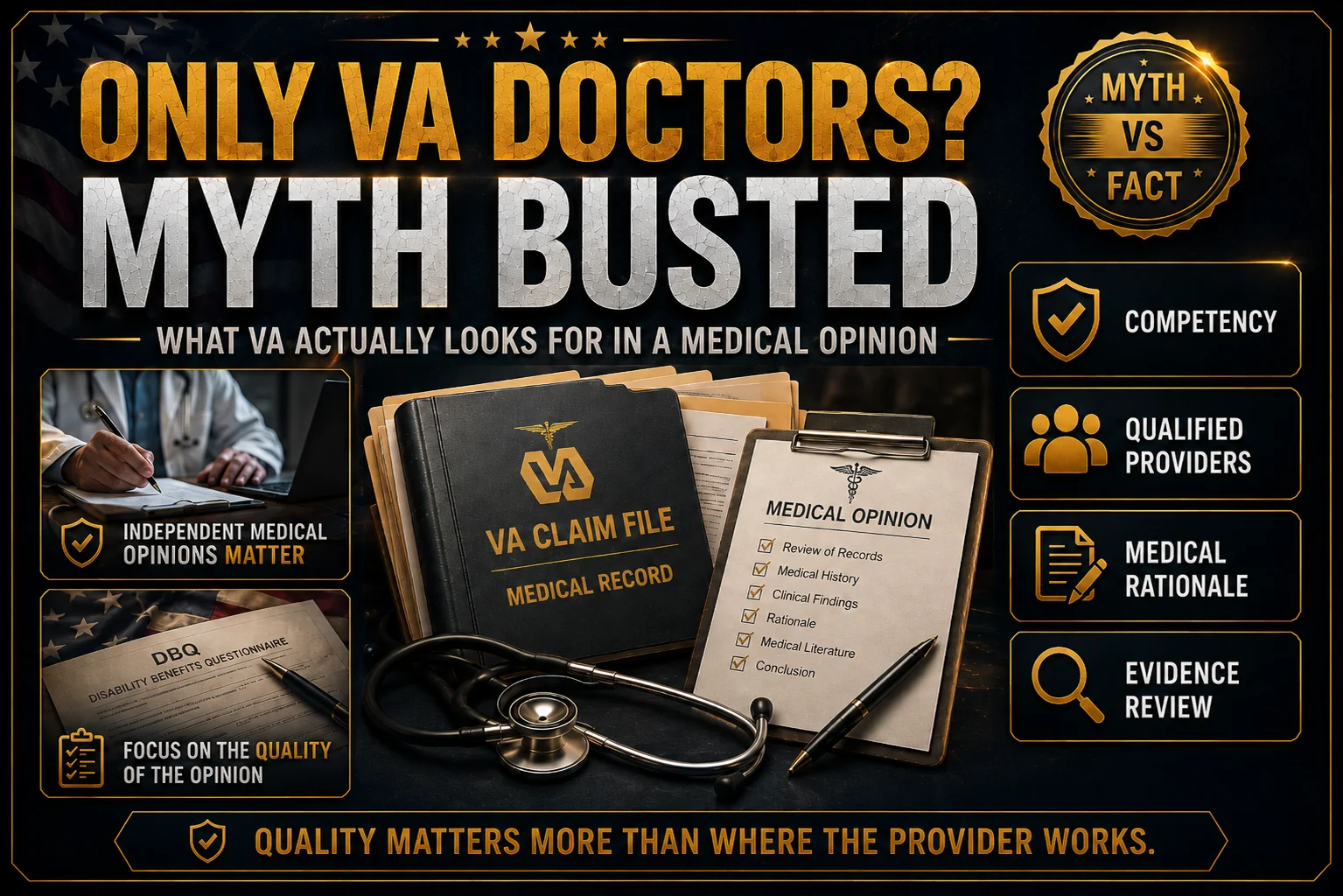
One of the most common myths veterans hear is that only VA doctors can write medical opinions for VA disability claims.
That is not accurate.
Many veterans believe that if their VA doctor refuses to write a Nexus letter or medical opinion, their claim has no chance. Others delay gathering evidence because they think only a VA-employed provider can give an opinion the VA will consider.
This misunderstanding can create unnecessary confusion.
In this Myth-Busting VA Claims video, Leah Bucholz, founder and CEO of Prestige Veteran Medical Consulting, explains what VA actually looks for when evaluating medical opinions, who may be qualified to write them, and why the quality of the opinion matters more than where the provider works.

Table of Contents
The Myth: Only VA Doctors Can Write Medical Opinions
The myth is simple:
Only VA doctors can write medical opinions for VA disability claims.
But the VA does not require every medical opinion or Nexus letter to come from a VA doctor.
A medical opinion may come from a qualified healthcare professional who is competent to address the specific medical issue being discussed. That may include different types of licensed professionals depending on the condition, the medical question, and the provider’s training and experience.
For example, a hearing loss opinion may involve an audiologist. A PTSD-related opinion may involve a psychologist or psychiatrist. An orthopedic issue may involve a physician, physician assistant, nurse practitioner, or other provider with relevant musculoskeletal experience.
The key question is not simply:
Does this person work for VA?
The better question is:
Is this provider qualified to give an opinion on this specific medical issue?
What VA Looks for Instead: Competency
VA regulations define competent medical evidence as evidence provided by someone qualified through education, training, or experience to offer medical diagnoses, statements, or opinions.
That definition matters because it shifts the focus away from the provider’s employer and toward the provider’s qualifications.
In other words, competency is not about whether the provider works inside or outside VA.
Competency is about whether the provider has the medical knowledge, training, education, or experience needed to answer the question at issue.
A private provider is not automatically less competent because they do not work for VA.
A VA examiner is not automatically more persuasive simply because they do work for VA.
The analysis should focus on the medical issue, the provider’s qualifications, the evidence reviewed, and the reasoning behind the opinion.
Competency Is About Qualifications, Not Employer
A medical provider’s qualifications should match the medical question being answered.
For example:
A psychologist or psychiatrist may be appropriate for mental health-related questions.
An audiologist may be appropriate for hearing loss or tinnitus-related issues.
A physician, physician assistant, or nurse practitioner with relevant clinical experience may be appropriate for many orthopedic, musculoskeletal, neurological, or general medical issues.
A specialist may be more appropriate when the condition is highly complex or outside a general provider’s usual area of practice.
The point is not that one credential is always better than another.
The point is that the provider should be practicing within their scope and should be competent to address the issue they are discussing.
A provider offering an opinion far outside their area of expertise may create problems.
For example, a provider with no mental health expertise writing a detailed PTSD causation opinion may raise questions. Similarly, a generic letter from a provider who does not explain the veteran’s actual medical history may not be very persuasive.
The right provider depends on the medical question.
VA Examiners Are Not Automatically More Persuasive
Another related misconception is that a VA examiner’s opinion automatically carries more weight than a private medical opinion.
That is not how medical evidence should be viewed.
A VA examiner has a medical license, training, and experience. But working for VA does not magically make that person’s reasoning stronger.
Likewise, a private provider does not become less qualified simply because they work outside the VA system.
The strongest medical opinion is usually the one that is medically sound, factually informed, clearly explained, and supported by the evidence.
A weak VA opinion can still be weak.
A strong private opinion can still be strong.
The employer is not the most important part of the analysis.
What Makes a Medical Opinion Persuasive?
Veterans should focus less on where the opinion comes from and more on whether the opinion is actually well developed.
A persuasive medical opinion should usually do several things.
First, it should accurately identify the veteran’s diagnosis.
Second, it should review the relevant medical history and service history. That does not always mean the provider must discuss every page of every record, but the opinion should show that the provider understands the important facts.
Third, it should explain the medical reasoning.
This is often the most important part.
A conclusion by itself is not enough.
For example, a sentence like:
“It is my opinion that the veteran’s condition is related to service.”
is only a conclusion.
The stronger opinion explains why.
It should connect the veteran’s diagnosis, service history, symptoms, medical records, timeline, risk factors, and medical principles in a way that makes sense.
Why Medical Rationale Matters So Much
Medical rationale is what turns a conclusion into an actual opinion.
A strong rationale answers questions like:
Why does this condition make sense medically?
What facts support the conclusion?
What does the veteran’s timeline show?
How do the records support the opinion?
Are there other possible causes?
If there are risk factors, how were they considered?
How does the provider connect the medical evidence to the conclusion?
This is where many weak medical opinions fall apart.
They may include the right phrase. They may use strong wording. They may even come from a provider with impressive credentials.
But if the opinion does not explain itself, it may not carry the weight the veteran expects.
Strong opinions connect the dots.
Weak opinions simply state conclusions.
Conflicting Evidence Should Be Addressed
A medical opinion should not ignore difficult facts.
If there are conflicting records, gaps in treatment, normal findings, prior injuries, other risk factors, or inconsistent timelines, those issues should usually be addressed.
That does not mean every negative fact destroys the opinion.
It means the provider should explain how those facts fit into the medical analysis.
For example, if the veteran had a long gap in treatment, the opinion may need to explain why the condition is still medically consistent with the history.
If there are multiple possible causes, the provider should discuss why one explanation is more medically persuasive than another.
If records appear inconsistent, the provider should explain how they interpreted those records.
Ignoring bad facts can weaken an opinion.
Addressing them responsibly can make the opinion more credible.
Common Misconceptions About Nexus Letters
There are several related myths veterans often hear about Nexus letters and medical opinions.
Myth 1: “My VA doctor refused to write a Nexus letter, so my claim is over.”
That is not necessarily true.
Some VA providers simply choose not to write medical opinions or Nexus letters. That does not automatically mean the veteran’s case lacks merit.
It may mean the veteran needs to better understand what evidence is already in the record, whether additional medical clarification is needed, and who may be qualified to provide it.
Myth 2: “My primary care doctor treated me for years, so their opinion will automatically carry the most weight.”
A long treatment relationship can be helpful, but it is not the only factor.
If the issue involves a highly specialized condition, a specialist or provider with more relevant experience may sometimes offer a more persuasive opinion.
The relationship matters, but so does the provider’s ability to answer the specific medical question.
Myth 3: “VA has to accept my doctor’s opinion.”
VA has to consider competent medical evidence, but that does not mean every opinion must be accepted without review.
Medical opinions may be weighed against other evidence in the file.
That is why reasoning, factual accuracy, and consistency matter.
Myth 4: “The longer the report, the better.”
Length does not equal quality.
A short opinion can be persuasive if every sentence serves a purpose and the reasoning is clear.
A long report can still be weak if it is repetitive, generic, or fails to explain the medical connection.
Quality matters more than quantity.
What Court Decisions Have Said About Medical Opinions
The value of a medical opinion often comes from its reasoning.
In Nieves-Rodriguez v. Peake, the Court explained that being suitably qualified and sufficiently informed are threshold considerations, but most of the probative value of a medical opinion comes from its reasoning.
That point is important for veterans to understand.
A medical opinion is not persuasive simply because the provider has a title.
It is persuasive when the provider understands the relevant facts and explains the medical reasoning clearly.
Another important case, Stefl v. Nicholson, addressed the need for enough medical analysis for the opinion to be useful in the decision-making process.
The takeaway is simple:
An opinion should explain itself.
A conclusion without analysis is usually not enough.
Red Flags in a Weak Medical Opinion
Whether a veteran is reviewing a private Nexus letter, a medical opinion from a treating provider, or an opinion already in the VA file, there are warning signs to watch for.
Common red flags include:
A one-sentence conclusion with no explanation.
No discussion of the veteran’s actual medical history.
No review of relevant service or treatment records.
Generic language that could apply to anyone.
A provider writing far outside their area of expertise.
No discussion of conflicting evidence.
No explanation of alternative causes or risk factors.
Overly broad statements without medical support.
A long report that says very little.
These issues can reduce the persuasive value of an opinion.
A strong opinion does not need to be dramatic. It needs to be medically sound, evidence-based, and clearly reasoned.
Final Thoughts
The myth is:
Only VA doctors can write medical opinions.
The truth is:
Medical opinions may come from qualified healthcare professionals who are competent to address the medical issue being discussed.
Veterans should not focus only on whether the provider works for VA.
They should focus on whether the provider is qualified, whether the opinion is based on relevant evidence, and whether the medical reasoning is clearly explained.
A strong medical opinion should identify the diagnosis, consider the relevant records, address the medical history, explain the rationale, and responsibly handle conflicting evidence.
A Nexus letter is not persuasive because of a logo, a title, or length.
It is persuasive when the analysis is medically credible and supported by the facts.
For veterans evaluating medical evidence, the key question is not just:
Who wrote this?
The better question is:
Does this opinion explain the medical issue clearly, accurately, and responsibly?
Also Read: Free VA Claim Guidance: What Veterans Should Know About Working With a VSO
At Prestige Veteran Medical Consulting, a veteran-owned company, we specialize in Independent Medical Opinions (IMOs) known as Nexus letters.
Our purpose is to empower YOU, the veteran, to take charge of your medical evidence and provide you with valuable educational tools and research to guide you on your journey.
Understanding the unique challenges veterans face, our commitment lies in delivering exceptional service and support.
Leveraging an extensive network of licensed independent medical professionals, all well-versed in the medical professional aspects of the VA claims process, we review the necessary medical evidence to incorporate in our reports related to your VA Disability Claim.
Prestige Veteran Medical Consulting is not a law firm, accredited claims agent, or affiliated with the Veterans Administration or Veterans Services Organizations. However, we are happy to discuss your case with your accredited VA legal professional.