

For some veterans, tinnitus is only one part of the problem. The ringing may be joined by sudden spinning, nausea, loss of balance, or the need to steady oneself while walking. When these symptoms occur together, an important question is whether the vertigo reflects a separate vestibular condition related to service-connected tinnitus.
Recurrent tinnitus generally receives a maximum schedular rating of 10%, and vertigo is not generally included in that evaluation. The VA rating for vertigo secondary to tinnitus depends on the diagnosed condition, the frequency and severity of episodes, objective findings, and the medical relationship between the conditions.
This article explains how VA evaluates vertigo, what medical and lay evidence may be considered, and how peripheral vestibular disorders differ from Ménière’s syndrome under the rating schedule.
Table of Contents
Can Vertigo Be Secondary to Tinnitus?
Tinnitus and vertigo can occur together because the inner ear contains structures responsible for both hearing and balance. The cochlea processes sound, while the vestibular organs detect movement and help the brain maintain balance, posture, and stable vision. A disease or injury affecting this area can therefore produce both auditory and balance-related symptoms.
Conditions that may involve both tinnitus and vertigo include:
- Ménière’s disease
- Labyrinthitis
- Vestibular migraine
- Inner-ear trauma
- Certain peripheral vestibular disorders
Their coexistence does not necessarily mean that tinnitus caused the vertigo. In some cases, the two symptoms reflect the same underlying condition. In others, they have unrelated causes.
Other Possible Explanations
A clinician must therefore consider other possible explanations, including:
- Benign paroxysmal positional vertigo (BPPV)
- Medication effects
- Head trauma
- Neurological disorders
- Blood-pressure changes
- Infection or age-related balance impairment
The timing and pattern of the symptoms also matter. For example, brief spinning triggered by rolling over in bed may suggest a different process than vertigo lasting several hours with fluctuating hearing and ear fullness.
For VA secondary service connection, the focus is on evidence of a diagnosed disability and a medical explanation of whether service-connected tinnitus caused or aggravated that condition.
What Is the VA Rating for Vertigo Secondary to Tinnitus?
The VA may evaluate a peripheral vestibular disorder under 38 C.F.R. § 4.87, Diagnostic Code 6204. The assigned percentage is based on the manifestations of the service-connected condition, not merely on the presence of the word “vertigo” in a medical record.
| VA Rating | General Criteria Under Diagnostic Code 6204 |
| 10% | Occasional dizziness |
| 30% | Dizziness and occasional staggering |
10% Rating for Occasional Dizziness
A 10% rating generally applies when a service-connected peripheral vestibular disorder causes occasional dizziness.
The symptoms may include intermittent spinning attacks, periodic disequilibrium, or brief episodes of dizziness triggered by changes in head position or movement. A veteran might need to stop walking or sit until the sensation passes.
The word “occasional” is not defined by a fixed number of weekly or monthly attacks in Diagnostic Code 6204. Medical records describing the frequency, duration, triggers, and functional effects of the episodes help show the overall disability picture. The final evaluation depends on the veteran’s complete record and the VA’s application of the rating schedule.
30% Rating for Dizziness and Occasional Staggering
A 30% rating, the maximum schedular evaluation under Diagnostic Code 6204, requires dizziness with occasional staggering. The regulation does not expressly define “staggering.” It may be reflected by stumbling, veering while walking, reaching for a wall, or needing support during an episode.
Relevant evidence may describe:
- An unsteady or staggering gait during attacks
- Stumbling or needing physical support
- Falls or near-falls
- Observed balance disturbances
- Medical findings showing gait or vestibular abnormalities
- Statements from people who have witnessed the episodes
Importantly, a subjective report of dizziness alone is not enough to satisfy the requirements for a compensable evaluation. The note under DC 6204 specifically requires objective findings supporting the diagnosis of vestibular disequilibrium before either a 10% or 30% rating may be assigned.
This does not necessarily mean that every episode of dizziness or staggering must be witnessed by a medical provider. Once the diagnosis is adequately supported, credible statements and other evidence describing the frequency, severity, and functional effects of dizziness and staggering may also be considered.
Can Vertigo and Tinnitus Be Rated Separately?
VA regulations generally allow a separate 10% rating for recurrent tinnitus to be combined with an evaluation under Diagnostic Code 6204. However, VA cannot compensate for the same symptoms twice, and a separate tinnitus rating may not be assigned when tinnitus is used to support another evaluation.
Tinnitus and a peripheral vestibular disorder may receive separate ratings when they produce distinct symptoms. The former involves perceived sound, whereas the latter may cause dizziness, balance problems, or staggering.
Whether separate ratings apply depends on the diagnoses, symptoms, supporting medical evidence, and the way VA applies the rating schedule to the individual claim.
How Secondary Service Connection Works
In 38 C.F.R. § 3.310, VA secondary service connection generally addresses a disability that is proximately caused by or aggravated by an existing service-connected disease or injury. In a vertigo-secondary-to-tinnitus claim, three elements are usually central.
A Current Diagnosed Disability
Vertigo describes a false sense of movement, often experienced as spinning. It is often a symptom rather than one specific disease.
The medical evidence generally needs to identify whether a current vestibular, ear, or neurological disability is responsible for the vertigo. Depending on the individual evaluation, possible underlying diagnoses may include:
- Peripheral vestibular disorder
- Benign paroxysmal positional vertigo
- Vestibular neuritis
- Labyrinthitis
- Ménière’s disease
- Vestibular migraine
This distinction is important because lightheadedness, imbalance, and true rotational vertigo do not always have the same cause.
Service-Connected Tinnitus
The evidence must establish tinnitus as a service-connected disability before vertigo can be recognized as secondary to it. Tinnitus may also be evaluated during the same overall adjudication, but the secondary relationship still depends on the primary condition being service connected.
A Medical Nexus
Medical evidence must explain whether the diagnosed condition responsible for vertigo was:
- Proximately caused by service-connected tinnitus; or
- Aggravated beyond its natural progression by tinnitus.
Causation and aggravation are separate medical relationships. Tinnitus does not have to be the original cause of the vestibular condition if medical evidence shows that it increased the condition’s severity beyond its natural progression. For aggravation, VA regulations also address establishing the condition’s baseline severity so the additional impairment associated with tinnitus can be considered.
Board of Veterans’ Appeals decisions involving vertigo and tinnitus have reached different conclusions. Those decisions are limited to their individual facts and are not binding precedent for another veteran’s case.
Evidence That May Support a Vertigo Secondary to Tinnitus Claim
Evidence for a vertigo VA claim may help answer three questions: What condition is present, how severe is it, and what is its medical relationship to tinnitus?
Medical Diagnosis and Treatment Records
Medical records can help show that the veteran has a diagnosed vestibular condition and provide a clear history of its symptoms. Regular documentation may also help distinguish true spinning vertigo from lightheadedness, faintness, or balance problems caused by another condition.
Useful treatment records may include:
- The diagnosis and the date it was established
- Symptom onset and progression over time
- Frequency, duration, and triggers of vertigo attacks
- Nausea, vomiting, tinnitus, hearing changes, or ear fullness
- Falls, staggering, gait disturbance, or other balance problems
- ENT, audiology, or neurology evaluations
- Prescribed medication and response to treatment
- Vestibular rehabilitation or other therapy
Consistency over time can be important. A record repeatedly describing rotational vertigo lasting 20 minutes twice a week is different from isolated notes mentioning faintness after standing.
Objective Vestibular Findings
Diagnostic testing depends on the suspected condition. An ENT specialist, audiologist, neurologist, or other qualified clinician may use:
- Videonystagmography or electronystagmography
- Dix-Hallpike or other positional testing
- Caloric testing
- Vestibular evoked myogenic potential testing
- Rotational-chair testing
- Posturography
- Hearing examinations
- Examination for nystagmus or abnormal gait
Not every veteran needs every test. For example, positional testing may be particularly relevant when attacks occur after rolling over in bed or looking upward. Other symptom patterns may require hearing, neurological, or more extensive vestibular testing. The appropriate examination depends on the symptoms and suspected diagnosis.
Personal and Witness Statements
Lay statements from the veteran, spouse, coworker, or friend can describe the experience and functional impact of a vertigo episode. Details may include whether the room spins, how long the symptoms last, whether sitting or lying down is necessary, and whether walking, driving, working, or climbing stairs becomes difficult.
Helpful observations may include:
- Sudden grabbing of furniture or walls
- Staggering, falls, or difficulty walking
- Leaving work or avoiding driving after an attack
- How long do episodes appear to last
- Changes in activity or daily routines
A lay or witness statement may be submitted using VA Form 21-10210 and can add useful context because a brief office examination may occur on a symptom-free day.
For example, a veteran may report that tinnitus becomes noticeably louder before some vertigo attacks. That pattern is relevant history, but it does not establish medical causation by itself and must be considered alongside the diagnosis and other medical evidence.
Symptom Diary
A symptom diary can preserve details that may otherwise be difficult to recall. Useful entries include the date, episode duration, tinnitus intensity, vertigo severity, balance problems, nausea, possible triggers, and effect on work and daily activities.
The diary should reflect actual experiences rather than estimated or reconstructed symptoms.
How a Medical Nexus Opinion May Support a Vertigo Secondary to Tinnitus Claim
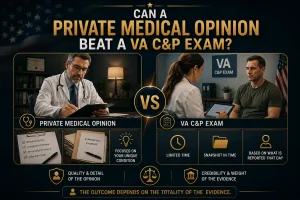
A medical nexus opinion can clarify whether a diagnosed vestibular condition is medically related to service-connected tinnitus. In a VA disability claim, its purpose is to provide a clear, evidence-based conclusion supported by the veteran’s medical history and clinical findings.
A well-supported nexus letter generally:
- Identifies the condition responsible for the vertigo
- Reviews relevant service and post-service medical records
- Discusses when the tinnitus and vertigo began and how each progressed
- Explains the proposed medical mechanism in the individual case
- Addresses causation and aggravation separately when supported by the evidence
- Considers alternative causes, such as BPPV, Ménière’s disease, vestibular migraine, medication effects, head trauma, or neurological disorders
- Connects the conclusion to relevant clinical findings
The medical reasoning should explain whether tinnitus and the vestibular disorder share an underlying auditory or inner-ear process, medically interact, or are better explained by another cause.
Example: A former artillery crew member may have long-standing tinnitus after repeated weapons exposure and later develop recurring vertigo and balance problems. An ENT specialist providing an independent medical opinion could review their history, hearing tests, vestibular findings, and other risk factors to explain whether both conditions fit a common inner-ear injury pattern or represent separate disorders.
Medical literature may support the analysis, but it must be applied to the veteran’s diagnosis, test findings, symptom timeline, and competing risk factors. Likewise, phrases such as “at least as likely as not” do not replace a clear medical rationale. The value of the nexus opinion usually comes from clear clinical reasoning, supporting evidence, and consideration of alternative medical explanations.
What to Expect During a Vertigo C&P Exam
A Compensation and Pension (C&P) exam for vertigo documents the medical information VA needs to evaluate the condition. The examiner may use the VA Ear Conditions Disability Benefits Questionnaire to record the diagnosis, onset and course of the disorder, medication use, vertigo and staggering, episode frequency and duration, gait, physical findings, diagnostic testing, and functional impact.
Questions About Your Symptoms
During the vertigo C&P exam, the examiner may ask:
- When the symptoms began
- How often episodes occur and how long they last
- Whether the sensation feels like spinning, swaying, lightheadedness, or imbalance
- Whether attacks involve nausea, vomiting, staggering, or falls
- Whether tinnitus, hearing loss, ear pressure or fullness, or headaches occur with the vertigo
- How symptoms affect walking, driving, employment, and ordinary activities
When vertigo is being evaluated as secondary to tinnitus, the examiner may also consider when each condition began and whether another medical condition could explain the symptoms.
Examination and Testing
Depending on the suspected diagnosis, the exam may include observation of gait, eye-movement assessment, a Romberg test, a Dix-Hallpike maneuver, or review of prior hearing and vestibular tests. Not every examination requires the same testing.
Because vertigo can be episodic, normal findings between attacks do not necessarily exclude a vestibular disorder. However, Diagnostic Code 6204 requires objective findings supporting the diagnosis of vestibular disequilibrium. The examiner may therefore consider the broader medical history, prior testing, treatment records, and the veteran’s description of how the episodes typically occur.
Specific examples are helpful. Describing a 15-minute spinning episode that requires holding a wall provides more useful information than saying the vertigo is simply “bad.”
Vertigo, Ménière’s Disease, and Pyramiding
Not every vestibular condition involving vertigo is evaluated under Diagnostic Code 6204. Ménière’s disease is an inner-ear disorder associated with abnormal fluid balance and may cause episodic vertigo, tinnitus, hearing loss, and ear fullness.
Ménière’s syndrome may be evaluated under Diagnostic Code 6205, which provides:
- 30%: Hearing impairment with vertigo occurring less than once a month
- 60%: Hearing impairment with vertigo and cerebellar gait occurring one to four times a month
- 100%: Hearing impairment with vertigo and cerebellar gait occurring more than once weekly
VA may evaluate Ménière’s syndrome under DC 6205 or separately evaluate vertigo, hearing impairment, and tinnitus, using the method that results in the higher overall evaluation. However, a DC 6205 rating cannot be combined with separate ratings for those same manifestations.
For example, a veteran diagnosed with Ménière’s disease may experience hearing loss, tinnitus, recurring vertigo attacks, and a cerebellar gait documented during examination. If VA evaluates these overlapping symptoms together under DC 6205, they are not evaluated again under separate diagnostic codes.
This limitation reflects VA’s rule against pyramiding: the same symptom cannot be compensated twice under different diagnostic codes. When separate ratings are used, VA combines them under its combined-ratings method rather than adding the percentages directly.
Case Study: VA Service Connection for Vertigo Secondary to Tinnitus
Citation: BVA Citation Nr. A24000719
Decision Date: January 5, 2024
The veteran served in the U.S. Air Force from September 1982 to June 2004 and was already service-connected for tinnitus. He sought secondary service connection for vertigo, diagnosed as benign paroxysmal positional vertigo (BPPV) in 2015.
Two VA examiners concluded that his BPPV was less likely than not caused by tinnitus. However, a private physician assistant provided a favorable nexus opinion in December 2019, finding that the veteran’s dizziness and vertigo were at least as likely as not connected to his tinnitus. The provider supported the opinion by citing three medical journal articles addressing the relationship between tinnitus and vertigo.
Board’s Finding: The Board determined that the favorable and unfavorable evidence was approximately balanced. Applying the benefit-of-the-doubt rule, it granted service connection for vertigo secondary to tinnitus under 38 C.F.R. § 3.310.
The decision illustrates how the Board may weigh competing medical opinions based on their reasoning and supporting evidence.
BVA decisions apply only to the individual case and are not precedential.
What Happens After VA Denies Your Vertigo Claim?
When VA denies a vertigo claim, the decision letter usually explains the reasons for the denial and the evidence reviewed.
Under Appeals Modernization Act (AMA), VA generally provides three decision review options:
- File a Supplemental Claim with new and relevant evidence
- Request a Higher-Level Review based on the existing record or
- Appeal to the Board of Veterans’ Appeals
Each option follows different evidentiary and procedural rules. A VA-accredited VSO representative, claims agent, or attorney can help you understand which review option may be appropriate, depending on your case.
Conclusion
Vertigo and tinnitus may occur together, but their relationship depends on the diagnosis and the evidence in the individual’s medical record. Clear treatment records, objective findings, consistent symptom descriptions, and a well-reasoned medical opinion can help explain the diagnosis and its relationship to service-connected tinnitus. Because vestibular symptoms can have several possible causes, each condition must be evaluated within the veteran’s complete medical history.
Veterans who need help understanding the VA disability claim process may consult a VA-accredited attorney, claims agent, or representative.
Frequently Asked Questions (FAQs)
What Is the Average VA Rating for Vertigo?
VA does not assign an average rating for vertigo, but a peripheral vestibular disorder may receive 10% for occasional dizziness or 30% for dizziness with occasional staggering under Diagnostic Code 6204.
Can Vertigo Be Secondary to Tinnitus for VA Disability Purposes?
Yes, vertigo may be evaluated as secondary when medical evidence shows that service-connected tinnitus caused or aggravated a diagnosed vestibular condition.
What Happens During a VA Vertigo C&P Examination?
During a vertigo C&P exam, the examiner typically reviews your medical history, documents the frequency and duration of symptoms, examines your ears and gait, may perform Romberg or Dix-Hallpike testing, and records effects on work and daily activities.
How Is Ménière’s Disease Rated Differently From Vertigo?
Ménière’s syndrome may be evaluated under Diagnostic Code 6205, which considers hearing impairment, vertigo attacks, tinnitus, cerebellar gait, and attack frequency. VA may instead evaluate hearing loss, tinnitus, and vertigo separately when permitted by the rating schedule.
Do I Need a Nexus Letter for Vertigo Secondary to Tinnitus?
A nexus letter is not required in every case. However, the medical record generally must explain whether service-connected tinnitus caused or aggravated the diagnosed condition responsible for the vertigo. This opinion may be provided by a treating clinician, VA examiner, or another qualified medical professional.
Is Vertigo Included in a Tinnitus Rating?
Vertigo is not ordinarily included in the standalone 10% tinnitus rating, though both symptoms may be evaluated together under an underlying condition such as Ménière’s disease.
Can Tinnitus and Vertigo Receive Separate Ratings?
Separate ratings may be assigned for tinnitus and a peripheral vestibular disorder when each reflects distinct symptoms, but they are not separately combined when both support a single Ménière’s disease evaluation.
Also Read: Why Dizziness & Vertigo Are So Hard to Diagnose in Veterans
At Prestige Veteran Medical Consulting, a veteran-owned company, we specialize in Independent Medical Opinions (IMOs) known as Nexus letters.
Our purpose is to empower YOU, the veteran, to take charge of your medical evidence and provide you with valuable educational tools and research to guide you on your journey.
Understanding the unique challenges veterans face, our commitment lies in delivering exceptional service and support.
Leveraging an extensive network of licensed independent medical professionals, all well-versed in the medical professional aspects of the VA claims process, we review the necessary medical evidence to incorporate in our reports related to your VA Disability Claim.
Prestige Veteran Medical Consulting is not a law firm, accredited claims agent, or affiliated with the Veterans Administration or Veterans Services Organizations. However, we are happy to discuss your case with your accredited VA legal professional.