


Last reviewed November 8, 2026.
Back conditions are among the most common disabilities veterans claim. The VA rates them under one set of rules for the spine, 38 CFR 4.71a. Your rating depends mostly on how far you can move, whether the spine is fused or fixed, and, for some disc conditions, how often you are bedridden by a physician’s order.
This guide covers how those rules work. To show that a back condition is connected to service, see our sample nexus letter for low back pain.
Table of Contents
Back Conditions the VA Rates
All of these are rated under the same General Rating Formula, except IVDS, which can also be rated by incapacitating episodes:
| Diagnostic code | Condition |
|---|---|
| 5235 | Vertebral fracture or dislocation |
| 5236 | Sacroiliac injury and weakness |
| 5237 | Lumbosacral or cervical strain |
| 5238 | Spinal stenosis |
| 5239 | Spondylolisthesis or segmental instability |
| 5240 | Ankylosing spondylitis |
| 5241 | Spinal fusion |
| 5242 | Degenerative arthritis, degenerative disc disease other than IVDS |
| 5243 | Intervertebral disc syndrome (IVDS) |
Pain alone can count as a disability when it causes functional impairment. The Federal Circuit held this in Saunders v. Wilkie) (2018).
The General Rating Formula
The formula applies “with or without symptoms such as pain (whether or not it radiates), stiffness, or aching.” The neck and the mid/low back are rated separately.
Thoracolumbar spine (mid and low back)
| Rating | Criteria |
|---|---|
| 10% | Forward flexion greater than 60° but not greater than 85°; or combined range of motion greater than 120° but not greater than 235°; or muscle spasm, guarding, or localized tenderness not causing abnormal gait or spinal contour; or vertebral body fracture with loss of 50% or more of height |
| 20% | Forward flexion greater than 30° but not greater than 60°; or combined range of motion not greater than 120°; or spasm or guarding severe enough to cause abnormal gait or abnormal spinal contour (scoliosis, reversed lordosis, or abnormal kyphosis) |
| 40% | Forward flexion 30° or less; or favorable ankylosis of the entire thoracolumbar spine |
| 50% | Unfavorable ankylosis of the entire thoracolumbar spine |
| 100% | Unfavorable ankylosis of the entire spine |
Cervical spine (neck)
| Rating | Criteria |
|---|---|
| 10% | Forward flexion greater than 30° but not greater than 40°; or combined range of motion greater than 170° but not greater than 335°; or spasm, guarding, or tenderness not causing abnormal gait or contour |
| 20% | Forward flexion greater than 15° but not greater than 30°; or combined range of motion not greater than 170°; or spasm or guarding severe enough to cause abnormal gait or contour |
| 30% | Forward flexion 15° or less; or favorable ankylosis of the entire cervical spine |
| 40% | Unfavorable ankylosis of the entire cervical spine |
| 100% | Unfavorable ankylosis of the entire spine |
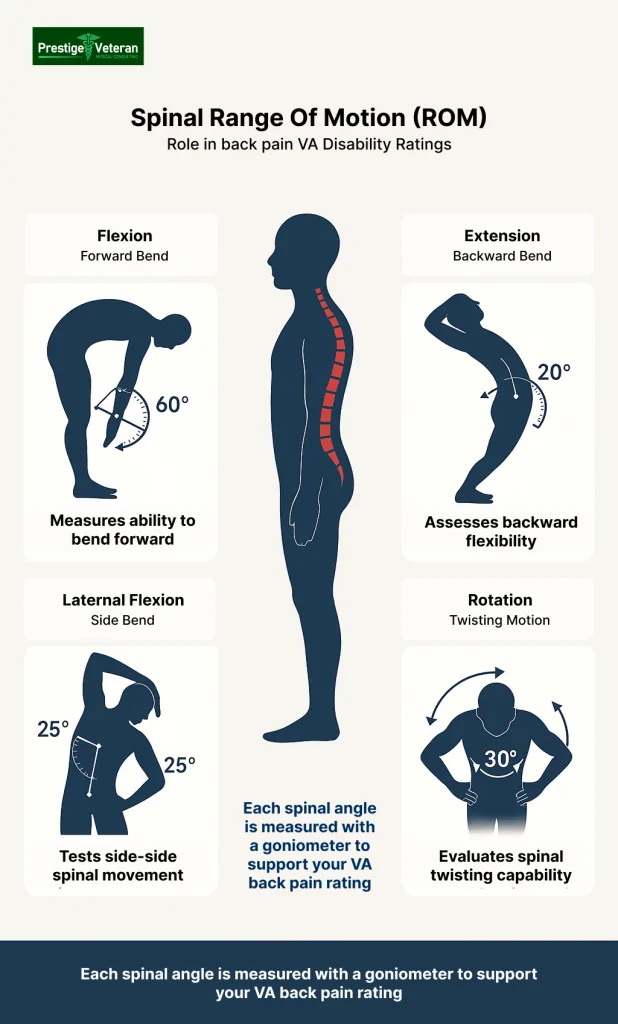
What the numbers mean
- Normal range of motion for VA purposes:
- Thoracolumbar spine: forward flexion 0 to 90°, extension 0 to 30°, and 0 to 30° each for left and right lateral flexion and rotation. The normal combined total is 240°.
- Cervical spine: forward flexion, extension, and lateral flexion 0 to 45° each, and rotation 0 to 80° each way. The normal combined total is 340°.
- Combined range of motion is the sum of all six movements. Each measurement is rounded to the nearest 5°.
- Ankylosis means the spine segment is fixed in place.
- Fixation in the neutral (0°) position is always favorable.
- Unfavorable ankylosis means the segment is fixed in flexion or extension and causes specific problems. Examples include difficulty walking because of a limited line of vision, restricted breathing, or nerve symptoms from nerve root stretching.
For how the measurements are taken, see how the VA measures range of motion.
Intervertebral Disc Syndrome (IVDS)
IVDS (DC 5243) is assigned only when a disc herniation compresses or irritates the adjacent nerve root. Other disc diagnoses are rated under DC 5242.
IVDS is rated under whichever method gives the higher result: the General Rating Formula above, or incapacitating episodes:
| Rating | Incapacitating episodes in the past 12 months |
|---|---|
| 10% | At least 1 week but less than 2 weeks total |
| 20% | At least 2 weeks but less than 4 weeks total |
| 40% | At least 4 weeks but less than 6 weeks total |
| 60% | At least 6 weeks total |
An incapacitating episode requires bed rest prescribed by a physician and treatment by a physician. Time off work or bed rest you chose yourself does not qualify unless the records show a physician ordered it.
Nerve and Bladder Problems Are Rated Separately
The VA rates associated objective neurologic problems separately from the spine. That includes radiculopathy, bowel impairment, and bladder impairment.
- Sciatic nerve involvement in the leg is usually rated under DC 8520, at 10% to 80% depending on severity, for each leg.
- Arm symptoms from the neck are rated under the upper extremity nerve codes.
See sciatica VA ratings and radiculopathy in veterans disability.
These separate ratings often make up a large part of a veteran’s total compensation for a back condition. They are also commonly missed.
Painful Motion, Flare-Ups, and Functional Loss
- Painful motion. Under 38 CFR 4.59, the rating schedule intends to recognize actually painful joints as entitled to at least the minimum compensable rating for the joint. Examiners are directed to test for pain on active and passive motion, and in weight-bearing and non-weight-bearing positions.
- Flare-ups. If you aren’t having a flare-up on exam day, the examiner should still ask about them: how often, how long, and what you lose during one. Describe your flare-ups clearly. They can affect how your functional loss is evaluated.
- Pyramiding. Under 38 CFR 4.14, the same disability is not rated under more than one diagnosis. Each separate rating needs its own symptoms.
Paths to a 100% Rating for a Back Condition
A 100% schedular rating for the spine requires unfavorable ankylosis of the entire spine, which is rare. Other paths are more common:
- Combined ratings. A spine rating plus separate ratings for radiculopathy in one or both legs, and for secondary conditions, combine toward a higher total.
- TDIU. If service-connected disabilities prevent substantially gainful employment, a veteran may be paid at the 100% rate. Under 38 CFR 4.16(a), the schedular requirement is either one disability rated at 60% or more, or at least one rated at 40% or more with a combined rating of 70% or more. See TDIU explained.
- Temporary total ratings.
- Under 38 CFR 4.29, a 100% rating applies when a service-connected disability requires hospital treatment or observation for more than 21 days.
- Under 38 CFR 4.30, a temporary 100% convalescence rating can follow surgery requiring at least one month of recovery, or surgery with severe postoperative residuals. It is assigned for 1, 2, or 3 months, and extensions are possible.
The Back C&P Exam
The examiner will:
- review your history, treatment, and flare-ups;
- measure your range of motion with a goniometer;
- look for spasm, guarding, abnormal gait, and nerve involvement.
Stop each movement when pain begins. Bring imaging and treatment records. Describe how the condition affects work, sleep, driving, and daily tasks.
For a full walkthrough, see our low back pain C&P exam guide.
Evidence That Supports an Accurate Rating
- A symptom and flare-up log: pain levels, triggers, how long flare-ups last, and what you can’t do during them.
- Outside records: MRIs, private evaluations, physical therapy, chiropractic, and pain management notes.
- Documentation of assistive devices, such as a brace, cane, or TENS unit.
- A personal statement with specifics, for example: “I can’t sit more than 30 minutes without shooting pain into my left leg.”
- Lay statements from a spouse, coworkers, or friends describing what they see.
- Physician-documented bed rest, if you have IVDS and are relying on incapacitating episodes.
- Secondary conditions. Radiculopathy, sleep problems, depression, and joint problems may be claimed when they are diagnosed and medically linked. See conditions related to back pain.
Connecting a Back Condition to Service
Service connection needs a current diagnosis, an in-service event or injury, and a medical nexus. A nexus does not have to be a formal letter. A C&P examiner can provide a positive opinion. Some veterans also choose a nexus letter from a treating or independent provider.
For two fictional examples of how that reasoning is written, see our sample nexus letter for low back pain.
FAQs
How does the VA rate back pain?
Mostly by range of motion and ankylosis under the General Rating Formula. Herniated discs with nerve root involvement can also be rated by incapacitating episodes. Nerve problems are rated separately.
What is the VA rating for lumbosacral strain?
Lumbosacral strain (DC 5237) uses the same General Rating Formula. See our lumbosacral strain rating guide.
How can I get a 100% VA rating for back pain?
A 100% schedular spine rating requires unfavorable ankylosis of the entire spine. More often, veterans reach 100% through combined ratings (spine plus radiculopathy and secondary conditions), TDIU, or a temporary total rating after hospitalization or surgery.
Does the VA rate forward flexion of 30 degrees or less?
Yes. Forward flexion of the thoracolumbar spine of 30° or less meets the 40% criterion.
What if my back claim is denied?
You can file a Supplemental Claim with new evidence, request a Higher-Level Review, or appeal to the Board of Veterans’ Appeals. An accredited representative can help you choose.
Also read: Sample Nexus Letter for Low Back Pain (VA Claim Examples)
At Prestige Veteran Medical Consulting, a veteran-owned company, we specialize in Independent Medical Opinions (IMOs) known as Nexus letters.
Our purpose is to empower YOU, the veteran, to take charge of your medical evidence and provide you with valuable educational tools and research to guide you on your journey.
Understanding the unique challenges veterans face, our commitment lies in delivering exceptional service and support.
Leveraging an extensive network of licensed independent medical professionals, all well-versed in the medical professional aspects of the VA claims process, we review the necessary medical evidence to incorporate in our reports related to your VA Disability Claim.
Prestige Veteran Medical Consulting is not a law firm, accredited claims agent, or affiliated with the Veterans Administration or Veterans Services Organizations. However, we are happy to discuss your case with your accredited VA legal professional.