


Many VA disability claims are denied not because the condition isn’t serious, but because the VA says there isn’t “enough evidence.” The truth is, most denials come down to missing proof in one of three elements: a current diagnosis, an in-service event, or a medical nexus tying your condition to service. Understanding what the VA actually requires can mean the difference between approval and months (or years) of frustration.
This veteran-focused checklist breaks down the VA’s legal standards, evidence requirements, and special claim rules in clear terms. Whether you’re filing a first-time claim, seeking an increase, or pursuing TDIU, knowing how to build a strong, well-supported VA disability claim puts you back in control.
Table of Contents
The 3 Legal Requirements for VA Service Connection
To approve any VA disability claim, the VA must see evidence that satisfies three legal requirements known as the Caluza Standard. If any of these elements are missing, the VA is likely to deny your claim.
1. A Current Diagnosed Disability
Veterans must show they have a current diagnosis of a medically recognized condition for which they are seeking benefits.
2. Evidence of an In-Service Event, Injury, or Illness
The veteran must show that an event, incident, or exposure occurred during their military service that could reasonably have caused or aggravated their current disability.
3. A Medical Nexus Linking the Current Disability to Service
The third piece of evidence is the nexus, a medical opinion stating that your current condition is at least as likely as not (50% probability or greater) connected to your military service. A nexus opinion can come from the VA Compensation and Pension examination. It can also be provided by a veterans treating doctor and be in the form of a simple statement in their records, and lastly a well-supported nexus letter from a qualified provider can establish service connection.
For increased-rating claims related to an already service connected issue, veterans must show current medical evidence that a previously service-connected condition has worsened. Whereas, TDIU claims may require demonstrating that service-connected disabilities prevent the veteran from maintaining substantially gainful employment.
The VA’s “Duty to Assist” and What It Means for Evidence Gathering
Under the Veterans Claims Assistance Act (VCAA), the VA has a legal responsibility known as the “Duty to Assist,” (38 U.S.C. § 5103A) to help veterans gather the evidence needed to substantiate their claims.
Under this duty, the VA must:
- Request your service treatment and service personnel records
- Request relevant records from VA hospitals and clinics
- Schedule Compensation & Pension (C&P) exams or provide medical opinions when needed
- Notify you if more evidence is needed to support the claim
However, many veterans misunderstand how far the VA’s Duty to Assist goes. The Duty to Assist does not require VA to prove the claim, obtain irrelevant or unobtainable records, provide exams without a factual basis, or gather evidence for higher-level reviews or board appeals.
How the VA’s “Benefit of the Doubt” Rule Helps Veterans
VA disability law applies a principle known as the “Benefit of the Doubt” rule, found in 38 U.S.C. § 5107(b) and 38 C.F.R. § 3.102, to lower the evidentiary burden for veterans. This rule states:
If the positive and negative evidence regarding any issue in your claim is approximately equal, the VA must resolve the doubt in your favor.
In other words, you only need to reach the –
50/50 threshold (“at least as likely as not”)
This is why providing evidence that is strong enough to move your case into the “at least balanced” category is critical, where the rule can work in your favor.
Types of Evidence Used in VA Disability Decisions
The VA reviews several categories of evidence before issuing a decision. Each type plays a different role, and understanding how they work helps veterans submit stronger, more complete claims.
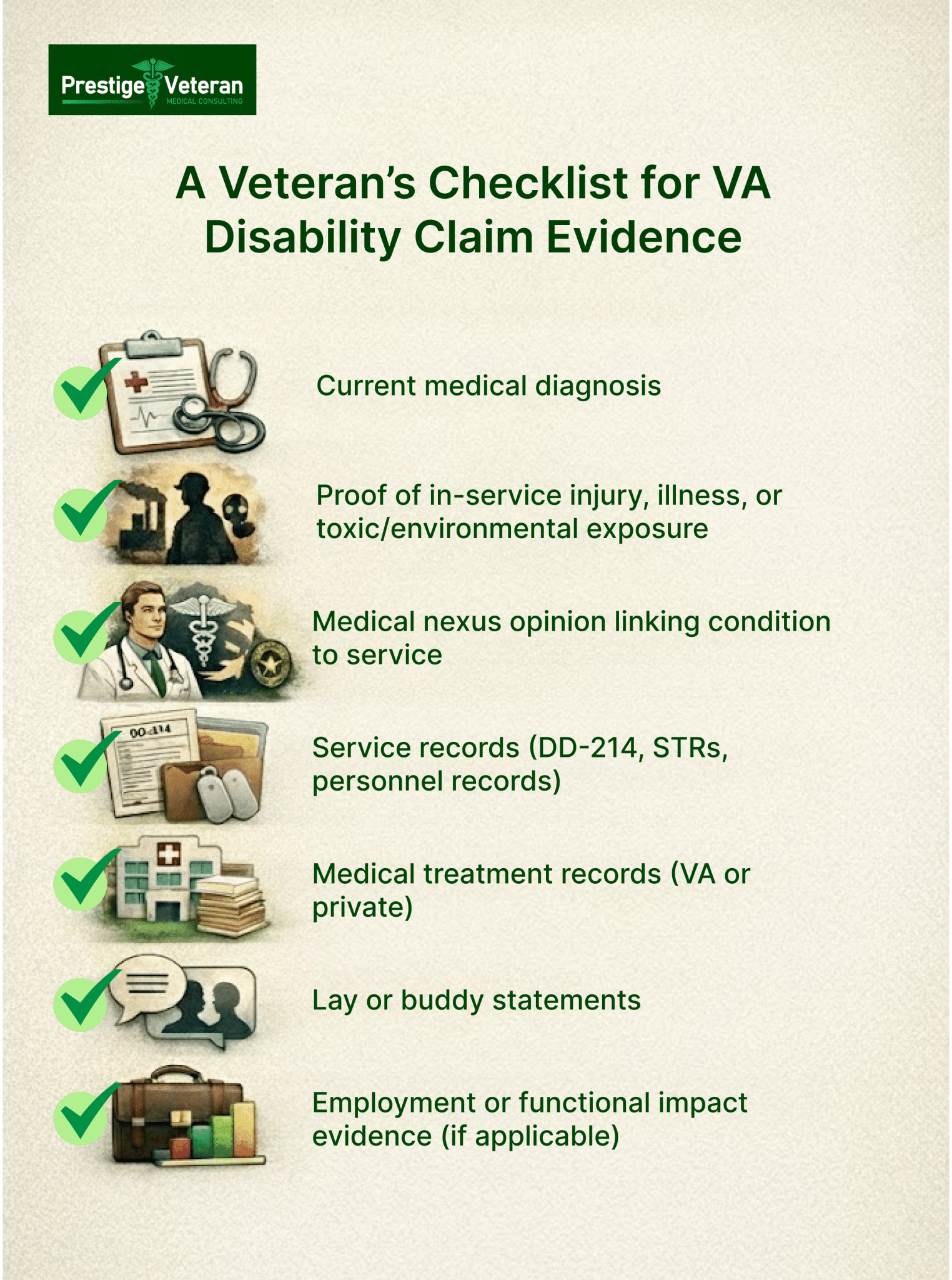
1. Military Records
Military records may form the backbone of a disability claim because they demonstrate where, when, and how an in-service event, exposure, or illness contributed to the claimed condition.
Common evidence of military service records includes:
- DD214 or separation documents
- Service Treatment Records (STRs) documenting injuries, sick call visits, and hospitalizations
- Personnel records showing line of duty limitations or decreased performance
- Deployment orders confirming exposure to toxins
- National Guard or Reserve medical records
- Deck logs, incident reports, and training records
These records are typically obtained through the VA’s Regional Office, FOIA or Privacy Act requests, and the National Personnel Records Center by submitting a Standard Form (SF) 180. Veterans may also access them using the VA’s online milConnect/eBenefits portals.
If a veteran needs help obtaining records, a Veteran Service Officer (VSO) or organizations can assist.
2. Medical Evidence
Medical evidence documents the existence, severity, and progression of a condition and helps establish a clear medical nexus between a veteran’s disability and military service.
Key types of medical evidence include:
- VA Medical Records: Provide documented diagnoses, treatment plans, imaging results, and physician notes from VA health facilities that show ongoing care and symptom progression.
- Private Medical Records: Include reports from civilian doctors, specialists, hospitals, and therapists that may offer more detailed or continuous documentation than VA records.
- Compensation & Pension (C&P) Examination Results: Contain objective findings and medical opinions from VA-contracted examiners used to confirm diagnoses, severity levels, and service connection.
- Independent Medical Opinion (IMO) or Nexus Letter: A specialized nexus letter from a qualified private provider that explains how a veteran’s condition is “at least as likely as not” connected to military service. While never required these can at times be helpful.
- Disability Benefits Questionnaires (DBQs): Standardized forms completed by private or VA clinicians recording symptoms and functional impairment in a format that VA rating criteria require.
- Other Medical Evidence: May include diagnostic imaging, lab work, emergency room visits, physical therapy notes, mental health evaluations, or chronic condition monitoring records supporting long-term impairment.
For veterans filing secondary claims or those needing complex opinions (e.g., sleep apnea caused by PTSD), strong medical opinions are crucial.
3. Lay Evidence and Personal Statements
Lay evidence is an important type of proof the VA considers when evaluating disability claims, especially when medical or service records are incomplete. This type of evidence includes firsthand, nonmedical observations describing symptoms, functional limits, or in-service events. Veterans, family members, coworkers, and fellow service members can all provide credible statements that help establish continuity and severity of a condition. These accounts often clarify what medical files cannot: how often symptoms occur, how they impact daily life, and whether an injury or stressor was witnessed.
Common forms of lay evidence include:
- Veteran personal statements (VA Form 21-4138)
- Witness or buddy statements (VA Form 21-10210)
- Written letters from spouses, friends, supervisors, or service members
- Descriptions of observed symptoms, behavioral changes, or unrecorded incidents
When consistent with medical findings, this evidence strengthens credibility in VA claims involving undocumented injuries, PTSD or Military Sexual Trauma (MST), and chronic conditions. For example, a former squadmate describing how the veteran often had to stop during marches due to knee swelling provides strong evidence of chronic joint issues.
4. Employment Records (For TDIU Claims)
The VA mostly uses employment records when evaluating disability claims involving Total Disability Based on Individual Unemployability (TDIU). These documents help show how service-connected conditions affect a veteran’s ability to work consistently or maintain substantially gainful employment.
Useful evidence to demonstrate functional impairment can include:
- Veteran’s TDIU application (VA Form 21-8940)
- Employer statements via VA Form 21-4192
- Workplace documentation, such as performance reviews, disciplinary actions, modified-duty arrangements, or termination notices.
- Supervisor letters describing attendance issues, reduced productivity, or the need for accommodations due to service-connected symptoms.
Together, these records strengthen both TDIU claims and increased-rating requests by showing the real-world impact of service-connected disabilities on the veteran’s ability to earn. For example, a veteran’s employment records included poor performance evaluations and a termination notice documenting that service-connected migraines caused frequent absences and an inability to sustain full-time work.
For additional guidance, review the VA’s official guidance on evidence needed for disability claims.
Additional Evidence Requirements for Special VA Claims
Certain VA disability claims require specialized forms of evidence because standard service records may be incomplete or unavailable. The VA recognizes these challenges and requests additional documentation to fully evaluate how a condition affects a veteran or their dependents.
PTSD and Mental Health Claims
VA mental health claims focus on showing a diagnosed condition, an in-service stressor, and a link between the two. Since many traumatic events were never formally documented, the VA accepts multiple forms of supporting evidence, including:
- A completed stressor statement describing the traumatic event
- Behavioral health treatment or counseling records
- Lay or buddy statements describing changes in behavior, mood, or functioning
- Indirect evidence, such as performance issues when official reports are missing
- For combat-related stressors, a personal statement may be sufficient if service records confirm exposure.
Military Sexual Trauma (MST)
Because Military Sexual Trauma (MST) is frequently unreported, the VA recognizes indirect “markers” rather than requiring official reports. Common supporting evidence includes:
- Requests for duty station or unit transfers
- Sudden decline in work performance
- Substance abuse or mental health treatment records
- Statements from chaplains, healthcare providers, friends, or family
Importantly, the VA cannot deny an MST claim solely due to the absence of formal documentation.
Individual Unemployability (TDIU)
For Total Disability based on Individual Unemployability, veterans must show that service-connected conditions prevent them from maintaining substantially gainful employment. This includes submitting VA Form 21-8940 outlining work history and limitations, along with VA Form 21-4192 completed by a recent former employer.
Medical evidence should explain how symptoms such as chronic pain, mobility issues, or mental health impairments interfere with maintaining consistent work. Supporting statements or vocational evaluations can further reinforce unemployability.
Temporary 100% Disability Rating
A temporary total disability rating may be granted when a veteran’s service-connected condition requires extended hospitalization or recovery. In this type of VA claim, submit key evidence like:
- Hospital admission and discharge papers showing a hospital stay or observation period at VA’s expense for more than 21 days, or
- Documentation of surgery resulting in severe post-operative complications, such as prolonged recovery, mobility restrictions, or the need for assistive devices.
If you didn’t have surgery, immobilization of a major joint by a cast may also qualify.
Presumptive Conditions
For VA presumptive claims, veterans are not required to prove causation. Instead, they must provide:
- A current diagnosis of a condition on the VA’s presumptive list
- Proof of qualifying service at specific locations or during approved timeframes
For example, Agent Orange exposure in Vietnam, Gulf War illnesses, exposure to contaminated water at Camp Lejeune, and others. Note that medical evidence confirming the ongoing disability is still required, even when the nexus is presumed.
VA Title 38 U.S.C. §1151 Claims
Claims under 38 U.S.C. §1151 require proof that a disability was caused or worsened by VA-provided hospitalization, medical or surgical treatment, health exam, or training programs. Medical records, treatment notes, and expert opinions must show fault on the VA’s part, such as negligence, error, or unforeseeable complication linked to VA care.
For instance, medical records showed the veteran suffered permanent nerve damage following a VA-performed spinal injection, with an independent medical opinion citing improper needle placement as the cause.
Seriously Disabled Child
To receive additional compensation for a dependent child, medical records must show the child became permanently disabled due to a physical or mental condition before turning 18. Veterans can submit pediatric medical records, specialist evaluations, and school documentation to confirm eligibility. Keep in mind, the veteran must also have a combined disability rating of at least 30% to qualify.
Evidence Requirements Based on the Type of VA Claim Filed
The strength of a VA disability claim depends largely on submitting the right evidence for the specific type of claim being filed. While all claims require thoughtful documentation, the VA evaluates evidence differently depending on whether the claim is original, for an increased rating, secondary, or supplemental. Knowing these distinctions can prevent delays and improve outcomes.
Original (First-Time) Claims
An original claim establishes service connection for the first time. Veterans must show evidence for three core elements:
- A current diagnosed physical or mental condition
- An in-service event, injury, or illness
- A medical nexus linking the current condition to military service
Common evidence includes discharge papers (DD-214), service treatment records, private medical records, personal or lay statements, and a medical nexus opinion. Submitting everything upfront as a Fully Developed Claim (FDC) can significantly speed up the process.
Benefits Delivery at Discharge (BDD) Claims
Service members filing a claim through the Benefits Delivery at Discharge (BDD) program must submit specific evidence before separation to allow the VA to begin processing the claim while the member is still on active duty.
For a BDD claim, you’ll need to consider submitting:
- Copies of your service treatment records (STRs) from your current period of service, and
- A completed Separation Health Assessment – Part A Self-Assessment form
If you’ve already submitted a BDD claim but did not include the Separation Health Assessment, you can still upload the completed form through VA.gov.
Increased Rating Claims
An increased rating claim is filed when an already service-connected condition has worsened.
To reflect the current severity of their condition, veterans should submit updated medical records or opinions from healthcare providers showing worsening of symptoms. Lay statements describing increased pain, functional loss, or impact on daily life and employment can also help demonstrate that the condition now meets a higher VA rating threshold.
For instance, recent orthopedic treatment records documented worsening of a veteran’s service-connected right ankle condition, noting increased joint instability and reduced range of motion.
Secondary Service Connection Claims
Veterans file secondary claims when a new condition is caused or aggravated by an existing service-connected disability. Evidence for a secondary service connection claim must include:
- A confirmed diagnosis of the secondary condition
- Proof of the primary service-connected disability
- A well-reasoned medical opinion clearly explaining how one caused or aggravated the other
For instance, a credible medical opinion from a veteran’s treating VA physician can conclude that their service-connected diabetes caused peripheral neuropathy in the lower extremities.
Supplemental Claims
If a claim was previously denied, a VA supplemental claim allows veterans to submit new and relevant evidence not considered before. This may include new medical records or nexus opinions, overlooked service records, or additional witness statements that directly address the reason for the prior denial.
How to Submit Evidence to the VA
The VA relies on clear, organized documentation to approve your VA disability claim. Hence, whether you’re filing a new claim, an increase, or an appeal, knowing how and where to submit evidence can save time and prevent delays.
1. Upload Electronically Through VA.gov
The fastest and most reliable way to submit evidence is online through VA.gov. Veterans can upload medical records, service treatment records, lay statements, nexus letters, and their DD-214 directly to an active claim.
2. Mail or Fax to the VA Evidence Intake Center
You can mail or fax documents to the VA Evidence Intake Center. While slower than online uploads, faxing provides a dated timestamp and is still an accepted method.
3. Work With a Veteran Service Organization (VSO)
Search for accredited VSOs near you, such as DAV, VFW, or the American Legion, who provide free assistance in organizing and submitting your evidence correctly.
4. Submit Evidence During a C&P Exam
Bring relevant evidence to your Compensation & Pension exam, but always upload it separately to ensure it becomes part of your official VA claim file. While not guaranteed to be reviewed, it can still help clarify your condition.
5. Be Proactive and Track Regularly
Submitting complete evidence early reduces delays and lowers the risk of denial. Keep copies of everything you submit and respond promptly to VA requests.
Final Thoughts
Winning a VA disability claim significantly depends on how well the evidence is prepared and presented. When you understand the VA’s service connection requirements, the types of evidence that matter most, and how the Benefit of the Doubt rule works, you position your claim for success. Take the time to gather medical records, service documents, and credible lay statements that clearly tell your story. Be proactive in evidence gathering, stay organized, and don’t rely solely on the VA’s Duty to Assist. If needed, seek help from a VSO or accredited professional. A well-documented claim not only protects your VA benefits but also honors the service and sacrifices you’ve made.
Frequently Asked Questions (FAQs)
What counts as evidence for a VA claim?
Evidence for a VA claim includes military records, VA or private medical records, C&P exam results, doctors’ nexus opinions, lay statements, employment records, and any document supporting a veteran’s service connection or disability severity.
What is the easiest VA claim to prove?
Presumptive condition claims are often the easiest to prove because veterans only need a current diagnosis and proof of qualifying service, as the VA presumes the service connection.
What are good things to claim for VA disability?
Common successful VA claims include tinnitus, hearing loss, PTSD, knee/back pain, sleep apnea, migraines, and conditions secondary to service-connected disabilities.
What is an example of proof of disability?
Proof of disability can include medical records showing a current diagnosis, service treatment records, VA or private medical records, or a nexus letter linking the condition to military service.
What VA claims are hardest to prove?
Claims are hardest to prove when service records are missing, or the condition requires a complex medical nexus, such as secondary conditions, non-combat PTSD, or long-delayed injuries.
How long is the evidence-gathering review and decision?
The evidence-gathering phase can take 30 to 60 days, while the review is typically completed in 7 to 14 days. This timeline varies depending on the complexity of the claim, the need for C&P exams, and how quickly evidence is submitted.