

Both nexus letters and buddy statements are accepted forms of evidence in VA disability evaluation, but they serve different purposes. When filing a VA disability claim, one of the most important parts of the process is showing service connection, the link between a veteran’s current medical condition and military service. Establishing this connection is not always straightforward, especially when records are incomplete, symptoms were not documented at the time, or a diagnosis was made years later.
This naturally leads to an important question:
Which type of evidence can be more helpful when establishing a service connection?
We explain how each type of evidence works, how VA may evaluate it, and when one or both may be relevant.
Table of Contents
What Is a Nexus Letter?
A nexus letter is a medical opinion written by a qualified healthcare provider that explains whether a veteran’s current condition is connected to military service. In some situations, a privately obtained nexus opinion may also be described as an Independent Medical Opinion (IMO), although these terms are not always interchangeable.
In VA disability claims, a nexus letter serves as a professional medical bridge between these key points:
- The veteran’s currently diagnosed condition
- An in-service event, injury, or exposure
- An already service-connected condition that may have caused or aggravated the current condition
The purpose of a nexus opinion is to explain medical causation, not just that a condition exists, but why it likely developed or worsened in relation to service.
What a Strong Nexus Letter Typically Includes
- A review of medical records and service history
- Identification of the condition
- A clear medical explanation of causation
- Use of standard opinion language such as “at least as likely as not (50% probability)”
- A logical rationale supported by examination findings, clinical reasoning, or medical literature
- Consideration of other facts or possible risk factors
VA medical opinions commonly use the phrase “at least as likely as not” to indicate that the evidence for and against a medical relationship is approximately balanced, meaning the likelihood is at least about 50 percent.
What VA May Consider When Evaluating a Nexus Letter
When evaluating a nexus letter, VA may consider the quality of the analysis and the qualifications of the healthcare professional providing it.
According to VA guidance on disability claims, medical opinions from health care providers are usually used to establish the required connection between a current condition and the event, injury, or disease that happened during service. They may especially help when the medical relationship is not clearly explained in service or treatment records.
Although a nexus letter does not guarantee the outcome of a claim, it translates medical history into a professional opinion that addresses VA criteria for service connection.
In short, a nexus opinion is a professional medical interpretation of “how and why” a condition is connected to service.
What Is a Buddy Statement?
A buddy statement, also called a lay statement or witness statement, is a written account from someone who personally knows the veteran and has observed their condition, experiences, or changes over time. It is classified as lay evidence VA disability claims rely on, that may come from fellow service members, spouses, caregivers, family members, or close friends.
Buddy statements are typically submitted using VA Form 21-10210 (Lay/Witness Statement).
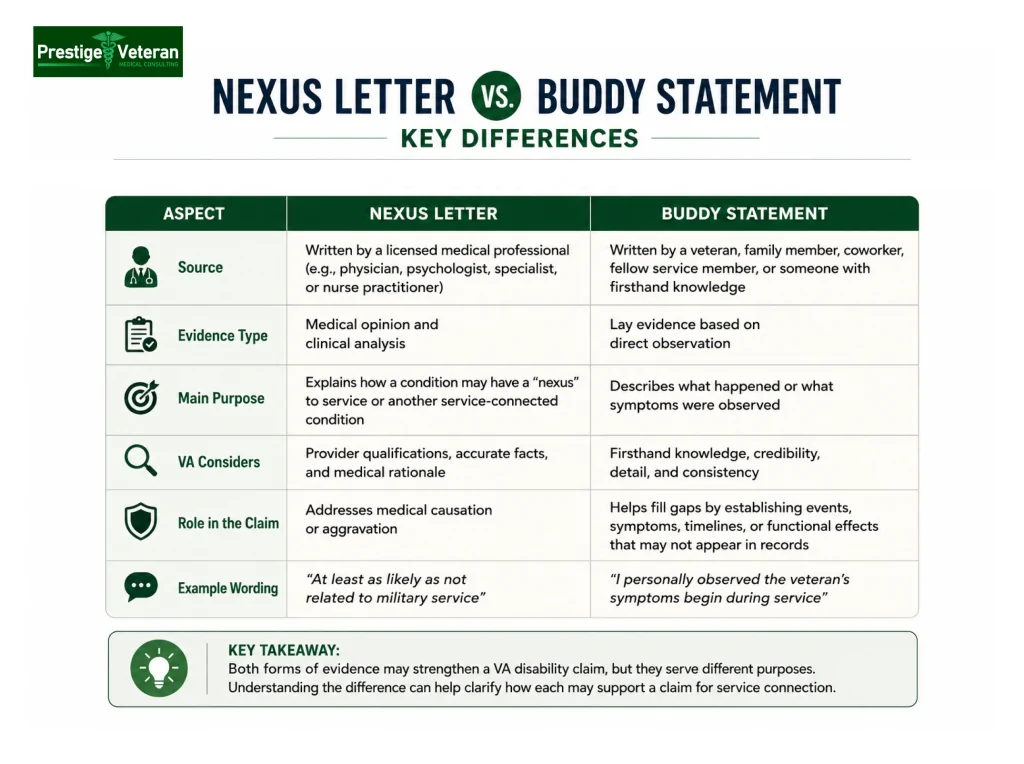
Unlike a nexus letter, a buddy statement does not diagnose or medically explain a service connection. Instead, its purpose is to describe observable facts such as:
- The occurrence of an in-service injury or stressful event
- Visible physical symptoms or behavioral changes over time
- Continuity of symptoms after service
- Struggles in mobility, sleep, work performance, or daily functioning due to the condition
- Statements the veteran made at or near the time of an event
What Makes a Buddy Statement Informative?
The strength of a buddy statement usually depends on the writer’s relationship to the veteran, how they gained firsthand knowledge, consistency with available records, and their ability to explain the observations. Specific descriptions are generally more informative than broad conclusions or assumptions.
For example, a fellow service member may describe seeing the veteran twist a knee during a field exercise and struggle with marching or climbing afterward, even though no formal treatment was recorded.
The Role of Lay Evidence in VA Claims
VA guidelines recognize that lay evidence can help support a claim, especially when service records are limited or incomplete.
Lay statements have been acknowledged as potentially credible evidence for describing symptom onset and continuity when consistent with other records. In some cases, lay testimony describing symptoms may also support a later diagnosis by a medical professional. See Jandreau v. Nicholson, 492 F.3d 1372, 1377 (Fed. Cir. 2007).
While a witness statement for veterans cannot provide a medical diagnosis or causation, it provides real-life context, helping VA decision-makers understand what occurred and how a condition may have appeared or progressed from a firsthand perspective.
In simple terms, a buddy letter helps describe what happened, not why it happened medically.
How VA Reviews Medical and Lay Evidence
Neither a nexus letter nor a buddy statement carries more weight in every VA disability claim. Each addresses a different type of question, so the value of either document largely depends on what VA must evaluate within the claim.
When Medical Expertise Is Required
A nexus opinion may be relevant when the question requires specialized medical knowledge. This may include whether one condition caused or aggravated another, whether an illness is consistent with a particular exposure, or whether symptoms diagnosed after service may be related to an earlier event.
Questions like these may require a healthcare professional to interpret examinations, treatment records, diagnostic findings, medical history, and the expected progression of a condition.
VA may also consider whether the opinion is based on an accurate medical and factual history, addresses relevant records, and provides a clear explanation for its conclusion. The opinion may also discuss other possible causes, risk factors, or conflicting facts.
When Firsthand Observations Matter
Buddy statements may provide information about events and symptoms that a layperson can directly observe. A writer may describe witnessing an in-service injury, noticing changes in behavior or physical ability, or observing symptoms such as pain, sleep problems, headaches, limited movement, or difficulty performing daily activities.
These statements may add context when service records are incomplete or do not document a reported event. VA may consider whether the writer had firsthand knowledge, provided specific details, identified a clear timeframe, and gave an account consistent with other available information.
Lay witnesses generally do not need medical training to report what they personally saw, heard, or observed. However, they may not be qualified to diagnose a condition or explain its medical cause when specialized expertise is required.
From an evidentiary standpoint:
- Nexus letter: Medical assessment of causation or aggravation
- Buddy statement: Firsthand account of observable events, symptoms, or changes
For example, if service records do not mention a fall from a military vehicle, a witness may describe what occurred. A medical professional may then evaluate whether a current condition is medically related to that event. By contrast, whether medication contributed to another disorder would generally require clinical analysis.
The two documents, hence, are not necessarily competing forms of evidence. Each may provide different information, and VA determines its relevance, credibility, and probative value within the complete record.
A VA-accredited attorney, claims agent, or Veterans Service Organization (VSO) representative may explain how each form of evidence relates to the circumstances of an individual case.
When a Nexus Letter May Be Helpful in VA Disability Claims
A nexus letter is commonly used when a medical explanation is needed to clarify how a condition is connected to service or an already service-connected condition.
VA claims may particularly benefit from a nexus opinion when:
- Service treatment records do not clearly document the condition or its early symptoms
- A condition was diagnosed years after separation from service
- One service-connected condition may have caused or aggravated another
- Several possible causes appear in the medical history
- The medical relationship involves delayed onset, toxic exposure, medication effects, or other complex factors
- Medical records contain conflicting opinions
These questions may commonly arise in VA claims involving mental health conditions, musculoskeletal disorders, sleep apnea or respiratory illnesses, neurological conditions, and secondary service-connected conditions.
Example: A veteran may develop numbness and weakness in one leg years after an in-service pelvic fracture. Current imaging may show lumbar degeneration, while older records document altered gait and recurring hip pain. Determining whether the neurological symptoms are related to the original injury, later spinal changes, or another cause requires medical interpretation rather than observation alone.
The central question is whether specialized medical knowledge is needed to explain the relationship being evaluated.
When Buddy Statements May Be More Effective
Buddy statements may be effective when they provide clear, firsthand observations of a veteran’s experiences. They can add context to the record when formal documentation is missing, limited, or does not reflect what occurred outside a medical setting.
A lay statement may be relevant when:
- An injury occurred during training, deployment, field exercises, or another setting where treatment was not immediately recorded
- Symptoms began during service but the veteran did not seek formal care
- Records were lost, incomplete, or created long after the event
- Family members, friends, or fellow service members observed changes over time
- The frequency or functional effects of symptoms are not fully captured in clinical notes
Example: A spouse may describe a veteran with PTSD waking suddenly, repeatedly checking doors, and avoiding crowded family gatherings after returning from deployment. Those observations may help document behavioral changes and their timeline, although they do not replace a professional mental health evaluation or nexus opinion.
Essentially, a lay statement may therefore supplement the formal record by documenting events or changes personally observed by the writer.
Creating a Fuller Record With Both Forms of Evidence
Sometimes, a clearer evidentiary picture emerges from combining medical and lay evidence that address different but related parts of the same history. Their value comes not from repeating one another, but from connecting observed events and symptoms with the medical analysis relevant to the condition under review.
The statements should connect naturally while remaining independent and based on each author’s knowledge. Together, they offer two complementary perspectives:
- Clinical explanation from a medical professional
- Real-world context from witnesses
Example: Hand Numbness During Vehicle Maintenance
Consider a tracked-vehicle mechanic who began experiencing hand numbness during an overseas assignment but rarely visited sick call because symptoms eased between maintenance shifts.
A shop supervisor could describe seeing the veteran drop tools, shake out his hands, or request help with fine mechanical work.
Years later, a clinician could consider those observations together with nerve-conduction testing, post-service employment, and findings involving the wrist or cervical spine.
The two accounts answer different questions without asking the witness to interpret neurological causes.
Maintaining Consistency and Credibility in the Evidence
Consistency matters. Dates, duties, symptoms, and major events should generally remain reasonably consistent with the statements and available records. Medical providers should distinguish documented facts from reported history and explain how each fact influenced their reasoning. At the same time, witnesses should avoid copying medical terminology or offering conclusions beyond their personal knowledge.
When submitted together, the documents can present a fuller record for the VA to review as part of the overall disability claim evidence.
Conclusion
The usefulness of a nexus letter or buddy statement in a VA disability claim ultimately depends on the specific question the evidence is meant to address. What matters most is that each statement remains accurate, relevant, and grounded in the knowledge of the person providing it. More evidence is not always more informative if it repeats the same facts or extends beyond the writer’s qualifications.
Veterans who notice gaps or inconsistencies in their records may benefit from discussing their circumstances with a VA-accredited representative, disability attorney, or claims agent. These professionals can help explain what additional evidence may be relevant to the specific issues under review.
Frequently Asked Questions (FAQs)
What Is the Difference Between a Nexus Letter and a Buddy Letter?
A nexus letter provides a medical opinion about causation, while a buddy letter helps reinforce factual history and provide a human perspective of events or symptoms that medical records may not fully capture.
How Does a Nexus Letter Help VA Evaluate Service Connection?
A nexus letter provides a medical analysis in a structured and professional format, which allows adjudicators to assess whether a condition is “at least as likely as not” related to service.
How Do I Write a VA Buddy Letter?
When writing a VA buddy statement, you should explain your relationship to the veteran, what you personally observed, when it occurred, and any relevant changes over time using clear, factual language.
How Do I Get a Nexus Letter for VA Disability?
You may request a nexus letter from a qualified healthcare professional who is willing to review the relevant medical and service records and provide an independent medical opinion on the current condition’s relationship to military service.
Do I Need Both a Nexus Letter and a Buddy Statement?
Not every claim requires both, because the relevance of each depends on whether the missing issue involves medical causation, a gap in the firsthand factual record, or both.
Also read: Best Evidence to Support a Nexus Letter for VA Disability Claims
At Prestige Veteran Medical Consulting, a veteran-owned company, we specialize in Independent Medical Opinions (IMOs) known as Nexus letters.
Our purpose is to empower YOU, the veteran, to take charge of your medical evidence and provide you with valuable educational tools and research to guide you on your journey.
Understanding the unique challenges veterans face, our commitment lies in delivering exceptional service and support.
Leveraging an extensive network of licensed independent medical professionals, all well-versed in the medical professional aspects of the VA claims process, we review the necessary medical evidence to incorporate in our reports related to your VA Disability Claim.
Prestige Veteran Medical Consulting is not a law firm, accredited claims agent, or affiliated with the Veterans Administration or Veterans Services Organizations. However, we are happy to discuss your case with your accredited VA legal professional.