

Filing a VA disability claim can feel like doing everything right and still getting denied. You have a diagnosis, you have your service history, and maybe you even paid for a professional opinion. Then the decision comes back and says there is no nexus. It is frustrating and confusing.
The truth is that not all medical opinions are created equally. After reviewing thousands of Nexus letters and medical opinions, certain patterns appear again and again. Many denials are not random. They trace back to predictable weaknesses in how the medical reasoning is presented.
Leah breaks down the most common Nexus Letter mistakes that can weaken an otherwise strong claim and explains how to avoid them.

Table of Contents
What Makes a Strong Nexus Letter?
Before diving into the mistakes, it helps to understand what the VA is actually looking for. A strong Nexus letter is not just supportive. It is:
- Evidence based
- Rooted in medical reasoning
- Supported by records
- Objective in tone
- Aligned with VA evidentiary standards
It is not enough to say a condition is related to service. The VA wants to understand why.
Nexus Letter mistakes: No Clear Medical Rationale
One of the most common Nexus Letter mistakes is failing to provide a clear medical explanation.
A statement like “it is at least as likely as not that the condition is related to service” sounds official, but on its own it is often not enough. The VA does not grant claims based on conclusions alone. It grants them based on reasoning.
For example, imagine a veteran with lumbar degenerative disc disease after years of airborne jumps. A weak opinion might say:
- The veteran completed many jumps
- Therefore, the back condition is related
That is a conclusion, not a rationale.
A strong opinion would go deeper and explain:
- The impact of repeated axial loading on the spine
- How micro trauma accumulates over time
- Why imaging findings match that mechanism
This connection between medical science and service history is what gives the opinion weight. Without it, the letter may be seen as superficial.
Ignoring Alternative Risk Factors
Another critical issue among Nexus Letter mistakes is ignoring other possible causes or risk factors.
This can quickly damage credibility. A strong medical opinion does not pretend other factors do not exist. Instead, it acknowledges them and explains why service connection still applies.
Take sleep apnea as an example. If a veteran develops it later in life and also has:
- Obesity
- Hypertension
- Family history
A weak letter might simply claim it is due to a service connected condition without addressing those factors.
A strong letter would say:
- These risk factors are present
- They are known contributors
- However, the service connected condition either caused or worsened the condition beyond normal progression
Addressing competing factors shows that the clinician considered the full picture. Ignoring them makes the opinion look incomplete or biased.
No Documented Record Review
One of the most overlooked Nexus Letter mistakes is failing to show that medical records were reviewed.
If a letter relies only on the veteran’s personal report, it carries less weight. The VA wants to see that the clinician reviewed relevant documentation.
Important records may include:
- Service treatment records
- Post service medical history
- Timeline of symptoms
- Prior diagnoses and treatments
For example, if a veteran claims migraines since service but the letter does not reference any records, the VA may favor another opinion that does.
A strong Nexus letter will clearly reflect:
- What records were reviewed
- How those records support the conclusion
- Consistency of symptoms over time
Documentation strengthens credibility. Without it, even a supportive opinion can be discounted.
Overstated Certainty or Emotional Language
This is one of the more surprising Nexus Letter mistakes because it often comes from a good intention.
Some letters try to sound more convincing by using strong or emotional language like:
- “There is absolutely no doubt”
- “This proves beyond question”
- Criticism of the VA decision
While this may feel supportive, it can actually backfire.
Medical opinions are not advocacy letters. They are not arguments. They are structured, professional assessments based on evidence.
The VA standard is “at least as likely as not,” meaning a 50 percent probability or greater. Most medical conditions are complex and influenced by multiple factors. Claiming absolute certainty can make the opinion appear biased rather than objective.
A more effective approach is:
- Use probability based language
- Stay neutral and professional
- Focus on medical reasoning rather than emotion
Professional tone builds trust. Emotional language can reduce credibility.
Confusing Causation and Aggravation
Among all Nexus Letter mistakes, this is one of the most misunderstood.
Causation and aggravation are not the same thing.
- Causation means one condition directly caused another
- Aggravation means one condition worsened another beyond its natural progression
Many claims fail because this distinction is not clearly explained.
For example, a veteran with a service connected knee condition later develops hip arthritis. It may be difficult to prove the knee caused the arthritis. However, it may be possible to show that:
- Altered gait mechanics increased stress on the hip
- This accelerated degeneration beyond normal aging
A strong letter should clearly explain:
- The baseline condition
- Evidence of worsening
- Why the worsening exceeds natural progression
Without this clarity, the VA may not fully consider the connection.
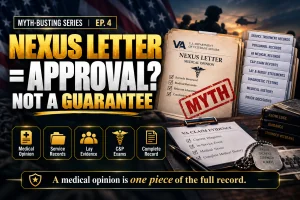
Not Every Denial Is About the Nexus Letter
It is important to understand that not all denials are caused by these Nexus Letter mistakes.
VA claims are complex and involve multiple factors, including:
- Service records
- Medical opinions
- Compensation and pension exams
- Lay statements
- Applicable regulations
Sometimes the medical opinion is strong, but the issue lies in how the evidence was interpreted or weighed.
For example:
- A favorable opinion may not be fully addressed
- The rationale may be misunderstood
- Aggravation may not be evaluated separately
- Conflicting opinions may not be properly compared
In these situations, accredited representatives such as VSOs, claims agents, or VA accredited attorneys play a critical role. They can evaluate whether the VA provided adequate reasoning and challenge the decision if needed.
Final Thoughts on Nexus Letter mistakes
When a claim is denied for lack of a nexus, it does not automatically mean there is no connection. Often, it means the connection was not clearly demonstrated in a way the VA requires.
Understanding common Nexus Letter mistakes can make a significant difference in the strength of your claim.
A well written Nexus letter should:
- Clearly explain the medical reasoning
- Address all relevant risk factors
- Be supported by documented records
- Maintain a professional and objective tone
- Distinguish between causation and aggravation
It is not just a supportive statement. It is a structured medical argument grounded in evidence.
If your claim has been denied, reviewing the Nexus letter with these points in mind may help you identify what went wrong and what can be improved moving forward.
Also Read: Why Veterans Are Always Tired (Chronic Fatigue Explained)
At Prestige Veteran Medical Consulting, a veteran-owned company, we specialize in Independent Medical Opinions (IMOs) known as Nexus letters.
Our purpose is to empower YOU, the veteran, to take charge of your medical evidence and provide you with valuable educational tools and research to guide you on your journey.
Understanding the unique challenges veterans face, our commitment lies in delivering exceptional service and support.
Leveraging an extensive network of licensed independent medical professionals, all well-versed in the medical professional aspects of the VA claims process, we review the necessary medical evidence to incorporate in our reports related to your VA Disability Claim.
Prestige Veteran Medical Consulting is not a law firm, accredited claims agent, or affiliated with the Veterans Administration or Veterans Services Organizations. However, we are happy to discuss your case with your accredited VA legal professional.