

When filing a VA disability claim, veterans may hear terms like “nexus letter,” “medical opinion,” or “independent medical opinion (IMO)” and assume they mean the same thing. While these terms are often used interchangeably, they can refer to different types of medical evidence within the VA claims process. Understanding how these opinions are used can help veterans better organize and present their medical evidence.
Table of Contents
What Is a Nexus Letter?
A nexus letter is a written medical opinion from a qualified healthcare professional that addresses the relationship between a veteran’s current condition and their military service. The term is sometimes used interchangeably with “independent medical opinion (IMO),” depending on the context. To establish service connection for VA disability benefits, a veteran generally must provide evidence of three elements outlined under 38 CFR § 3.303:
- A current diagnosis
- An in-service event or injury
- A medical link (nexus) connecting the two
In a VA disability claim, the “nexus,” or medical link, is one of the key elements used to establish service connection. A veteran may have evidence of a current diagnosis and an in-service event, but if the relationship between the two is not clearly addressed, it may impact how the claim is evaluated. A nexus letter is intended to address that relationship.
Nexus opinions often use the standard “at least as likely as not” (50% or greater probability) when addressing whether a condition is caused or aggravated by an in-service event, injury, or exposure. This language aligns with the VA’s standard of proof. If the relationship between a current condition and service is not addressed, it may affect how the VA evaluates the claim, even when there is evidence of an in-service event and a current diagnosis.
Who Writes a Nexus Opinion?
A nexus letter can be written by a licensed and qualified healthcare provider, such as:
- Your treating physician
- Medical specialists (e.g., neurologists, orthopedists, cardiologists)
- Psychologists/psychiatrists (for mental health claims such as PTSD)
- Physician assistants or nurse practitioners
While any licensed provider may offer a medical opinion, the VA may consider factors such as the provider’s qualifications, relevant expertise, and familiarity with the condition when evaluating the opinion. A treating VA clinician may provide a medical opinion, but in practice, veterans may request nexus letters from private or non-VA providers for a variety of reasons, including access, availability, or preference.
Essential Components of a Medical Nexus Letter
A well-supported medical opinion often includes:
- Identification of records reviewed (e.g., service records and medical history)
- A clear diagnosis
- Reference to a relevant in-service event, injury, or exposure
- A medical explanation (“rationale”) addressing the relationship to service
- Use of VA-standard language, such as “at least as likely as not” when appropriate
- Supporting evidence or clinical references, when applicable
When these elements are present, a medical opinion can help clarify the relationship between a condition and military service in a manner that aligns with VA standards. In some cases, a well-reasoned opinion may help address gaps or provide additional context within the overall evidence of a claim.
What Is a VA Medical Opinion?
A VA medical opinion is an evaluation provided by the Department of Veterans Affairs, typically during a Compensation & Pension (C&P) exam. It is prepared by a VA or VA-contracted examiner to address questions such as whether a condition is related to military service and, when applicable, its severity.
How It’s Created (C&P Exam Process)
When a disability claim is filed, the VA may schedule a C&P exam. During this process, the examiner may:
- Review medical and service records
- Ask about symptoms, history, and functional impact
- Perform a physical or mental evaluation
The C&P examiner may provide a medical opinion using the “at least as likely as not” standard, which is considered by VA adjudicators when evaluating the claim.
Who Provides a Medical Opinion?
VA medical opinions are written by:
- VA-employed healthcare professionals
- Contracted examiners working for third-party vendors on behalf of the VA
These providers are part of the VA claims process. Their opinions are intended to be professional and based on clinical judgment.
Purpose of the VA Medical Opinion
A VA medical opinion is used within the claims process to address questions such as:
- Whether a condition is related to military service
- The severity of a condition, when applicable
- Interpretation of relevant medical evidence
The level of detail in any medical opinion can vary depending on the specific case and the information available at the time of evaluation.
How it Impacts VA Disability Claims
VA medical opinions are considered as part of the evidence reviewed by VA adjudicators when evaluating a claim. The conclusions provided may influence how the evidence is interpreted in the context of the overall record. C&P exams are one part of the VA’s evaluation process and are based on the information available at the time of the examination. In some cases, veterans choose to submit additional medical evidence, such as a nexus letter or independent medical opinion, to provide further context within the overall record.
What Is an Independent Medical Opinion (IMO)?
An Independent Medical Opinion (IMO) is a medical opinion provided by a private, non-VA healthcare professional who reviews available records and offers an assessment of a veteran’s condition. In some cases, an IMO may be used to provide additional analysis or context within the overall evidence of a claim.
Often Confused with Nexus Letters
The terms “independent medical opinion (IMO)” and “nexus letter” are sometimes used interchangeably, though they may be used differently depending on the context.:
-
Scope of Evaluation
Medical opinions can vary in scope depending on the purpose of the evaluation and the information available. Some opinions focus on addressing the relationship between a condition and military service, while others may include a broader review of medical records, prior evaluations, and relevant clinical considerations. In some cases, a provider may also incorporate additional analysis or conduct a clinical evaluation when appropriate.
-
Neutral, Third-Party Opinion
The term “independent” generally refers to a medical opinion provided by a clinician who is not involved in the VA claims process. These opinions are based on a review of the available records and the provider’s clinical judgment.
-
More Detailed vs. Brief
A nexus letter and an independent medical opinion (IMO) are both forms of medical opinion used to address the relationship between a condition and military service. The level of detail may vary depending on the provider, the available records, and the purpose of the evaluation. In general, well-supported opinions include a clear rationale and consideration of relevant medical evidence.
-
Strength of Evidence During Appeals
Medical opinions, whether referred to as nexus letters or independent medical opinions, may support a disability claim when they are well-reasoned, based on a review of the record, and supported by medical rationale. The weight given to any opinion depends on factors such as clarity, consistency with the evidence, and overall probative value.
Supporting Your Claim Beyond a Nexus Letter
Some medical opinions may address multiple aspects of a claim, depending on the purpose of the evaluation and the information available. These may include:
- Review of relevant records (e.g., prior medical evaluations or VA examinations)
- A medical rationale supported by clinical judgment and, when appropriate, medical literature
- Consideration of reported symptoms and history
- Discussion of relevant clinical factors, when applicable
- Use of VA-standard language, such as “at least as likely as not,” when appropriate
Medical opinions vary in scope and may not always address the question of service connection. For VA purposes, an opinion is generally most helpful when it clearly addresses the relevant medical question and explains the relationship between the condition and service, when applicable. Many independent nexus opinion providers may also complete a Disability Benefits Questionnaire (DBQ) based on a records review or clinical evaluation. A DBQ is a standardized form used by the VA to document the nature and severity of a condition as part of the disability evaluation process.
In practice, medical opinions may serve different purposes depending on the needs of the claim. Some focus on addressing the relationship between a condition and military service, while others may provide additional context or analysis within the overall record.
When Should You Use a Nexus Letter vs. IMO?
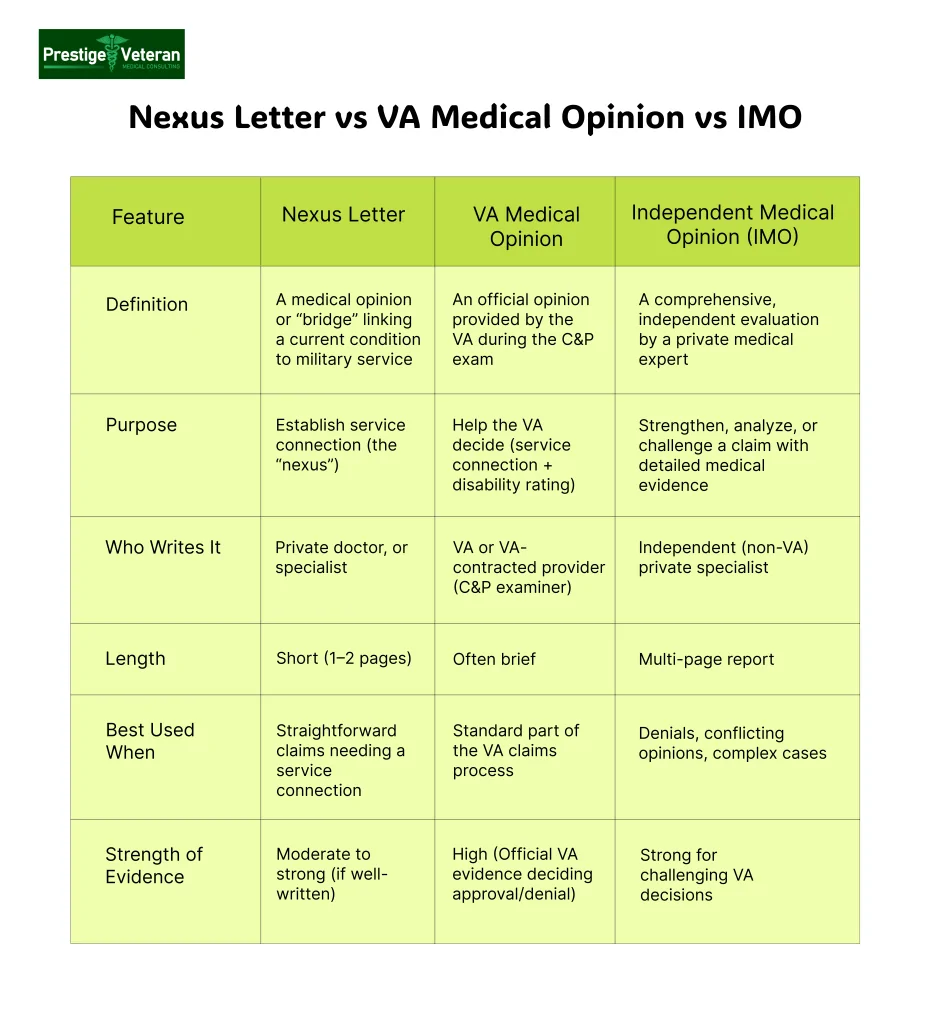
Different types of medical opinions may be used in VA disability claims depending on the circumstances of the case. While terms such as nexus letter and independent medical opinion (IMO) are sometimes used interchangeably, they may be used in different contexts within the overall evidence of a claim.
Veterans Use Nexus Letters When:
Nexus letters may be used in a variety of situations where a medical opinion is needed to address the relationship between a condition and military service. Examples may include:
- Situations where the relationship between a current condition and service is not clearly addressed in the record
- Cases involving direct, secondary, or aggravated conditions
- Situations where additional medical context may be helpful in understanding the progression of symptoms over time
For instance, a veteran who fell during training but developed chronic back pain years later can use a nexus opinion to medically connect that in-service injury to their current diagnosis. Hence, a nexus letter is medical evidence meant to build the bridge between military service and a current disability.
Use an Independent Medical Opinion (IMO) When:
Independent medical opinions (IMOs) may be obtained in situations where additional medical analysis or clarification is needed within the record. Examples may include:
- Cases involving complex medical questions (e.g., multiple conditions or delayed onset)
- Situations where there are differing medical opinions in the record
- Instances where additional context or analysis may be helpful in understanding the available evidence
For example, if a VA examiner denies a knee condition claim by attributing it to “aging,” an IMO orthopedist can review documented in-service injuries, explain how trauma accelerates degeneration, and directly challenge that conclusion.
Understanding How Medical Evidence May Be Used in Different Situations
Medical opinions may be used in different ways depending on the facts of a particular case and the evidence already in the record. Examples may include:
- Documented in-service event with a current condition: A medical opinion may address whether there is a relationship between the in-service event and the current diagnosis.
- Questions regarding service connection: A medical opinion may provide additional context regarding potential relationships between a condition and military service.
- Secondary conditions: A medical opinion may address whether a current condition is caused or aggravated by an already service-connected condition.
- Situations involving differing medical opinions or complex medical questions: Additional medical analysis may be included to help clarify the available evidence.
If additional guidance is needed, a VA-accredited attorney, claims agent, or VSO may be able to assist in evaluating the claim and identifying appropriate next steps. Find a trusted representative here.
Debunking Common Misconceptions About Medical Evidence in VA Claims
Misconception 1: “A nexus letter and medical opinion are identical.”
Truth: A nexus letter is a type of medical opinion that addresses the relationship between a condition and military service. The terms “nexus letter” and “independent medical opinion (IMO)” are sometimes used interchangeably, though they may be used differently depending on the context and scope of the evaluation.
Misconception 2: “VA doctors always provide the best evidence.”
Truth: Medical opinions from VA providers, as well as those from private clinicians, are considered as part of the overall evidence in a claim. The weight assigned to any opinion depends on factors such as the rationale provided, consideration of relevant evidence, and consistency with the record.
Misconception 3: “You don’t need a nexus letter if you have a diagnosis.”
Truth: A diagnosis is one component of a VA disability claim. In cases where service connection is at issue, a medical opinion may be used to address the relationship between a condition and military service as part of the overall evidence.
Misconception 4: “IMOs guarantee approval.”
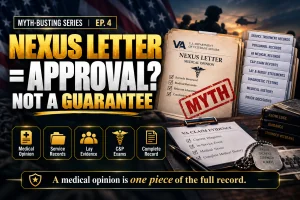
Truth: An independent medical opinion is one piece of evidence that may be considered as part of a VA disability claim. The VA evaluates all evidence of record, and no single document determines the outcome of a claim.
Which Evidence Carries More Weight with the VA?
When evaluating VA disability claims, no single document is automatically determinative. The VA does not assign weight based solely on whether an opinion is labeled a nexus letter, an independent medical opinion (IMO), or a C&P examination. Instead, each opinion is considered within the context of the overall evidence of record. When reviewing medical opinions, the VA may consider factors such as:
- Examiner qualifications and relevant expertise
- Review of available records
- Clarity and reasoning provided in the opinion
- Consistency with other evidence in the record
- Use of appropriate medical principles or references, when applicable
- Whether the opinion reflects the VA standard of proof (“at least as likely as not”)
A medical opinion that includes clear reasoning and is consistent with the available evidence may be given greater consideration, while an opinion that lacks explanation or support may be given less weight.
The bottom line: Quality matters the most. A clear, well-reasoned medical opinion, whether from the VA or a private provider, can make the difference between approval and denial.
Final Thoughts
Nexus letters, VA medical opinions, and independent medical opinions (IMOs) are related forms of medical evidence used within the VA disability claims process. While the terminology may vary, each type of opinion may serve a different purpose depending on the facts of the case and the evidence of record. In all cases, the VA evaluates medical opinions based on factors such as clarity, supporting rationale, and consistency with the overall record. A well-reasoned medical opinion, regardless of how it is labeled, can help provide context and support within the evidence considered. If additional guidance is needed, a VA-accredited attorney, claims agent, or VSO may be able to assist in evaluating the claim and identifying appropriate next steps.
Frequently Asked Questions (FAQs)
Is a Nexus letter a medical opinion?
Yes, a nexus letter is a written medical opinion that clearly links a veteran’s current condition to their military service.
What is an IMO for VA disability?
An Independent Medical Opinion (IMO) is a detailed, third-party medical evaluation that provides an expert, unbiased opinion to support or challenge a VA disability claim.
Why does the VA ask for a medical opinion?
The VA requests a medical opinion to determine whether a condition is service-connected and to assess its severity for disability rating purposes.
Is it hard to get a Nexus letter from a doctor?
It can sometimes be challenging to obtain a medical opinion, as provider availability, familiarity with VA requirements, and individual practice preferences may vary.
What does it mean when a VA claim is deferred for a medical opinion?
A deferred claim means the VA needs additional medical evidence or clarification, often through a medical opinion, before making a final decision.
What is the duty to assist in veterans’ claims?
Under the VA’s Duty to Assist, the VA may help veterans obtain evidence needed to support a disability claim, which can include scheduling medical examinations or obtaining medical opinions.
Can the VA ignore a Nexus letter?
The VA considers nexus letters as part of the evidence in a claim. The weight assigned to any medical opinion may vary depending on factors such as the rationale provided, supporting evidence, and the provider’s qualifications.
Also read: How to Find Nexus Letter Doctors Near Me: Practical Tips
At Prestige Veteran Medical Consulting, a veteran-owned company, we specialize in Independent Medical Opinions (IMOs) known as Nexus letters.
Our purpose is to empower YOU, the veteran, to take charge of your medical evidence and provide you with valuable educational tools and research to guide you on your journey.
Understanding the unique challenges veterans face, our commitment lies in delivering exceptional service and support.
Leveraging an extensive network of licensed independent medical professionals, all well-versed in the medical professional aspects of the VA claims process, we review the necessary medical evidence to incorporate in our reports related to your VA Disability Claim.
Prestige Veteran Medical Consulting is not a law firm, accredited claims agent, or affiliated with the Veterans Administration or Veterans Services Organizations. However, we are happy to discuss your case with your accredited VA legal professional.