

Many veterans face frustration after receiving a denial, but improving the outcome of a VA disability appeal starts with knowing how each appeal path works and what truly influences favorable results. Whether you’re filing a Supplemental Claim, requesting a Higher-Level Review, or taking your case to the Board of Veterans’ Appeals, winning an approval depends on strong medical evidence and well-organized documentation that effectively addresses VA’s reasons for denial.
By understanding how the VA reviews evidence and makes its decisions, you can dramatically improve your chances of achieving a successful outcome.
Table of Contents
What are the VA Disability Appeal Success Rates?
In reality, the VA does not publish official success rates for disability appeals. The following estimated figures reveal how often veterans succeed and where challenges still remain.
Supplemental Claim Success Rate
The Department of Veterans Affairs (VA) reports that 81% of veterans filing supplemental claims receive some form of monetary benefit and that 63% of pending claims are supplemental and 37% are original.
Higher-Level Review (HLR) Success Rate
The VA evaluates Higher-Level Reviews (HLRs) on a case-by-case basis using only the evidence of record.
However, the AMA Metrics Report shows that in 2022, higher-level review decisions overturned previous rating decisions in only 10.7% of cases. This suggests that while the definition of “success” (overturned vs favorable) may vary, veterans should keep realistic expectations unless strong evidence or clear errors are present. As of September 30, 2025, the VA reported that a total of 322,661 supplemental claims and 909,374 higher-level reviews had been completed.
Board of Veterans’ Appeal Success Rate
According to the Board of Veterans’ Appeals FY 2024 Annual Report, the overall favorable (granted) decision rate for AMA appeals was approximately 25.5%, with a remand rate of 32.5% and a denial rate of 26.6%.
Here is the official BVA data according to the docket type:
- Direct Review – 24.1% granted, 33.1% remanded
- Evidence Submission – 26.1% granted, 32.7% remanded
- Hearing – 26.9% granted, 31.6% remanded.
Ultimately, the success of a VA disability claim varies widely depending on the appeal type and the strength of evidence. Which is why it’s essential for veterans to understand how to strategically position their case for approval at every review level.
How to Increase Your VA Supplemental Claim Success Rate
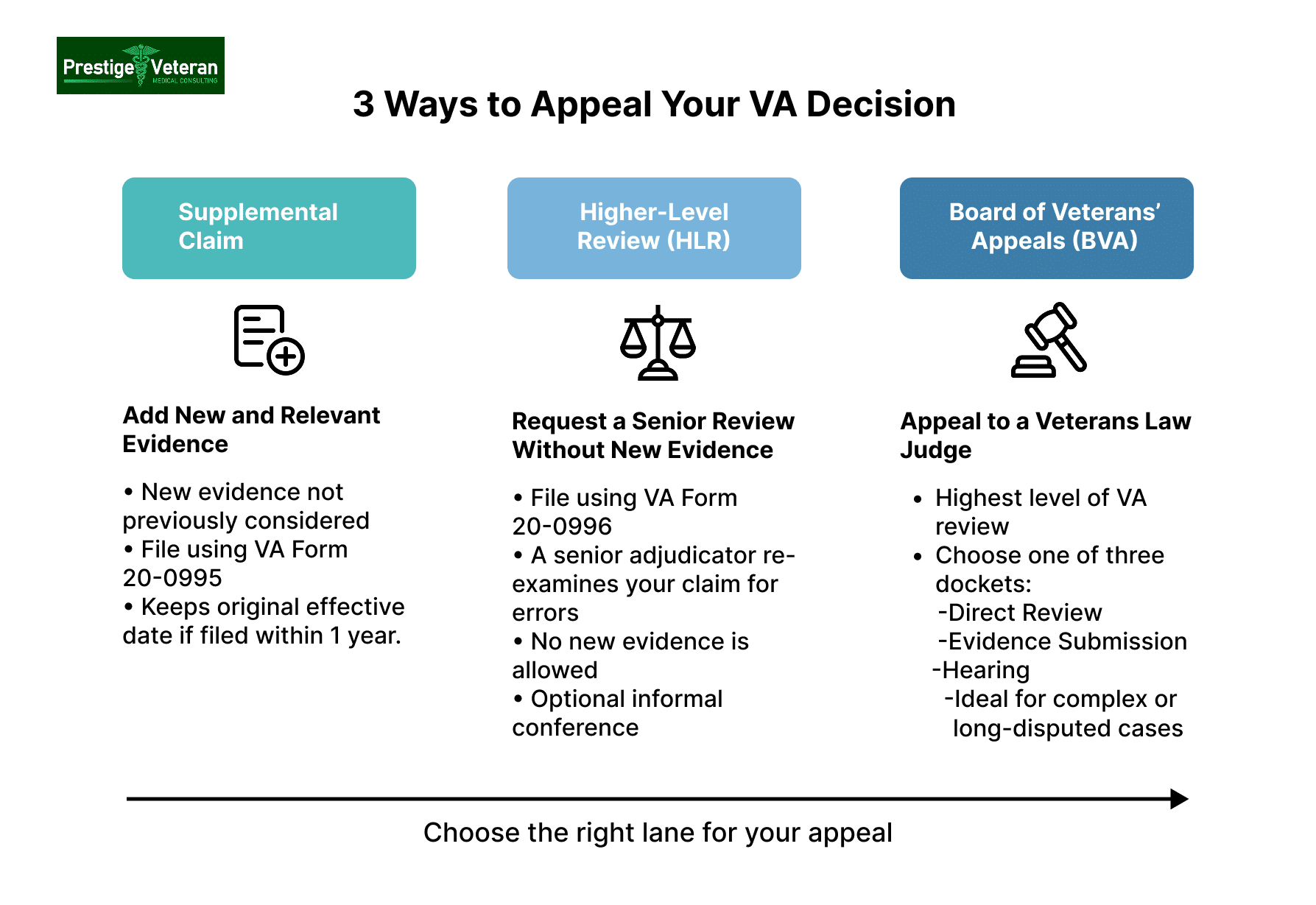
A VA Supplemental Claim allows veterans to reopen a previously denied or underrated claim by submitting new and relevant evidence not considered in the original decision. Filed through VA Form 20-0995, this appeal lane under the Appeals Modernization Act (AMA) helps fill evidentiary gaps while maintaining the original effective date if filed within one year. On average, supplemental claim decisions take 74 days (2 to 3 months), making this one of the faster review options within the VA approval process.
Understanding what drives the VA supplemental claim success rate can significantly improve outcomes and preserve valuable retroactive benefits.
1. Submit Truly New and Relevant Evidence
The most important factor in winning a supplemental claim is the credibility and probative value of your new evidence submitted. “New” means it wasn’t previously part of your C-File, and “relevant” means it directly addresses why your claim was denied.
Under 38 CFR §3.156(d), veterans can improve the chances of their supplemental claim approval with relevant evidence such as:
- Recent diagnostic reports
- Nexus letters from licensed providers linking the condition to service
- Buddy statements corroborating service-related incidents
- Personal statements detailing the current severity and daily impact of symptoms
- Updated Disability Benefits Questionnaires (DBQs)
For instance, if your claim for PTSD was denied due to a lack of a verified stressor, submitting a detailed buddy statement confirming the in-service traumatic event and a new psychological evaluation diagnosing PTSD linked to that event can dramatically improve your VA supplemental claim success rate.
2. Address the Exact Reasons for Denial
Read the VA’s denial letter carefully. Was your claim denied due to lack of service connection, insufficient medical evidence, or failure to meet the rating criteria? Your new evidence must specifically address that deficiency.
If the VA denied your claim for degenerative joint disease due to “no service connection,” submit a medical nexus letter from your orthopedist explaining how repetitive physical strain or injuries during service caused or worsened your condition. If the denial was based on insufficient evidence of severity, include recent X-rays and a DBQ that clearly shows your limited range of motion and functional impairment.
The more precisely you target the reason for denial, the higher your chances of approval.
3. File Within One Year to Protect Your Effective Date
Although there’s technically no deadline for filing a supplemental claim, submitting it within one year of your VA decision preserves your effective date. This means you could qualify for retroactive back pay dating to your original claim.
Hence, if you are aiming to maintain your original effective date, file as soon as new evidence becomes available, as waiting any longer can cost you thousands of back pay. The sooner you file, the faster your case can advance through the VA supplemental claim decision timeline, reducing delays in receiving your compensation.
4. Keep Your Evidence Package Organized
A well-structured evidence package helps VA raters review your supplemental claim faster without any misunderstandings. Arrange your records chronologically or by issue. Label each document, include a brief cover letter summarizing how each piece supports your VA disability claim, and submit your file as a Fully Developed Claim (FDC) whenever possible.
Boosting Your VA Higher-Level Review Success Rate
A VA Higher-Level Review (HLR) is a second look process where a senior adjudicator re-examines your initial claim or supplemental claim decision without new evidence. Filed using VA Form 20-0996, this path strictly focuses on identifying legal or factual errors in the original decision. The HLR review is ideal when you believe the VA misapplied the law, overlooked existing evidence, or failed its “duty-to-assist”. Typically, a higher-level review takes an average of 125 days (4 to 5 months) to complete.
1. Identify Specific Errors in the Original Decision
Senior higher-level reviewers, also known as Decision Review Officers (DROs), look for mistakes in how evidence was interpreted or how the law was applied. The reviewer also verifies if the VA met its statutory duty-to-assist by gathering necessary records or scheduling medical exams. Carefully review your VA claim denial letter and pinpoint specific errors, such as misinterpretation of evidence or misapplication of a regulation under the VA Schedule for Rating Disabilities, rather than simply expressing a broad disagreement.
For example, if a prior decision assigned only a 10% rating for a lumbar spine condition despite the C&P exam showing forward flexion limited to 40 degrees, cite that report directly. Explain that this limitation meets the criteria for a higher 20% rating under Diagnostic Code 5237.
2. Use the Informal Conference Strategically
Requesting an informal conference with the reviewer allows veterans to directly explain mistakes in the original decision and increase HLR success rates. However, due to growing backlogs and overwhelmed staff, these conferences are harder to schedule and less impactful when the reviewer is unfamiliar with your case.
During this optional phone or virtual conference,
- Summarize your strongest arguments
- Highlight critical evidence
- Rehearse explaining the VA regulations that were misapplied
- Keep the tone respectful and professional
3. Strengthen Your Written Arguments
When informal conferences are not effective, a detailed written argument can serve as a strong alternative. A successful higher-level review is not about, “I disagree with the decision”, you must show how and why they got it wrong.
For instance, if your asthma rating was too low, show how the VA failed to consider objective findings like reduced FEV-1 test results or the need for daily inhaler use that meet the criteria for a higher rating (38 C.F.R. §4.97). Focus on the evidence already in your file and connect it directly to the VA rating criteria, as this targeted approach often leads to favorable outcomes.
4. Know When to Choose HLR Over Other Appeal Lanes
If your case has no missing evidence but includes a VA error in law or fact, a Higher-Level Review (HLR) is usually the better option. If the VA denied your claim due to missing proof or documentation, it’s smarter to file a Supplemental Claim instead. When an HLR is denied, and you have since gathered new medical or diagnostic evidence, submit a Supplemental Claim rather than appealing the same issue again.
Knowing when to switch between VA HLR and Supplemental Claims maximizes your future back pay and odds of VA disability appeal success.
Increasing Success at the VA Board of Veterans’ Appeals (BVA)
The Board of Veterans’ Appeals (BVA) represents the highest administrative level within the VA system, where complex or long-disputed cases are reviewed by Veterans Law Judges. While this route has the longest timeline of 1 to 2 years, it provides the most comprehensive legal scrutiny.
Here are some tips to secure a favorable decision at the VA disability appeals:
1. Choose the Right Docket for Your Situation
The Board of Veterans’ Appeals offers veterans three dockets to select from: Direct Review, Evidence Submission, and Hearing.
- Direct Review is the fastest but prohibits new evidence.
- Evidence Submission allows written proof within 90 days.
- A hearing docket lets you testify before a judge, but it may take over two years.
Selecting the right docket for your case ensures the Board considers your strongest arguments in the most effective format.
2. Strengthen Your Medical and Service Evidence
Review your entire C-file to understand what evidence the VA considered and identify any gaps. Gather supporting evidence such as:
- Detailed Nexus Letters
- Service treatment and deployment records
- Witness statements
- Disability Benefits Questionnaires (DBQs)
- Treatment summaries that demonstrate worsening of symptoms
For example, if a back injury VA claim was denied for “lack of chronicity,” submitting a physician’s nexus letter linking in-service strain to current MRI findings can transform the outcome of the Board Appeal.
3. Craft a Personal Statement That Resonates
Whether written or presented at a BVA hearing, your statement should clearly describe how your service-connected condition began, how it has progressed, and how it affects your daily life and employment. Use specific examples and honest details to make your story credible and relatable.
4. Prepare Thoroughly for Your Hearing
If you select the hearing docket, be ready to tell your story effectively. Review your file, including all medical and service records, and your personal statement, so you can speak confidently about your case.
Practice answering questions honestly, such as “How has your condition affected your daily life?” or “What events during service relate to your condition?” Stay on topic, remain calm, and remember the BVA hearing is non-adversarial, meaning the judge’s goal is to fully understand your situation, not to try to find holes in your story.
5. Address Remands Strategically
In Fiscal Year 2024, 32.5% of all AMA appeal issues decided by the Board were remanded. A remand means the Board of Veterans’ Appeals has identified missing information or procedural errors that need correction before a final decision can be made. If your VA claim is remanded, use this opportunity to bolster your case. Respond quickly to VA requests for new exams or evidence documents to keep momentum.
Why Professional Representation Matters for Your VA Appeal
Veterans who work with a VA-accredited attorney or claims agent have higher approval rates because they know what specific details VA reviewers often look for. Many VA disability appeal success stories reveal that professional representation often plays a decisive role in overturning initial denials.
Here’s how expert representation can help you:
-
Strategic Appeal Selection: An accredited representative can determine whether a Supplemental Claim, Higher-Level Review, or Board appeal is the strongest option based on the specific reason for denial.
-
Regulation-Based Advocacy: They align medical and service records with the correct VA regulations and rating criteria so the claim is presented clearly and accurately.
-
Error Identification: Trained advocates are also able to identify VA errors, including overlooked evidence, misapplied rules, or failures in the duty to assist that may support a reversal or remand.
-
Effective Case Presentation: Prepares clear, persuasive arguments for informal conferences, written submissions, or BVA hearings.
-
Back Pay Protection: Keeps filings on time to preserve your effective date and potential retroactive benefits.
When you’re filing a VA disability appeal, an experienced representative can guide you through each step of the process and help you secure the compensation you deserve.
You can find an accredited representative to help with your VA claim on the official VA website.
Impact of an Independent Nexus Letter on VA Disability Appeals
A nexus letter oftentimes influences the outcome of a VA disability appeal, particularly in Supplemental Claims. This independent medical opinion (IMO), written by a qualified healthcare professional outside the VA system, explicitly connects a veteran’s current medical condition to their military service.
The document addresses the most common reason the VA denies an original claim, that is, “lack of service connection” or “insufficient medical linkage.”
Key Factors Nexus Letters Drive VA Disability Appeal Success:
- Direct Causation Statement: A credible physician reviews all service and medical records and provides an explanation linking the veteran’s condition to specific in-service events, exposures, or injuries.
- Detailed Medical Rationale: A clear pathophysiological explanation of how specific service events or exposures medically caused or aggravated the veteran’s condition. This medical rationale is supported by diagnostic tests, treatment history, and peer-reviewed medical literature.
- Clarity and Professional Authority: The letter must be written by a licensed physician or specialist experienced in the relevant field, clearly stating the causal link using VA-compliant terminology such as “at least as likely as not.”
- Integration into Appeals Strategy: When combined with Disability Benefits Questionnaires (DBQs) or updated C&P examination results, nexus letters provide a complete medical foundation.
- Independent Review of Records: Physicians who independently review the veteran’s C-File, service treatment records, and post-service medical history provide an unbiased, evidence-based opinion that carries substantial weight with VA adjudicators.
Hence, a well-written, medically supported, and independently authored nexus letter can be the deciding factor between a denied and an approved VA disability appeal.
Case Study: Board Appeal for Chronic Migraines Secondary to TBI
Disclaimer: The following case study is entirely fictional. It is created for informational and educational purposes only and does not describe any real person, event, or legal matter
After serving eight years in the Army, Sergeant Marcus H. filed a VA disability claim for chronic migraines secondary to a service-connected traumatic brain injury (TBI) sustained during a 2011 IED blast in Afghanistan. The VA initially granted service connection for TBI at 10% but denied migraines, stating there was “no objective evidence linking headaches to the in-service injury.”
Building a Strong Evidence Record
Marcus filed a supplemental claim with new neurology records and a nexus letter from a private physician confirming that his migraines were at least as likely as not related to the TBI. Despite this, the VA again denied the claim, citing “insufficient chronicity.”
The Board Appeal
Determined, Marcus appealed to the Board of Veterans’ Appeals under the Evidence Submission docket. His representative submitted lay statements from fellow soldiers confirming his frequent headaches after the explosion and an updated Disability Benefits Questionnaire showing prostrating attacks twice weekly.
During review, the Veterans Law Judge found the private nexus opinion and corroborating buddy statements credible. The Board granted service connection with a 50% rating, retroactive to his original 2018 claim, demonstrating how well-supported medical and lay evidence can lead to a successful VA appeal.
Final Thoughts
Every VA disability appeal is an opportunity to strengthen your case and earn the benefits you deserve. Veterans should carefully review their decision letter, gather new and relevant proof, and ensure all paperwork is complete and organized. Most importantly, working with an experienced VA-accredited representative or medical expert can help you avoid common mistakes and move forward toward a fair decision.
Frequently Asked Questions (FAQs)
Is it worth appealing a VA disability claim?
Yes, appealing a VA disability claim is often worthwhile because many denials are overturned when veterans submit new evidence or identify VA errors.
What percentage of VA disability claims are approved?
The Department of Veterans Affairs reported that a record-breaking 61.8% of disability claims were approved in 2025, granting benefits to nearly 1.3 million veterans or family members.
What are the chances of winning a VA appeal?
The overall VA appeal success rate varies by lane and is based on independent variables.
How do I win my VA appeal?
You can improve your chances of winning a VA disability appeal by submitting strong evidence or legal arguments that directly address the VA’s stated reason for denial. Seeking help from a VA-accredited representative also boosts your claim.
How long does a higher-level review take for the VA?
A VA higher-level review typically takes about 125 days, or roughly four to five months, to complete.
Also Read: How to Fix a Not Service Connected Denied VA Claim and Get Approved
At Prestige Veteran Medical Consulting, a veteran-owned company, we specialize in Independent Medical Opinions (IMOs) known as Nexus letters.
Our purpose is to empower YOU, the veteran, to take charge of your medical evidence and provide you with valuable educational tools and research to guide you on your journey.
Understanding the unique challenges veterans face, our commitment lies in delivering exceptional service and support.
Leveraging an extensive network of licensed independent medical professionals, all well-versed in the medical professional aspects of the VA claims process, we review the necessary medical evidence to incorporate in our reports related to your VA Disability Claim.
Prestige Veteran Medical Consulting is not a law firm, accredited claims agent, or affiliated with the Veterans Administration or Veterans Services Organizations. However, we are happy to discuss your case with your accredited VA legal professional.